
Slash No-Shows With Automated Reminders for CollaborateMD
💡 Automated appointment reminders for CollaborateMD help practices cut no-shows by up to 53% and protect lost revenue from empty slots. Curogram...
8 min read
Aubreigh Lee Daculug
:
March 23, 2026
Your NextGen Enterprise appointment reminders are already going out. But are they coming back?
Sending a reminder and receiving a confirmation are two completely different things. One informs a patient. The other tells you whether they plan to show up.
For large ambulatory organizations running 20 to 100+ providers, that gap is costing real money.
When a patient doesn't respond to a one-way notification, there's no way to know if they're coming until the slot either fills or goes empty. Staff end up calling patients by hand, doing exactly the phone work the reminder was supposed to replace.
Curogram's Confirmation Engine solves this by turning every reminder into a two-way conversation.
Patients get a text message they can actually reply to — typing "Confirm," "Cancel," or "Reschedule."
The moment they respond, the NextGen Practice Management schedule updates automatically.
No manual entry. No cross-referencing. No calls.
This is what 2-way smart reminders with NextGen PM schedule real-time sync actually looks like in practice. Atlas Medical Center reduced its no-show rate from 14.20% to 4.91% in three months. Covina Arthritic Clinic scaled from 369 to 1,300+ automated confirmations per month.
For a 50-provider NextGen network, even a 10% drop in no-shows can mean six figures in recovered quarterly revenue.
For enterprise organizations — multi-specialty groups, orthopedic networks, behavioral health organizations, and large primary care operations — the NextGen Enterprise appointment reminders 2-way patient confirmation text reduce no-shows real-time schedule sync multi-location framework isn't a nice-to-have.
It's the operational foundation of a reliable schedule. The organizations achieving 75%+ confirmation rates aren't doing anything exotic. They're just making sure every reminder closes a loop.
Below, we break down the exact problem, the solution, and the results — so you can see how it maps to your organization's scale.
NextGen's appointment reminder capability — whether through native options or the Luma Patient Engage add-on — sends notifications via text, email, or phone. That sounds useful. But sending a reminder and getting a confirmation are two different operations.
A one-directional reminder tells the patient when to come. A 2-way confirmation captures whether they will.
For enterprise organizations managing thousands of appointments per week, the gap between "reminder sent" and "confirmation received" is exactly where no-show revenue disappears. The schedule shows the appointment exists. It doesn't show whether the patient is actually coming.
That uncertainty compounds across every location, every provider, every day.
No-show rates across specialties range from 10% to 50%. For a 50-provider NextGen Enterprise network averaging 25 patients per provider per day, a 15% no-show rate means 187+ unfilled slots every single day.
The math is hard to ignore:
These aren't theoretical numbers. They're the figures CFOs and Revenue Cycle Directors track every quarter. And when the existing reminder system is already running but no-show rates aren't moving, it's usually a sign that reminders are going out — but confirmations aren't coming back.

For organizations that haven't purchased Luma Patient Engage, NextGen's native reminder options are limited. For those that have, Luma adds another layer of cost and operational overhead.
Getting a NextGen patient appointment confirmation without Luma add-on module is something many operations leaders are actively looking for.
The confirmation capability shouldn't require a multi-month implementation and a separate vendor relationship just to make patients text back "yes."
Luma's costs aren't just financial. They're structural. IT must manage Luma alongside NextGen Enterprise, PxP, InstaMed, and Navigator AI.
Every module added to the stack is another support channel, another configuration dependency, and another implementation window that delays value.
Without real-time confirmation data, front desk staff at every location start each morning with uncertainty.
Which patients confirmed?
Which cancelled?
Which never replied?
Without those answers, staff default to manual calls — the same phone triage the reminder was supposed to eliminate.
Staff end up making 80+ calls per day to close a loop that automated reminders should have closed automatically. That's not a staffing problem. It's a confirmation problem.
Curogram's Confirmation Engine sends automated 2-way text reminders at set intervals before each appointment.
Patients reply with a single word — "Confirm," "Cancel," or "Reschedule" — and the confirmation status syncs directly to the NextGen PM schedule in real-time.
Confirmed appointments lock in. Cancelled slots open for backfill. Reschedule requests route to the scheduling team.
No staff phone calls. No manual status updates. No one-way notifications that leave the schedule uncertain. The 2-way smart reminders NextGen PM schedule real-time sync architecture means the practice always knows the true state of tomorrow's schedule — before the day starts.
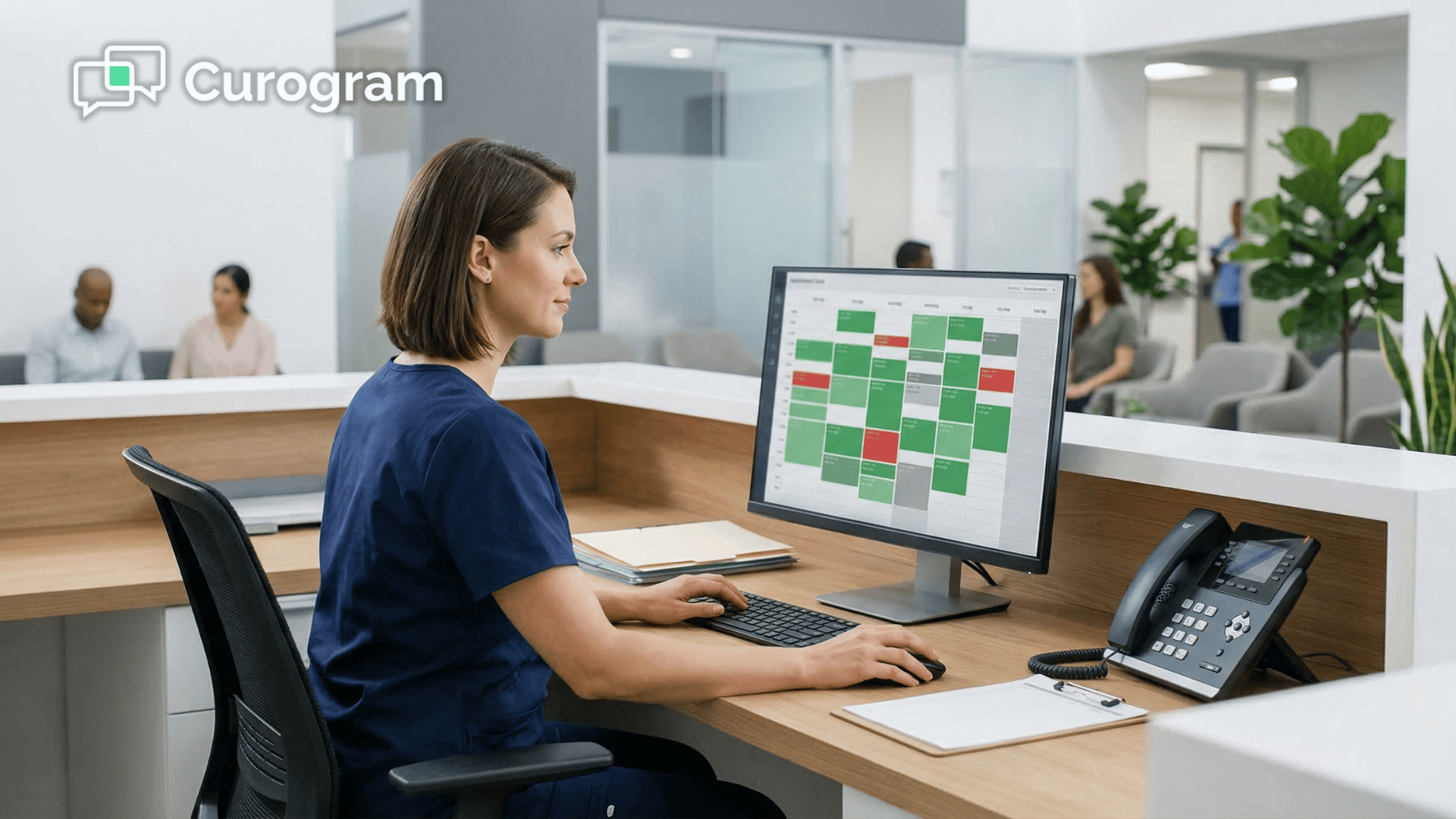
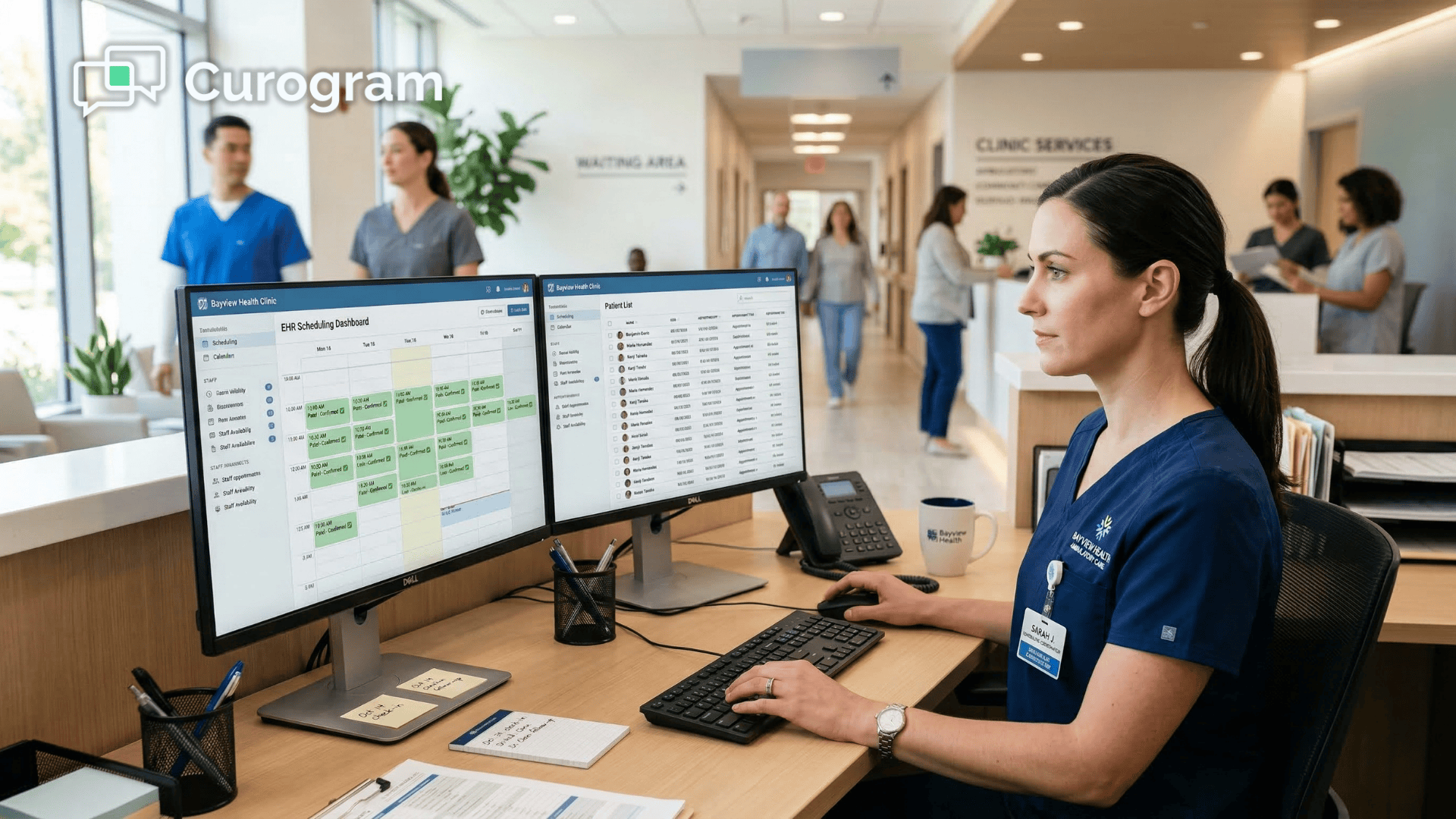
For multi-location NextGen organizations, Curogram provides a centralized dashboard showing real-time confirmation status across every provider and every location.
Operations leaders see tomorrow's schedule color-coded at a glance:
This visibility transforms scheduling from reactive to proactive. Staff can backfill cancelled slots before the morning starts — not after the patient simply doesn't show up.
For large networks managing 20 to 100+ providers, that shift changes the entire shape of the workday.

Confirmation status writes back to the NextGen Practice Management schedule as a structured entry — not a sticky note, not a manual flag, not a separate dashboard that staff must cross-reference.
The PM schedule reflects reality in real-time. IT directors get the data integrity they require: audit logging for every confirmation, role-based access controls, and API-based integration that doesn't disrupt existing NextGen configuration.
Curogram processes reminders and confirmations in the cloud, independent of NextGen's desktop performance.
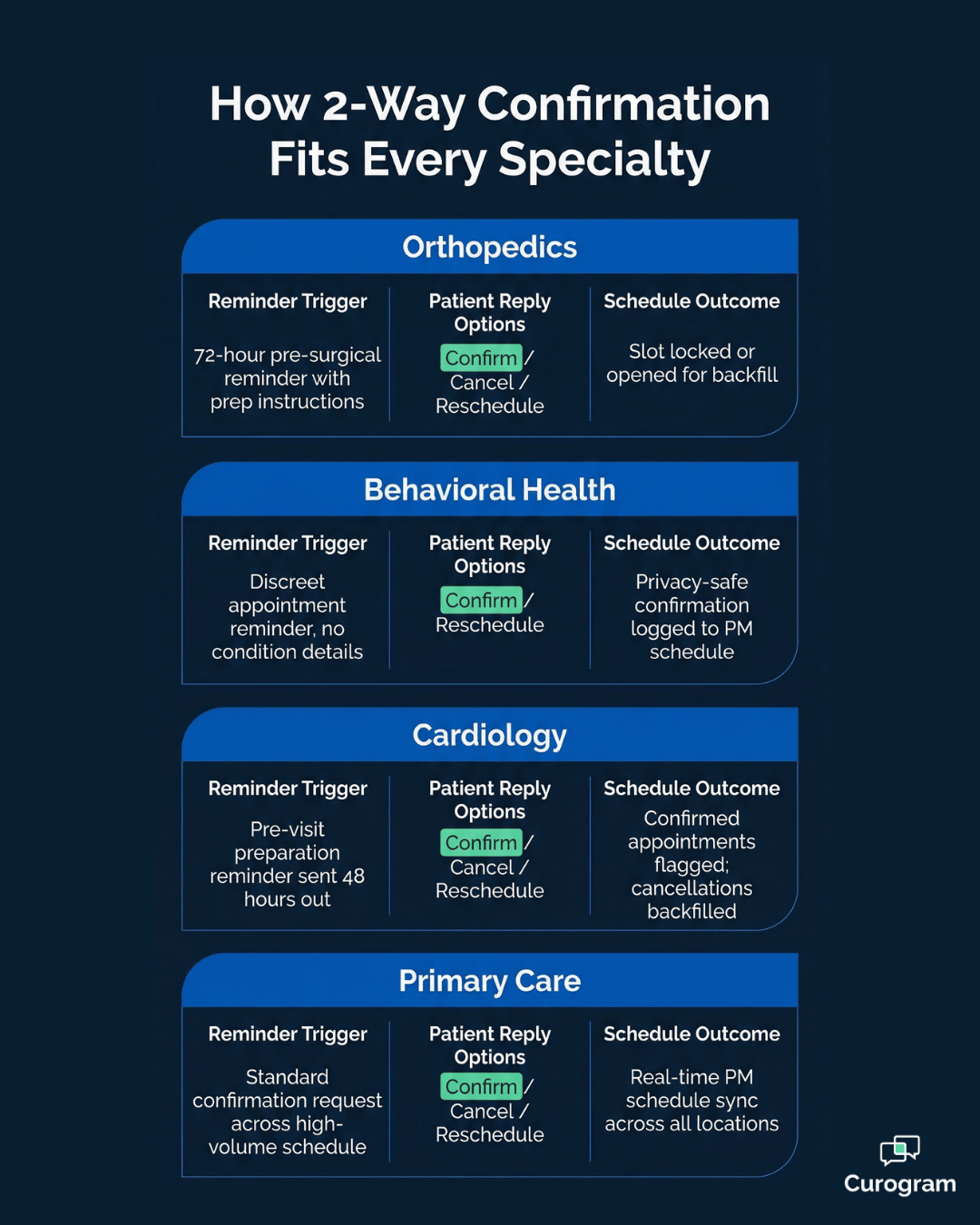
Reminder cadence and confirmation logic adapt to specialty requirements. Orthopedic medical practices send pre-surgical instruction reminders 72 hours out with a confirmation request. Behavioral health networks use discreet reminders that protect patient privacy.
Cardiology groups include pre-visit preparation instructions alongside the confirmation prompt. Primary care operations send standard confirmation requests across high-volume schedules.
One platform, configurable per specialty, deployed across every location. The NextGen multi-location no-show revenue recovery confirmation automation framework works because it adapts to how each specialty actually schedules — not the other way around.
Atlas Medical Center reduced its no-show rate from 14.20% to 4.91% in just three months — a result that is more than 3x better than the industry average.
Curogram clients across the board average more than 75% appointment confirmation rates. Covina Arthritic Clinic grew from 369 to 1,300+ automated confirmations per month, showing that 2-way confirmation scales cleanly as volume increases.
For a 50-provider NextGen network, even a 10% improvement in no-show rates recovers hundreds of appointments per month. When tracked against the NextGen Enterprise schedule confirmation rate 75 percent text-based benchmark, organizations that hit or exceed that mark consistently report six figures in recovered quarterly revenue.
The math isn't complicated — fewer empty slots means more revenue from the same schedule.
The shift is operational, not just numerical. Instead of starting each day with a schedule full of unknowns, operations leaders see a dashboard full of answers. Confirmed slots are locked.
Cancelled slots are open for same-day backfill. Reschedule requests are already being handled before the morning huddle starts.
The no-show rate goes from an accepted cost of doing business to a managed metric — something measured, tracked, and reduced systematically across the network. That's not a minor operational improvement. It's a structural change in how the schedule performs.
The results look different depending on where you sit in the organization, but they point in the same direction:
And the providers who blocked their time for patient care? They see their schedules fill with patients who confirmed they're coming — not empty slots from patients who never responded. That's what happens when the reminder system actually closes the loop.
NextGen Enterprise manages the clinical schedule. Curogram manages the confirmation intelligence that determines whether that schedule generates revenue or wastes it.
The difference between a reminder and a confirmation is the difference between hoping a patient shows up and knowing they will. NextGen's PM schedule is the system of record. Curogram's Confirmation Engine is the system of certainty.
Together, they close the loop that one-directional notifications never could.
For VPs of Operations, CFOs, and Revenue Cycle Directors at large ambulatory organizations, the numbers are clear.
A 10% improvement in no-show rates across a 50-provider network recovers six figures per quarter. A 75%+ confirmation rate doesn't happen by sending more reminders — it happens by making sure patients can reply.
Curogram's 2-way smart reminders integrate directly with NextGen Enterprise — no Luma Patient Engage add-on required, no 45-day implementation timeline, no separate module to manage. You get a centralized confirmation dashboard that shows real-time status across every provider and every location.
You get appointment data writing back to the NextGen PM schedule automatically. And you get a no-show rate that finally moves.
Atlas Medical Center went from a 14.20% no-show rate to 4.91% in three months. That result is available to any NextGen network willing to stop sending one-way notifications and start capturing two-way confirmations.
The NextGen appointment reminder text confirmation reduce no-show rate enterprise framework is already working across multi-specialty groups, orthopedic networks, behavioral health organizations, and large primary care operations.
The question isn't whether 2-way confirmation works. It's how long your organization will keep leaving that revenue on the table.
Schedule a demo with Curogram. See exactly how Atlas Medical Center's 65% no-show reduction maps to your network's scale — and what it means for your bottom line.
Yes. Curogram's 2-way smart reminders pull appointment data from the NextGen PM schedule and write confirmation status back in real-time. When a patient replies "Confirm," the PM schedule updates automatically. When they cancel, the slot opens for backfill. No manual entry, no separate dashboard to cross-reference. Your scheduling staff see confirmation status directly in the workflow they already use.
No. Curogram's confirmation system is a standalone platform that works directly with NextGen Enterprise — no Luma contract required. For organizations already using Luma, Curogram can complement the existing setup or serve as a consolidation option. For organizations evaluating whether to add Luma specifically for reminders, Curogram delivers 2-way confirmation at a lower total cost with a faster deployment timeline.
Curogram deploys 2-way smart reminders across your entire NextGen network in weeks — not the 45+ day implementation typical of enterprise engagement modules. Your organization gets a dedicated implementation engineer who configures reminder cadence, confirmation logic, specialty-specific settings, and NextGen PM write-back for every location. Most organizations are live network-wide within the first month.
When a patient cancels, the slot is immediately flagged as available in the NextGen PM schedule — ready for same-day backfill before the morning even starts. When a patient doesn't respond at all, Curogram marks the appointment as unconfirmed and surfaces it on the confirmation dashboard so staff can follow up with a targeted call or a second reminder. Either way, your team knows exactly which slots need attention before the day begins, instead of discovering empty chairs when it's too late to fill them.
Yes. Curogram is a fully HIPAA-compliant platform. Appointment reminder texts are designed to contain only scheduling information — no protected health information is transmitted via standard SMS. For communications that do involve patient health details, Curogram routes those through its encrypted secure messaging channel. All confirmation data is stored securely, access is role-based, and every interaction is audit-logged. Your organization stays compliant without needing to retrain staff on a new set of rules — the platform is built to handle the compliance layer so your team can focus on the schedule.
💡 Automated appointment reminders for CollaborateMD help practices cut no-shows by up to 53% and protect lost revenue from empty slots. Curogram...
💡 Azalea Health office manager SMS appointment confirmation automation replaces daily manual calling with a system that runs on its own. Curogram...
💡 Automated patient confirmations for ModMed eliminate manual phone calls with real-time status sync. Patients confirm by text, and the scheduler...