


Weave Alternatives for Medical Practices: What to Consider
💡 Medical practices looking for Weave alternatives want a platform that goes beyond basic phone and text tools — one that's built for healthcare...
14 min read
Aubreigh Lee Daculug
:
July 31, 2026
You asked three vendors what their platform costs. You got three answers, and not one of them was a number.
One said pricing depends on your practice size. One sent a link to a form. One quoted a per-user rate that looked reasonable until you counted how many people at your office would actually need a login.
So how much does HIPAA compliant texting cost, really? That question is harder to answer than it should be, and our [HIPAA-compliant texting hub — internal link placeholder] exists because so many practices stall at exactly this step.
Here is the uncomfortable part. The healthcare software market has trained buyers to expect vague pricing. Vendors hide rates behind demo requests because the real total depends on variables they would rather discuss on a call.
That is not always dishonest. It is just inconvenient when you have a budget meeting Thursday and a spreadsheet with an empty cell where a number should be.
Meanwhile, your front desk is drowning. Phones ring in the middle of patient check-in. Voicemails pile up faster than anyone can return them. Staff play phone tag over questions a single text would settle in twelve seconds.
You already know texting would help your practice. What you do not know is what it should cost, and which line items will quietly appear after you sign.
This guide fixes that. We will walk through the four pricing models vendors use, the fees that rarely show up in a first quote, what published rates look like across major platforms in 2026, and how one platform compares against the stack of separate tools you may already be paying for.
No fluff, and no vague ranges anywhere. Just the math, laid out the way an office manager needs to see it before a budget meeting.
Here is the short version. Most independent practices land somewhere between $200 and $500 per month for a HIPAA-compliant texting platform. Seat-based plans start near $24 per user per month. Flat-rate plans tend to start near $250 to $300 per month.
That range is wide for a reason.
A solo provider with two staff members and a three-location group with 40 users are buying very different things, even when the logo on the invoice is the same.
Part of the spread comes from what the word texting actually covers. One vendor sells a secure inbox and stops there. Another bundles reminders, intake forms, payment links, and review requests into the same monthly fee. Same category, very different product.
The table below shows what a typical monthly bill looks like at different practice sizes. These figures are built from published 2026 vendor rates, not from quotes, so treat them as a planning range rather than a promise.
| Practice size | Typical users | Common monthly range | Rough annual cost |
|---|---|---|---|
| Solo provider | 2–4 | $100–$250 | $1,200–$3,000 |
| Small practice (2–5 providers) | 5–12 | $200–$500 | $2,400–$6,000 |
| Mid-size group (6–15 providers) | 15–35 | $400–$1,200 | $4,800–$14,400 |
| Multi-location (3+ sites) | 40+ | $750–$2,500+ | $9,000–$30,000+ |
Read that table as a starting point for a budget conversation, not as a quote. A practice at the top of one row can easily pay more than a practice at the bottom of the row below it. At the small end, feature scope moves the number more than headcount does.
Three things push you up or down inside that range.
The first is headcount, since most vendors charge by seat.
The second is EMR integration, because a platform that writes appointment data back into your chart system costs more to build and more to license.
The third is scope, meaning whether you are buying texting alone or texting plus forms, reminders, payments, and review requests.
Those three factors compound. A twelve-person office that also wants EMR sync and bundled forms will sit near the top of its range. A twelve-person office that only needs two-way messaging can land closer to the bottom.
Notice what is missing from that list: message volume. Good platforms include unlimited messaging. Ones that meter it will surprise you later.
It helps to convert the monthly figure into something your practice already counts. A $300 monthly plan costs $3,600 a year. At $150 per visit, that is 24 recovered appointments, or two a month. Most practices lose far more than two appointments a month to missed reminders.
For your team, the practical takeaway is simple. If a vendor cannot tell you which of those three factors is driving their quote, you are not looking at a price. You are looking at an opening bid.
Every quote you receive will use one of four models. Knowing which one you are looking at tells you more than the number itself, because each model behaves differently as your practice grows.
This is the most common model. You pay a set rate for each person who needs an account, billed monthly. Spruce Health, for example, prices per user per month and counts every teammate added to the organization, including clinicians, staff, and other employees, but not patients.
That definition matters more than the rate. A clinic with three physicians, two nurses, and two front desk staff pays for seven seats, not three. Ask any vendor quoting patient texting software cost per provider whether "provider" means licensed clinicians or every login.
Per-user pricing is clean and predictable for small teams. It punishes growth. Every hire raises your bill, and front desk staff often send more messages than the doctors do.
Run the number at your real headcount before you judge it. At $24 per user, five seats costs $120 a month and eleven seats costs $264. Somewhere around that eleventh seat, flat-rate plans start to look cheaper. Find your crossover point before you sign, not after your next two hires.
Here the unit is the office, not the person.
You pay one rate per site, and everyone at that site is covered. Weave, for instance, lists a starting rate of $249 per location per month.
This model rewards practices with lots of staff per site. A location with 15 users pays the same as one with four. It punishes small satellite offices, where you may pay a full site fee for two people.
Do the per-head math anyway. At $249 a site, a location with 15 users works out to roughly $17 per person. The same fee at a two-person satellite office lands near $125 per person. Ask whether smaller sites can sit on a reduced tier.
One monthly fee covers the whole practice, regardless of seat count. OhMD publishes flat monthly tiers, starting at $300 per month and rising to $500 per month for its automation tier, with custom enterprise pricing above that.
Flat rates make budgeting easy. You know the number a year out. The trade-off is that small teams subsidize the model, since a two-person office pays the same base rate as a twelve-person one.
Flat pricing tends to win once your login count passes ten or twelve. It also removes a quiet penalty on hiring. When adding a front desk hire does not change your software bill, staff get the accounts they actually need instead of sharing one.
Some vendors offer a no-cost tier. These almost always limit you to in-app messaging, which means your patients must download something before they can reach you.
That single restriction usually kills adoption. Patients will text a normal phone number. They will not install an app to ask whether they should fast before labs. Free tiers also tend to exclude EMR integration, automated reminders, and broadcast messaging, which are the features that actually save staff time.
Free tiers do have one real use. They let your team preview an interface before money changes hands. Treat them as a look at the product, not as a plan you will run on. Any practice sending automated reminders will outgrow one within weeks.
When you compare secure messaging platform pricing for medical practices, judge each model by how it behaves at your size in three years, not just this quarter.
One more thing to check across all four models is what happens at renewal. Some contracts carry automatic annual increases buried in the terms. A rate that looks competitive in year one can drift upward by year three.

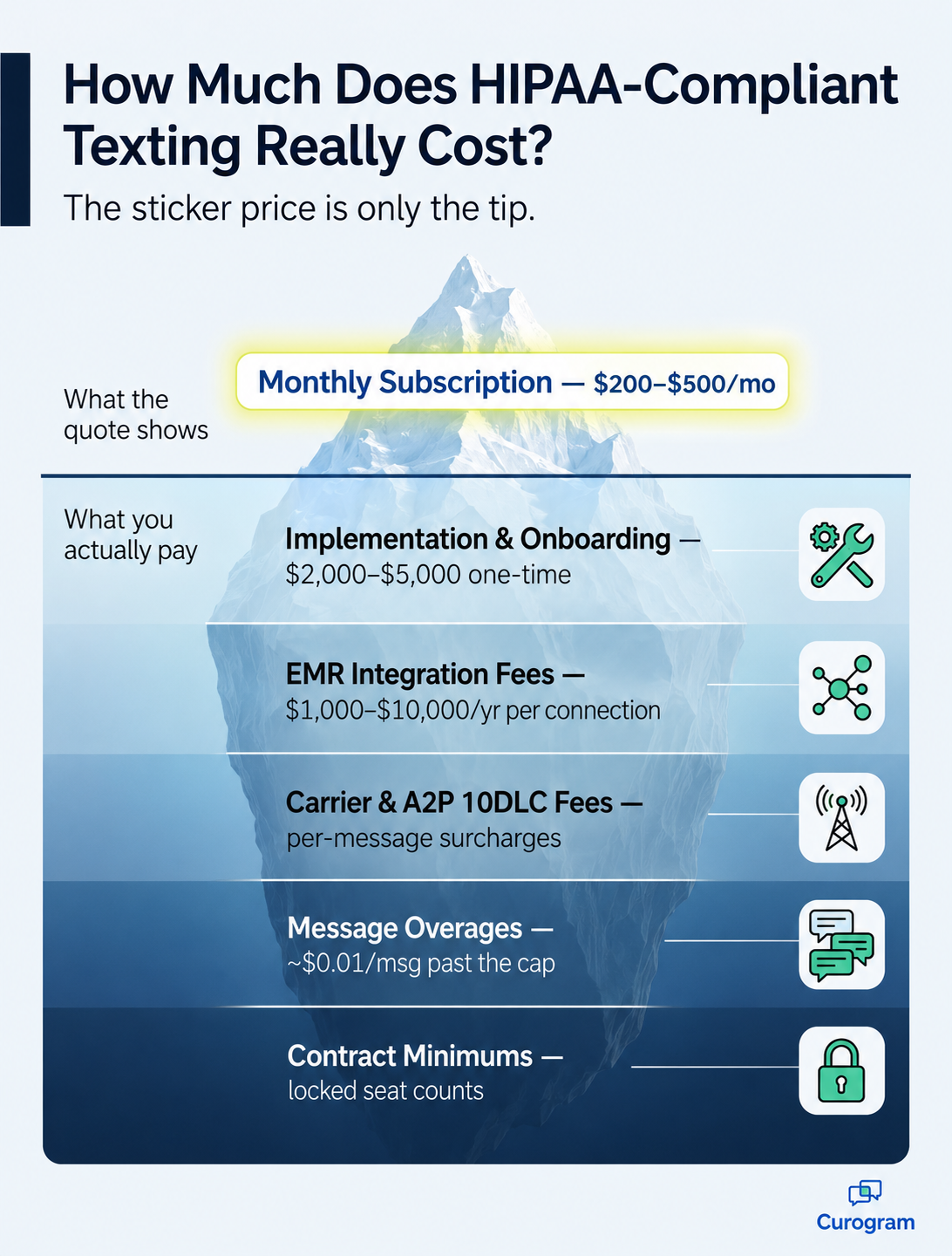
The quote is the beginning of the conversation, not the end. Most of the budget surprises in this category come from a short list of predictable line items.
None of this is unique to texting software. It is how most healthcare technology gets sold. But this category has more moving parts than most, because you are buying software, a carrier relationship, and an integration all at once.
Here are the five that catch practices most often, in rough order of how much damage they do.
None of these are scandals. They are normal parts of how software gets sold. The problem is that hidden fees in patient texting software rarely appear in the same document as the headline rate, which makes clean comparison almost impossible.
So change what you ask for. Instead of requesting a price, request a written first-year total that includes setup, integration, carrier fees, and any minimums. Vendors who price honestly will send it without friction.
Build a simple worksheet while you shop. Put the monthly rate times twelve in the first row, then add setup, integration, and carrier fees below it. That total is your real comparison number. Cost guides for practice software warn that an advertised rate can understate the first-year total by a wide margin.
Two more questions separate honest quotes from optimistic ones. Ask what the invoice looks like in month thirteen, once any first-year discount ends. Then ask what happens if you cancel in month seven.
Most practices do not start from zero. You are probably already paying for pieces of this, scattered across different vendors and different invoices.
These stacks build up quietly. You add a reminder tool one year, a forms vendor the next, and a payment link service after that. Nobody ever sits down and adds the invoices together.
Before you judge a texting platform as an added expense, count what it might replace:
Now run a sample calculation for a four-provider primary care practice. The numbers below are illustrative, not quoted, but they reflect common price points for standalone tools in this category.
Reminders run about $99 a month. Intake forms add $89. Text-to-pay adds $79, review requests another $99, and a separate secure messaging app about $150.
The stacked bill: $516 per month. $6,192 per year. Five vendors, five invoices.
One consolidated platform: roughly $300 per month. $3,600 per year. One invoice.
Difference: about $2,592 saved annually, before counting any staff time.
That gap is real money, but it is the smaller half of the story. The bigger cost of a five-tool stack is the friction it creates every day.
In practice, the savings are bigger than the invoice suggests. Five tools means five logins, five support numbers, five renewal dates, and five places where patient data lives. Your front desk stops switching screens. Your administrator stops chasing five renewal emails.
Put a number on that time. If consolidating saves your front desk five hours a week at roughly $22 an hour, that is about $5,700 a year. Curogram client data shows front desk productivity gains of around 30% after consolidation. Even a fraction of that dwarfs the difference between two monthly rates.
There is a revenue side too, and it usually dwarfs the software line. One practice using Curogram cut its no-show rate from 14.2% to 4.91% in three months, according to Curogram client data. Apply that to a clinic seeing 300 appointments a month at $150 per visit, and you recover about 28 slots monthly. That is roughly $4,200 a month, or $50,400 a year, against a platform cost near $3,600.
Even if your results come in at a third of that, the tool pays for itself several times over. Our [patient communication ROI breakdown — internal link placeholder] walks through that math in more detail. This is why comparing texting platform cost for a small practice against the reminder tool alone gives you the wrong answer. Compare it against the whole stack, plus the revenue the stack recovers.
One caution is worth stating plainly. Consolidation only pays off if the single platform does each job well enough that nobody quietly keeps the old tool running. Ask to see the forms builder and the payment flow during your demo, not just the inbox.

Any honest HIPAA texting pricing comparison has to start with a caveat: most vendors in this space do not publish rates. The table below reflects only what is publicly stated or widely reported as of mid-2026. Confirm current figures directly with each vendor before you budget.
There is a reason so many rates stay hidden. Vendors price against your EMR, your seat count, and how much they want your specialty. Publishing one number would weaken all three levers. That is a business decision rather than a scandal, but it moves the work of comparison onto you.
| Platform | Published pricing | Model | Notes |
|---|---|---|---|
| Spruce Health | $24 and $49 per user/month | Per user | Taxes and surcharges are passed through; some integrations and onboarding fees are quoted separately |
| OhMD | $300 and $500 per month | Flat rate | Enterprise tier is custom with minimums; outbound calling billed separately |
| Weave | From $249 per location/month | Per location | Bundles VoIP phone with texting and reminders |
| Luma Health | Quote-based | Custom | Third-party analysis places entry pricing near $250 per month |
| Klara | Not published | Quote-based | Third-party reports cite roughly $300 to $500 per provider per month |
| Curogram | $200–$400 per month | Per provider | Setup included, no per-message fees |
Read that table sideways rather than down. The cheapest per-seat rate is not the cheapest platform once you count seats. Spruce at $24 per user looks like the value pick until a ten-person office does the math and lands at $240 per month, which is roughly where flat-rate plans start.
That is the trap in per-seat pricing. It looks small because it is small, once. Multiply it by your actual login count and the ranking changes.
The same logic runs the other way.
A flat $300 plan is expensive for a three-person office and cheap for a twenty-person one. Neither figure is right or wrong until you attach it to your own headcount.
Also weigh what each rate includes.
A $249 bundle that replaces your phone system is not competing with a $300 plan that only handles messaging. They are different purchases wearing similar price tags.
Check the integration column carefully too. A platform that syncs both ways with your EMR saves staff from double entry every day. One that only pushes messages out will leave someone updating charts by hand.
The most useful thing you can do is build one spreadsheet with three columns: monthly rate at your real seat count, first-year add-on fees, and the tools each platform lets you cancel. Whichever vendor wins that comparison is the one to shortlist.
Then ask each shortlisted vendor for those same three numbers in writing. Quotes get slippery on a phone call. They get precise in an email, and precise is what a budget needs.
Every pricing conversation leaves out the most expensive option on the table: staying exactly where you are. The status quo has a cost too. It just never shows up on an invoice, so it is easy to ignore.
Trace where the money actually leaks. A reminder that never goes out becomes a no-show. A no-show becomes an empty slot on a booked-solid day. An empty slot becomes revenue you can never bill, plus a follow-up call your staff now has to make by hand.
Here is what that leak tends to look like once you add it up.
18% to 25% — the no-show rate a typical clinic runs without automated reminders. Cut that in half and a practice seeing 300 visits a month recovers dozens of appointments.
$150 — a conservative value per recovered visit. At 28 recovered slots a month, that is roughly $4,200 back in the door, or about $50,400 a year.
98% — the SMS open rate Curogram messages see, according to Curogram client data. Compare that to a voicemail, which most patients never hear.
Those numbers reframe the whole question of how much does HIPAA compliant texting cost. A $300 monthly platform is not really a $3,600 expense. It is a $3,600 tool sitting directly beside a five-figure revenue leak that it was specifically designed to close.
The staff side compounds the problem. Phone tag does not merely cost a few minutes here and there. Improving patient communication helps practices reduce friction, improve coordination, and create a better care experience before, during, and after each visit.
None of this means you should overpay. It means the honest comparison is never platform cost against zero. It is platform cost against the slow, invisible bleed of doing nothing, and that bleed almost always runs larger than the subscription.
Pricing in this category is frustrating because it is quoted backward. Vendors lead with a rate and let you discover the total later, which leaves office managers building a budget out of fragments.
Flip the order. Start with what your practice actually needs, then make vendors price against it.
Write down four numbers before your next demo. How many people need a login, and which EMR you run. How many patient messages you send in a typical month, and what you currently pay for reminders, forms, payments, and review requests combined.
Those four numbers turn a vague quote into a real comparison. They also change the conversation, because a vendor who knows you have done the math will skip the theater and answer plainly.
Then look past the software line at what the platform recovers. Practices using Curogram have seen no-show rates land 53% below the industry average, more than 1,100 appointment confirmations handled in a single month at one clinic, and roughly 30% gains in front desk productivity, according to Curogram client data.
Those numbers are the reason a $300 monthly line item can return several thousand dollars a month in recovered visits. The right platform should pay for itself well inside the first quarter of use. If a vendor cannot show you how, that tells you something.
Curogram publishes its range openly: $200 to $400 per month, priced per provider, with setup and staff training included and no per-message fees. Most offices are running within days, because staff training takes about ten minutes.
If you want a real number for your practice instead of a range, bring your four figures to a walkthrough. Book a Demo, and we will price it against your actual seat count, your EMR, and the tools you would finally be able to cancel.
Frequently Asked Questions
Not always. A free or low-cost tier can still meet HIPAA rules if the vendor signs a business associate agreement and encrypts data properly. But many freemium plans cap features that matter for compliance, like audit logs or secure message links. Always confirm a signed business associate agreement is included before you assume a free plan is safe for patient information.
No. Some platforms include EMR integration in their base price. Others charge a separate fee for the connection, especially for deeper, two-way data sync. Ask this during your first demo, since it can add a meaningful amount to your monthly cost if it isn't included upfront.
It depends on the vendor and how complex your setup is. Some platforms include setup and staff training at no extra charge. Others bill a one-time fee that can range from a small flat amount to several hundred dollars. Ask for this in writing before you sign, since it's one of the most common places a quote changes later.
Yes. Many HIPAA-compliant texting platforms offer pricing designed for independent practices and small clinics, with options ranging from per-user subscriptions to flat monthly plans. The most affordable solution isn't always the one with the lowest advertised price—it's the one that includes the features your practice needs without requiring multiple additional subscriptions. When comparing vendors, consider the total cost of ownership, including implementation, integrations, messaging limits, and any add-on fees.
Often, yes. Many healthcare software vendors provide custom quotes based on your practice's size, number of providers, locations, and feature requirements. If you're evaluating multiple platforms, ask whether implementation fees, onboarding, or contract terms are flexible. Request a detailed breakdown of all costs so you can compare quotes accurately and avoid unexpected charges after signing.
💡 Medical practices looking for Weave alternatives want a platform that goes beyond basic phone and text tools — one that's built for healthcare...
💡 Patient texting software helps medical practices send secure, HIPAA-safe messages to patients for reminders, follow-ups, and two-way chats. The...
💡 HIPAA-compliant texting means using a secure platform to send patient health information by text while meeting HIPAA's Privacy and Security...