
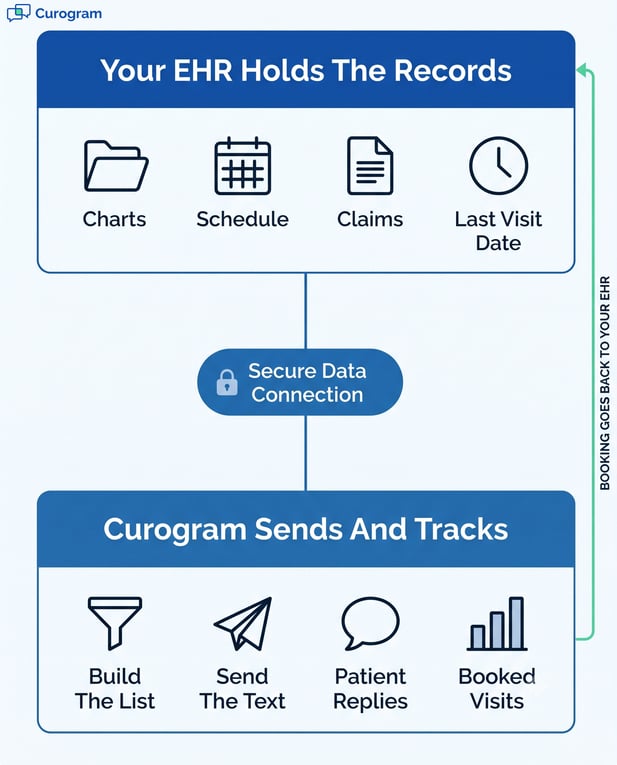

Intellect already knows who is overdue. Its Schedule Recall screen and Missing Appointments report print that list, and the delivery options are letters, faxes, or one-way Twilio voice calls. Curogram adds the text layer through an HL7 connection to Prime Clinical, so a 600-name list goes out in a single send.
We call the problem “The Quiet Attrition”: charts that go dormant with no complaint and no transfer request. Based on our internal data, 35% of texted patients at one multi-location practice booked within a month, and 1,240 were seen from recall messages alone.
Every Prime Clinical practice already owns the list. Intellect will print it on request: open the Schedule Recall menu, run Missing Appointments, and out comes a stack of patients who were due for something and never scheduled it. Most offices run that report once a year, look at the page count, and set it aside.
Setting it aside is the reasonable choice, because the delivery options attached to that report are letters and phone calls. Both cost more than the practice wants to spend on people who may not answer. So the list sits, and it grows.
Our position is simple. A lapsed patient list is the cheapest revenue an established practice has access to, and text is the only channel that makes working it realistic at the size the list has already reached.
One multi-location practice we work with reconverted 35% of the patients it texted, and 1,240 of them were seen from recall messages alone.
That number is not a marketing rate. It came from patients who already knew the providers, already had a chart, and needed nothing more than a reminder that the practice existed and was expecting them.
Prime Clinical has carried practices since 1983, and Intellect still runs the schedule and the billing exactly as it should. The recall logic inside it is real, and it works. What Prime Clinical never shipped is a way to send that recall to a phone and get an answer back.
That is a gap you can close this quarter without touching a chart, a claim, or a template.
The Villain: The Quiet Attrition
Attrition at an established practice doesn't announce itself. Records requests are rare. Angry calls are rarer. The chart simply goes quiet, another patient fills the slot, and no report you read on Monday morning tells you anyone is missing.
Nobody Files a Complaint on the Way Out
Patients who leave on purpose usually say so. They ask for records. They mention a plan change or a move. Those departures leave a trail somewhere in the practice.
The larger group leaves no trail at all. Someone came in for a knee follow-up in early 2024, felt better, meant to call about the annual, and then a year passed. Their chart in Patient Chart Manager is complete, accurate, and untouched for 19 months.
Your daily workflow has no hook for that person. Morning huddle covers today's schedule. Billing review covers claims that went out.
Neither one asks who stopped coming, which is what makes this kind of loss expensive: you can't respond to something you never learn about.
The gap sits between your records and your patients, in the same place we mapped in two-way HIPAA texting for Prime Clinical practices.
Pull the 18-Month List and Count the Names
Run the report before you decide how big this is. Intellect builds recall from real clinical logic, including diagnosis-driven rules where a recall can be set to fire 11 months after a charge with a given diagnosis code posts.
For a three-provider practice, an 18-month window usually returns several hundred names. Each one had a reason to come back.
Skipped preventive visits are not a quirk of your panel either. A study using 20% nationally representative Medicare claims found that 37.3% of beneficiaries received an annual wellness visit in 2019.
Why the Recall Never Actually Goes Out
Intellect gives you two ways to deliver the list. You can print letters from its built-in letter library, or send a one-way Twilio voice message if your clinic has set up its own Twilio account inside Intellect.
Do the arithmetic on the phone option. Six hundred names, four minutes each once you count the voicemail and the chart note, comes to 40 hours. That is one person for a full week, and that person also answers the front desk line.
Letters cost differently. A first-class stamp hit 82 cents in July 2026, and paper, toner, envelopes, and folding sit on top of it. A share of those letters comes back undeliverable, because the address on file is from the visit that lapsed.
The portal has the same weakness in a different form. A patient who stopped booking also stopped logging in, so a portal message waits for someone who is not coming to look.
Somebody Is Working Your Patient List
Two miles away, the urgent care that opened last spring mails a welcome offer to every household in the ZIP code. The dental group down the block texts. A retail clinic buys the search term your patients type at 9 p.m.
Your 18-month patient is being remembered by practices that have never met them.
Recall is the cheapest revenue available to an established practice, and most Prime Clinical offices leave it sitting in a printer tray.
The list also compounds. Everyone who lapses this quarter joins everyone who lapsed last quarter, so the report gets longer each time you run it.

The Guide: The Recall Engine
Recall works once it stops being a project somebody remembers to run in November. Four parts make patient recall text campaigns for Prime Clinical practices repeatable: a segment, a message, a reply path, and a number at the end. Intellect gives you the first one. Curogram supplies the other three.
Segment From the Data Intellect Already Holds
Curogram receives patient demographics and visit history from Prime Clinical over an HL7 connection. Last visit date, appointment type, rendering provider, age, and location all come across with the record.
You build the lapsed segment by filter. No visit in 18 months, seen by Dr. Reyes, Arcadia office, age 50 and up. The list assembles inside the platform and refreshes with your data.
Skipping the export step matters more than it sounds. Spreadsheet recall dies from version drift: somebody pulls a CSV in March, works half of it, and by June nobody knows which half or whether those patients came back.
The same segmentation drives broader sends when you need them, which is how mass texting for Prime Clinical practices reaches a full roster instead of one cohort.
Write Like a Practice That Noticed
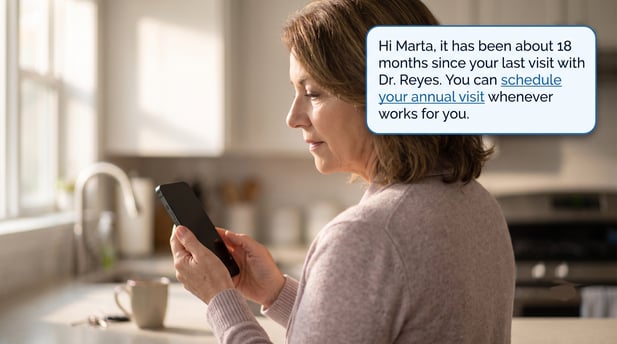
Copy carries most of the result. A recall text that works reads like a front desk person, not a campaign:
Hi Marta, this is Foothill Family Medicine. Our records show it's been about 18 months since your last visit with Dr. Reyes, and you're due for your annual. Reply YES and we'll call you with times. Reply STOP to opt out.
Four things are doing work in those two lines. Naming the practice first matters because the number is unfamiliar. Dr. Reyes appears by name, since that relationship is what the patient actually remembers.
One word answers it. And the opt-out sits inside the message rather than in fine print at the bottom.
What we leave out matters too. No countdown, no discount, no urgency language. These are people who trusted your providers for years, and a preventive care outreach text that reads like retail marketing gets read as spam.
Campaign Tracking Turns Recall Into a Rate
Campaign Tracking records sends, deliveries, replies, and appointments booked against each campaign. That converts recall from an activity into a measurement.
Compare it to a letter run. After 600 letters go out, nobody in the building can tell you what came back, because there is no way to attribute a booking made three weeks later to the envelope that caused it.
A campaign report reads differently: 612 messages sent, 231 replies, 189 appointments booked over the next 30 days. That is the patient reconversion rate a medical practice can actually put in front of an owner.
It also tells you which segment to run again. If the 12-to-18-month cohort books at twice the rate of the three-year cohort, next quarter's send weights toward the group that answers.
Where Prime Clinical Ends and Curogram Starts
Intellect stays the schedule and the system of record. Appointments get booked there, claims go out from there, and none of that changes. Curogram complements Prime Clinical; it never stands in for it.
Replies land in a shared inbox where any front desk staffer can pick them up. They book the visit in Intellect, then close the thread. Training runs short because the reply is a conversation, not a new module.
Security sits where a practice needs it: Curogram is SOC 2 Type II certified and HIPAA compliant, and a BAA is part of the arrangement.
The Success: The Returned Patient
The number worth having is your own. Four of the five steps that produce it happen inside Intellect, before you talk to any vendor. Run them on a slow afternoon.
Size Your Own Recall Opportunity in Five Steps
Start with the raw list. Take away everything that won't convert. What survives is the real opportunity, and it runs larger than most owners guess.
|
Step |
What You Do |
Example |
|---|---|---|
|
1. Pull |
Schedule Recall, Missing Appointments, 18-month window |
820 names |
|
2. Scrub |
Drop deceased, transferred, and moved-away patients |
720 remain |
|
3. Check numbers |
Count records carrying a mobile number |
612 textable |
|
4. Apply the rate |
35% reconversion, based on our internal data |
214 booked |
|
5. Value it |
214 visits at the $174 G0438 allowable |
roughly $37,200 |
The 820, the scrub rate, and the mobile-number share above are illustrative, and your own report will move all three. Only two figures are fixed: the 35% comes from our case data, and the $174 comes from AAFP.
That $37,200 also undercounts. It prices the wellness visit alone, ignoring the labs ordered off it, the chronic care follow-up scheduled at checkout, and the specialist referral that stays inside your group.
Run the same five steps at 24 months and 36 months before you stop. Older groups book at lower rates. That is expected, and they still cost nothing extra to text. A three-year name that converts costs you one message.
What 1,240 Returned Patients Looked Like
One multi-location practice we work with had the ordinary version of this problem. Patients needed follow-up care inside a recommended window, and they never scheduled it. Phone recall had stopped being realistic there years earlier.
They sent SMS recalls to that population instead. Within a month, 35% of the patients who received one had an appointment on the books. Across the group, 1,240 patients were seen from recall messages alone.
Those figures come from our internal case data. Not one of the 1,240 was a new patient. Every chart existed, every provider relationship existed, and the outbound cost for the entire group was a set of text messages sent in a few batches.
Lapse Becomes a Stage With a Playbook
Practices that keep this gain stop treating recall as a rescue mission. Lapse becomes a stage in the patient lifecycle, with a set response. The calendar looks about like this:
- Q1: 18-month sweep across the full panel
- Q2: annual wellness visit recall campaign for the Medicare cohort
- Q3: screening-age outreach, colorectal at 45 and up, mammography by age band
- Q4: patients with unmet deductibles who benefit from coming in before reset
Each quarter's send stays small enough that the front desk absorbs the replies without a special project plan. Two hundred messages produce a manageable number of conversations across a week.
Rebooked patients then flow into your normal confirmation sequence through automated appointment reminders for Prime Clinical Systems, so the visit you worked to recover doesn't turn into a no-show.
Preventive Care Compliance Rises With the Schedule
Filling the schedule from records you already own pays off on quality reporting too. The same segments you text to win back inactive patients line up with the measures you have to report.
Colorectal screening. A1c control. Mammography. Depression screening.
Each is a group defined by who has not been in. Texting to reactivate lapsed patients moves those denominators the way MIPS reporting needs.
A patient who comes back for an annual also gets a blood pressure reading, a medication review, and a chance to mention the symptom they meant to ignore.
Conclusion: Call Back the Quiet Ones
The cheapest patient your practice will add this year is one who already trusts your providers, already has a chart in Patient Chart Manager, and hasn't been asked to come back.
Intellect holds every one of those names. The text layer is what carries them to a phone and brings an answer back, which is the whole of what patient recall text campaigns for Prime Clinical practices do.
Do the exercise before you decide anything. Run Schedule Recall, set the window to 18 months, and count the rows. Multiply by 35%. That product is a real number of visits sitting in records you already paid to create, and it will be larger than the meeting you were planning to have about new patient acquisition.
Practices that run this quarterly stop losing people without noticing. A patient goes quiet in March, lands in the June sweep, and gets a text asking about the annual they skipped. Some of them book that week. The rest stay on the list for the next quarter, which costs nothing to keep.
See how Curogram fills the communication gap in 48 hours. Schedule a demo.
Frequently Asked Questions
Name your practice first, since the number is unfamiliar. Reference the provider they saw and the care they're due for, keep it under 320 characters, and close with a one-word reply option and an opt-out.
Letters reach the address from the visit that lapsed, cost 82 cents in postage before staff time, and offer no reply path. A text reaches the phone in their pocket and returns an answer you can count.
Campaign Tracking ties each send to its replies and to appointments booked afterward, so reconversion reports as a rate per campaign rather than a guess about whether the mailing did anything.
Quarterly suits most panels: one lapsed-patient sweep plus a seasonal push tied to wellness visits, screening months, or year-end benefits. Smaller, scheduled sends keep reply volume inside what the front desk can absorb.
Care recalls to established patients are a clinical service, tied to a due date in their own chart. Opt-out handling is automatic, and most patients respond warmly to a practice that noticed their absence.