9 min read
Patient Recall for Multi-Location eCW Groups | Curogram
Mira Gwehn Revilla
:
August 20, 2026
- Segments come from eCW visit history: months since the last visit, visit type, provider, and location
- Each site sends from its own local number, so the message looks familiar
- 35% of patients who got an SMS recall booked a visit within one mont
- Replies land in a shared inbox, not a voicemail box nobody checks
- Recovered visits then join the reminder sequence, where Curogram clients average above 75% confirmation
1,240 appointments. That is how many visits one multi-location practice booked from texts sent to patients who had stopped coming in. No ad spend, based on our internal data. The list came from the group's own records.
Most growth plans skip that list. Your biggest pool of unbooked volume already sits in eCW: patients with a closed chart note, no future visit, and no plan to make one.
Front desk teams know this. They also know what working the list takes. Someone has to pull the report, sort it by site, and dial 4,000 numbers. Then leave voicemails. Then call back the ones who answer at 6 p.m.
That work gets scheduled for a slow week. The slow week never shows up, so the list ages. A patient who cancelled in March gets no call in April.
By November she has forgotten your name and found a competitor through search, one your own ad budget is bidding against.
Patient recall campaigns for multi-location eClinicalWorks groups solve a staffing problem before they solve a marketing one.
Every field needed to build the campaign is already in eCW. What has been missing is a way to send thousands of messages per site, keep each one local and compliant, and route replies to someone who can book.
Below is how that plays out at network scale. How the leak forms. How segments get built from real visit data. What a throttled six-week rollout looks like across a dozen sites, and what happens to the schedule once recovered patients start walking in.
The Villain: The Leaky Panel
eCW records attrition well. Visit history, appointment types, recall flags, patients with no future visit on the books: all of it is in there. A report writer can produce the list by location in an afternoon.
Then the list has to be worked. That part runs on phone calls.
A scheduler juggling walk-ins and a live phone queue might get through 20 or 25 outbound calls an hour.
That is a generous estimate for a busy front desk. Most calls go to voicemail. Some numbers are dead. At 4,000 lapsed patients for one mid-size site, that is roughly 160 hours of dialing, or four full weeks of one person doing nothing else.
No office manager has four spare weeks. Recall becomes a project for January, or the week after Thanksgiving, or whenever the schedule finally softens. The list keeps growing while it waits.
Providers do their part, by the way. They set the recall flag at the end of the visit. Six months, one year, three months post-op. The flag is accurate and the follow-up is clinically correct.
March Cancellation, November Search Result
One patient cancels a six-month orthopedic follow-up in March because of a work trip. She tells the scheduler she will call back to rebook. The scheduler believes her. Nothing gets flagged.
April passes. So does July.
In November her knee starts hurting again. The practice name is gone from her memory, along with the provider and which of your five sites she visited. So she searches for a knee doctor near her, clicks the second result, and books two miles away.
Your marketing team is bidding on that exact search term. You may end up paying to reacquire a patient you already had. She had a chart, a payer on file, and a relationship with one of your providers.
Multiply that by the cancellations, no-shows, and unrebooked follow-ups across every site, every month, for three years. That pile is the leaky panel.
Small at One Site, Serious Across 12
A single clinic loses patients at a rate that looks tolerable. Network math changes the picture. The table below is illustrative example math, not case data.
|
Step |
Illustrative figure |
|
Locations in the group |
12 |
|
Patients per site with no visit in 18 months |
3,000 |
|
Network lapsed panel |
36,000 |
|
Share with a valid mobile number and consent on file |
70% (25,200) |
|
Reconverted at the 35% rate from our internal case data |
8,820 visits |
Treat that last figure as a ceiling. No group should text 25,000 patients in one week, and no schedule could absorb the callbacks if they did. Real campaigns run in waves sized to each site's open capacity.
Look at the first column instead. Patient panel leakage recovery starts with one number: how many people in your database have gone quiet.
The Acquisition Budget Covers for the Leak
Networks track cost per new patient closely. Very few track cost per lost patient, because nobody sends an invoice when someone stops coming.
Growth targets then get met by buying more visibility. New listings. More paid search. Another referral push. Meanwhile the back door stays open at every site, and the same budget refills a bucket with a hole in it.
A reactivated patient costs a text message and about two minutes of a scheduler's time. The chart exists. The insurance is on file. Nobody has to be sold on your providers, because they have already sat in one of your exam rooms.
There is a second cost that never shows up in a marketing report. Care gaps widen while the panel leaks. A diabetic patient two years past an A1c check is a clinical risk before he is a revenue line, and value-based contracts price that risk back to you.
Quality scores tell the same story from another angle. Screening and wellness measures depend on patients coming in. A panel that leaks at every site drags those numbers down one lapsed patient at a time.

The Guide: The Panel Recovery Engine
Recall works when it runs on a calendar that does not depend on a slow week. So the segment logic has to live somewhere other than a staff member's memory.
Curogram builds recall audiences from eCW visit data. Months since the last visit. Visit type. Rendering provider. Location. Whether a recommended follow-up ever happened. Those filters combine, which is what makes a segment usable.
Real segments look like this:
- Patients seen for an annual physical 14 or more months ago at the three western sites
- Post-op patients with a documented follow-up recommendation and no completed visit after it
- Patients who cancelled any visit in the past 12 months and never rebooked
- Diabetic patients with no A1c-related visit in over a year
Recall automation and eCW text outreach belong together for a plain reason. A segment is only as good as the visit data behind it, and that data already sits in the chart.
Local Numbers, 1 Set of Network Rules
Patients answer texts from numbers they recognize. A message from the Pasadena office should come from a Pasadena number. Corporate short codes read like a marketing blast, and they get ignored like one.
Each site sends under its own local number while the templates stay governed centrally. Marketing writes the message once. Compliance approves it once. Twelve sites send it without twelve versions drifting into existence.
Consent and opt-outs sit in the same layer. Anyone who replies STOP is removed across the network, not at one site only. A patient who opts out in Glendale and then gets a text from Burbank has been handed a reason to complain.
Care recall to an established patient and a promotional offer fall under different TCPA consent tiers.
The wording and the consent on file need to match. Curogram is HIPAA compliant, and recall texts stay light on clinical detail by design. The message says a visit is due. It does not say what for.
Care Gap Outreach Across Multi-Location Service Lines
Multi-specialty groups have a routing problem that single-site clinics do not. A dermatology recall that reaches a cardiology-only patient reads as sloppy. It also teaches that patient to ignore your texts.
Segments filter by provider and department, so eClinicalWorks patient reactivation outreach stays inside the service line the patient belongs to.
Care gap outreach in a multi-location group can then run several campaigns at once. Mammogram follow-ups from imaging. Annual wellness visits from primary care. Post-op checks from the surgical sites.
Cadence changes by service line too. A missed annual physical can wait a week for a second nudge. A post-op follow-up cannot.
Surgical sites usually run a two-day gap between the first message and the second, then stop, since a third text about a healed incision helps nobody.
The Success: The Self-Refilling Schedule
Lapsed patient win-back across a medical network runs on two things: clean segment data and the patience to throttle. What follows is a rollout at a twelve-site group over about six weeks.
Step 1: Count Before You Write Anything
Pull every patient with no completed visit in 18 months, split by location. Drop deceased patients, anyone flagged as moved, and existing opt-outs. Check how many have a mobile number on file, because that share sets your real audience size.
Groups get surprised twice at this step. The panel is bigger than they guessed. The share with usable mobile numbers is smaller.
Run the count by location before you total it. A site still using paper registration will have far worse mobile capture than one that switched to digital intake last year. That gap decides which locations you start with.
Step 2: Cut by Service Line and Recency
An 18-month gap means something different in dermatology than in primary care.
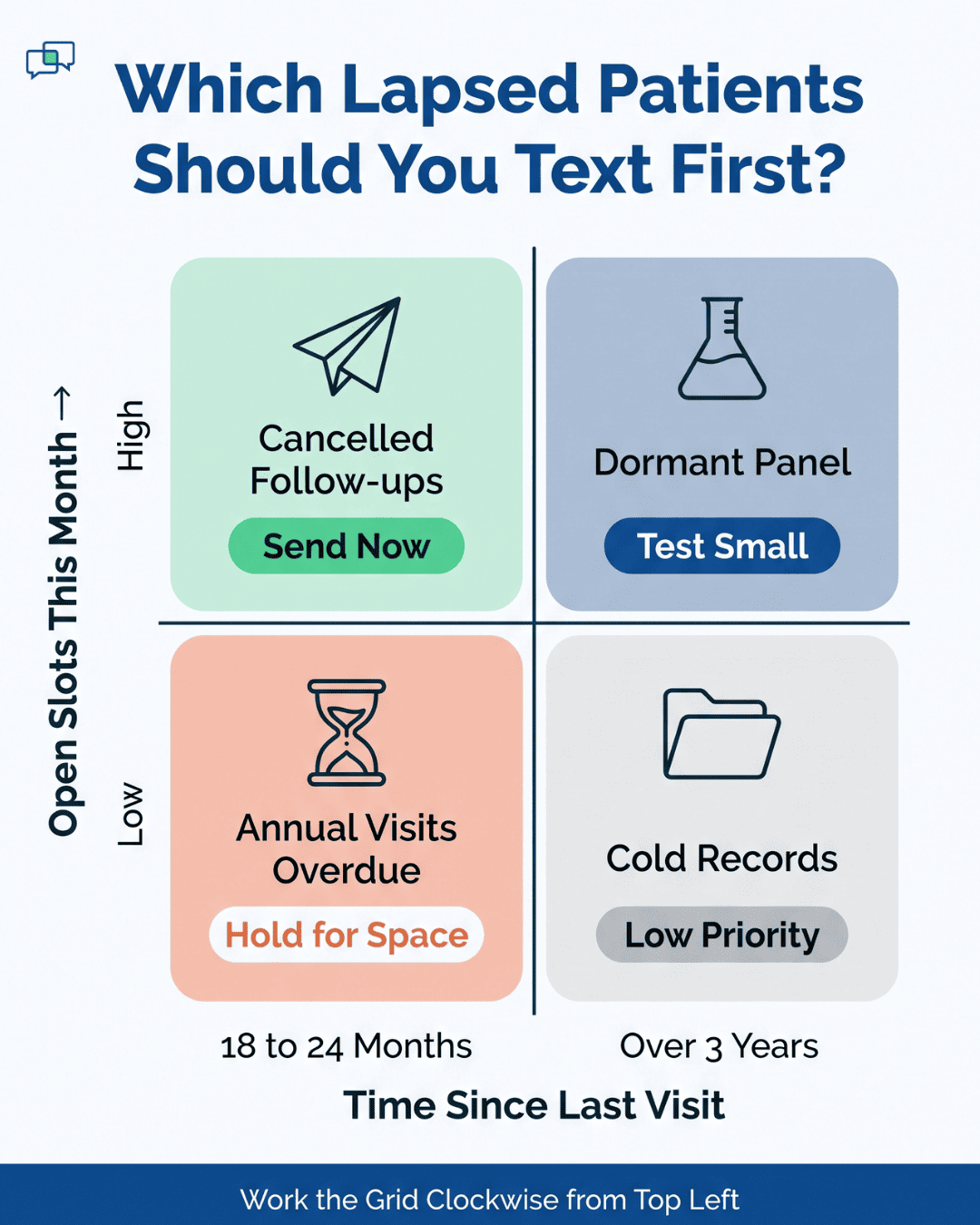
Split by department first, then by how long the patient has been gone. Patients out 18 to 24 months respond better than patients gone five years. Run those waves first and learn from them.
Step 3: Write 2 Messages per Segment, Not 12
Copy stays short. Name the location, name the reason, give one next step.
|
Segment |
Message angle |
Follow-up timing |
|
Annual physical, 14+ months |
Wellness visit is due, book online |
7 days |
|
Cancelled, never rebooked |
We can hold a new spot for you |
5 days |
|
Post-op follow-up missed |
Your provider wants to check your progress |
3 days |
|
Chronic care gap |
Time for your regular check, labs included |
7 days |
Two versions per segment is enough to test tone. More than that and nobody can tell what moved the number.
Step 4: Throttle to Booking Capacity
Most campaigns fail right here. A site with four providers and 60 open slots a week cannot handle 2,000 texts on Monday.
Set a daily cap per location tied to open capacity, usually 100 to 200 messages a day. Stagger start times so twelve sites are not all firing at 9 a.m. Reply volume then matches what schedulers can absorb that same hour.
Pace the waves by wait time as well. If your Pasadena orthopedic panel books out three weeks, a heavy recall send makes that four, and the recovered patient waits long enough to lapse again.
Step 5: Route, Book, Hand Off to Reminders
Replies go to the location inbox. Staff book directly in eCW or send the self-scheduling link. Every booked visit inherits the standard reminder sequence, which protects the recovered appointment from becoming a fresh no-show.
Expect a third bucket of replies that are neither yes nor no. Patients ask what the visit costs, whether their new plan is accepted, or whether the provider they liked still works there.
Those answers should be written and ready before wave one goes out, because a scheduler improvising insurance answers at 4 p.m. is how a warm lead cools.
Step 6: Read the Reconversion Rate by Site
Bookings divided by messages delivered gives you the reconversion rate of a recall campaign. Watch it weekly.
Our internal data puts that figure at 35% for one multi-location practice. Recovered appointments feed a 10% to 20% revenue increase when otherwise empty slots get filled.
Curogram Highlight: Automated Recall Campaigns
Automated Recall Campaigns turns a static eCW report into standing outreach. You define the campaign once. It then runs on its own schedule, per location, without anyone remembering to launch it.
Setup covers four things: segment rules, message copy, send cadence, and a daily volume cap per site.
Messages go out under each site's own number. Replies land in the unified inbox tied to that location, where staff can book directly or send a self-scheduling link. Opt-outs apply network-wide.
Reporting breaks out by location and by campaign, which gives an operations lead something to act on. If Riverside reconverts at 31% and Downtown sits at 12%, somebody can go find out why.
The internal case data behind this feature comes from a multi-location practice. It sent SMS recalls to patients overdue for follow-up care. 35% booked within a month, and 1,240 patients were seen from those recall messages alone.
Recall is one workflow among several on the same platform. Reminders, two-way texting, intake forms, and text-to-pay run beside it. A reactivated patient does not fall out of the process the moment they book.
Conclusion: Patch the Panel Before Buying More Water
Run one query this week. Count the patients across all your locations with no visit in the last 18 months.
That number is your recall audience. For most multi-site groups it is larger than every new-patient campaign on the roadmap combined.
eCW holds the record of who left. Giving those people a reason to come back, and a way to book in under a minute, is a communication job rather than a records job. That gap is where recall campaigns live.
The economics are hard to argue with. A patient who knows your providers, has a chart, and has insurance on file is the cheapest appointment your network will book all year. Strangers cost more and convert worse.
Book a demo and we will size the opportunity from your own panel data. We will pull lapsed counts by location, model 35% reconversion against them, and show you what a throttled six-week rollout would put back on your schedule.
Frequently Asked Questions
Start with recency and capacity. Patients gone 18 to 24 months respond better than patients gone five years, so those waves go out first. Then check which sites have open slots next month. Texting a location that books out four weeks creates a wait long enough for the recovered patient to lapse a second time.
Segments pull straight from eCW visit history. You filter by months since the last visit, visit type, provider, location, and whether a follow-up ever happened. The filters stack, so you can isolate post-op patients at two surgical sites who never came back. Each segment refreshes on its own as new patients cross the gap you set.
Volume and answer rate. A scheduler managing walk-ins gets through 20 or 25 outbound calls an hour, and most reach voicemail. A recall campaign sends 150 messages per site per day without touching anyone's queue. Patients also reply on their own time, which a ringing phone at 2 p.m. does not allow.
Consent and opt-outs run network-wide. A STOP reply at one clinic removes that patient at every site. Care recall to an existing patient and a sales offer sit in different TCPA consent tiers, so the wording has to match the consent on file. Curogram is HIPAA compliant, and recall texts carry no clinical detail.
Track the reconversion rate by location. Divide bookings by messages delivered. Our internal data shows 35% for one multi-location practice. Watch reply times too, plus the share of numbers that bounce. A site under the network average usually has a copy problem or a slow inbox. Both are quick to fix.