11 min read
Tebra Mass Messaging: Recover Lost Patients with Broadcast SMS
Mira Gwehn Revilla
:
April 3, 2026
- Tebra's tools only handle one-to-one patient messages
- Recall lists with hundreds of overdue patients sit idle with no way to reach them at scale
- Curogram sends filtered, personal broadcast texts in minutes
- Every patient reply routes back to the office for fast scheduling
- Based on our internal data, one practice recovered 1,240 patients at a 35% reconversion rate
Right now, there's a list inside your Tebra system. It has the names of 500, maybe 800 patients who are overdue for care. You know it's there. Your office manager knows it's there. And nobody has time to do anything about it.
That's the core problem with Tebra mass messaging — or rather, the lack of it. Tebra's tools are built for one-to-one talks. You can send a reminder for a booked visit. You can reply to a portal message.
But you can't select 600 overdue patients and text them all at once. There is no broadcast SMS tool. There is no campaign builder. The data lives in your EHR, but the outreach channel does not.
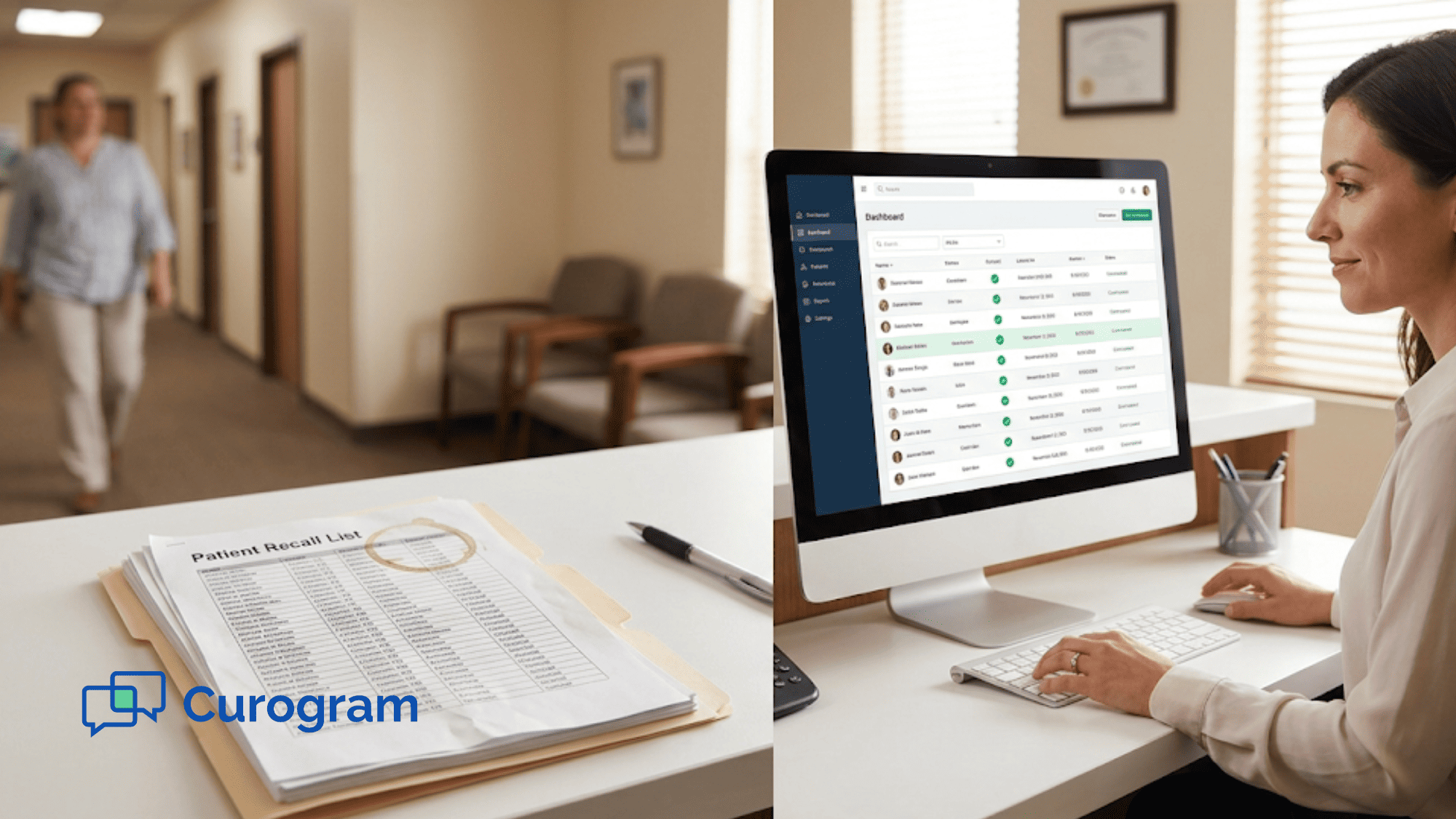
So what happens? The office manager prints the recall report. A staff member starts calling. After three hours, they've reached 40 people. Eight booked. The phones keep ringing with today's patients. The list goes back in the folder. Next quarter, it's even longer.
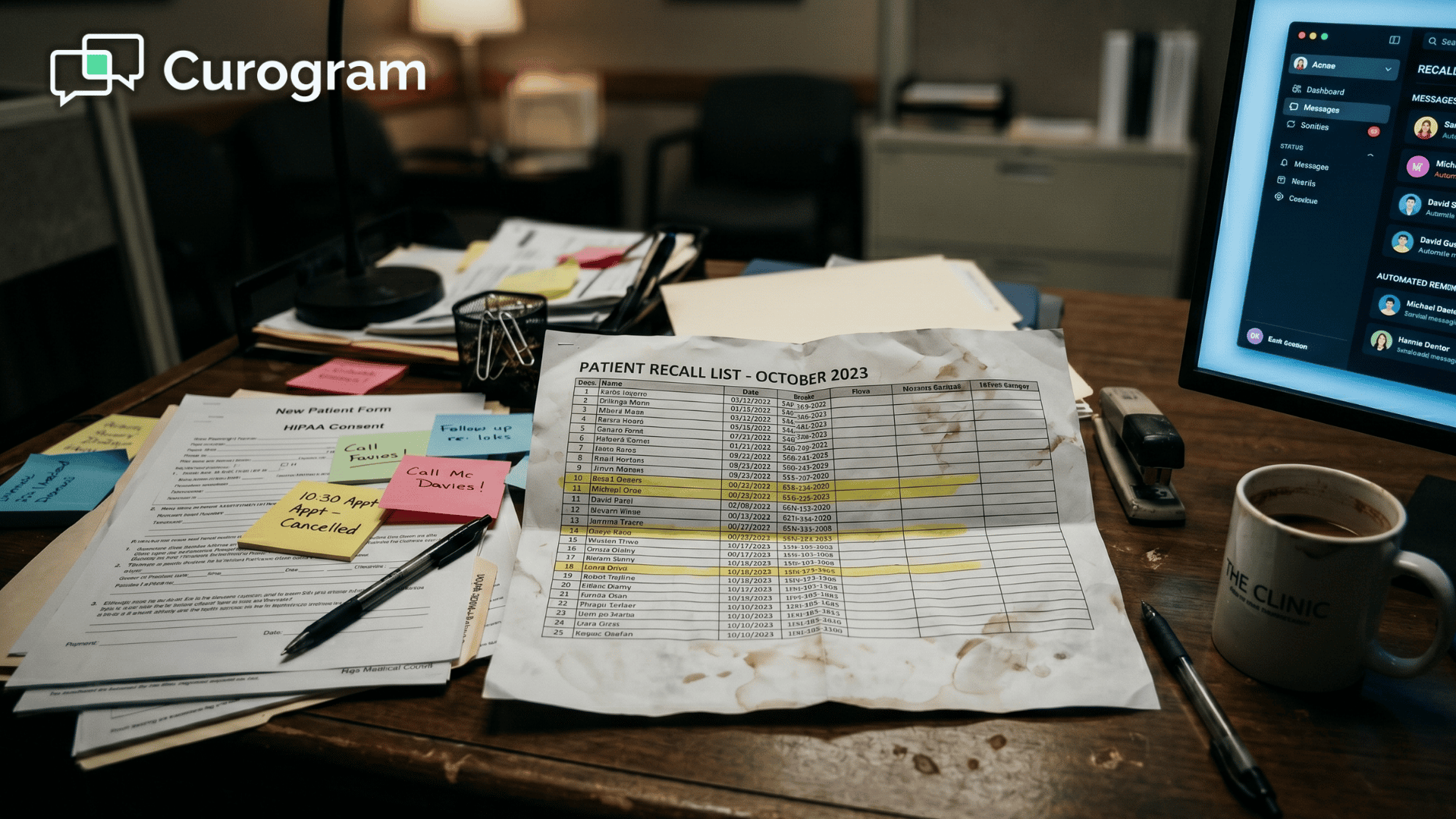
This is what we call "The Recall List Collecting Dust." Every Tebra practice has one. Few have a way to act on it.
Curogram changes that. With patient recall campaigns built on targeted bulk text, your practice can reach every overdue patient in minutes — not months. No extra staff. No phone tag. Just a short, personal text that drives patients back to your schedule.
Based on our internal research, one multi-location practice used this approach to recover 1,240 patients. Their appointment reconversion rate hit 35%. That's real revenue from patients already in the system — no new patient costs, no ads, no guesswork.
This article breaks down the problem, the fix, and the real-world results. If your recall list keeps growing, keep reading.
The Villain: The Recall List Collecting Dust
Every EHR tracks recall data. Tebra is no different. The system knows when patients are overdue for follow-ups, yearly physicals, screenings, shots, and chronic care visits. The data is right there. What's missing is a tool inside Tebra to act on it at scale.
Tebra's messaging features — reminders, portal messages, two-way texting — all work one patient at a time. There's no way to pick 500 patients who missed their annual wellness visit and text them all at once.
Because Tebra has no broadcast messaging for patient recall, the data just sits there. The list grows. And the gap between what the EHR knows and what the practice can do about it gets wider every month.
What This Looks Like Day to Day
Here's a scene that plays out in Tebra practices across the country.
The office manager runs the recall report. It shows 800 patients who haven't been seen in six months or more. The plan? Call them. A staff member starts dialing. Three hours later, she's reached 40 patients. Most calls went to voicemail. Eight people booked.
Meanwhile, today's patients are calling in. The waiting room is full. The front desk is swamped. The recall list goes back in the drawer.
Next quarter, the same report runs. Now it shows 1,100 names. The list never shrinks because the practice has no way to reach overdue patients without pulling staff off current tasks.
The Real Cost of Doing Nothing
Each patient on that list is worth $150 to $500 in direct visit revenue alone. That doesn't count lab work, prescriptions, referrals, or follow-up care that comes from that visit. A practice with 800 overdue patients is sitting on roughly $120,000 to $400,000 in revenue that could be recovered.
Here's a simple way to see the math:
|
Overdue Patients |
Revenue Per Visit (Low) |
Revenue Per Visit (High) |
Total Recoverable Revenue |
|
400 |
$150 |
$500 |
$60,000–$200,000 |
|
800 |
$150 |
$500 |
$120,000–$400,000 |
|
1,200 |
$150 |
$500 |
$180,000–$600,000 |
And it's not just about money. These are patients who need care. Overdue screenings. Chronic conditions that aren't being tracked. Missed flu shots. The recall list is both a revenue problem and a care problem — and Tebra's one-to-one tools can't solve it at the population level.
The Mindset Trap
Most practice owners accept this gap as normal. "We don't have the staff to call through that list." The thinking is that reaching overdue patients means more people making more calls. More labor hours. More cost.
What never crosses their mind is this: a single broadcast text could reach the entire list in minutes. Text messages have a 98% open rate. Replies go straight back to the office for scheduling. No phone tag. No voicemail. No wasted hours.
But that idea doesn't surface when your only frame of reference is Tebra's one-to-one messaging model. If the tool doesn't exist in your EHR, the strategy doesn't exist in your workflow. This is the Tebra population health outreach bulk messaging gap in plain terms — the data says "reach these patients," but the platform gives you no way to do it.
The result? Practices leave tens of thousands of dollars on the table every quarter. Not because the patients are gone, but because nobody could reach them.

The Guide: The Recall Revenue Engine
If the problem is that Tebra has no way to reach overdue patients at scale, the fix is simple: add a channel that can. That's what Curogram's broadcast messaging does. It gives your practice the ability to send targeted text messages to filtered patient groups — at any size, in minutes.
How It Works
Your office manager picks the patient criteria. That might be "overdue for annual wellness," "last seen 6+ months ago," "age 65 and up," or "due for flu shot." The system pulls the matching list from your patient data. Then the manager sends a personalized broadcast text.
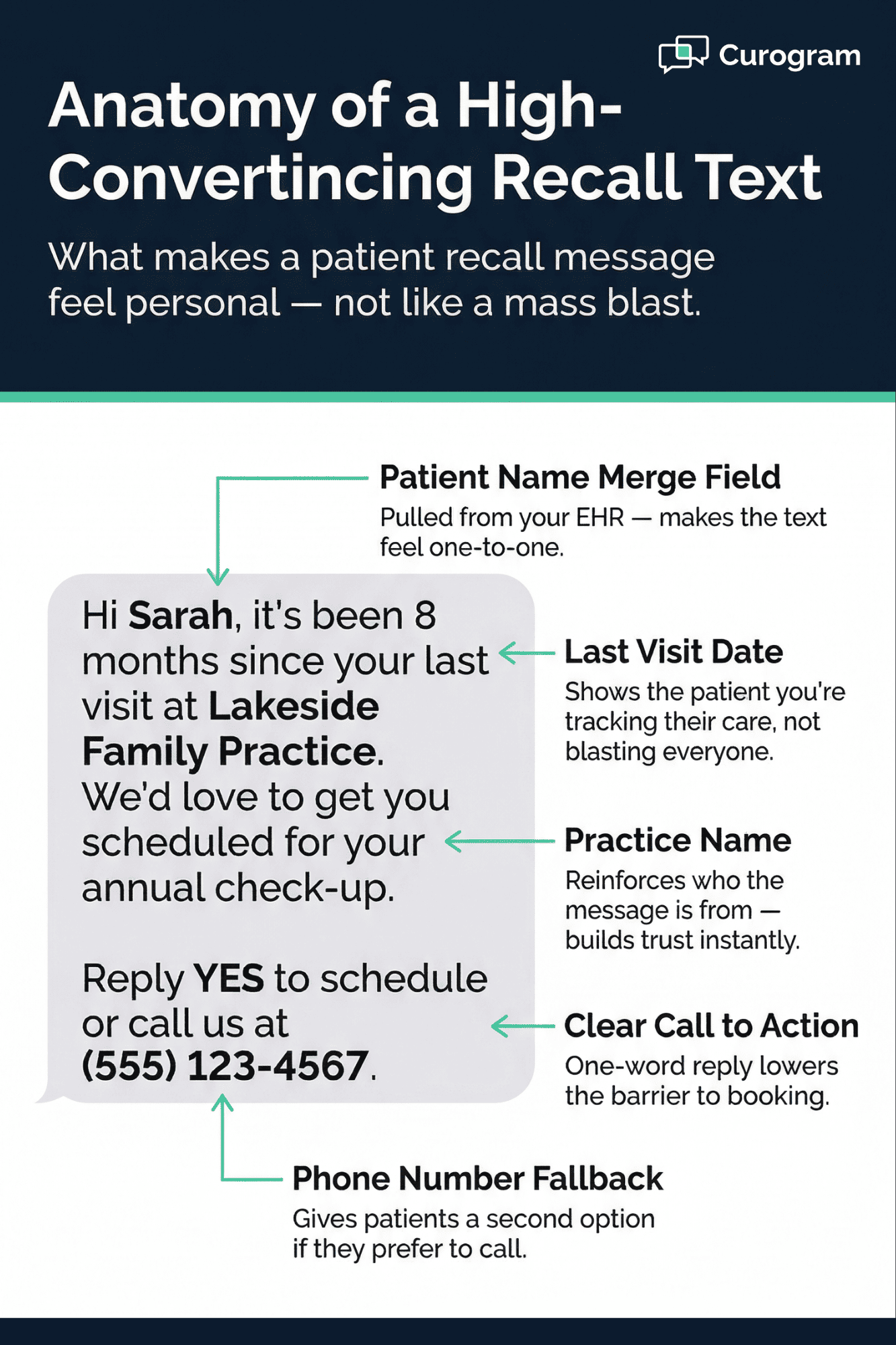
The message reads like it came from a real person, not a robot:
"Hi Sarah, it's been 8 months since your last visit at Lakeside Family Practice. We'd love to get you scheduled for your annual check-up. Reply YES to schedule or call us at (555) 123-4567."
Every reply routes back to the office dashboard. Staff see the responses in the same inbox they use for all patient messages. There's no extra app to check, no new system to learn.
This is the Tebra no broadcast messaging patient recall workaround that practices have been looking for. You don't replace Tebra — you add the outreach layer it's missing.
Targeted Broadcast with Response Routing
The key to good mass text outreach isn't blasting the same message to everyone. It's sending the right text to the right group. Curogram's tool supports filtered lists, merge fields for the patient's name and last visit date, and response routing that captures every reply.
Think of it this way. A flu shot campaign text should go to patients who haven't had one this season — not to patients who got theirs last week. An annual wellness recall should target those who are actually overdue, not your entire patient list. The more targeted the message, the better the response.
This is what makes broadcast SMS for overdue patient re-engagement at an independent practice so effective. The texts feel personal because they are based on real patient data. And because responses route right to the office, staff can book the appointment on the spot.

Seamless Integration with Tebra
Curogram doesn't replace your EHR. The recall data comes from Tebra. The outreach goes through Curogram. When a patient responds and books, the appointment goes back into Tebra's calendar. Your EHR stays the system of record. Curogram is the layer that turns static recall data into booked visits.
Built for Every Specialty
Different practices use broadcast messaging in different ways:
|
Specialty |
Common Campaign Type |
|
Primary Care |
Annual wellness recalls, flu shot campaigns |
|
Pediatrics |
Well-visit reminders by age group |
|
OB-GYN |
Annual exam outreach |
|
Dermatology |
Skin cancer screening events |
|
Orthopedics |
Post-surgery follow-up re-engagement |
|
Multi-location |
Site-specific recall campaigns |
A mass text for patient recalls or a flu shot campaign at a Tebra practice looks different depending on the specialty. But the tool adapts because it's a channel, not a fixed feature. Whatever your outreach need — a seasonal campaign, a schedule gap filler, or a full recall push — the broadcast tool handles it.
Multi-location practices can run separate campaigns per site. Each office addresses its own recall list. Each campaign targets its own patient group. The flexibility is the point.
The Success: The Revenue You Forgot You Had
Talk about recall lists long enough and it starts to feel abstract. So let's look at what happens when a practice actually does something about it.
The Real Numbers
Based on our internal data, one multi-location practice used Curogram's broadcast messaging to run patient recall campaigns over several months. The results:
- 1,240 patients came back for visits from recall texts alone
- 35% appointment reconversion rate — meaning 35% of patients who got a recall text went on to book and attend an appointment
These weren't new patients. They were people already in the EHR who had fallen off the schedule. There was no cost to acquire them. No onboarding. No marketing spend. Just a text message that turned a lapsed relationship into a booked visit.
The patient recall appointment reconversion rate from SMS broadcast text at this practice is a standout number. Industry-wide, phone-based recall efforts often see rates below 10%.
A 35% rate shows what happens when you meet patients where they are — on their phones, with a short text that takes two seconds to read and reply to.
From Backlog to Pipeline
Here's the real shift that happens after a practice starts using broadcast SMS. The recall list stops being a source of guilt and starts being a source of revenue.
Before Curogram, the recall list was a quarterly reminder of failure. "We should really call those patients." Nobody did. The list grew. After Curogram, the recall list becomes a tool. It's something the office manager uses on purpose, with a plan.
Flu season coming up? Send a broadcast to patients overdue for flu shots. Open slots on the schedule next week? Target patients who haven't been seen in six months. New provider joining the practice? Reach out to patients who don't have a PCP on file.
The recall list isn't a problem to solve. It's an asset to deploy.
A Real-World Scenario
Let's walk through a real scenario to show how this works in practice.
A 5-provider Tebra practice has 1,200 patients on its recall list. The office manager has been trying to chip away at it for two years through phone calls. Progress has been slow.
The practice activates Curogram's broadcast messaging. The first campaign targets 400 patients overdue for annual wellness visits. The text goes out on a Monday morning. It takes about 10 minutes to set up — choose the filter, write the message, review, and send.
Within 72 hours:
- 140 patients respond to the text
- 95 patients schedule appointments over the next two weeks
- The practice fills open slots that would have gone unused
Why Text Beats Phone for Recalls
The reason broadcast SMS works so much better than phone calls comes down to three things.
-
Open Rates - Text messages have a 98% open rate. Most are read within three minutes. Phone calls? Half go to voicemail. Many are ignored because patients don't pick up unknown numbers.
-
Speed - One person can send a broadcast to 400 patients in 10 minutes. The same 400 calls would take a staff member roughly 30 to 40 hours of dialing, waiting, leaving voicemails, and calling back.
-
Ease of Response - A patient reads the text and replies "YES." That's it. They don't need to find the office number, wait on hold, or call during business hours. The barrier to booking is almost zero.
This is why population outreach to recover overdue appointments through bulk text works. It removes friction at every step — for the practice and for the patient.
The Revenue That Keeps Compounding
The first visit is just the start. When you bring a patient back for a wellness check, that visit often leads to more care. Lab orders. Referrals. Prescription renewals. Follow-up visits for new findings. Chronic care management.
A single recalled patient who comes in for a $300 wellness visit might generate $1,000 or more in downstream revenue over the next 12 months. Multiply that by 95 patients from one campaign, and the long-term value runs into six figures.
And here's the thing — you can run these campaigns as often as you need to. Monthly. Weekly. Whenever your schedule has gaps or your recall list hits a certain size. It's not a one-time fix. It's an ongoing revenue channel.
What About Practices That Think They Can't Afford It?
The math speaks for itself. If one campaign generates $28,000 to $47,000 in visit revenue, the cost of Curogram's platform pays for itself many times over.
Based on our internal research, the revenue from one recall campaign typically covers six months or more of the platform cost.
Practices that say "we can't afford new software" are often the same practices sitting on six figures of recoverable revenue in their recall list. The cost of not doing this is far greater than the cost of the tool.
How One Broadcast Campaign Can Outperform Months of Phone Calls
Most Tebra practices treat the recall list as a manual chore. Someone on staff gets assigned to call through a spreadsheet. They spend hours dialing, leaving voicemails, and waiting for callbacks that rarely come. Progress is slow. Results are thin. And the list keeps growing.
Curogram flips this entire process. Instead of one-by-one phone calls, the office manager sends a single broadcast text to a filtered list of overdue patients. The message is short, personal, and easy to respond to. Patients reply with one word — and the conversation moves to the office dashboard for scheduling.
Based on our internal data, one multi-location practice recovered 1,240 patients through recall campaigns alone, achieving a 35% appointment reconversion rate. That's 35% of the overdue patients who received a text going on to book a visit. No phone calls. No extra staff. Just a text that took minutes to send.
The tool works because it's built around how patients actually want to be reached. People read texts. They don't answer calls from unknown numbers. A recall text that says "Hi Sarah, it's time for your annual check-up — reply YES to schedule" gets read in seconds and acted on in the same moment.
For practices running Tebra, this fills a real gap. The EHR holds the recall data but offers no tool to act on it at scale. Curogram adds the outreach layer that Tebra lacks — personalized broadcast SMS with response routing, filtered lists, and merge fields for patient names and visit dates.
Whether you're running a flu shot campaign, clearing a schedule gap, or tackling a recall list that's been growing for years, one campaign can do more than months of manual effort. The revenue from a single recall campaign often pays for six months of Curogram.
Conclusion: The Channel Tebra Doesn’t Have
Let's be direct. Tebra is a solid EHR for independent practices. It handles scheduling, charting, billing, and patient records well. But when it comes to outreach at scale, there's a clear limit.
Tebra's messaging is built for one-to-one talks. Send a reminder for a specific visit. Reply to a message in the patient portal. Text one patient at a time. These are useful features. But they don't help when you need to reach 500 patients at once about overdue care.
Curogram's broadcast messaging fills that gap — not as a nice-to-have extra, but as a function that does not exist without it. It's the broadcast SMS tool for overdue patient re-engagement that independent practices need but can't get from Tebra alone.
Think of it this way: Tebra manages your scheduled patients. Curogram re-engages the ones who haven't scheduled yet. Your EHR knows which patients need to come back. Curogram gives you the channel to reach them.
Your EHR knows which patients need to come back. Curogram gives you the tool to reach them — all of them, in minutes.
The numbers back this up. Based on our internal data, practices using Curogram's broadcast messaging have seen a 35% appointment reconversion rate and recovered over 1,200 patients from recall campaigns alone. That's revenue that was already in the system, waiting for a channel to unlock it.
Every week your practice goes without a broadcast tool is another week of recoverable revenue slipping away. The patients are there. The data is there. The only thing missing is the outreach.
Stop losing revenue to a list no one has time to call. Request a demo and send your first recall campaign this week.
Frequently Asked Questions
Scale and targeting. Tebra’s messaging is designed for one-to-one interactions — you can message one patient at a time. Curogram’s broadcast messaging lets you select a patient segment (e.g., all patients overdue for annual wellness visits, patients aged 65+ who haven’t had a flu shot, patients not seen in 6+ months) and send a personalized text to the entire segment in minutes. Responses route back to your dashboard for follow-up.
Most practices see patient responses within 24 to 72 hours of sending the first broadcast. Based on our internal data, practices have booked 95 appointments from a single 400-patient campaign within two weeks.
Messages use merge fields to include the patient's name, last visit date, and provider name. Each text reads like a personal note from the office — not a mass blast. Combined with opt-out compliance, patients receive relevant, timely messages they actually want to respond to.