11 min read

How a Single SMS Recall Re-Engages Overdue Tebra Patients Instantly

How a Single SMS Recall Re-Engages Overdue Tebra Patients Instantly
💡 Tebra practices can re-engage overdue patients through SMS recall powered by Curogram's broadcast text messaging.
  • Patients who haven't been seen in months get a direct, personal text — no app or portal login required
  • One practice recovered 1,240 patients with a 35% appointment reconversion rate, based on our internal data
  • Text messages have a 98% open rate, far higher than calls, letters, or portal alerts
  • Patients can reply to schedule in seconds — no phone call needed
  • Campaigns can target by visit type, age, provider, or last visit date
If a Tebra patient hasn't been seen in 6 months, a single re-engagement SMS can bring them back for the care they need. Curogram makes overdue patient recall as simple as sending one text.

Think about the last time you missed a dentist visit or skipped a yearly check-up. Nobody called. Nobody texted. You just... forgot. Now think about how many of your patients are doing the same thing right now.

For Tebra practices, this is a growing problem. Your EHR knows which patients are overdue. It tracks their last visit, flags their care gaps, and stores every detail. But it can't reach out and say, "Hey, it's time to come back."

Tebra's built-in tools handle patients who already have visits on the books. Reminders go out. Portal messages get sent. But what about the patients with nothing on the schedule? The ones who were supposed to come back 6 months ago — and didn't?

There's no way to reach these patients at scale inside Tebra. Your staff can call them one by one. They can mail letters. They can send portal notes. But here's the truth: patients don't answer calls from numbers they don't know. Letters sit in the mail pile. Portal messages go unseen for months.

This is what we call "The Reminder That Never Arrives." It's not that your practice doesn't care. It's that the outreach tools don't reach the patient.

Curogram fixes this with one simple feature: broadcast SMS recall. Your staff uploads a list of overdue patients, writes a personal text, and hits send. The message lands on the patient's phone — the one device they check dozens of times a day.

Based on our internal research, one practice brought back 1,240 patients this way. The reconversion rate was 35%. No app. No portal. No phone call. Just a text that says, "We'd love to see you again."

This article shows how overdue Tebra patients re-engage through a single SMS recall — and why it works better than every other method you've tried.

The Villain: The Reminder That Never Arrives

From the patient's side, going overdue for a visit is rarely on purpose. Life gets busy. Work piles up. Kids need rides to school. The appointment they were "going to schedule" just keeps sliding down the to-do list.

Here's the key point: there's no appointment to remind them about. Tebra's reminders only fire when a visit is booked. If the patient never books, the system stays silent. The practice knows the patient is overdue — the chart shows it clearly — but there's no built-in tool to tell the patient.

So the patient doesn't think, "I'm avoiding my doctor." They think, "I keep meaning to call." Without a prompt that truly reaches them, "meaning to" never turns into action.

The Agitation

The old-school recall methods all fail at the same point: delivery.

Your front desk sends a letter. It lands in a pile of junk mail. The patient skims it, sets it aside, and forgets. Your staff calls. It goes straight to voicemail from a number the patient doesn't know. They never listen to it. Your system sends a portal alert. The patient hasn't logged in for 8 months and forgot their password long ago.

Each try costs your practice time and money. But the message never actually gets through. When you compare the patient experience of a recall text vs phone call vs letter mail, the pattern is clear — the older methods just don't land.

Recall Method

Open/Answer Rate

Patient Action Needed

Cost to Practice

Phone Call

~20% answer rate

Call back, wait on hold

High (staff time)

Mailed Letter

~10–15% open rate

Read, call to schedule

Medium (print + postage)

Portal Message

~5–10% seen

Log in, remember password

Low cost, low impact

SMS Text

~98% open rate

Reply to schedule

Low cost, high impact


The channels are wrong — not the intent.

The Drop-Off

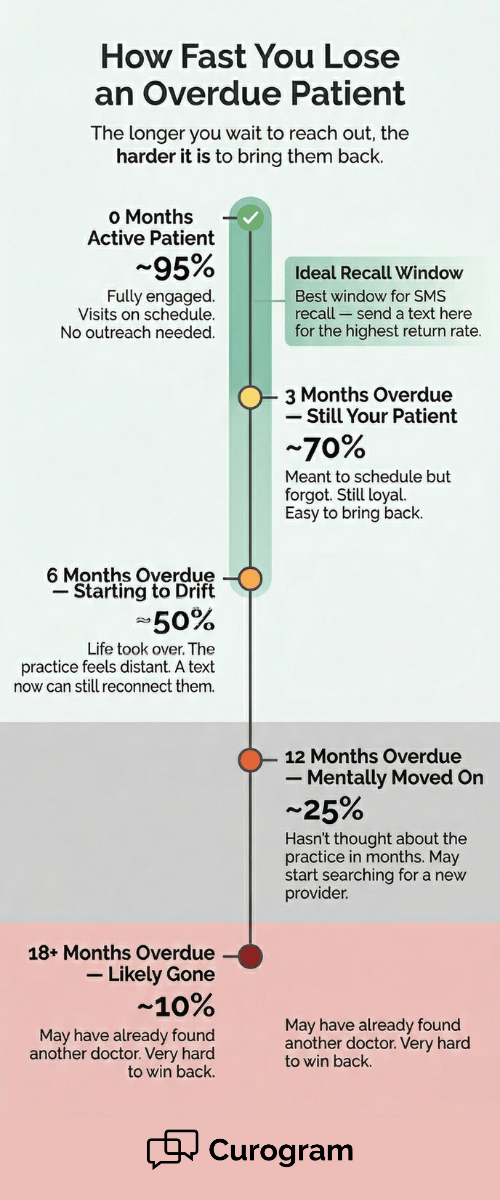
The longer a patient goes without hearing from you, the harder it is to bring them back.

A patient overdue by 3 months still feels like your patient. They'd say, "Oh yeah, I go to Dr. Chen." A patient overdue by 12 months may have moved on in their mind. And a patient overdue by 18 months or more? They may have found a new doctor down the street.

The window shrinks with each passing month. Without a channel that reaches patients right away, your practice loses these people on a rolling basis. Not all at once — but steadily, one lapsed patient at a time.

Vertical timeline infographic showing how patient recall success rates drop from 95% to 10% over 18 months

The Result

Patients don't blame you for not reaching out. They don't even think about it. They don't know you called. They don't recall the letter. They never saw the portal note.

From their point of view, the practice just stopped talking to them.

For patients with ongoing conditions or overdue screenings, this silence has real health effects. The patient who needed a follow-up screening but was never reached isn't just lost revenue — it's a missed chance for early care.

The patient who skipped their child's yearly well-visit isn't ignoring health; they just didn't get a nudge they could see.

SMS patient outreach for an overdue visit or preventive care gap in Tebra can close this cycle. But right now, Tebra has no native broadcast channel to make it happen. The EHR tracks the care gap — it just can't close it on its own.

The Guide: The Text That Brings Patients Back

Curogram's broadcast text reaches patients where they live: their text messages. The recall text is short, direct, and hard to miss.

Here's what it might look like:

"Hi Sarah, it's been 8 months since your last visit at Riverside Family Medicine. Dr. Chen would love to see you for your annual wellness check. Reply YES to schedule or call us at (555) 123-4567."

The patient reads it in seconds. They see their doctor's name. They can respond right away. No app to open. No portal to log into. No password to reset. No phone call to make. Just a quick reply.

This is text recall with appointment scheduling and no portal login required. The patient taps a reply, and they're on their way back.

The Personal Touch at Scale

Every broadcast text has merge fields built in — patient name, provider name, last visit date, and practice name. A mass message to 500 patients feels like a personal note to each one.

The patient doesn't know that hundreds of others got a similar text at the same time. And frankly, they don't care. What they feel is their doctor's office reaching out to them, by name, through a channel they trust.

This blend of personal detail and broad reach is what sets text-based recall apart from calls, letters, or portal alerts. It doesn't feel like marketing. It feels like someone at the office thought of them.

Think of it this way: if a friend texts you, "Hey, let's grab lunch," you reply. If a robot dials your phone and says, "You have a pending appointment," you hang up. The format matters just as much as the message.

The Integration

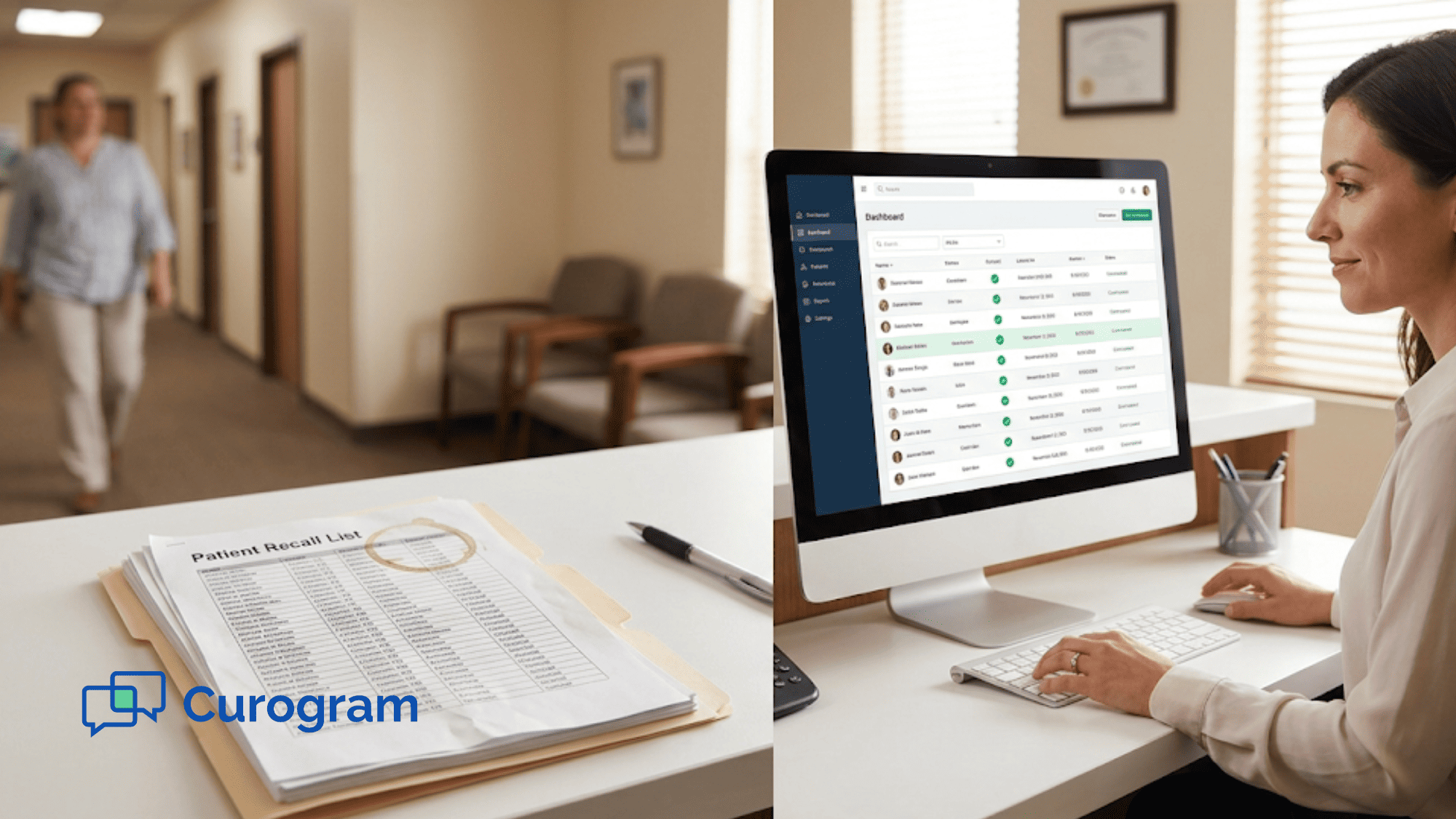
When a patient replies, the message flows right into Curogram's office dashboard. This is the same screen your staff already uses for all patient texts.

The front desk sees the reply, confirms the patient's open times, and books the visit into Tebra's calendar. The shift from broadcast message to one-on-one chat is smooth. The patient sees it as one single, clear exchange with your office — not two separate systems.

There's no copy-paste. No switching between screens. No lost replies. The tool fits into your team's current workflow so they can schedule overdue patients easily without learning a new system.

The Accessibility Fit

Text-based recall reaches the patients that every other method misses.

Older patients who don't use email. Working parents who can't pick up the phone at 2 p.m. Patients who never made a portal account. Young adults who ignore voicemails but text back in under a minute.

With a 98% open rate, the recall message reaches nearly every patient on the list. That includes the ones your practice has been trying — and failing — to contact for months. When a Tebra patient hasn't been seen in 6 months, a re-engagement SMS through Curogram is the most direct path back into the care relationship.

The beauty of texting is that it meets every age group where they are. A 70-year-old who can't navigate a patient portal can still read and reply to a text. A 25-year-old who hasn't checked voicemail in a year will see your message within minutes.

The Success: Back in the Chair

Based on our internal data, one multi-location practice brought back 1,240 patients through Curogram's broadcast recall. These patients had not scheduled follow-up care within the suggested time frame. In plain terms — the practice had lost them.

The campaign hit a 35% appointment reconversion rate. That means more than 1 in 3 patients who got the text came back and booked a visit.

To put this into context, consider the math for a small practice. Say you have 400 overdue patients. A 35% return rate brings back 140 of them. If the average visit brings in $150, that's $21,000 in recovered revenue — from a single text blast that took minutes to send.

Metric

Value

Patients contacted

Varies by campaign

Reconversion rate

35%

Patients recovered (case study)

1,240

Staff time to launch campaign

~10 minutes

Patient action needed

Reply to text

App or portal download needed

None


These aren't cold leads. These are patients who already trust your practice. They already have a chart. They already have a relationship with your provider. They just needed someone to reach out in a way they'd notice.

From Forgotten to Reconnected

The shift in patient experience is real and felt on both sides.

Before Curogram, an overdue patient drifts away with no contact. They might wonder if the practice even cares that they haven't been back. They don't think about the portal note they missed or the voicemail they didn't play. They just feel... forgotten.

After one text, that changes. The patient sees their name. They see their doctor's name. They read a short note that says, "We'd love to see you." In that moment, the practice goes from silent to caring — in the patient's mind.

For patients with chronic conditions, this is even more important. A diabetic patient who skips a 6-month follow-up might not track their A1C for another year. A woman who delays her annual screening may miss early signs. A child who skips a well-visit may fall behind on vaccines.

The text doesn't just fill a time slot. It closes care gaps that would have grown wider without action.

This is the heart of it. The practice shows that the patient isn't just a chart number. They're someone the office wants to see. And the patient responds to that because it feels genuine — because it is.

The Outcome in Action

Let's walk through a real-world example based on patterns from our internal research.

The Practice

A 6-provider Tebra group. They handle primary care and pediatrics across two locations. They've been on Tebra for three years but have never had a way to do mass outreach for overdue patients.

The Problem

Over 350 patients are overdue for well-visits. Some are kids who haven't been in for a check-up in over a year. Others are older adults who missed annual exams. The front desk has called through the list before, but most calls go unanswered. Letters were mailed last quarter — the response was almost zero.

The Campaign

The office manager builds a list of these 350 patients in Curogram. She writes a simple message:

"Hi [First Name], your child is due for a well-visit at [Practice Name]. We'd love to get them on the schedule. Reply YES or call us at [Phone]. — Dr. [Last Name]'s office"

She sends the campaign at 10 a.m. on a Tuesday.

The Response

By end of day, 47 patients have replied. By end of week, 122 patients have responded. Over the next month, 85 of those patients book and attend their visits.

Here's what the practice noticed:

  • Parents who hadn't brought their kids in for over a year booked right away when they got a text saying their child was due.
  • Older patients who had ignored letters and missed phone calls replied to the text within minutes.
  • Several patients responded with, "I've been meaning to schedule — thanks for the reminder."

The text didn't feel like a sales pitch. It felt like care. That's the difference.

The Revenue Impact

If 85 visits average $175 each, that's $14,875 recovered from one campaign. Factor in follow-up visits, lab work, and referrals, and the real number climbs higher. The office manager spent about 10 minutes setting it up.

The Schedule Impact

The practice filled open time slots with high-value visits — annual physicals, well-child checks, and chronic care follow-ups. These aren't quick sick visits. They're the kind of visits that build lasting patient relationships and strong revenue.

The Care Impact

Some of those 85 patients hadn't seen a doctor in over a year. Two parents booked overdue vaccine catch-ups for their children. One older patient came in for a screening that was 8 months late. The text didn't just bring patients back to the chair. It brought them back to their health plan.

This is what happens when you move from phone calls and letters to a channel patients actually use. The practice can now run these campaigns monthly, targeting different groups each time — flu shots for seniors, well-visits for kids, follow-ups for chronic care patients. Each round fills more gaps and strengthens more relationships.


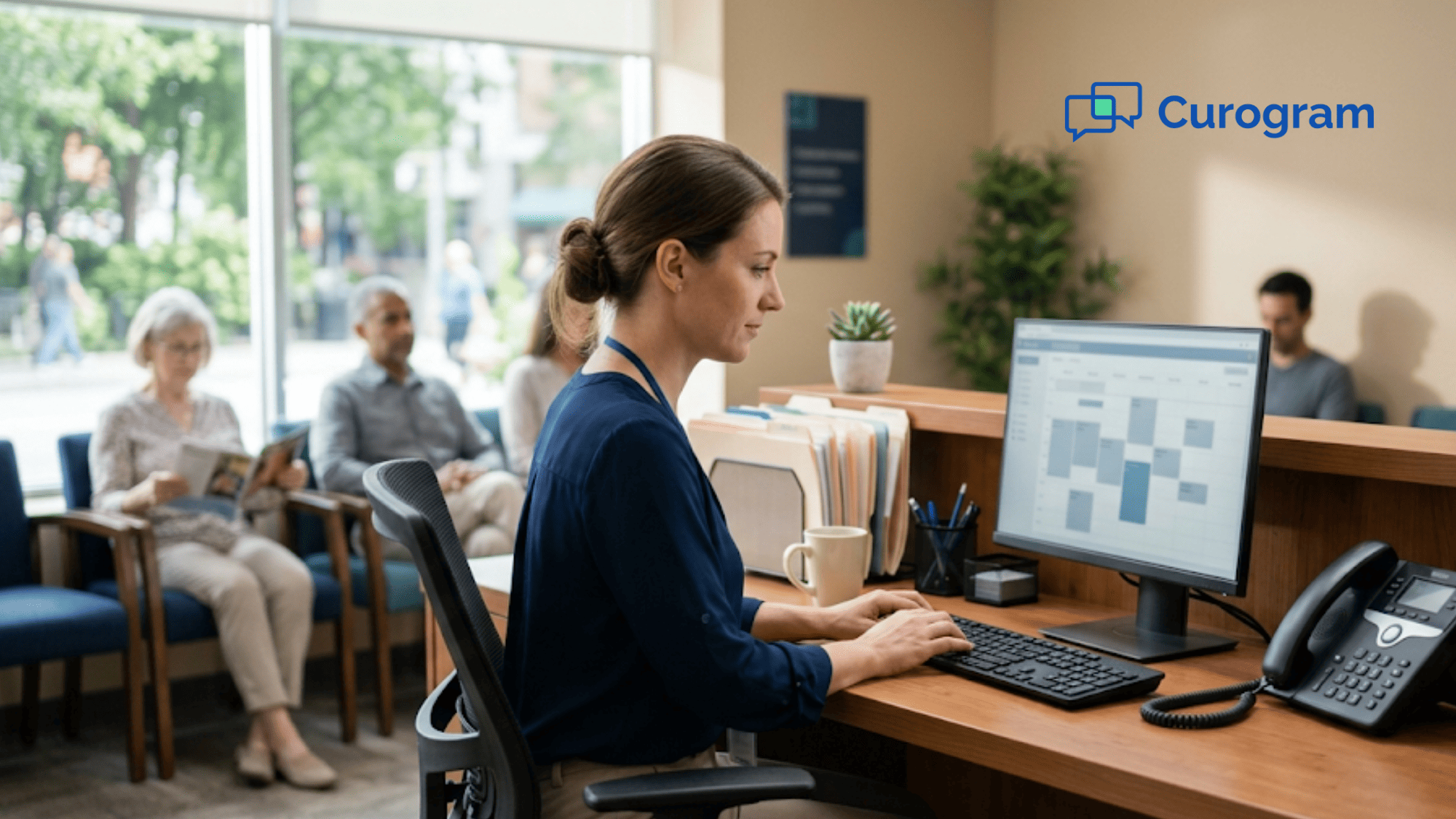
A woman stands at a clinic front desk while other patients wait in a full reception area

How Curogram Turns One Text into a Full Recall Strategy

Curogram isn't just a texting tool — it's the recall engine that Tebra doesn't have.

Tebra is built for patients who are already on the schedule. It sends reminders, pushes portal notes, and tracks visit history.

But for the patients who fell off the calendar months ago, Tebra goes quiet. There's no native broadcast tool, no mass text option, and no way to reach hundreds of overdue patients at once.

Curogram fills that gap with targeted broadcast SMS campaigns. You filter patients by last visit date, provider, visit type, age, or insurance. Then you craft a short, personal message and send it to the full list. The text arrives on the patient's phone — the one place they always check.

When the patient replies, the chat lands in the same Curogram dashboard your staff uses every day. From there, booking into Tebra's calendar is seamless. The patient sees one smooth exchange. Your team sees one clean workflow.


The result? Practices recover patients they thought were gone for good. Based on our internal data, one practice saw a 35% reconversion rate and brought back 1,240 patients through SMS alone.

Whether you run a solo family practice or a multi-site group, Curogram gives you the broadcast power to reach every overdue patient on your list. Your EHR knows who needs to come back. Curogram makes sure they hear about it — through the one channel that actually works.

Conclusion: Reach Them Where They Are

Your patients haven't left. They just haven't heard from you in a way that got through.

Phone calls from unknown numbers go to voicemail. Letters get buried in the mail. Portal alerts sit unseen behind forgotten passwords. These aren't bad patients — they're busy people using a world that runs on text.

Curogram's broadcast recall sends a personal text that connects overdue patients with the care they need. It goes to the one channel they check — their phone. The 98% open rate isn't a guess. It's the reason this works when nothing else does.

Tebra knows which patients need to come back. It tracks every chart, every gap, every overdue visit. But knowing and reaching are two different things. Curogram bridges that space. The EHR holds the care plan. The text message brings the patient back to follow it.

Based on our internal data, one practice recovered 1,240 patients and hit a 35% reconversion rate with a single broadcast campaign. That's real patients back in the chair, getting care they would have missed.

And it took about 10 minutes to set up.

If you manage a Tebra practice — whether it's 1 provider or 20 — your overdue patients are waiting to hear from you. Not through a portal. Not through the mail. Through a text.

One text can bring them back.

Stop losing patients to voicemail and forgotten letters. Book a demo to see how Curogram brings them back with a single text.


Frequently Asked Questions

Will patients feel uncomfortable receiving a mass text from their doctor’s office?
No. Because Curogram’s broadcast texts include personalized merge fields — the patient’s name, their provider’s name, and their last visit date — the message feels personal, not generic. Patients experience it as their doctor’s office reaching out to them individually.
What if a patient doesn’t want to receive recall texts?
Patients can opt out at any time by replying STOP. Curogram automatically removes opted-out patients from all future broadcast messages. The system is fully TCPA compliant, and opt-out management is handled automatically — the front desk doesn’t need to maintain a manual do-not-contact list.
Can we send recall texts for specific types of visits or conditions?

Yes. Curogram’s broadcast tool supports filtered campaigns based on patient criteria: visit type, age, insurance, last visit date, provider assignment, and more. You can run a flu shot campaign for patients aged 65+, a well-visit recall for pediatric patients by age cohort, or a follow-up campaign for patients with specific chronic conditions. Each campaign can have its own message and targeting, ensuring patients receive relevant outreach rather than generic blasts.

Why is SMS more effective than portal messages for reaching overdue Tebra patients?

Portals require a login, a password, and an active account. Most overdue patients haven't logged in for months. Texts arrive on their phone with no login needed — and 98% get opened.

How can a practice target specific patient groups for a recall campaign?

Curogram lets you filter by last visit date, provider, visit type, age, and insurance. You can run a flu shot campaign for seniors, a well-child recall for toddlers, or a follow-up push for chronic care patients — each with its own custom message.