12 min read
Patient Recall Campaigns for MD Systems That Fill Schedules
Mira Gwehn Revilla
:
March 4, 2026
- Filter MD Systems data by age, last visit, or diagnosis code
- Send flu shot reminders or wellness visit texts to hundreds of patients at once
- Patients click a link to self-schedule on their phone
- No postage, no printing, no wasted staff hours
- Based on our internal data, 35% of patients who get a recall text book within one month
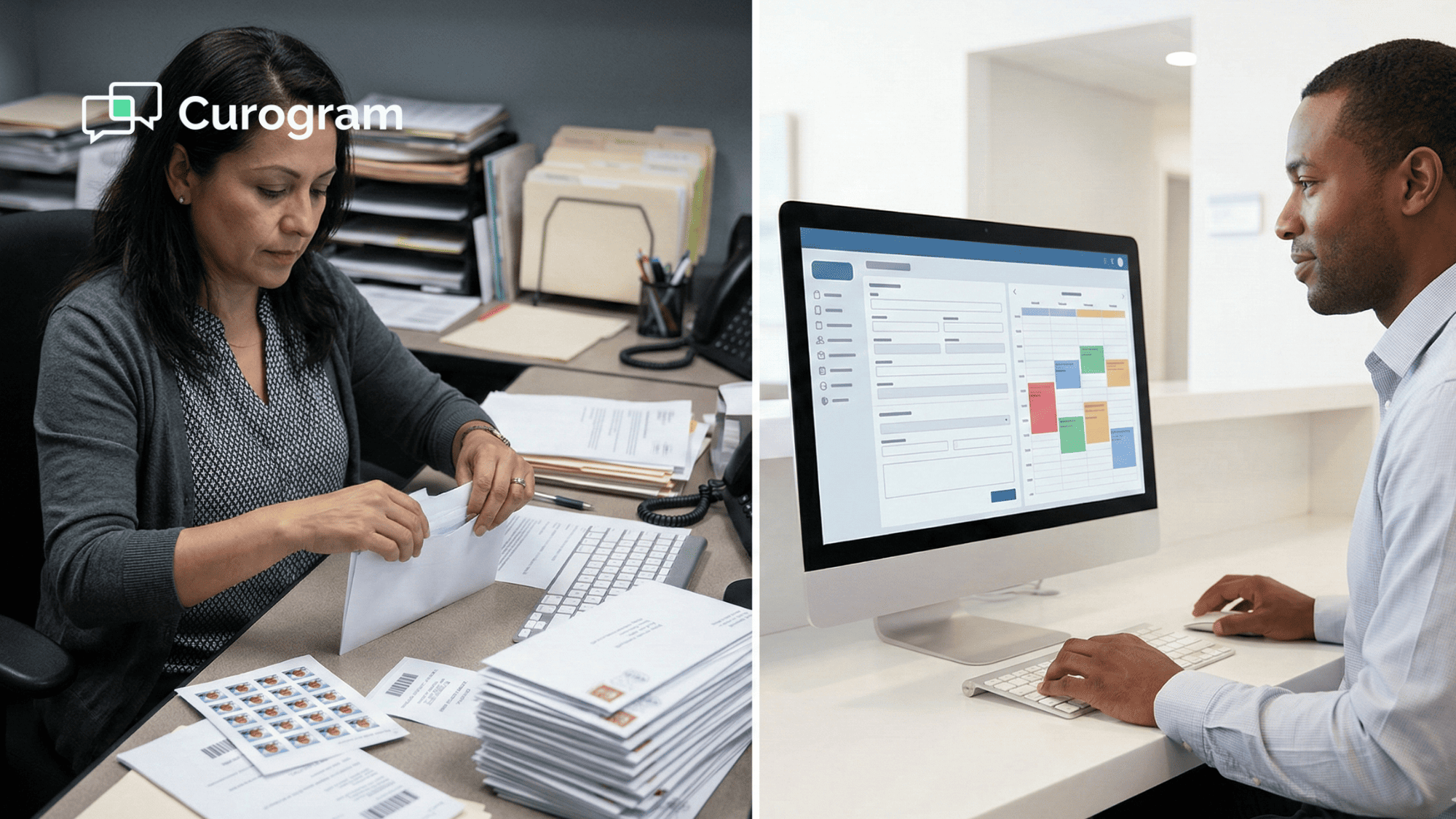
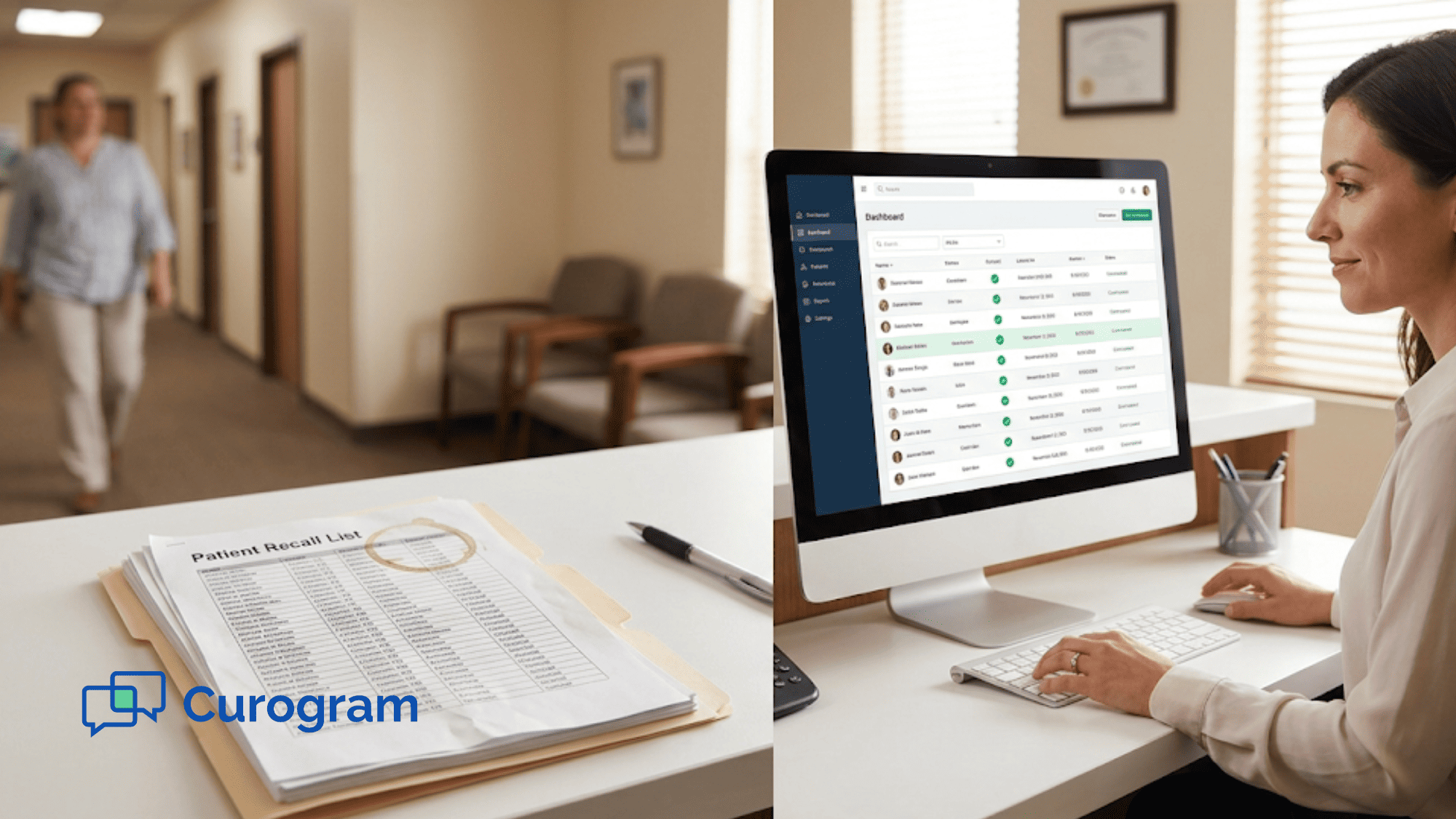
Flu season hits. Your front desk pulls a report from MD Systems. Then comes the part everyone dreads: printing labels, stuffing envelopes, and hauling a stack to the post office.
Three days later, those letters land in mailboxes. Most end up in the trash. A few patients call. Hardly anyone shows up. Sound familiar?
This is the old way of running patient recall campaigns for MD Systems. It is slow, pricey, and gives you almost nothing in return. Your staff spends hours on a task that brings in a handful of visits at best.
But here's the thing. Your patients aren't checking their mailbox for health updates. They're checking their phone. Text messages have a 98% open rate. That means when you send a flu shot reminder by text, almost every patient will see it.
With the right tool, you can turn that same MD Systems report into a mass text campaign. You skip the stamps. You skip the wait. You reach 500 patients in about five minutes, not three weeks.
That's what this article is about. We'll show you how to ditch the snail mail approach, launch fast digital recalls, and fill your schedule with high-value visits like annual wellness exams and chronic care follow-ups.
Based on our internal research, practices that switch to text-based recalls see 35% of contacted patients book within the first month. One clinic alone brought in 1,240 visits from recall messages.
If your practice still relies on postcards and printed letters, you're leaving both money and patient health on the table. Let's walk through a better way.
The Villain: The "Snail Mail" Recall
Let's paint the picture. It's October. Flu season is picking up, and your clinic wants to remind patients to come in for their shots. Your office manager runs a report in MD Systems, pulls a list of 500 patients over age 65, and exports it to Excel.
|
Now the real work starts: Someone has to print 500 mailing labels. Someone else stuffs and seals 500 envelopes. Then there's the cost: at today's postage rates, you're looking at around $300 just in stamps. Add in paper, ink, and envelope costs, and you're well past $400 for a single campaign. |
And that's before a single patient even sees the letter. The letters go out. They arrive two to three days later, if nothing goes wrong with the mail. But think about what happens next.
Your patients pull them from the mailbox right next to pizza coupons and credit card offers. Most people toss anything that looks like junk mail without reading it.
Let's say you're lucky and 10% of patients open the letter. That's 50 people out of 500. Of those 50, maybe 15 actually call to book. That's a 3% return on your full effort and spend. Here's what that looks like side by side:
| Metric | Snail Mail Recall | Digital Text Recall |
| Time to launch | 3–5 days | 5 minutes |
| Cost per 500 patients | $400+ (postage, print, labor) | Near $0 (included in plan) |
| Delivery speed | 2–3 days | Instant |
| Open rate | ~10% (estimated) | 98% |
| Staff hours needed | 4–8 hours | Under 10 minutes |
| Patient response | Handful of calls | Dozens of bookings |
The gap is massive. And it's not just the cost. It's the lost time. Think about what your front desk could do with those four to eight hours.
They could be taking calls, checking in patients, or handling billing. Instead, they're folding paper and licking stamps for a campaign that barely moves the needle.
There's also the timing problem. MD Systems patient outreach by mail is always behind. By the time the letter lands, a week may have passed since you ran the report. Patients who were free last Tuesday now have plans. The window to catch them is gone.
Worse, mail-based recalls are one-way. There's no easy way for the patient to act on it. They have to find your phone number, call during office hours, wait on hold, and then schedule. Most won't bother.
Now, consider this from the patient's point of view. They get a letter that says, "It's time for your annual checkup." There's no link to click. No way to book at 9 PM from the couch. Just a phone number and a hope that they'll remember to call during your business hours.
This is the core problem with traditional recall methods. They ask too much of the patient and give too little in return. The message is fine. The delivery method is the villain.
And it's not just flu shot reminders that suffer. Chronic care management recalls for diabetes follow-ups, blood pressure checks, and lab work face the same issues. Every mailed letter has the same low odds of getting read, let alone acted on.
If your practice has been doing it this way for years, you might think this is just how it works. But it's not. Practices that switch to digital recalls see a night-and-day shift in patient response, and they get their staff time back. The snail mail recall had its moment. That moment has passed.
The Guide: The 5-Minute Blast
So what does the better way look like? It starts and ends with one idea: send the letter straight to their pocket.
Instead of printing, mailing, and waiting, your team uses Curogram to pull patient data from MD Systems and send targeted text blasts in minutes. No exports to Excel. No trips to the post office. No guessing if anyone got the message.
|
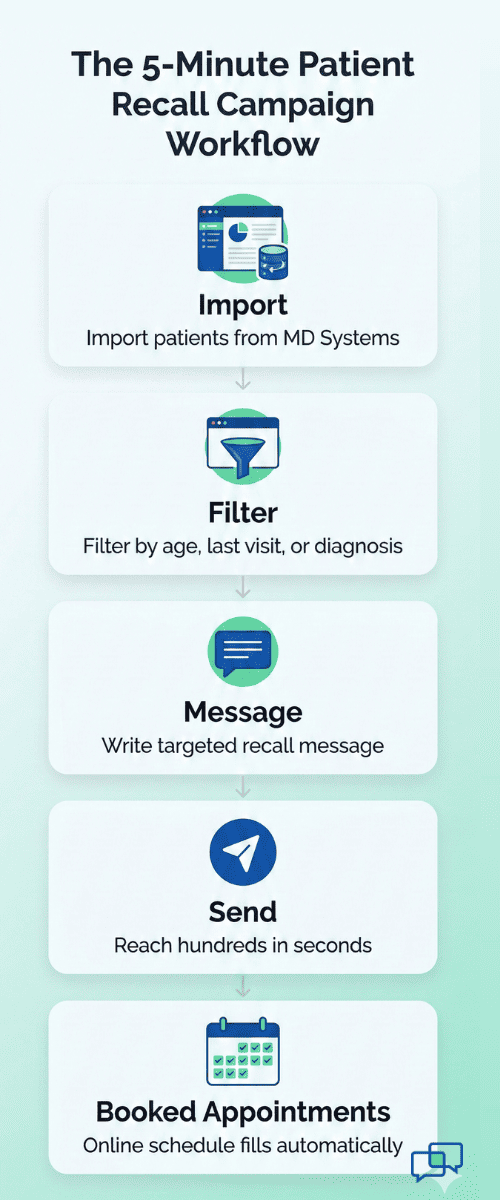
Here's the step-by-step workflow: Step 1: Import from MD Systems Open Curogram and choose "Import from MD Systems." The system pulls in your patient list with all the data fields you need, like age, last visit date, and diagnosis codes. Step 2: Filter your list Want to reach all patients over age 65 for flu shots? Set the filter to "Age > 65." Need to recall patients who haven't been seen in over a year? Filter by "Last Visit > 1 Year." You can also filter by diagnosis code to target patients due for chronic care management recalls, like those with diabetes or high blood pressure. Step 3: Write your message Type a short, clear text. For example: Step 4: Hit send That's it. You reach your entire list at once. Five hundred patients. Five minutes. Done. Let's compare that to the old process: With snail mail, it takes your team half a day just to prep the mailers. With Curogram, the whole campaign fits in a coffee break. The speed gap isn't small. It's a total shift. |
And this isn't just fast. It's smart. Because you're pulling real data from MD Systems, your outreach is already targeted. You're not sending flu shot reminders to a 25-year-old who was in last week. You're reaching the right patients with the right message at the right time.
This is what makes it true automated medical marketing. The system does the heavy lifting. Your staff just picks the filter, types the message, and clicks send.
|
Here's an example of how this might play out in a real clinic: Say, your practice has 2,000 active patients. You run a filter for everyone who hasn't had a visit in over 12 months. That returns 400 names. You send them all a text that says, "We miss you! It's time for a checkup. Click to book." Within 48 hours, based on our internal data, you could see 140 or more of those patients book a visit. That's 35% of the list, returning to your care because of a five-minute task. |
Now, think about doing this once a month. You could run a flu shot drive in October. A wellness visit recall in January. A diabetes screening push in March. Each one takes five minutes and fills slots that would have sat empty.
The 5-minute blast also works for preventative care text messages beyond the basics. You can remind patients about cancer screenings, eye exams, or lab work that's overdue. Any data point in MD Systems can power a recall.
The key idea here is simple. The message hasn't changed. You still want patients to come in for care. The delivery method is what changes everything.
When the message lands on a phone instead of in a mailbox, patients act on it. And when the process takes five minutes instead of five days, your staff can run campaigns on a regular basis without burning out.

The Success: Instant Action
So what happens after you hit "send" on that 5-minute recall blast? This is where the real magic shows up.
|
Let's start with the numbers: Text messages have a 98% open rate. Compare that to email (around 20%) or direct mail (which often falls below 10%). When you send a recall text to 500 patients, roughly 490 of them will read it. Most will open it within three minutes of getting it. |
That alone puts you miles ahead of any mail-based campaign. But opens are just the start. What matters is what patients do next.
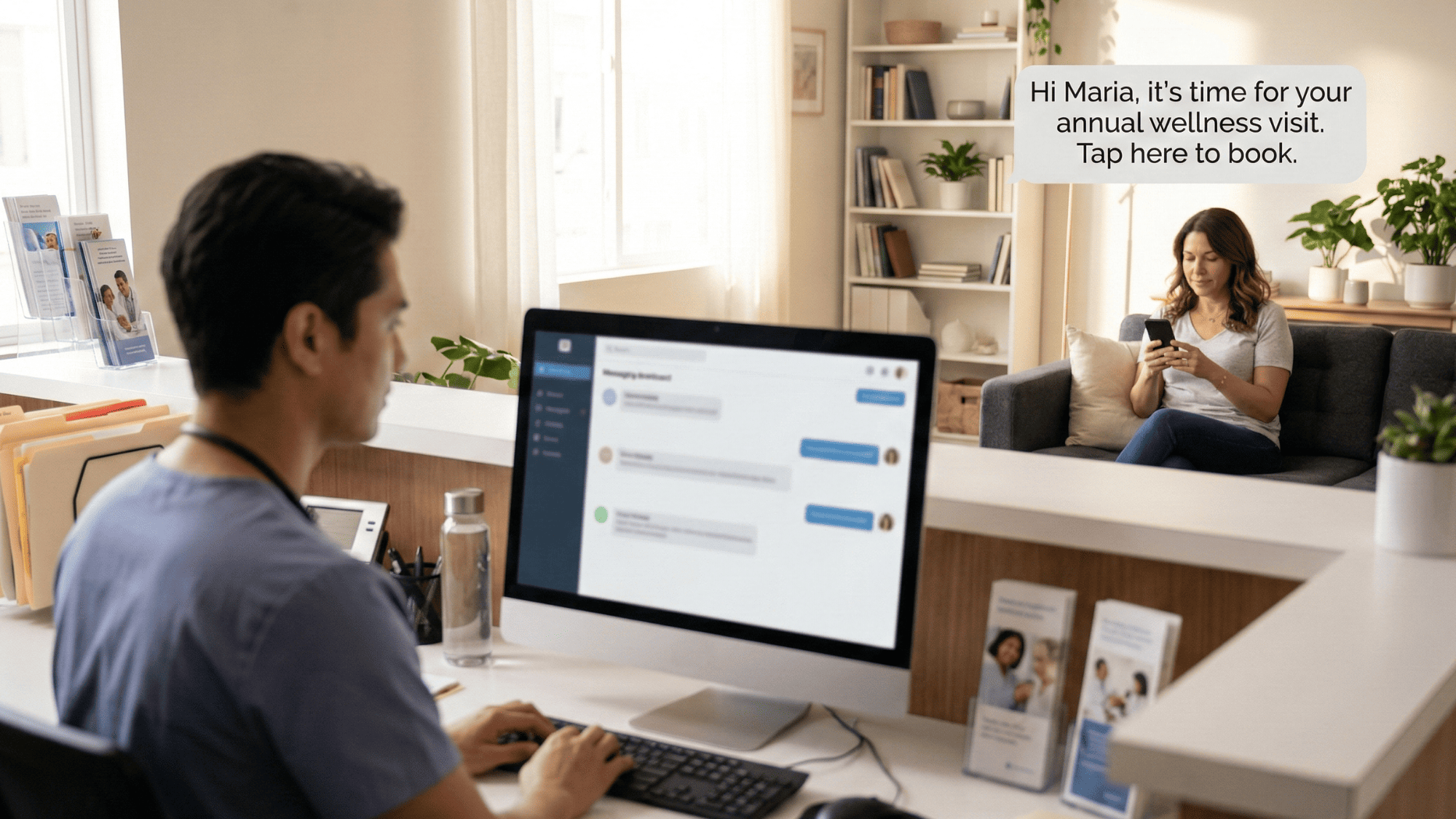
Because your text includes a direct booking link, patients can schedule right from their phone. They don't have to call. They don't have to wait on hold. They tap the link, pick a time that works, and they're booked.
This is especially powerful after hours. A patient gets your text at 8 PM, taps the link, and books a 10 AM slot for tomorrow. No phone call needed. No extra work for your staff. Your phone doesn't just ring. Your schedule fills up on its own.
Based on our internal data, 35% of patients who receive a recall text through Curogram end up booking an appointment within one month. For one multi-location practice, that meant 1,240 patients were seen from recall messages alone.
These weren't new patients from ads. They were existing patients who just needed a nudge to come back in.
|
Let's break down the real-world impact with a simple example: Say, you run a recall campaign for annual wellness visits. You filter MD Systems for patients over 65 who haven't been in for more than a year. You get a list of 300 patients. You send the text. Within 30 days, about 105 of those patients book. Now, each Annual Wellness Visit (AWV) can bring in around $200 to $300 in revenue, depending on your payer mix. At the low end, 105 visits at $200 each brings in $21,000. At the high end, that's $31,500. All from a single campaign that took five minutes and cost you nothing extra. |
Here's a quick look at how the revenue can add up across just a few campaigns per year:
| Campaign Type | Patients Texted | Bookings (35%) | Revenue per Visit | Total Revenue |
| Annual Wellness (Q1) | 300 | 105 | $200 | $21,000 |
| Flu Shot Drive (Q4) | 500 | 175 | $40 | $7,000 |
| Diabetes Follow-Up (Q2) | 200 | 70 | $150 | $10,500 |
| Blood Pressure Check (Q3) | 250 | 88 | $100 | $8,800 |
| Yearly Total | 1,250 | 438 | — | $47,300 |
That's nearly $47,000 in found revenue from four short text campaigns. And that's a careful estimate. Some practices run monthly campaigns and see much higher totals.
The return on investment here is hard to ignore.
There's no postage cost. No print cost. No extra staff hours. Curogram plans often include unlimited texting, so the campaign doesn't cost extra like mailing does. The ROI is close to pure profit.
But it's not just about money. It's about patient health. Every patient who comes in for a flu shot, a wellness check, or a chronic care visit is getting care they might have skipped. Think about the patient with diabetes who hasn't been seen in 14 months.
A recall text brings them back in for a blood sugar check. That simple visit could catch a problem early and prevent a trip to the ER later.
This is what preventative care text messages are really about. They don't just fill your schedule. They close gaps in care. They bring patients back before small problems become big ones.
And then there's the ripple effect. When a patient comes in for a recall visit, they often book follow-up care. A wellness visit turns into a referral to a specialist. A flu shot visit leads to a chat about a new symptom. That one recall text can spark a chain of care events that serves the patient and the practice.

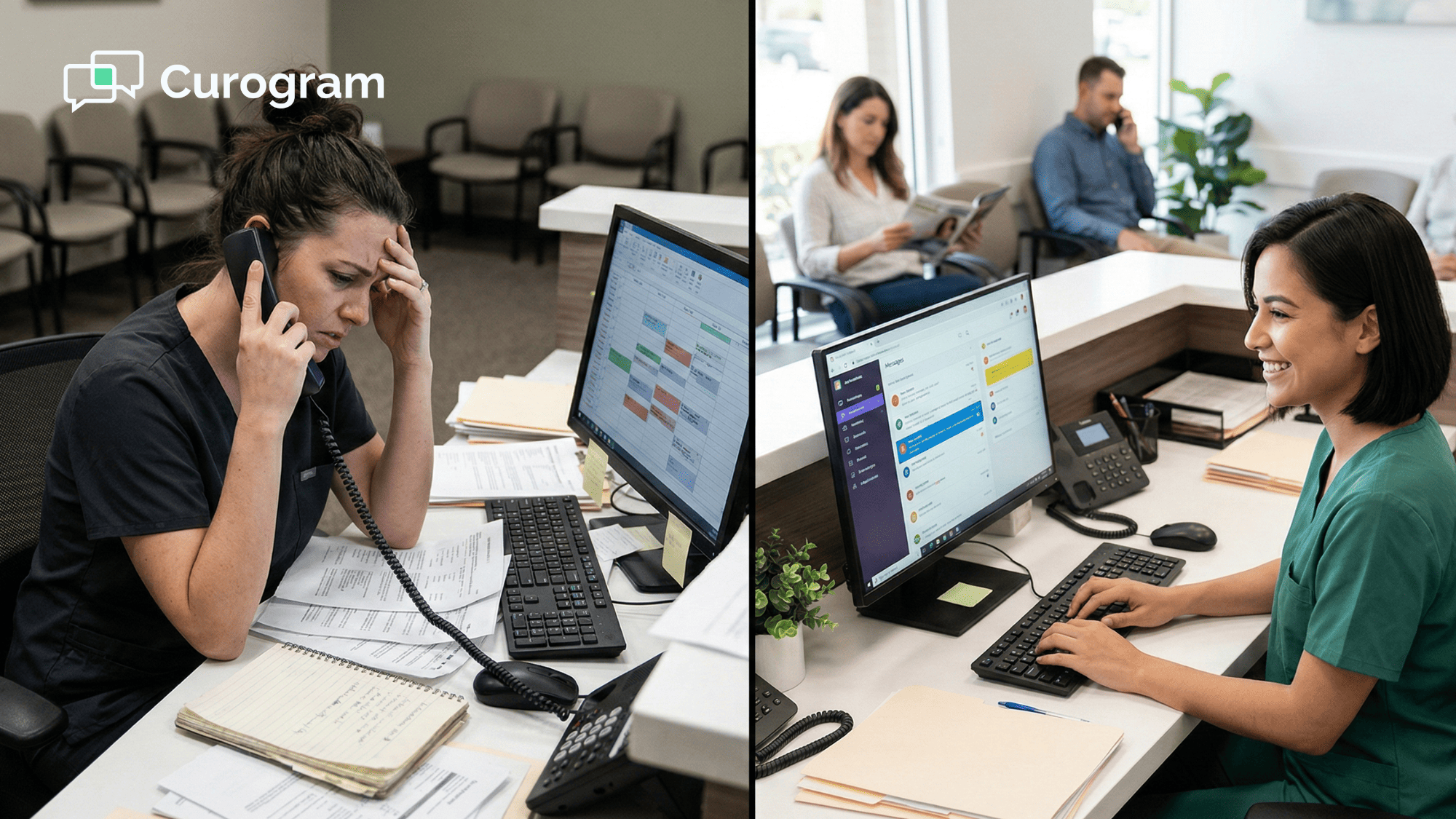
Let's also talk about what this means for staff morale. When your front desk isn't drowning in label printing and envelope stuffing, they can focus on patient care. They answer phones faster. They greet patients with less stress. The clinic runs smoother.
One thing worth noting: the results get better the more you use this system.
Your first campaign might feel like a test. By the third or fourth, your team has a rhythm. They know how to filter the list, write the message, and launch in under five minutes. It becomes part of the weekly routine, not a yearly chore.
And patients start to expect it. They get used to getting helpful texts from your clinic. Instead of seeing your name and thinking "spam," they think "oh, I need to book that." Over time, your MD Systems patient outreach becomes a trusted channel, not background noise.
Compare that to the snail mail approach, where patients barely notice your clinic exists between visits. Digital recalls keep you top of mind without being pushy.
The bottom line is this: instant delivery leads to instant action. When you put the right message in front of the right patient at the right time, and make it easy to act on, people respond. Your schedule fills. Your revenue grows. Your patients get healthier. And it all starts with a five-minute campaign.
Filling the Gap Between Visits
Most practices think of revenue and patient care as two separate goals. Recall campaigns prove they're the same thing.
When a patient misses a follow-up, two things happen. Their health suffers because they go without needed care. And your practice loses the visit revenue. Patient recall campaigns for MD Systems solve both problems at once.
Consider a typical primary care office with 3,000 active patients. Based on our internal research, up to 40% of patients fall off schedule each year. That means over 1,000 patients are overdue for something, whether it's a flu shot, a blood pressure check, or a diabetes follow-up.
If those 1,000 patients never come back, that's lost revenue sitting in your own database. It's also 1,000 patients whose chronic conditions may get worse because no one reached out.
This is why digital recalls aren't just a nice-to-have. They're a core part of running a healthy practice. When you send preventative care text messages on a regular cycle, you shrink the gap between visits. Patients stay on track. Problems get caught early. And your schedule stays full.
There's a clinical side to this, too. The CDC has long stressed the importance of outreach to improve things like vaccination rates.
Flu shot reminders sent by text make it simple for patients to take action. They don't need to remember on their own. Your practice does the reminding, and the patient just clicks a link.
For chronic care management recalls, the stakes are even higher. A patient with diabetes who falls off their check-up schedule may end up in the ER six months later. That ER visit costs the system thousands of dollars and puts the patient at risk. A $0 text message could have prevented it.
How Curogram Turns Your MD Systems Data Into a Patient Recall Engine
Curogram was built to work with the tools your practice already uses. It connects to MD Systems so your patient data flows in without manual uploads, CSV exports, or copy-paste headaches.
Your team opens Curogram, selects "Import from MD Systems," and applies the filters they need. Want to reach every patient over 65 who hasn't had a flu shot this year? Done in two clicks.
Need to message patients with a certain diagnosis code who are overdue for a follow-up? That's two more clicks.
The message goes out as a text, not a letter. It lands on the patient's phone in seconds. If you include a booking link, they can schedule on the spot. Based on our internal data, this workflow helped one multi-location practice bring back 1,240 patients from recall texts alone.
Curogram also manages opt-outs for you. If a patient replies "STOP," they're removed from future texts right away. This keeps your practice in line with anti-spam rules without your staff having to track anything by hand.
You can attach files to your texts, too. Need to send a flu shot consent form before the patient arrives? Attach the PDF. Want to include a clinic flyer with your hours and address? Drop it in. The patient gets the info and the action step in one message.
And because Curogram syncs with MD Systems in real time, your lists stay current. You'll never text a patient who was just seen last week. That keeps your outreach sharp and your patients happy.
It's patient outreach that runs on your data, works in your workflow, and takes almost no time.
Conclusion: Proactive Care Made Simple
Waiting for patients to get sick before you see them is not a strategy. It's a gamble. And it's one that costs your practice money and puts your patients at risk.
Patient recall campaigns for MD Systems flip the script. Instead of hoping patients remember to call, you reach out first. A short text. A booking link. Five minutes of your staff's time. That's all it takes to bring dozens of patients back into your care.
We've covered the problem: snail mail is slow, costly, and easy to ignore. We've shown the fix: pull your MD Systems data into Curogram, filter your list, and send targeted texts.
And we've seen the results: 35% booking rates, thousands in found revenue, and better health outcomes for your patient panel.
The practices that win in today's market are the ones that stay in touch with their patients between visits. They send flu shot reminders before flu season peaks. They send wellness check texts before a full year passes. They run chronic care management recalls before small issues snowball.
None of this takes hours. It takes minutes. If your office is still stuffing envelopes and buying stamps, you're spending more and getting less. Every week you wait is another week of missed visits and lost revenue.
Stop mailing and start texting. Schedule a quick demo now to see how Curogram filters your MD Systems data and turns it into a recall engine that fills your schedule.
Frequently Asked Questions
Curogram manages opt-outs for you and keeps messages within HIPAA guidelines. As a provider reaching existing patients about their care, your texts fall under healthcare operations, but best practices are built in.
Flu shot drives, annual wellness visit reminders, chronic care follow-ups, and overdue lab work recalls perform well. Any data field in MD Systems can power a targeted campaign.
Based on our internal data, about 35% of patients who receive a recall text book within one month. Many respond within the first 48 hours, especially when the text includes a direct booking link.