Broadcast Messaging for Cerbo: Scaling Community via Bulk SMS
💡 Broadcast messaging for Cerbo lets integrative and functional medicine practices send bulk SMS to their entire patient base at once. SMS has a...
12 min read
Mira Gwehn Revilla
:
March 3, 2026
It's 2:47 PM on a Tuesday. A patient just canceled their 3:30 slot. Your front desk picks up the phone and starts dialing. No answer. Voicemail. No answer again. By 3:30, that slot is dead — and so is the revenue it could have brought in. This scene plays out in clinics every single day. And it doesn't have to.
Mass patient texting for MD Systems clinics lets you fill last-minute gaps in under 10 minutes. Instead of calling patients one by one, you send a single text to your entire waitlist. The first person to reply gets the spot. Done.
Here's how it works. Curogram syncs with your MD Systems patient database. Your staff filters by criteria like last visit date or provider name. Then they send one bulk SMS to every matching patient. No more wasted time. No more dead air on the phone.
But this isn't just about filling same-day holes. It's about turning your patient database into a tool that drives revenue on demand. Think of it as MD Systems patient outreach on autopilot. Need to fill a flu shot clinic? Send a blast. Have 10 open slots next week? Text your recall list.
Based on our internal data, 35% of patients who receive an SMS recall book an appointment within a month. One multi-location practice brought back 1,240 patients from recall messages alone.
çYour schedule doesn't have to be at the mercy of no-shows and last-minute cancellations. This article will show you exactly how to take control — step by step.
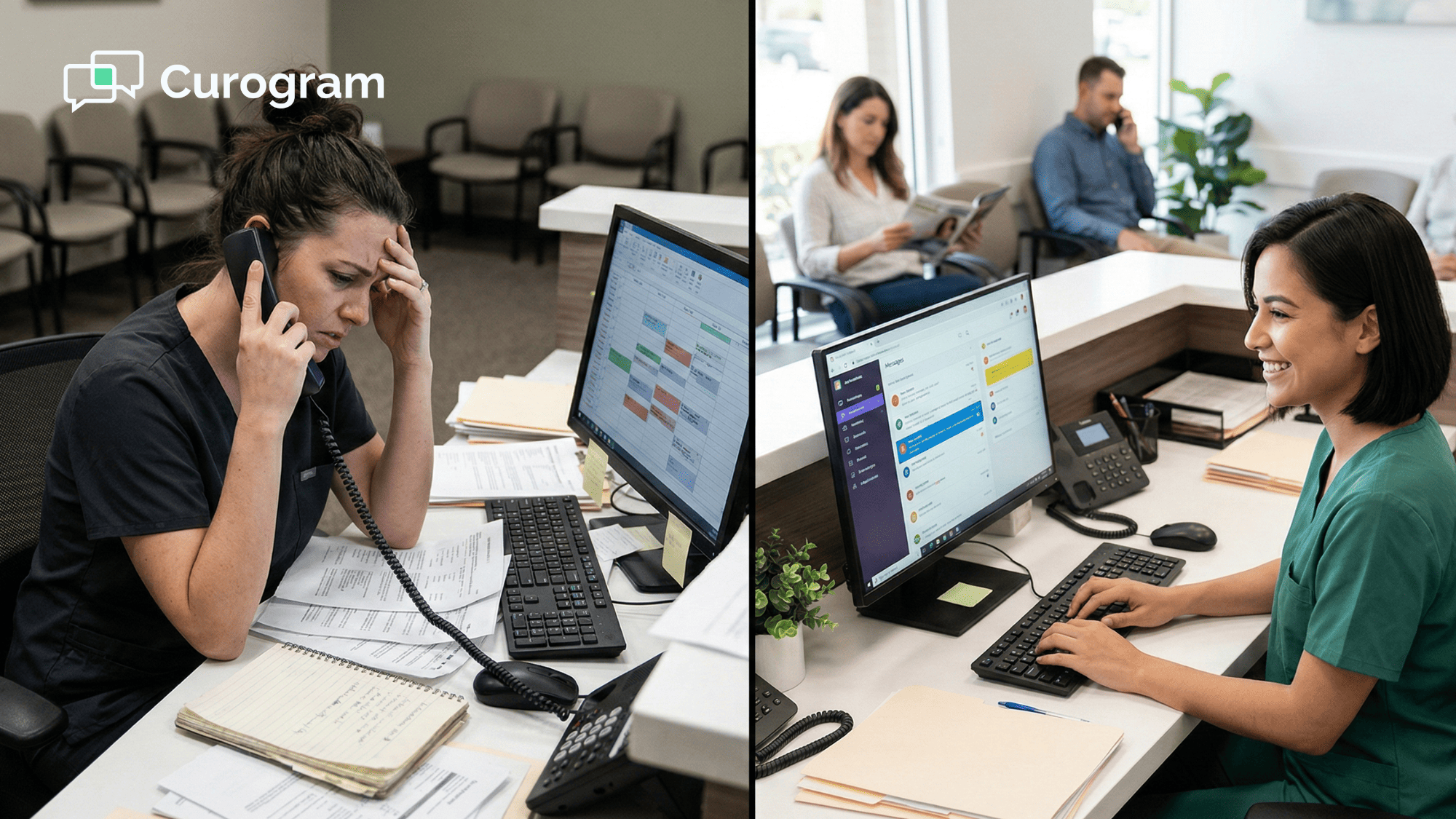
Most clinics run on what we call a "passive schedule." They book patients weeks in advance and then just… wait. If someone shows up, great. If they don't, that time slot vanishes. The revenue is gone forever. Let's paint a picture of what this looks like in real life:
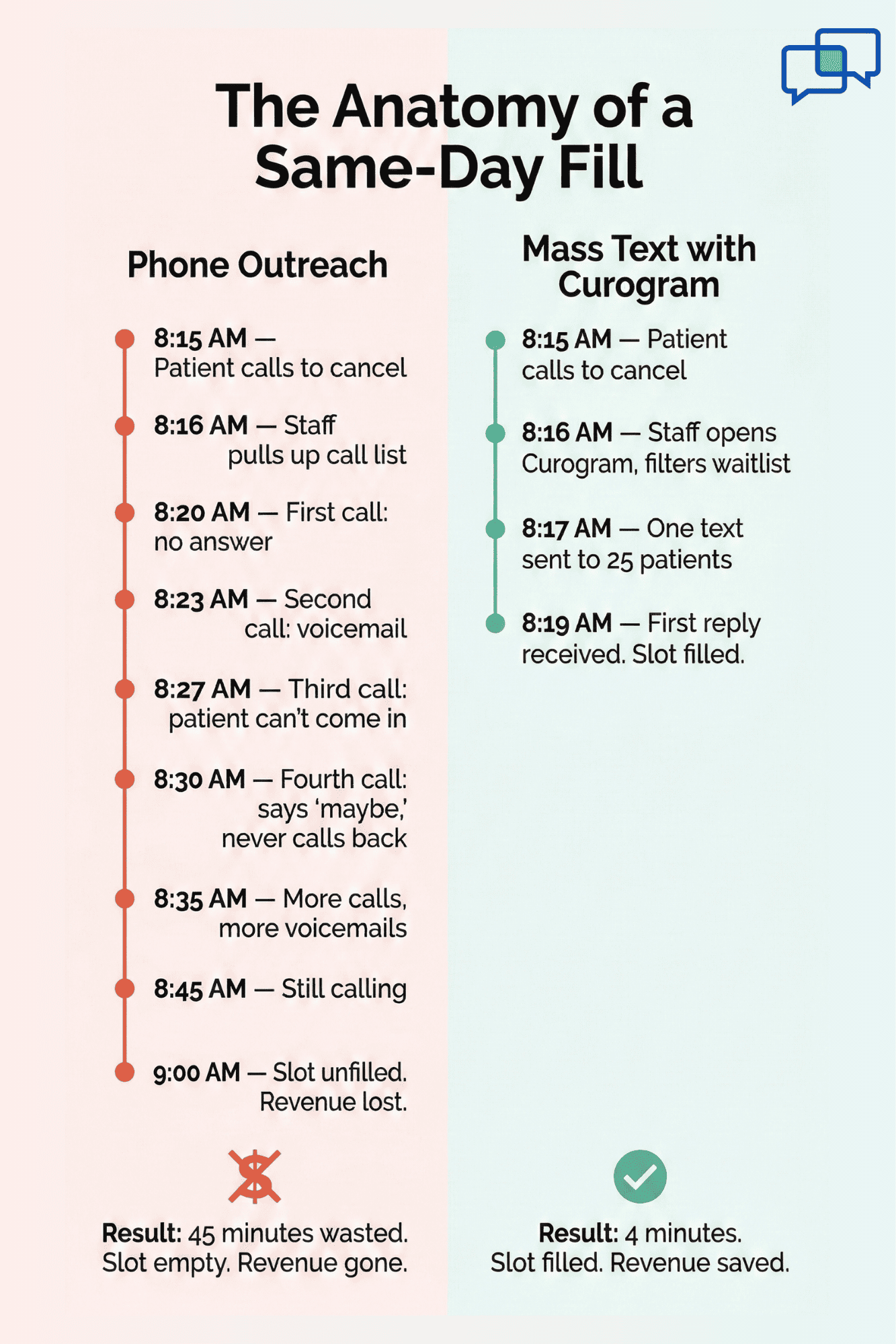
It's 10:00 AM. A patient calls to cancel their 2:00 PM visit. Your front desk now has four hours to fill a one-hour gap. Sounds like plenty of time, right?
Not really. Your staff pulls up a list of patients who might want that slot. They start calling. The first patient doesn't pick up. The second one goes to voicemail. The third answers but can't come in today. The fourth says maybe, but never calls back.
By 1:45 PM, no one has claimed the slot. The doctor sits idle for an hour. That's an hour of payroll with zero return.
Now, multiply that by three or four times a week. Over a month, a single provider could lose 12 to 16 hours of billable time. If the average visit brings in $150 to $200, that's $1,800 to $3,200 in reactive lost revenue — from just one provider.
Here's the hard truth: Phone calls are a terrible way to fill same-day openings. People don't answer calls from unknown numbers. Even when they do, the back-and-forth eats up staff time.
Think about it this way. Your front desk person makes 15 calls. Each call takes about 2 minutes, counting the dial, the wait, and the voicemail. That's 30 minutes of work — just to fill one slot. And most of the time, it doesn't even work.
Meanwhile, that same staff member could be checking in patients, handling intake forms, or answering the phones that are actually ringing. The manual call-down method doesn't just fail to fill slots. It pulls your team away from the work they're already doing.
Here's what makes this problem so painful: provider time is perishable. You can't save it. You can't roll it over. Once that 2:00 PM slot passes, the money is gone.
This isn't like retail, where unsold stock sits on a shelf. In a medical practice, every open slot that goes unfilled is a direct hit to your bottom line.
And the worst part? Your patient database has dozens — maybe hundreds — of people who would have taken that slot. You just couldn't reach them fast enough.
| Scenario | Phone Outreach | Mass Text Outreach |
| Time to reach 20 patients | 40+ minutes | Under 1 minute |
| Average response rate | Low (most don't answer) | High (texts have 98% open rate) |
| Staff time used | 30–40 minutes per slot | 2–3 minutes per slot |
| Slot fill success | Rare | Frequent |
The passive schedule puts your practice in a cycle. You lose a slot, scramble to fill it, fail, and move on. Then it happens again the next day. And the next.
If you run your practice on MD Systems, you already have a goldmine of patient data. Names, phone numbers, visit history, provider assignments — it's all in there. The problem isn't the data. The problem is that most clinics never use it in real time.
Bulk SMS for medical practices changes this completely. Instead of letting your database sit idle, you put it to work the moment a slot opens up. You stop waiting and start acting. That shift — from passive to active — is the single biggest change a clinic can make to protect its revenue.
So the passive schedule is the villain. What's the fix? Simple: stop calling patients one at a time. Text them all at once.
Think of Curogram as your clinic's broadcasting station. When a slot opens up, you don't dial 20 numbers. You send one message to 20 people — or 50, or 100. The first person to reply claims the spot. Everyone else gets a polite auto-reply letting them know it's been taken.
Here's how the workflow breaks down, step by step:
Open Curogram's dashboard. It pulls patient data straight from your MD Systems database, so you're always working with real-time info. From there, you pick your filter.
For example, say you need to fill a 2:00 PM slot with Dr. Smith. You could filter by patients who have seen Dr. Smith in the past year, are due for a follow-up, or are already on your waitlist.
The filters are flexible. You can sort by age, last visit date, provider, or even appointment type. This step takes about 30 seconds.
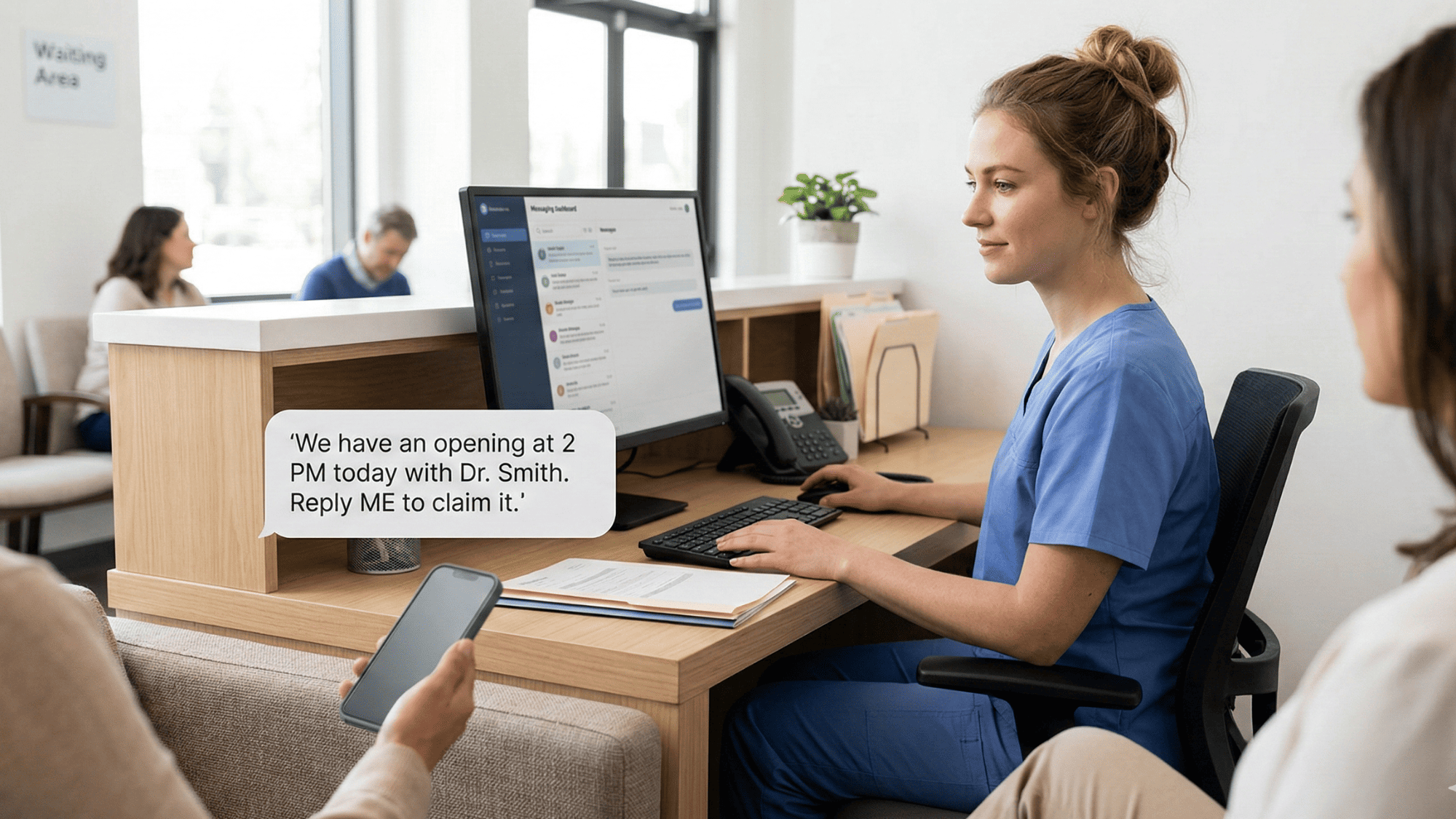
Keep it short and clear. Something like:
"Hi! We have a sudden opening at 2 PM today with Dr. Smith. Text 'ME' to claim it."
That's it. No long email. No phone tree. Just a quick, direct text that tells the patient exactly what to do.
Curogram stores templates so your staff doesn't have to write a new message each time. They pick a template, tweak the time and provider name, and move on.
One click. The message goes out to your filtered list — all at the same time. Whether it's 15 patients or 150, the process takes the same amount of time: a few seconds.
Your staff doesn't need to hit "send" on each message one by one. Curogram sends the entire batch as a single broadcast. The system also tracks which messages were delivered and which bounced.
So if a patient has a bad number on file, you'll know right away. No guessing, no wasted effort — just clean, fast outreach that reaches the right people at the right time.
This is the part that makes it work so well. The first patient who texts back "ME" gets the slot. Curogram can send an auto-reply to the rest: "Thanks for your interest — that slot has been filled. We'll let you know when the next one opens up."
|
Now, let's say your clinic has a Monday morning cancellation at 9:00 AM. Here's the timeline:
Total staff time: about 3 minutes Compare that to 30+ minutes of phone calls that may or may not work. |
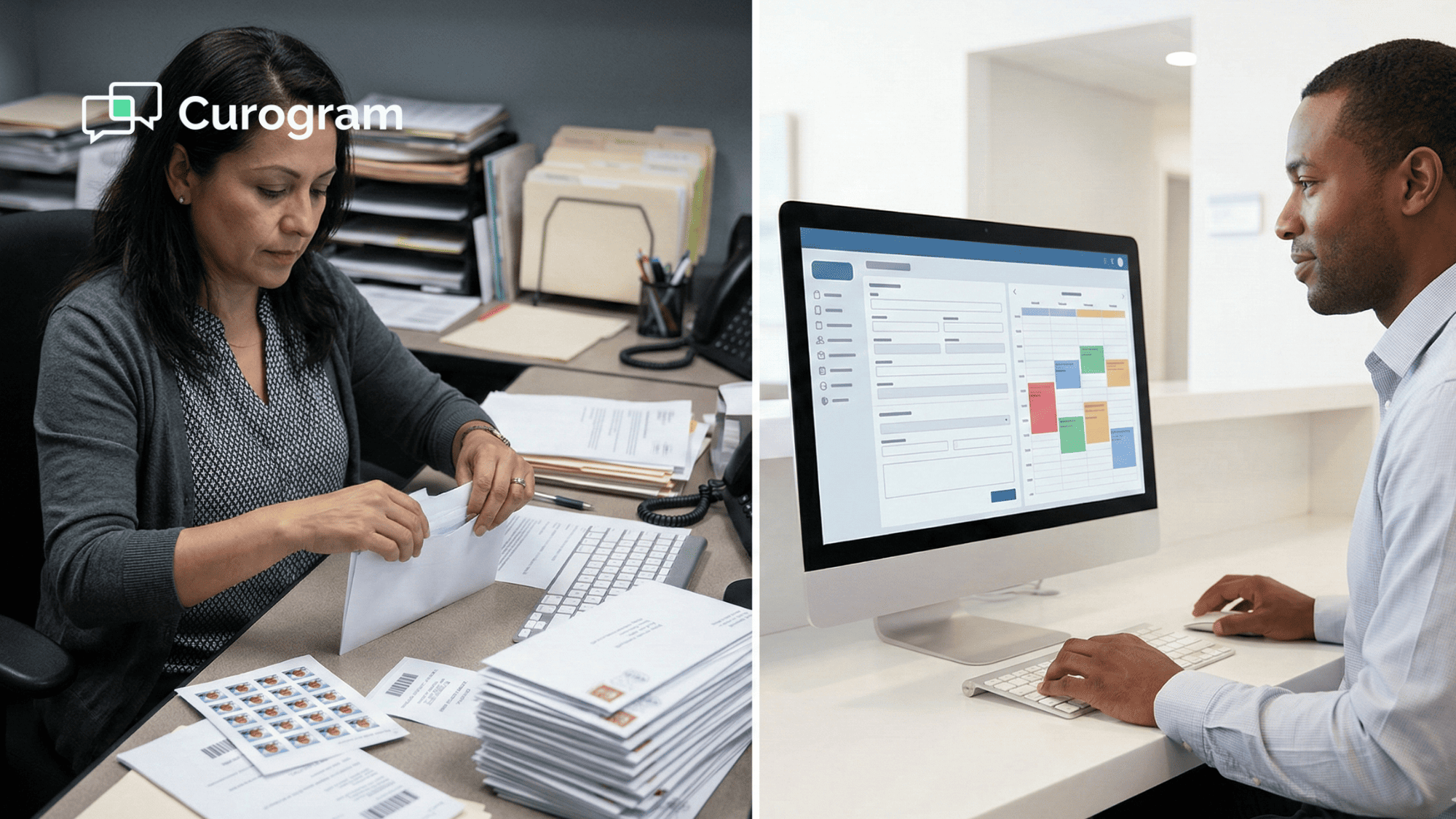
This workflow isn't just for emergencies. You can also use it for planned campaigns. Patient recall software for MD Systems makes it easy to bring back patients who are overdue for care.
For example, say flu shot season is coming up. You filter your database for patients over 65 who haven't had a flu shot this year. Then you send a simple message: "Flu shot season is here. Click the link below to book your visit."
Or maybe you have a new provider joining the team and need to build their schedule fast. You send a text to patients who haven't been seen in 6+ months: "We have new openings with Dr. Lee. Book your visit today."
This is what MD Systems patient outreach looks like when it's proactive instead of passive. Your database stops being a static record. It becomes a tool that creates revenue on demand.

So what happens when you move from phone calls to mass texting? The short answer: you make more money and waste less time. But let's break that down with real numbers and real scenarios.
Most clinics that rely on phone outreach fill fewer than 10% of same-day cancellations. That means 9 out of 10 open slots go empty. The provider waits. The revenue disappears.
Practices that use mass texting flip that number. Based on our internal research, clinics using Curogram's text broadcast feature fill the vast majority of last-minute openings. When you can reach 20 to 50 patients in under a minute, the odds of someone saying "yes" go way up.
Let's do some quick math: Say your clinic sees one cancellation per day. The average visit brings in $175. Over a month, that's about 22 lost slots — or $3,850 in potential revenue. If phone calls fill 10% of those, you recover $385. If mass texting fills 85%, you recover $3,272.
| Phone Calls | Mass Texting | |
| Cancellations per month | 22 | 22 |
| Fill rate | ~10% | ~85% |
| Slots recovered | 2 | 19 |
| Revenue per visit | $175 | $175 |
| Revenue recovered | $350 | $3,325 |
| Monthly difference: | +$2,975 | |
That's nearly $3,000 more per provider, per month. For a clinic with three providers, that adds up to almost $9,000. Over a year, that's over $100,000 in revenue that would have been lost to the passive schedule.
Filling same-day gaps is just the start. The bigger win comes from patient reactivation — bringing back people who fell off your schedule.
Every clinic has patients who came in once or twice and then stopped booking. Maybe they moved. Maybe they got busy. Maybe they simply forgot. Whatever the reason, these patients are still in your MD Systems database. And most of them are still in your area. This is where patient recall software for MD Systems really shines.
Based on our internal data, 35% of patients who receive a recall text schedule within a month. One multi-location practice sent SMS recall messages to patients who hadn't booked follow-ups in time. The result? 1,240 patients came back from those messages alone.
Let's put that in dollar terms: If each visit brings in $175, those 1,240 visits equal $217,000 in revenue. From a text message campaign.
Here's a look at what a single recall campaign can do:
| Campaign Type | Audience | Message | Expected Outcome |
| Flu Shot Recall | Patients 65+, no flu shot this year | "Flu shot season is here. Book now." | 25–35% booking rate |
| Annual Checkup | Patients not seen in 12+ months | "You're due for a checkup. We have openings this week." | 20–30% booking rate |
| Post-Procedure Follow-Up | Patients who had a procedure 3+ months ago | "Time for your follow-up. Text us to schedule." | 30–40% booking rate |
| New Provider Launch | All active patients | "Meet Dr. Lee — now accepting patients." | Fills new provider's schedule fast |
Each one of these campaigns takes minutes to set up and costs almost nothing to send.
Let's zoom out and look at the full picture. What's the return on investment for a clinic that runs two or three text campaigns a month.
Consider a practice with 2,000 active patients in its MD Systems database: Each month, they run one same-day fill campaign per week (about 4 per month) and one recall campaign.
Here's a rough picture of what that looks like:
Same-day fills: 4 campaigns × 5 recovered slots = 20 visits × $175 = $3,500/month
Recall campaign: 200 messages sent × 35% response rate = 70 visits × $175 = $12,250/month
Total monthly revenue added: ~$15,750
Annual impact: ~$189,000
And the cost? Curogram's plans run around $200 to $400 per month. That's a return of 30x to 70x on your investment. Very few tools in healthcare deliver that kind of ROI.
The Ripple Effect
Revenue is the most obvious benefit. But there are others that add up over time:
Staff Time - When your team isn't burning 30 minutes on phone calls for every cancellation, they can focus on the patients who are actually in the office. Based on our internal research, practices using two-way texting reduce phone call volume by up to 50% and boost staff output by over 30%.
Patient Satisfaction - People prefer texts over calls. A short, friendly message feels helpful, not pushy. And when patients can book with a quick reply instead of waiting on hold, they're more likely to follow through.
Provider Morale - Doctors don't want to sit idle. When their schedule stays full, they feel productive. That matters for retention, especially in smaller clinics where every provider counts.

Here's how one Curogram client used this approach: Atlas Medical Center struggled with high no-show rates and missed revenue.
After setting up Curogram's reminder and texting system, they dropped their no-show rate from 14.20% to 4.91% in just three months — a result that was 3x better than the industry average, based on our internal data.
But they didn't stop there. By also using mass text campaigns to fill cancellations instantly, they kept their providers' schedules full. Each recovered slot fed straight into their bottom line. The practice saw a 10–20% increase in revenue, with each recovered visit adding directly to their income.
This wasn't a tech overhaul. It was a simple change in how they reached out to patients. And it made a massive difference.
Your MD Systems database holds more value than you think. Every name, phone number, and visit record is a chance to book an appointment.
Mass texting is what unlocks that value. It lets you fill cancellations instantly, bring back lapsed patients, and keep every slot on your schedule working for you.
The question isn't whether this works. The data proves it does. The question is how much revenue you're leaving on the table by not doing it yet.
Picture this. It's Monday morning. Three patients cancel before lunch. Your front desk starts dialing. By noon, they've made 45 calls. Two people picked up. Neither could come in. All three slots stayed empty.
That's $525 gone — just from one morning. And your staff just lost an hour they could have spent on the patients already in your lobby.
Now, picture the same Monday with mass texting. A patient cancels at 9:00 AM. Your staff opens the dashboard, filters 30 waitlist patients, and sends one text. By 9:04 AM, someone replies. Slot filled. Total effort: three minutes.
Do that three times a day, five days a week, and you're recovering 15 slots that would have died on the vine. At $175 per visit, that's $2,625 a week your practice keeps instead of loses.
But the real power shows up when you use it beyond emergencies. Flu season hits and you have 500 patients over 65 in your database. One text blast. Within a week, 150 of them book. That's a full week of provider time — filled from a single campaign that took five minutes to send.
Every week you rely on phone calls is another week of dead slots, wasted staff hours, and money walking out the door. The patients are there.
They want to come in. They just need you to ask them — the right way, at the right time, through the right channel.
Mass texting is that channel. And the gap between clinics using it and clinics still dialing only gets wider.
How Curogram Powers Mass Texting for MD Systems Clinics
Curogram was built for clinics like yours — busy, lean, and running on MD Systems. It lives inside your workflow. Curogram syncs directly with your MD Systems database. That means no CSV uploads, no copy-pasting phone numbers, and no switching between platforms. Your patient list is always up to date and ready to use.
It gives your staff real filters. Want to text only patients who saw Dr. Smith in the last 6 months? Done. Want to reach patients over 50 who are due for a screening? Two clicks. The filters pull from the data already in MD Systems, so you don't have to build lists from scratch.
It handles replies for you. When you send a broadcast, replies flow into the Curogram dashboard — not your phone lines.
Staff can manage hundreds of text replies in minutes without picking up a handset. The first person to claim a slot gets it. Everyone else gets a polite auto-reply.
It keeps you compliant. Every message goes through a HIPAA-compliant platform. Opt-outs are managed on their own. You're texting patients who have consented to hear from you — no spam, no risk.
Curogram does more than fill cancellations. Beyond same-day slots, you can run recall campaigns, send review requests, collect intake forms, and even process payments — all through text. It's a full MD Systems patient outreach platform, not just a one-trick tool.
Based on our internal research, practices using Curogram see no-show rates that are 53% lower than the industry average. They also see over 75% appointment confirmation rates — fully automated, with zero extra effort from staff.
If you're looking for patient recall software for MD Systems that actually moves the needle, Curogram is where to start.
Your MD Systems database is full of patients who want to see you. They're overdue for checkups. They need follow-ups. They'd happily take a same-day slot if you told them it was open. The problem is, most clinics never ask.
Mass patient texting for MD Systems clinics changes that. It turns your patient list from a static record into an active revenue engine. Every name in your database is a potential booking — you just need the right tool to reach them.
The math is simple. A single recall campaign can bring back hundreds of patients. A single broadcast can fill a cancellation in under 5 minutes. And over the course of a year, these small wins add up to tens of thousands of dollars in recovered revenue.
You don't need a bigger team. You don't need more ad spend. You need to use the data you already have. Stop accepting empty slots. Every gap on your schedule is money walking out the door. Broadcast messaging puts you in control.
Start with one campaign. Pick your lowest-hanging fruit — patients on a waitlist or those overdue for an annual visit. Send one text. See what happens.
Your schedule should work for you — not the other way around. Book a demo now to see how Curogram filters your MD Systems data for targeted campaigns.
The platform manages opt-outs on its own. When a patient replies "STOP," they're removed from future messages right away. All texts are sent through a HIPAA-compliant system with full audit logs.
Replies go to the Curogram dashboard — not your voice lines. Staff can manage hundreds of text replies in minutes from one screen, without picking up a phone or tying up the front desk.
Most clinics see responses within minutes of sending a broadcast. For recall campaigns, based on our internal data, 35% of patients book within a month. Some practices have recovered over 1,200 visits from recall messages alone.
💡 Broadcast messaging for Cerbo lets integrative and functional medicine practices send bulk SMS to their entire patient base at once. SMS has a...
💡 2-Way HIPAA compliant texting for MD Systems practice workflows lets small clinics cut front-desk phone volume by up to 50%. Here is how it works:
💡 Broadcasting office closures for Prime Clinical Systems works best when you replace manual phone trees with automated mass text alerts. With the...