Broadcast Messaging for CollaborateMD Recalls: A Revenue Playbook
💡 Broadcast messaging for CollaborateMD recalls lets medical practices wake up dormant patients and fill schedule gaps with targeted,...
12 min read
Mira Gwehn Revilla
:
March 4, 2026
There's a good chance your biggest source of new revenue is already sitting on your hard drive.
If you run a practice on MD Systems, you likely have thousands of patient charts. Many of those patients haven't walked through your door in over a year. They didn't switch doctors. They didn't move away. They simply forgot to come back.
Meanwhile, you may be spending hundreds — even thousands — of dollars each month on Google Ads and mailers trying to attract total strangers. That's like buying groceries when your fridge is already full. The food is right there. You just haven't opened the door.
Reactivating lost patients for MD Systems practices is the most cost-effective path to medical practice revenue growth. These are people who already know your name, trust your care, and have your number saved in their phone. Reaching them takes a single text — not a costly ad campaign.
Based on our internal research, a single SMS recall campaign achieved a 35% appointment reconversion rate. That means more than one in three patients who got a text came back and booked a visit. And 1,240 patients were seen from recall messages alone.
The return on this kind of outreach is hard to beat. You're not paying per click or per impression. You're sending a short, warm message to someone who already said "yes" to your care once before. When you compare that to the cost of winning over a stranger, the math speaks for itself.
This article walks you through the exact strategy behind what we call "Database Activation." You'll learn how to find dormant patients in your MD Systems account, send the right message, and turn old charts into fresh appointments — all in less time than it takes to finish your morning coffee.
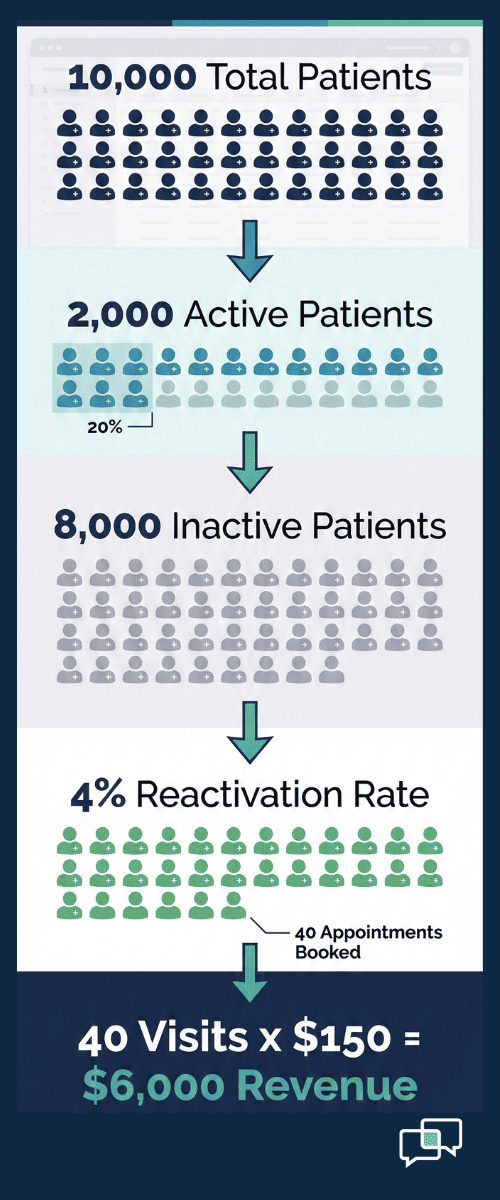
Let's start with a number that might sting a little. Your MD Systems account may hold 10,000 active charts. But if you're like most practices, you only see about 2,000 of those patients in a given year.
That leaves around 8,000 patients sitting untouched in your system — people who already trust you, already have a file with you, and already chose you once.
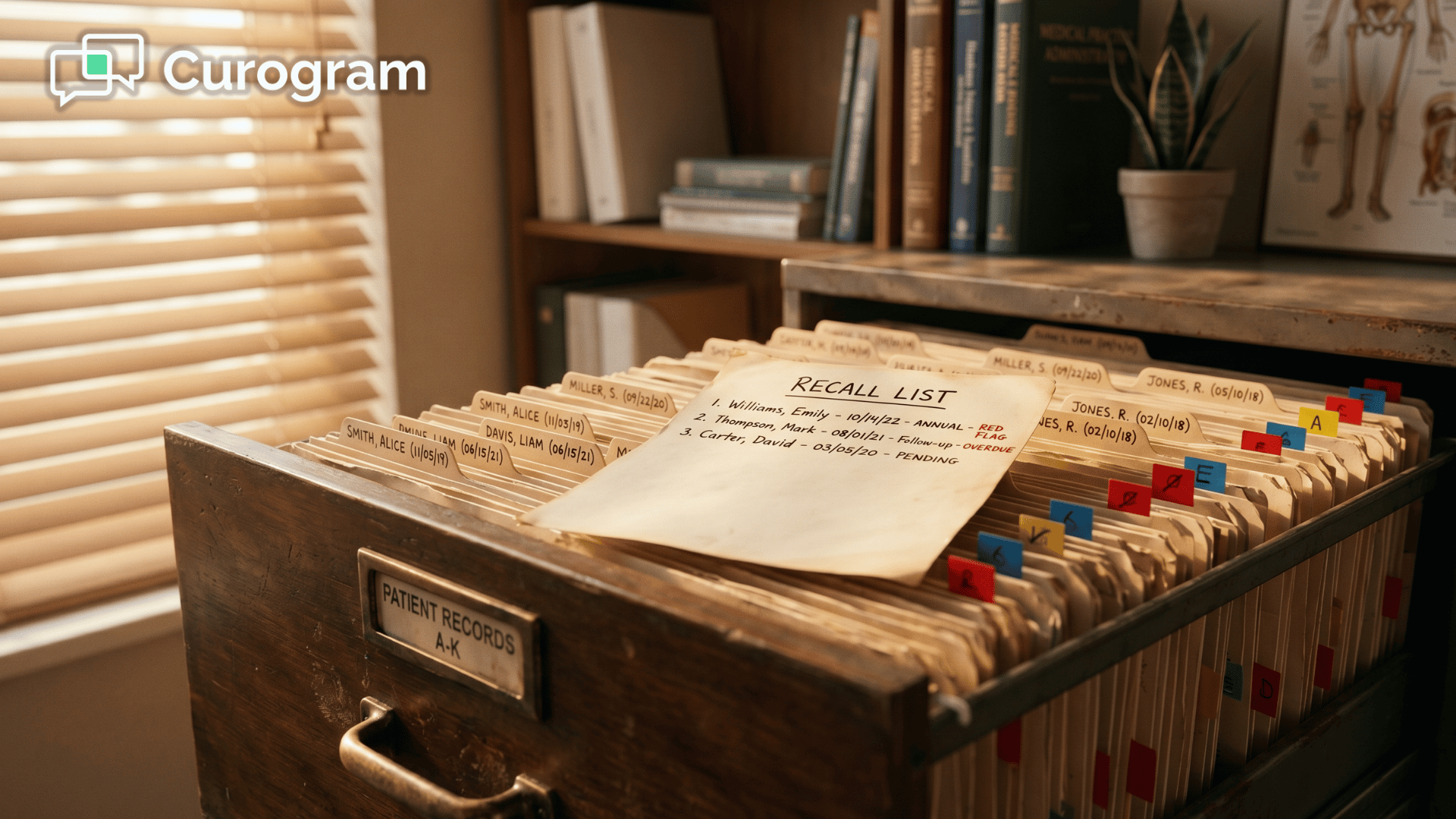
So why are they sitting there doing nothing? The answer is simple. Most practices treat their patient database like a filing cabinet. It stores old records. It tracks billing history.
But no one thinks of it as a revenue tool. No one looks at it and asks, "How many of these people would come back if we just asked?" That mindset is costing you money — quietly, every single month.
Think about what you spend to get a brand-new patient through the door. Between Google Ads, direct mail, and staff time spent fielding calls, the average cost to acquire a new patient can range from $150 to over $300.
Now, compare that to the cost of sending a text to someone who already knows you. It's a fraction of a penny. Here's a quick way to see the gap:
| Approach | Cost Per New Visit | Trust Level | Time to Book |
| Google Ads | $150–$300+ | Low (stranger) | Days to weeks |
| Direct mail | $1–$3 per piece | Low | Weeks |
| Patient reactivation text | Less than $0.01 | High (existing patient) | Minutes to hours |
The numbers don't lie. You're pouring money into channels that bring in cold leads while ignoring a list of warm ones you already own.
It's easy to assume that inactive patients left on purpose. Maybe they were unhappy. Maybe they found someone else. But the truth is far less dramatic. Most patients go dormant for boring reasons:
Life got busy and they forgot to schedule.
They lost your phone number or moved to a new phone.
They didn't realize they were overdue for a check-up.
They meant to call but kept putting it off.
In short, they didn't leave you. They just drifted away. And the longer they sit in your MD Systems patient database, the harder it becomes to bring them back — unless you reach out first.
Every idle patient in your system is a missed visit. Every missed visit is lost revenue. If your average visit brings in $150, then 100 lost patients equal $15,000 in potential income that you're leaving on the table.
Now, scale that up. If even 500 of your 8,000 dormant patients came back for one visit, that's $75,000 in revenue — with almost no marketing spend.
This is the problem with treating your database as "storage." You end up spending more to find new patients while ignoring the thousands of people who are already in your system, waiting for a reason to come back.
The dormant database isn't just a missed chance. It's an active drain on your practice. Every month you don't reach out, those patients drift further away — toward other providers, urgent care clinics, or simply skipping care altogether.
The good news? Fixing this problem doesn't require a big budget, a marketing agency, or a full IT overhaul. It starts with one decision: stop ignoring the goldmine sitting inside your own server. The next section shows you exactly how to mine it.

Now that you see the problem, let's talk about the fix. The goal is simple: stop chasing new patients until you've harvested the ones you already have.
This is what we call "Database Activation." It's a focused strategy that uses text message marketing for doctors to reach dormant patients in your MD Systems account.
No ad spend. No agencies. No complicated tools. Just a smart filter, a short message, and five minutes of setup.
Start inside Curogram's dashboard. Run a search using two simple filters:
Last visit: more than 18 months ago
Patient status: Active
This pulls up every patient who hasn't been seen in a year and a half but still has an open chart. These are your warm leads — people who never formally left your practice. They just stopped coming in.
For a typical MD Systems practice with 10,000 charts, this filter might return anywhere from 1,000 to 5,000 names. That's your reactivation list.
The key here is tone. You're not selling. You're not pressuring. You're simply reminding someone that you're still here and you care.
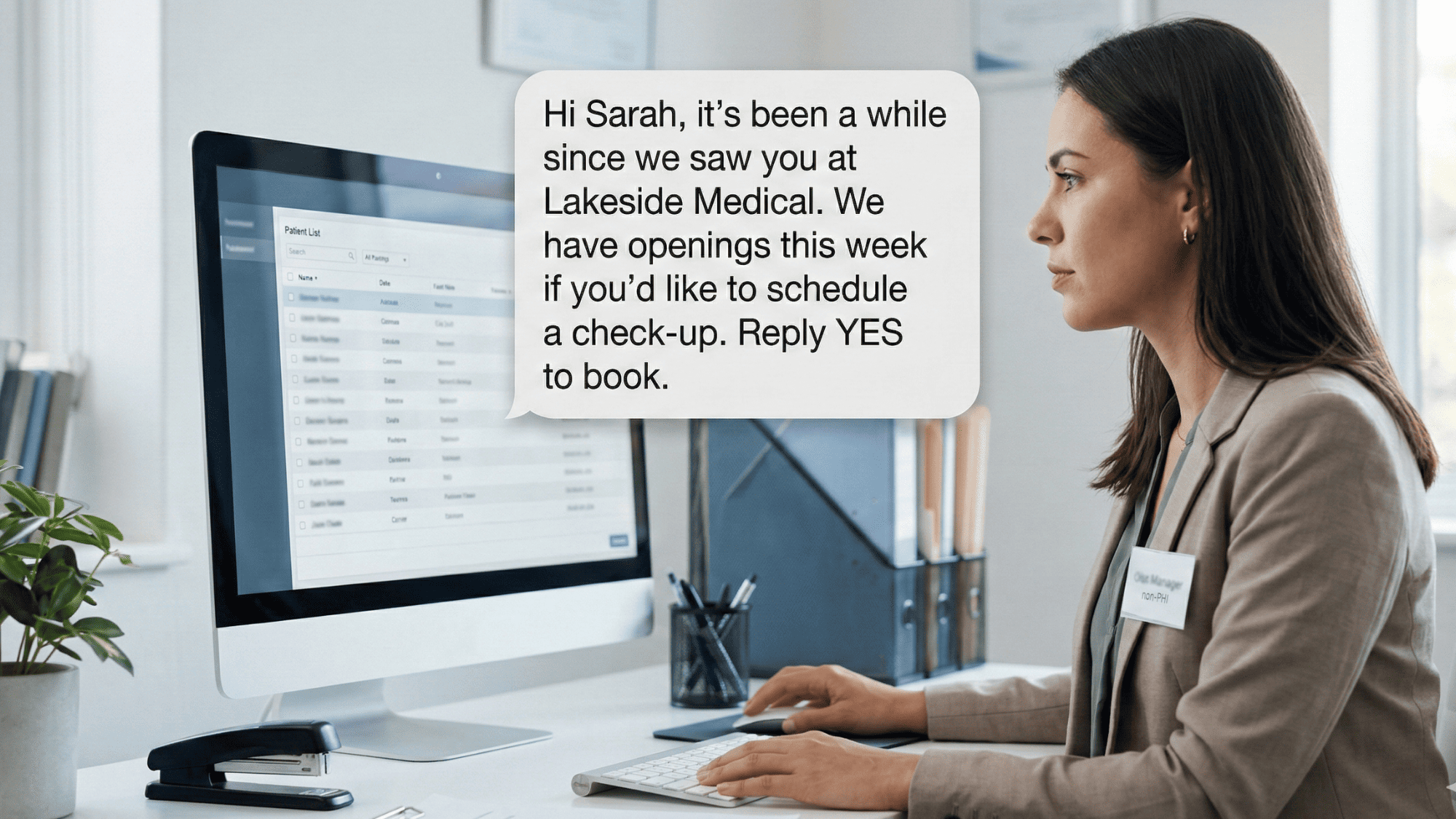
Here's a sample message that works well:
"Hi [Name], it's been a while since we saw you at [Practice Name]. We have open slots this week if you need a check-up. Text 'YES' to book."
Notice what this message does:
It uses the patient's first name, which feels personal.
It mentions the practice name, which triggers memory.
It offers a clear, low-effort way to respond — just text "YES."
You don't need to write a novel. Keep it under 160 characters if you can. Short messages get read. Long ones get skipped.
Once the message goes out, Curogram handles the rest. Replies come back into your two-way texting inbox. Your front desk can confirm times, answer questions, and schedule visits — all through text, without a single phone call.
The whole process — from filter to send — takes fewer than five minutes. And the results start showing up almost right away.
Why This Works So Well
There's a reason text-based outreach beats email, phone calls, and mailers for patient reactivation. Consider the data:
| Channel | Average Open/Response Rate |
| 20–25% open rate | |
| Phone call | 10–15% answer rate |
| Direct mail | 1–2% response rate |
| Text message | 95%+ open rate |
Text messages are read within minutes. They don't get buried in a spam folder or tossed in the recycling bin. And for patients who are used to texting in their daily lives, replying feels natural — not like a chore.
This is why text message marketing for doctors has become such a powerful tool for increasing patient retention. It meets patients where they already are: on their phones.
|
A note on timing and frequency: You don't need to blast your entire list at once. In fact, staggering your sends can help your staff manage the flow of replies. Try sending to 200–300 patients at a time, once or twice a week. This keeps your inbox manageable and gives your team time to book each wave of appointments. |
You can also test different days and times. Based on our internal data, mid-week messages sent between 9 a.m. and 11 a.m. tend to get the best response rates.
The beauty of this approach is its simplicity. You don't need a marketing degree or an IT department. You just need a filter, a message, and the will to press "send."

Let's stop talking theory and start talking real numbers. Because this is where the strategy goes from "interesting idea" to "why didn't we do this sooner?"
A typical reactivation campaign converts 3–5% of the list. That's a solid baseline. But based on our internal research, some practices using Curogram have seen conversion rates as high as 35% — which is what happened in one multi-location practice that used SMS recalls to bring back overdue patients.
Let's walk through a more cautious example using the lower end of that range: Say, you text 1,000 dormant patients. At a 4% conversion rate, 40 patients book a visit. If your average visit brings in $150, that's $6,000 in revenue — from a single text blast that took five minutes to send.
Here's how that breaks down:
| Metric | Value |
| Patients texted | 1,000 |
| Conversion rate | 4% |
| Appointments booked | 40 |
| Revenue per visit | $510 |
| Total Revenue | $6,000 |
Now imagine you run that same campaign once a month. Over a year, even with overlap and shrinking returns, you could bring in $50,000 to $70,000 in revenue — just from reactivation texts. That's real medical practice revenue growth with zero ad spend.
Most MD Systems practices don't have just 1,000 dormant patients. Many have 3,000 to 8,000. If you text 3,000 patients at the same 4% rate, you're looking at 120 booked visits and $18,000 in revenue. From one campaign.
And these aren't pie-in-the-sky numbers. Based on our internal data, one practice saw 1,240 patients return from recall messages alone. That kind of volume doesn't just boost revenue — it transforms your schedule, your staff workload, and your cash flow.
Let's compare the MD Systems patient database ROI of a reactivation campaign to a standard Google Ads campaign:
| Campaign Type | Cost | Patients Gained | Revenue | ROI |
| Google Ads (1 month) | $2,000 | 10–15 | $1,500–$2,250 | 0.75:1 to 1.1:1 |
| Reactivation text blast | ~$10 (SMS costs) | 40+ | $6,000+ | 600:1 |
The reactivation campaign costs almost nothing. The trust is already built. The patient file already exists. There's no ad creative to design, no landing page to build, and no bidding war to fight. You're simply tapping into value that's already yours.
This is why unlocking legacy patient data is one of the smartest moves a practice can make. The return is massive because the cost is near zero.
Revenue from the visit itself is just the start. When a dormant patient comes back, several other things tend to happen:
They bring updated insurance information. If they've switched plans since their last visit, you now have a fresh payer on file. That means cleaner billing and faster payment.
They bring new health needs. A patient who hasn't been seen in two years likely has new symptoms, new concerns, or overdue screenings. One visit often turns into a series of follow-ups, referrals, or procedures.
They restart their care cycle with your practice. This is the big one. A single reactivation text doesn't just create one visit. It relaunches a long-term relationship.
That patient goes back into your regular reminder rotation, your recall system, and your review funnel. In other words, each reactivated patient isn't a one-time win. It's the start of a new revenue cycle.
|
Let's paint the picture: It's a Tuesday morning. Your office manager opens Curogram, filters for patients who haven't visited in 18+ months, and sends a friendly "We miss you" text to 1,500 patients. It takes about four minutes. By noon, 60 replies come in. By 3 p.m., your front desk has booked 45 appointments across the next two weeks. At $150 per visit, that's $6,750 already locked in. By end of week, a few more trickle in — bringing the total to 70 booked visits and over $10,000 in new revenue. All from one afternoon. No ads. No agencies. No cold calls. |
That's what we mean by "The $10,000 Afternoon." It's not a fantasy. It's the natural result of taking five minutes to reach out to people who already want to hear from you.
Medical practice revenue growth doesn't always come from flashy marketing campaigns or big-budget ad buys. Sometimes it comes from the quiet, practical act of looking at what you already have and putting it to work.
Your MD Systems database is not just a record system. It's a list of real people who chose your practice once. Many of them would choose you again — if someone just reminded them you're there.
Increasing patient retention through reactivation is one of the highest-impact, lowest-cost strategies any practice can use. And the best part? It compounds.
Every patient you bring back enters your care cycle again, generating visits, referrals, reviews, and revenue for months or years to come. The dormant database isn't a dead weight. It's a growth engine waiting to be turned on.
There's a common trap in healthcare marketing. Practices pour money into finding new patients while forgetting the ones they already have. It's like searching for treasure in someone else's yard when there's gold buried in your own backyard.
The data backs this up. Studies have long shown that keeping an existing customer costs far less than winning a new one. In healthcare, this gap is even wider.
A new patient requires ads, intake forms, insurance checks, and a first-impression visit. A returning patient already has a chart, a history, and a reason to trust you.
When you invest in reactivating dormant patients, you're not just filling empty slots. You're rebuilding relationships that already have a strong foundation. These patients know your staff.
They know your office. They know how you practice medicine. That familiarity makes every step easier — from booking to billing to follow-up.
This is why text-based outreach through Curogram creates such outsized results. It combines the ease of a personal message with the scale of a mass campaign. You're reaching thousands of patients with a note that feels like it came from a friend, not a call center.
Practices that embrace this mindset — "reactivate before you advertise" — consistently see stronger returns. They spend less. They fill more slots. And they build a more loyal patient base over time.
It's the kind of strategy that doesn't just boost this month's numbers. It changes the trajectory of the entire practice.
How Curogram Turns Your MD Systems Database into a Revenue Engine
Curogram connects directly to your MD Systems account and pulls in your full patient list. From there, it gives you filters that let you find exactly who you're looking for — patients who haven't visited in a set time frame, patients with a certain status, or patients in a specific age group. You can build a reactivation list in under a minute without touching a single spreadsheet.
Once you have your list, sending a message takes seconds. Curogram's two-way texting lets patients reply right away, and your staff can manage the entire conversation from one dashboard.
But the real power goes beyond one campaign. Curogram also automates appointment reminders, sends review requests after visits, and offers online booking links.
So when a dormant patient comes back, they don't just book one visit — they enter a system that keeps them engaged for the long haul. That single reactivation text becomes the start of a full care cycle that runs on its own.
Your staff saves time because they're not chasing patients by phone. Your schedule stays full because reminders go out without anyone lifting a finger. And your online reputation grows because happy returning patients leave reviews after each visit.
Based on our internal data, Curogram clients see over 75% appointment confirmation rates and no-show rates that are 53% lower than the industry average. That means the patients you bring back actually show up — and keep showing up.
It's not just about getting patients through the door once. It's about keeping them there for good.
If there's one thing to take from this article, it's this: stop spending money on strangers before you've talked to the people who already know you.
Your MD Systems database is full of patients who trust you. They've been to your office. They've met your staff. They've sat in your exam room. The only reason they stopped coming is because no one reminded them to come back.
Reactivating lost patients for MD Systems practices isn't a theory. It's a tested strategy that works — fast. A five-minute text campaign can fill your schedule for weeks. And the return on investment makes traditional advertising look like a waste.
The math is simple. The setup is easy. And the revenue is real. So before you write another check for Google Ads or spend another hour chasing cold leads, take a look at what's already on your server.
Your best "new" patients are the old ones who drifted away. Bring them back with a warm text, and watch what happens.
Ready to see how much hidden revenue is sitting in your inactive files? Schedule a demo today to see exactly what your MD Systems database is worth.
Include a booking link or "Request an Appointment" option in your message. This sends patients to an online form instead of the phone line, turning replies into scheduled slots — not incoming calls.
Based on our internal data, texting 1,000 dormant patients at a 4% conversion rate and $150 per visit yields about $6,000 in revenue. The cost of sending those texts is under $10, making the ROI extremely high.
Filter out patients by billing status in MD Systems before you send. This lets you exclude anyone with open balances so your campaign targets only patients in good standing.
💡 Broadcast messaging for CollaborateMD recalls lets medical practices wake up dormant patients and fill schedule gaps with targeted,...
💡 When you reactivate dormant patients in CollaborateMD through broadcast text messaging, your practice can bring in over $15,000 in new revenue...
💡 Mass patient texting for MD Systems clinics lets you fill open slots in minutes — not hours — by texting your whole waitlist at once. Sync with...