Mass Texting for Medstreaming: Automate Imaging Alerts & Communication
💡 Mass texting in Medstreaming automates HIPAA-compliant patient alerts across locations, delivering prep instructions, reminders, and urgent...
12 min read
Mira Gwehn Revilla
:
February 20, 2026
Your most valuable asset isn't your office space. It isn't your medical gear. It's the patient list sitting inside your CollaborateMD system right now.
Here's the problem: Up to 40% of that list is likely dormant. These are real patients who came to your practice, received care, and then simply stopped showing up. They didn't leave because they were unhappy. Life got busy. They forgot. No one reminded them.
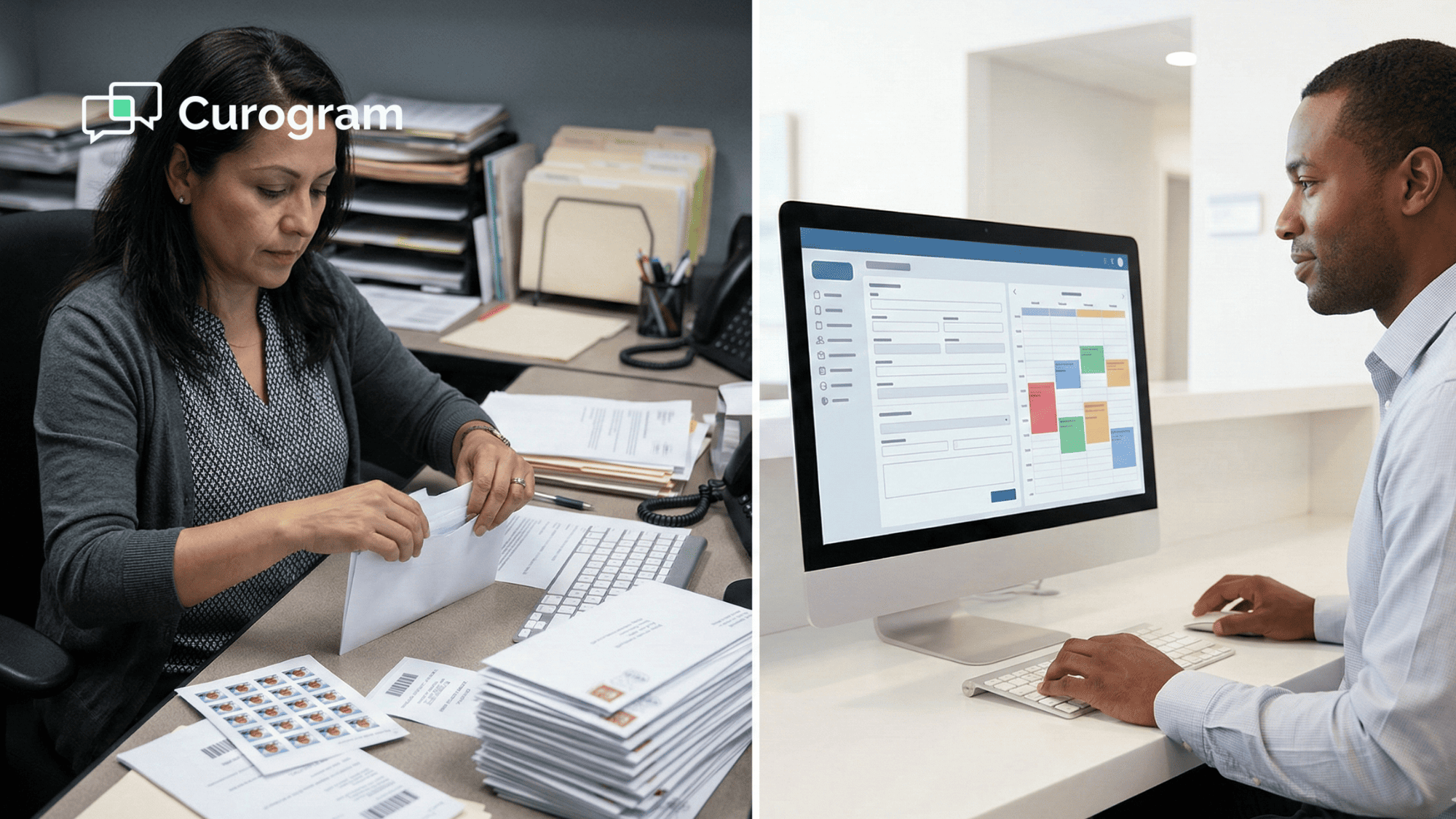
Meanwhile, your staff is staring at a light schedule and scrambling to fill it. The old fix? Print out a recall list. Start dialing. Hope someone picks up. But phone calls reach less than 15% of patients on a good day. It's slow, draining, and the results rarely move the needle.
There is a better way. Broadcast messaging for CollaborateMD recalls lets you text hundreds of overdue patients at once. One message, sent in minutes, with no manual phone calls needed. The result? A 35% booking rate and over $15,000 in new revenue from a single campaign.
This isn't spam. It isn't a marketing blast. It's what we call "Clinical Activation," sending the right health reminder to the right patient at the right time.
Patients who are overdue for annual physicals, chronic care visits, or screenings get a simple text nudge. Most of them are grateful to hear from you.
Curogram makes this possible by connecting directly to your CollaborateMD database. You filter, write a short message, and hit send. Your front desk doesn't get slammed because the system drips messages out at a pace you control.
In this guide, we'll show you exactly how it works, why it drives results, and how one medical practice used it to fill two weeks of provider time with a single campaign.
Every CollaborateMD user is sitting on hidden gold. Your patient database holds the names, contact details, and visit history of every person who has ever walked through your doors. But for most practices, their database is collecting dust.
These are patients who haven't been seen in 6, 12, or even 18 months. They're not gone for good. They just fell off the radar. Maybe they missed a follow-up and never rebooked.
Maybe they moved to a new area and assumed they had to start over. Or maybe no one reached out to them at all. That last reason is the most common, and the most costly.
Think about the math for a moment. Say your practice has 5,000 patients in CollaborateMD. If 35% of them are overdue for some type of visit, that's 1,750 patients who need care but haven't scheduled. If even a fraction of them come back, the revenue impact is huge.
A single office visit might bring in $150 to $250 in billable charges. If you reactivate just 100 of those patients, that's $15,000 to $25,000 in revenue you were leaving on the table. And you didn't need a single new patient to get there.
This is what makes CollaborateMD patient reactivation so powerful. The patients already exist. The data already exists. You just need a way to reach them.
Every practice hits slow stretches. Summer months. Holiday weeks. Post-insurance enrollment lulls. When provider time drops below 80% usage, the bottom line takes a serious hit.
Staff still need to be paid. Rent doesn't pause. Overhead stays the same whether you see 20 patients or 5. A light schedule isn't just stressful. It's expensive.
The natural instinct is to panic and throw money at online ads or new patient marketing. But that's the wrong move.
New patient marketing can cost $200 to $500 per patient. Meanwhile, your existing database is full of people who already know you, trust you, and just need a reason to come back.
So what do most offices do when the schedule gets thin? They pull a recall list from CollaborateMD and hand it to the front desk. "Call these patients. See if you can get them in." What follows is painful. Your staff spends hours dialing numbers. Most calls go to voicemail.
The few patients who do pick up often can't book on the spot. The whole process is slow, draining, and pulls your team away from the patients who are already in the office.
On average, manual phone recall campaigns reach less than 15% of the list. That means for every 100 patients your staff calls, 85 of them never hear your message. And your front desk just burned a full day trying.
It's not a lack of effort. It's a broken process. Calling patients one by one is like trying to fill a swimming pool with a coffee cup. The intent is good, but the tool doesn't match the job.
This is exactly why bulk SMS for medical practices has become so important. Text messages have open rates above 90%.
Most people read a text within three minutes. When you need to fill schedule gaps in CollaborateMD, a single text campaign can do in five minutes what phone calls can't do in five days.
The dormant database isn't a problem to be solved later. It's money you're losing right now. And the good news is that waking it up is far easier than you think.
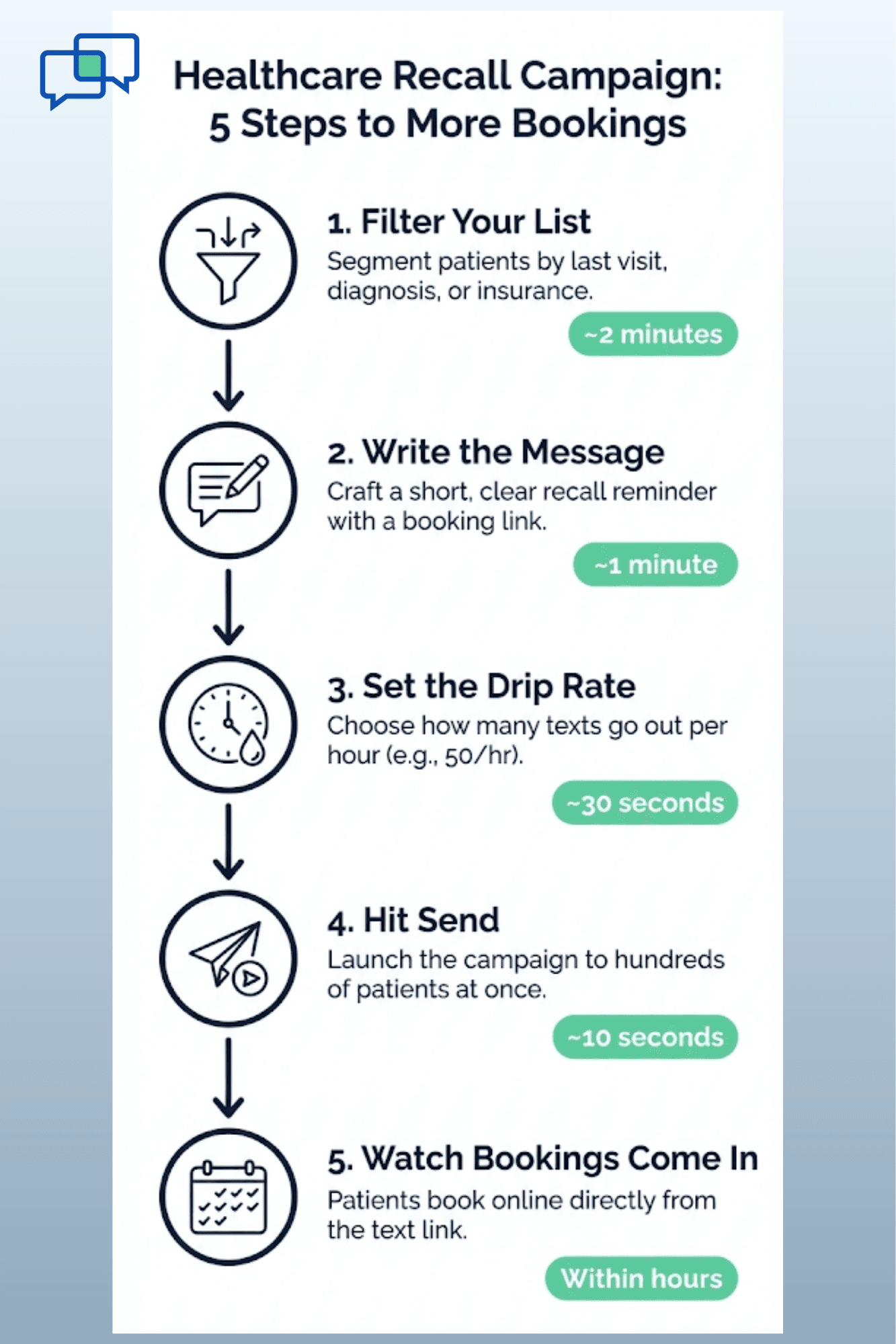
Curogram connects directly to your CollaborateMD system. That means you don't export spreadsheets, upload CSV files, or copy-paste patient lists. Everything happens inside the platform with a few clicks. Here's how the process works from start to finish:
The first step is building your audience. Curogram lets you filter your CollaborateMD database using the same fields you already know. You can segment patients by last visit date, diagnosis code, provider, insurance carrier, and more.
|
For example: You could build a list that says: "Show me all patients with a diabetes diagnosis code who haven't been seen in the last 6 months." Or: "Pull every patient over age 50 who is overdue for an annual wellness visit." |
This level of filtering is what separates Clinical Activation from generic marketing. You aren't blasting every patient in your system with the same message. You're reaching the right patients with a recall that is tied to their actual care needs.
If you want to target a specific payer, you can filter by insurance type too. For instance, if Medicare Annual Wellness Visits are a priority, you can segment your list to focus on Medicare patients only. This helps you close care gaps and meet quality metrics at the same time.
Once your list is ready, you write a single message. Keep it short and clear. Something like: "Hi, it's time for your annual check-up at [Practice Name]. Click here to book your visit."
Then you hit send. That one message goes to 200, 500, or even 1,000 patients at once. No phone calls. No voicemails. No hold music. Your staff saves hours of work and reaches more people in five minutes than they could in an entire week of dialing.
This is what an automated patient recall system looks like in action. Instead of your front desk doing the heavy lifting, the software handles the outreach. Your team can focus on the patients in front of them while Curogram works in the background.
Here's a concern that comes up a lot: "If I text 500 patients, won't they all call back at the same time?"
Good question. And Curogram has solved for it. The system uses a drip feature that sends messages in small batches. For instance, you can set it to send 50 texts per hour. That way, the responses trickle in at a pace your front desk can handle.
No one gets overwhelmed. No one misses a call. The flow stays steady and smooth.
If you include a link to online booking in the text, many patients will book on their own without ever calling the office. That takes even more pressure off your team and lets patients schedule at a time that works for them.
Let's be clear about what these messages are. They are not ads. They are not promos. They are health reminders tied to real care needs.
A patient who is 14 months out from their last physical needs to come in. A diabetic patient who hasn't had lab work in 8 months needs a follow-up. A woman overdue for a mammogram screening needs that nudge.
These messages drive necessary care. Patients don't view them as spam. They see them as a helpful reminder from their doctor's office. That's why the booking rates are so high. People respond because the message matters to them.
When done right, broadcast messaging for CollaborateMD recalls is a win for the patient and a win for the practice. Better health outcomes. A full schedule. Stronger revenue. Everyone benefits.

Let's look at how one real practice used broadcast messaging to turn a slow schedule into a revenue machine. Atlas Medical Center is a primary care practice that uses CollaborateMD as its practice management system.
Like many offices, they had a large patient database with thousands of names. And like many offices, a big chunk of those patients hadn't been seen in over a year.
The providers had open slots. The front desk was making phone calls. But the schedule stayed light. Revenue was flat. Something had to change.
That's when they started using Curogram for broadcast patient recalls. Here's what happened:
Atlas Medical Center ran a targeted campaign aimed at patients who were overdue for annual physicals. Using Curogram's smart filters, they pulled a list of patients whose last visit was more than 12 months ago.
They wrote a simple text message. No jargon. No links to lengthy forms. Just a clear, friendly reminder that it was time for their yearly check-up, with a link to book online.
As a result, over 35% of the patients who received the message booked an appointment. Compare that to the industry average for phone recalls, which sits below 15%. The text campaign more than doubled the response rate.
|
Let's put that in real numbers: If they sent the text to 500 patients, around 175 of them scheduled a visit. That's 175 appointments that didn't exist the day before. No marketing spend. No print ads. No Google campaigns. Just one message, one list, and five minutes of staff time. |
Now, let's talk money. Each of those annual physicals generates billable revenue. Depending on the payer mix and coding, a single wellness visit can range from $100 to $300 in charges.
At an average of $150 per visit, those 175 appointments added up to more than $26,000 in potential billable revenue. Even on the conservative end, the campaign easily crossed the $15,000 mark.
Atlas Medical Center didn't just fill a few slots. They filled their providers' schedules for two full weeks. That's the kind of impact that changes the way you think about revenue cycle optimization.
And this wasn't a one-time trick. They can run the same type of campaign any time the schedule softens. Overdue diabetic care visits in Q1. Flu season follow-ups in the fall.
Pediatric well-child visits before school starts. The playbook is the same every time: filter, message, book.
This is the detail that gets most office managers' attention. The cost to acquire these patients was $0.00.
Why? Because these weren't new patients. They were existing patients already in the CollaborateMD database. They had chart history. They had insurance on file. They had a relationship with the practice.
When you run a Google ad or a Facebook campaign, you might pay $200 to $500 to get one new patient through the door. That new patient needs to be registered, their insurance verified, and their intake completed before you even see a dime of revenue.
With broadcast messaging, none of that applies. The patient is already in your system. Their chart is ready. The visit flows like any normal return appointment. The cost of acquisition is zero, and the revenue is immediate.
This is what CollaborateMD patient reactivation looks like at its best. You're not spending money to find new patients. You're spending minutes to wake up the patients you already have.
Let's walk through a simple example. Say your practice has 3,000 active records in CollaborateMD. If 35% are overdue for some type of visit, that gives you about 1,050 patients to target.
You run a broadcast campaign. Based on the Atlas Medical Center results, you can expect about 35% of those patients to book. That's roughly 367 new appointments.
At an average of $150 per visit, that's around $55,000 in billable revenue. From one campaign. From patients who were already in your database.
Even if your practice is smaller, say 1,000 patients total, the numbers still work. A 35% dormancy rate gives you 350 targets. A 35% booking rate gives you about 122 appointments. At $150 each, that's over $18,000 in revenue.
The point is this: every CollaborateMD practice has revenue sitting idle in the database. The only question is whether you have a tool fast enough to unlock it.

Phone calls reach less than 15% of patients. Email open rates in healthcare hover around 20%. Direct mail is slow and expensive.
Text messages get opened at a rate above 90%. Most are read within three minutes of being received. And because Curogram lets patients book right from the text, there's no friction. No "call us back during office hours." No "visit our website and find the appointment page."
The patient reads the text, taps the link, picks a time, and they're booked. That speed and ease is what drives the 35% booking rate.
When you're trying to fill schedule gaps in CollaborateMD, there is no faster or more effective tool than a well-timed text campaign. And with Curogram's drip feature, you can control the flow so your team is never caught off guard.
The Atlas Medical Center case isn't a one-off success story. It's a repeatable playbook. Any time your schedule needs a boost, you have a button you can press.
Think of it as an on-demand volume knob. Turn it up when things are slow. Dial it back when the schedule is packed. You control the pace, the audience, and the message.
That kind of control is rare in healthcare. Most growth takes months of planning, big budgets, and uncertain outcomes. Broadcast messaging gives you results you can measure in days, not quarters.
You don't need to find new patients to grow your practice. The growth is already inside your CollaborateMD system, waiting to be unlocked.
Every overdue patient in your database is a missed visit. Every missed visit is lost revenue. And every day you wait to reach out, you risk losing that patient to a competitor who will.
Broadcast messaging for CollaborateMD recalls flips the script. Instead of chasing new leads with expensive ads, you text the patients who already know and trust you. The response is fast. The cost is near zero. And the revenue is real.
Curogram gives you the tool to make it happen. Filter your patient list by visit date, diagnosis, or insurance. Write a short, clear message. Press send. Watch your schedule fill up.
Atlas Medical Center did it and generated over $15,000 from a single campaign. They filled two weeks of provider time with no ad spend and no extra staff. You can do the same.
Revenue cycle optimization doesn't have to mean complex billing audits or contract renegotiations. Sometimes it's as simple as texting patients who haven't been in for a while.
Why Curogram Is Built for CollaborateMD Recall Campaigns
Curogram isn't a generic texting app. It's a platform built for medical practices that need fast, compliant, and effective patient outreach. When paired with CollaborateMD, it becomes a powerful engine for turning a quiet schedule into a packed one.
The integration between Curogram and CollaborateMD is direct. You don't need to export files or move data between systems.
Curogram reads your patient records and lets you build filtered lists inside the platform. That means your recall campaigns are always based on live, accurate data.
HIPAA compliance is built into every feature. Curogram never puts protected health details in a text message. Instead, it uses simple reminders and secure portal links. Your practice stays compliant without extra steps or workarounds.
Throttling sets Curogram apart from basic SMS tools. You control how many messages go out per hour, so your front desk can keep up with the response flow. If you pair the campaign with online booking, many patients will schedule on their own without ever picking up the phone.
The automated patient recall system also supports opt-out management. Patients who prefer not to receive texts can unsubscribe with a single reply. This keeps your list clean and your compliance airtight.
Curogram's broadcast feature works for more than just annual physicals. You can use it for chronic care follow-ups, vaccine reminders, seasonal campaigns, and even insurance-specific outreach. If you can filter for it in CollaborateMD, you can build a campaign around it.
For practices that want to take control of their schedule and stop losing revenue to dormant patient lists, Curogram offers a simple answer. Filter, message, book. That's all it takes to start seeing results.
Your CollaborateMD database is more than a record-keeping tool. It's a revenue source that most practices barely tap into. Every patient who hasn't been seen in 6, 12, or 18 months is a visit waiting to happen and income waiting to be earned.
The outdated way of fixing a slow schedule doesn't work. Printing recall lists and making phone calls one by one is too slow, too draining, and too easy to ignore. Your staff deserves better tools, and your patients deserve better outreach.
Broadcast messaging changes the game. With Curogram, you can filter your patient list by the criteria that matter most, write a single clear message, and reach hundreds of patients in minutes.
The results speak for themselves. A 35% booking rate. Over $15,000 in revenue from one campaign. Two weeks of filled provider time. Zero cost for patient acquisition. These aren't projections. They're real outcomes from a real practice using this exact approach.
Revenue cycle optimization starts with using the assets you already have. And the biggest asset in your practice is the patient database you've spent years building. It's time to put it to work.
Whether you need to fill schedule gaps this week or build a long-term recall strategy, Curogram gives you the control. Filter by visit date. Filter by diagnosis. Filter by payer. Send the message. Watch the bookings roll in.
Stop letting your patient list collect dust. Schedule a demo to see how Curogram reactivates your CollaborateMD patients in minutes.
Stop letting your patient list collect dust. Schedule a demo with us to see how Curogram reactivates your CollaborateMD patients in minutes.
You can segment your list by insurance carrier directly in Curogram's filtering tools. This lets you run campaigns for specific payers, such as Medicare patients due for Annual Wellness Visits, to close care gaps.
Text messages have open rates above 90% and are read within minutes. Phone calls reach less than 15% of patients. Texts also let patients book instantly through a link, removing the need to call back during office hours.
Most practices see appointment bookings within hours of sending a campaign. Since Curogram drips messages at a controlled rate, the front desk can handle responses in real time without being overwhelmed.
💡 Mass texting in Medstreaming automates HIPAA-compliant patient alerts across locations, delivering prep instructions, reminders, and urgent...
💡 Broadcast messaging for Cerbo lets integrative and functional medicine practices send bulk SMS to their entire patient base at once. SMS has a...
💡 Opus EHR broadcast alerts through Curogram let behavioral health centers send urgent SMS updates to patients in seconds. Notify all scheduled...