9 min read
OncoEMR Mass Messaging and Patient Recalls: Reach Every Patient
Mira Gwehn Revilla
:
May 1, 2026
- 35% of recalled patients re-book within one month (based on our internal data)
- 1,240 patients returned in a single month from one client
- 98% text open rate beats portal alerts
- HIPAA-compliant and SOC 2 Type II certified
- Works alongside OncoEMR with no costly HL7 build
Cancer follow-up care does not wait. Yet many oncology practices lose track of patients who skip their next visit. The reason is simple: their EHR cannot send a text. OncoEMR handles chemo plans well, but it has no built-in tool for mass texting.
This gap costs lives and revenue. A patient overdue for a scan may miss a recurrence. Staff cannot call every overdue patient by hand. Portal alerts go unread because most patients never log in.
OncoEMR mass messaging and patient recalls for oncology follow-up campaigns solve this gap. Curogram adds a simple SMS layer next to your EHR. You build a patient cohort, hit send, and let the texts do the work. Replies come back in real time.
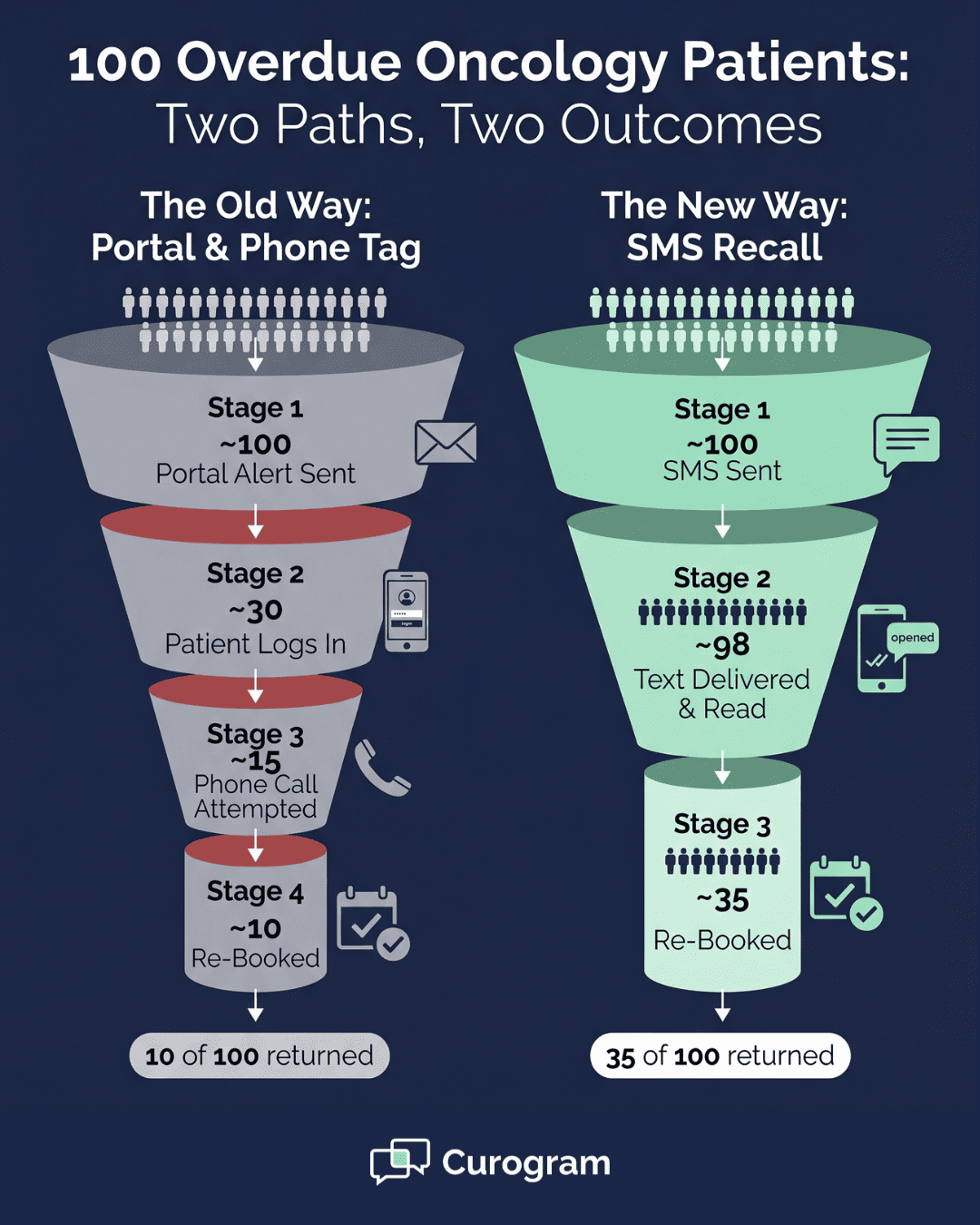
The numbers back this up. Based on our internal data, 35% of patients who got an SMS recall booked within one month. One multi-site client brought back 1,240 patients in a single month. These are people who would have stayed lost to follow-up.
Curogram is HIPAA-compliant and SOC 2 Type II certified, so your data stays safe. It works as a stand-alone tool, so you skip costly HL7 builds. Staff run all campaigns from one dashboard while OncoEMR keeps its clinical records intact.
This guide shows you how to fix the recall gap. We cover the cost of the current setup, how the SMS layer works, and what results to expect. You will also see how mass messaging for oncology practices fits into your daily flow. By the end, you will know how to recover lost revenue and lost patients with one quick text.
The Villain: The Oncology Tax — Limited Recall Reach
Cancer care depends on regular follow-up. But OncoEMR does not give your team a way to text patients in bulk. CareSpace, the patient portal, asks people to sign up, save a password, and log in. For older patients, this is a real wall.
CareSpace Is a Portal, Not a Communication Tool
CareSpace was built for messages, not mass outreach. Patients must create an account, recall their login, and check it often. The average oncology patient is 66 years old. Many feel tired from treatment side effects.
This makes portal use a tough sell. OncoEMR has no native SMS recall feature for staff. So when a patient is overdue, the system stays quiet. Your team must reach out by hand.
Manual Calls Drain Your Staff
A nurse spends 15 to 20 minutes on one recall call. Most patients do not pick up. Voicemails go unanswered. Staff then mail letters, which cost money and rarely work.
Weeks pass before the patient hears from you. Meanwhile, the open slot stays open. The OncoEMR appointment recall workflow becomes a slow drip, not a steady flow.
The Clinical Cost of Missed Follow-Ups
Missed visits in oncology are not just lost revenue. They mean missed scans, late recurrence checks, and broken treatment plans. Practices without active outreach see follow-up rates drop by 20% to 30%.
Each missed appointment can cost the clinic $500 to $2,000 or more. This includes drug prep, chair time, and staff hours. For a practice with 50 missed visits a month, that is real money lost.
Picture a patient who finished chemo six months ago. Her scan is overdue by three weeks. The portal sent an alert, but she never logged in. Your front desk cannot keep up with calls. The recurrence goes undetected for two more months.

Your Front Desk Cannot Scale
Your clinical team knows who is overdue. The lists are easy to pull. But reaching all those patients at scale is the hard part.
You have two options today. Push portal use, which most patients reject. Or call by hand, which does not scale. The result is always the same: patients fall through the cracks.
This is the oncology tax. You pay it in lost revenue, missed scans, and stressed staff. Other specialties feel this too, but cancer care has higher stakes.
|
Recall Method |
Avg. Time Per Patient |
Typical Response Rate |
|
Phone calls |
15-20 minutes |
5-10% |
|
Mailed letters |
5 minutes (plus postage) |
2-5% |
|
Portal alerts |
1 minute |
Below 10% |
|
SMS recalls |
Less than 1 minute |
35% (based on our internal data) |
The table shows why text wins. SMS reaches the patient where they already are: their phone. Compare that to a portal that asks for one more login.
For practices that run population health campaigns, Flatiron Health offers strong clinical tools but no SMS engine. You need a system that works with OncoEMR but fills the texting gap. That tool needs to respect HIPAA rules. It also needs to run with no major IT lift.
The good news is that this fix exists. The next section shows you how it works in your practice.
The Guide: The Population Health Text Layer
Curogram acts as a simple text layer next to your EHR. It does not replace OncoEMR. It fills the gap by sending recall texts to large groups of patients at once.
An SMS-First Recall Engine
Patients get a normal SMS, not a portal link with a login wall. They reply with a "Y" to confirm or ask a quick question. Staff see all replies in one shared inbox. This makes mass messaging for oncology practices fast and direct.
Build Cohorts in Minutes, Not Days
The mass messaging tool lets you set up patient lists fast. You can target patients overdue for follow-up scans. You can also reach annual screening groups or flu-shot cohorts.
Once the list is set, Curogram sends a personal text to each patient. Two-way replies are tracked in real time. Patients confirm, cancel, or opt out with one tap.
For example, you might run an overdue scan recall on Monday. By Tuesday, dozens of replies are in. Staff sort them in the dashboard, not on sticky notes.
Works Alongside OncoEMR, Not on Top of It
Curogram does not need a deep build to start. It can read patient data from your OncoEMR system when an API is open. It can also work with patient lists you upload by hand.
You do not need an HL7 interface to send recalls. This saves weeks of setup and thousands in vendor fees. Staff manage all SMS work from the Curogram screen. Clinical notes stay safe inside OncoEMR.
This is what we call automating oncology follow-up reminders without IT pain. You pick the cohort. We handle the texts. The data stays clean on both sides.
A Fit for Real Cancer Patients
Most cancer patients do not want to learn a new app. They are tired, in treatment, or in survivorship. Texting works because every phone has it.
A patient gets a short text: "Hi Maria, you are due for a scan. Reply Y to book." She replies Y. Curogram sends a follow-up text with the next steps. No login. No app. No stress.
This is cancer patient re-engagement SMS done right. The tone stays warm. The flow is short. The patient feels seen, not chased.

Built for HIPAA From Day One
Curogram is SOC 2 Type II certified and HIPAA-compliant. SMS recalls follow safe templates that hold no PHI. For sensitive details, patients click a secure link to view a private message.
This means your compliance team will sign off fast. Your IT team will not have to vet a new risk. Your patients will know their data stays private.
One Dashboard for All Outreach
Curogram pulls all SMS work into one view. Staff see who replied, who opted out, and who needs a follow-up. They can also send mass texts for closures, holiday hours, or new services.
Compare this to the old setup, where a nurse keeps a paper list. Or where a phone call only reaches one in ten patients. The shift is huge.
For practices running population health campaigns, Flatiron Health's portal alone leaves a clear gap. Curogram fills that gap with one simple text channel. You keep the strong clinical core in OncoEMR. You add the patient-facing layer in Curogram.
The result is a complete practice. Clinical work stays in the EHR. Patient outreach gets a tool built for the job.
The Success: The Simplicity of Text-Based Outreach
The proof is in the numbers. Based on our internal data, 35% of patients who got an SMS recall booked an appointment within 30 days. One multi-site practice saw 1,240 patients return in just one month.
From Phone Tag to Mass Outreach
These were patients who had gone quiet. They missed scans, follow-ups, or annual checks. A short text brought them back. No portal login. No phone tag.
This works because text is the most-read channel. Internal research shows a 98% open rate for SMS. Compare that to email, which often lands below 25%.
Picture your old workflow: a nurse pulls a list of 100 overdue patients. She calls each one for 15 minutes. Most do not pick up. By the end of the week, she has reached maybe ten patients.
Now picture the new flow: she uploads the same 100 names to Curogram. She picks a template. She hits send. Within an hour, replies start coming in.
The shift is from 1-to-1 calls to 100-to-100 SMS. Staff hours drop. Patient touch points rise. Re-booking rates climb.
Real Revenue Recovery
Each recovered oncology visit can be worth $500 to $2,000 or more. For a 50-provider group, even a small lift adds up fast. Practices report $30,000 to $50,000 in monthly recovery.
Here is a quick math example for one campaign:
|
Input |
Value |
|
Patients overdue for follow-up |
200 |
|
SMS reconversion rate |
35% |
|
Patients who re-book |
70 |
|
Average visit value |
$1,000 |
|
Monthly revenue recovered |
$70,000 |
That is one campaign, sent in minutes. No IT build. No new staff. Just a clean cohort and a short text.
Multi-Location Practices Win Big
Cancer groups often have multiple sites. Each site has its own list, its own staff, and its own gaps. Manual calling does not scale across sites.
Curogram lets you run one campaign across all your locations. Or run site-specific cohorts when needed. Reports break down results by site, provider, or visit type.
This makes leadership reviews easy. You can show the C-suite which sites bring back the most patients. You can spot weak sites and coach them. You can prove the ROI of OncoEMR patient recall SMS work in clear numbers.
Better Patient Trust
A text feels personal. A robocall feels cold. A letter feels old. When you reach out via SMS, patients feel seen.
One client said their patients started replying with thanks. "I forgot about my scan, thank you for the nudge." Trust grows. Reviews improve. Word of mouth gets better.
This is part of the long game in oncology. Your patients are with you for years. The tone of your outreach shapes their loyalty.
Adherence Metrics Improve Across the Board
When patients return for scans on time, your adherence metrics rise. This matters for value-based contracts and quality scores. Some payers tie payment to follow-up rates.
A 35% reconversion rate means more patients meet their care plan timing. Recurrence checks happen on time. Survivorship visits stay on track. Your data tells a stronger story to payers and partners.
Less Burnout for Your Team
Manual recall work burns out staff. Nurses did not train to be call center reps. When SMS handles the bulk of outreach, nurses get back to nursing.
One office manager said her team got back six hours a week. That is time for clinical care, prior auths, or patient questions. Less burnout means lower turnover. Lower turnover means a stronger team.
Predictable Monthly Outreach
Most practices set up recurring campaigns. For example, every Monday morning, send a recall to patients overdue by 30 days. Or run a quarterly survivorship check.
Predictable outreach means predictable revenue. You can plan staffing around expected re-bookings. You can budget for clinic capacity. You can model growth with real data.
This is the magic of automating oncology follow-up reminders. You set the rules once. The system runs them again and again.
How Curogram Powers OncoEMR Patient Recall SMS Workflows
Curogram is built for medical offices that need fast, safe SMS at scale. We work with OncoEMR practices to bring patients back with one text. The tool lives next to your EHR, not on top of it.
Our platform offers HIPAA-compliant 2-way texting. Staff send mass texts, get replies, and track outcomes from one screen. We are SOC 2 Type II certified, so your data stays safe.
What makes Curogram different is the speed of setup. Most practices go live in days, not months. We do not need a deep HL7 interface to start. You upload a cohort, write a short template, and send.
Why does this matter for oncology? Because cancer care has unique needs. Patients are older. Treatment plans are long. Follow-ups are non-negotiable. A simple text can save a life.
Based on our internal data, our clients see a 35% reconversion rate from SMS recalls. They reduce phone call volume by up to 50%. They boost staff productivity by 30% or more. No-show rates drop to 53% below the industry average.
We also offer smart appointment reminders, online booking, secure messaging, and patient forms. Each tool plugs into your daily flow. You pick what you need and skip the rest.
The goal is simple: keep cancer patients on plan. Recover lost visits. Free your team from manual calls. Curogram does this with care, speed, and full compliance.
Conclusion: Take Action Today
The call to act is clear. Cancer follow-up cannot wait, and portal-only recalls do not work. Manual phone calls do not scale to your full overdue list. The cost shows up in lost scans, missed recurrences, and missed revenue.
Curogram fixes this gap with a simple SMS layer. Texts reach a 98% open rate (based on our internal data). Replies come back in minutes, not days. Staff hours go back to clinical work, not phone tag.
OncoEMR is built to manage clinical records and treatment plans. It is not built for patient outreach at scale. That is where Curogram comes in. Together, they give you a complete cancer practice.
The math is on your side. A 35% reconversion rate on a 200-patient cohort means 70 visits saved. At $1,000 per visit, that is $70,000 in monthly revenue. For multi-site groups, the totals climb fast.
Your front desk should not be the bottleneck for follow-up care. Your nurses should not spend hours on cold calls. Your patients should not need a portal login to hear from you.
Stop letting overdue patients slip through the cracks of your OncoEMR portal. Schedule a demo today and see how a single SMS campaign can recover $30,000+ in monthly follow-up revenue.
Frequently Asked Questions
Most practices go live within a few days. Curogram does not need a full HL7 build to start. You can upload patient lists by hand or use API access where it is open.
Top campaigns include overdue scan reminders, survivorship visits, annual screenings, and flu shots for treatment patients. Curogram lets you build each cohort and send the right text within minutes.
We are SOC 2 Type II certified and HIPAA-compliant. Our SMS templates avoid PHI by design. For private details, patients click a secure link to view a safe message in our portal.