HIPAA 2-Way Texting for Dolphin Ortho — Skip the Weave Bundle
💡 Dolphin orthodontic two-way patient texting that is HIPAA compliant gives practices a focused SMS channel — no Weave, no bundle, and no phone...
11 min read
Mira Gwehn Revilla
:
Updated on April 28, 2026
Your oncology front desk fields 80+ calls a day. Schedule changes, lab follow-ups, prior auth updates, and symptom checks pile up fast. Your nurses spend afternoons leaving voicemails. And your CareSpace portal? Most patients don't log in.
This is the gap. OncoEMR handles chemo protocols and clinical records very well. It was never built for the back-and-forth messaging that runs your practice each day. Your staff feels it. Your patients feel it. Your revenue feels it too.
OncoEMR 2-way HIPAA-compliant texting for oncology patient communication closes that gap. Curogram sits next to your EMR and handles the texting layer. Patients get a text, tap a reply, and it's done. No login. No app. No chemo-fogged confusion.
The numbers tell the story. Based on our internal data, SMS sees a 98% open rate. Portals? Just 20-30% of patients even log in. When your 66-year-old patient is tired after infusion, a quick "Reply Y to confirm" just works.
This matters more in oncology than in almost any other specialty. A missed chemo slot isn't only a lost visit fee. It's wasted drugs, empty infusion chairs, and a broken treatment plan. The cost stacks up fast.
If your team is tired of phone tag and drained by no-shows, this is for you. Let's look at how text-based patient engagement oncology teams now rely on can reshape your day. You don't need a new EMR. You need a simpler way to reach patients who are too tired to navigate one more screen.
Your oncology practice pays a tax every day. Not a real one, but a hidden cost that drains time, money, and morale. We call it "The Oncology Tax." It's the price you pay for using a clinical EMR to do a job it was never built for—daily patient messaging.
OncoEMR shines at what it was built for. Chemo protocols, staging, lab tracking, and clinical notes all live there. CareSpace, its portal, was built around ePRO tools and clinical access. It was never built for quick back-and-forth chats.
Your patients prove this every week. Most don't log in. Of the ones who try, many give up before they finish.
Even when patients do reply through CareSpace, messages often sit unread. Staff don't live in the portal during the day. The flow breaks on both ends.
Here's a normal day at an OncoEMR practice. Your front desk takes 80+ calls. Your nurses spend afternoons leaving voicemails about lab results and schedule swaps.
When a patient does try to reach out, they hit a wall. They need to recall their portal login. They need a clear head—which chemo often steals. Most just call instead, and the cycle starts again.
On top of that, write-back between systems needs costly HL7 interfaces. Flatiron controls that pipe. Each added tool means another fee and another vendor line to manage.
Missed chemo appointments hit hard. Without strong reminder tools, oncology no-show rates run 10-15%. The specialty baseline is 5-7%. That gap is the Oncology Tax at work.
Each missed slot isn't just a lost visit fee. It's:
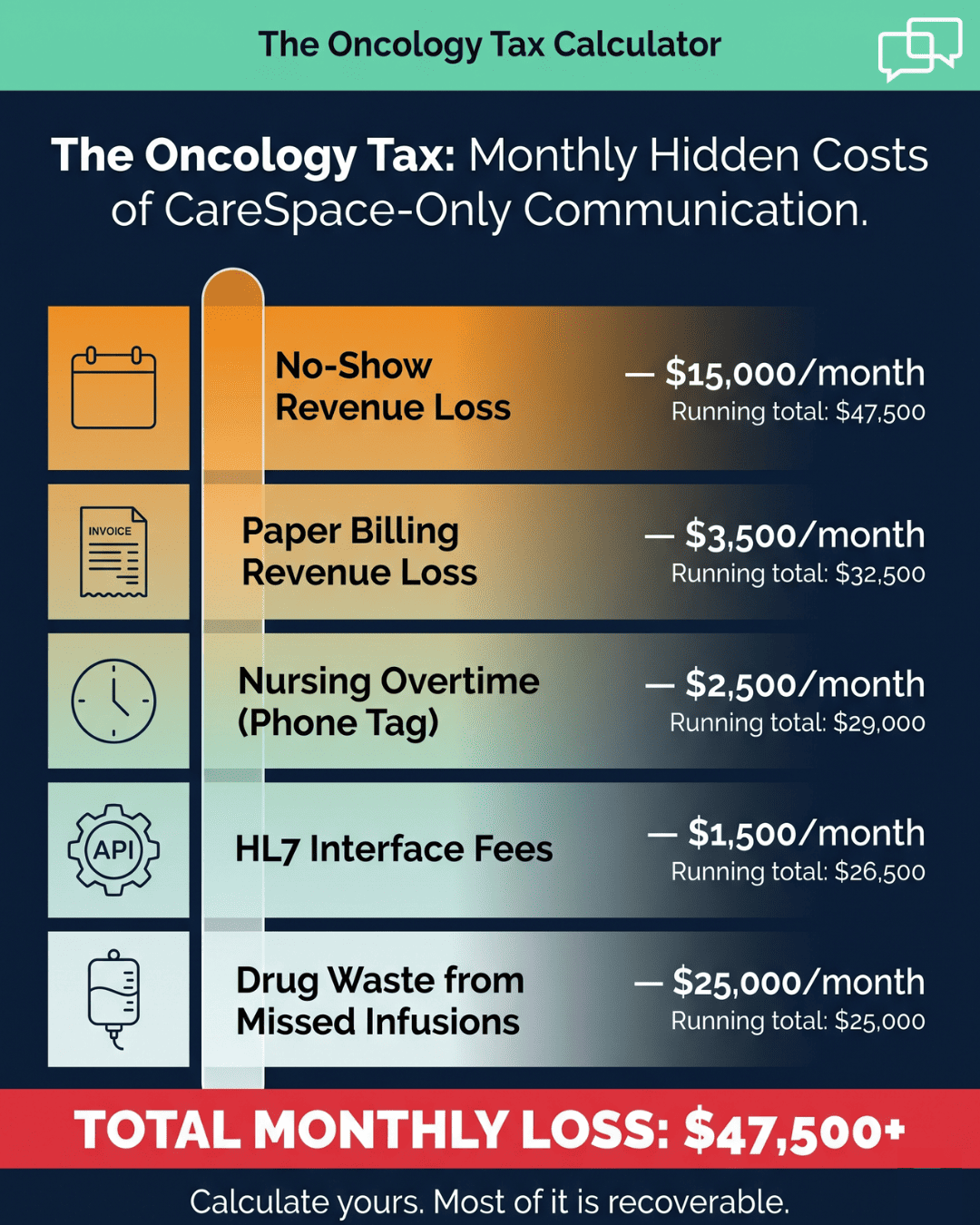
Based on our internal research, practices can lose $30,000-$50,000 a month through these gaps. That's before HL7 fees, paper statement costs, and nursing overtime spent on phone tag.
Let's look at where the tax shows up each month:
|
Hidden Cost |
Monthly Impact |
|
Missed chemo slots |
$30,000-$50,000 |
|
HL7 interface fees |
$500-$2,000 |
|
Nursing overtime for phone tag |
$1,500-$3,000 |
|
Low bill-pay conversion (paper vs. text) |
20% vs. 60%+ |
Add it up. You're bleeding time and cash through a leak that no extra portal feature can fix.
Your nurses trained to be clinicians. Now they spend half their shift tracking down replies. They care deeply about patients, but they're stuck doing call-center work.
Your admin team feels the vendor trap. CareSpace, Canopy, and Willowglade each check a box. None solve the daily messaging gap. You're paying more and getting less.
This is why many oncology leaders now look for alternatives to CareSpace portal workflows—not to replace OncoEMR, but to fill the gap the portal alone leaves open. The need is clear: a simple texting layer your patients will actually use.
The Oncology Tax isn't a budget line you can cut. It's a slow drain across every shift. But it's fixable—and the fix is far simpler than swapping EMRs.

Here's the good news. You don't need to replace OncoEMR. You don't need to retrain your team or rewrite workflows. You just need a shortcut—a way to reach patients without pulling them into the portal.
That shortcut is Curogram.
Curogram is HIPAA-compliant SMS for Flatiron oncology practices. It works alongside OncoEMR instead of replacing any part of it. Your clinical records stay where they are. Your staff gets a simple texting tool for daily patient messaging.
Think of it like this: OncoEMR is your clinical brain. Curogram is your voice. The two work together and stay in their lanes.
Your staff uses Curogram for:
No app. No portal. No login. Just text.
Curogram's 2-way texting is the core feature. Your nurses start a thread. Patients reply right from their phone. The full thread lives in the Curogram dashboard, where any approved staff member can pick it up.
Here's how it plays out in real life. A nurse texts a patient about a lab draw window. The patient taps "Yes, tomorrow at 2 works." The thread updates. No voicemail. No callback.
Staff can send secure links for forms or payments. Patients finish intake before they arrive. The front desk checks them in faster. Wait times drop.
This is where many Flatiron practices breathe easier. Curogram connects to OncoEMR through the standard FHIR API. That means you can read patient demographics and appointment data without a costly HL7 interface.
Your OncoEMR admin sets up read-only API access. The whole setup takes about 30 minutes, one time. If you already have HL7 for another tool, Curogram can use it—but it's never required just to text patients.
Your clinical notes stay in OncoEMR. Your texts stay in Curogram. Nothing gets duplicated or tangled.
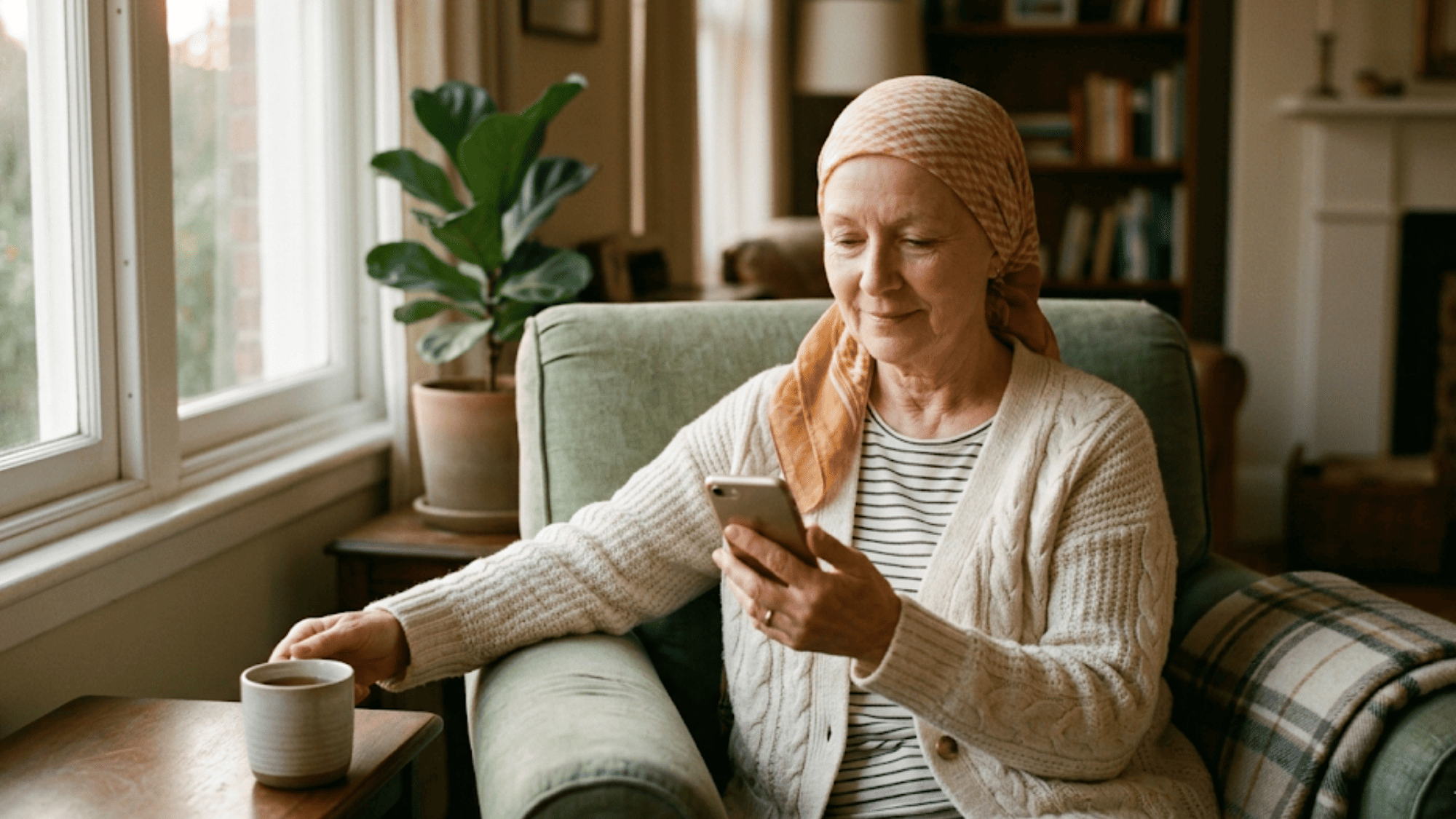
Oncology patients are special. The median age is around 66. Many juggle fatigue, nausea, and chemo brain while trying to manage daily life. Asking them to log into a portal is asking a lot.
Asking them to tap "Yes" or "No" to a text? That's easy. It feels less clinical and more human.
This is why 2-way patient texting OncoEMR practices adopt tends to stick. Staff love it because phone tag drops. Patients love it because it feels normal—it's how they text their kids, their friends, and their other doctors' offices too.
Curogram supports HIPAA-compliant texting for community oncology settings specifically. Patient privacy is protected end-to-end. The platform is SOC 2 Type II certified. A BAA is in place from day one.
Your nurses go back to being nurses. Your front desk stops drowning in callbacks. Your admins stop fielding vendor questions about HL7 pipes. And your patients get a way to reach you that doesn't demand a second ounce of energy.
This is the Communication Shortcut. It's not a new EMR. It's the missing piece that makes your current one finally work for your patients.
So what does life after the Oncology Tax look like? It looks calm. It looks quiet. It looks like a front desk that isn't ringing off the hook at 10 a.m.
Here's what changes when 2-way HIPAA-compliant texting is in place.
The first thing you'll notice is open rates. Based on our internal data, texts hit a 98% open rate. Email sits at 20-30%. Portal notifications track even lower.
This isn't a small jump. It's the difference between a message being read and a message being ignored. In oncology, that gap is deadly for your schedule.
Here's a side-by-side look:
|
Channel |
Open Rate |
Patient Response Rate |
|
SMS (Curogram) |
98% |
>75% on first attempt |
|
|
20-30% |
5-10% |
|
Patient Portal |
20-30% login rate |
Variable, often low |
|
Phone Call |
N/A |
Low (voicemail gaps) |
More than 75% of patients confirm appointments by text on the first try. That's based on real Curogram client data across specialties. For oncology practices with older patient bases, the rate often stays just as high—because texting is simple.
Picture your current morning. Front desk answers nonstop calls. Nurses chase down patients who didn't reply to yesterday's voicemail. The schedule has gaps you can't see yet.
Now picture the new morning. Reminders went out at 7 a.m. the day before. By 9 a.m., 80+ confirmations have streamed back. The schedule is clear on your dashboard.
Staff can focus outreach on the 20-25% who didn't reply. That's a manageable list. Not an ocean.
This is the shift. You go from "broadcast and hope" to "guaranteed read, guaranteed response." The stress drop on your team is real.
Here's the bottom-line result. Based on our internal data, Curogram clients see no-show rates 53% lower than the industry average. In one case, Atlas Medical Center cut their no-show rate from 14.20% to 4.91% in just three months.
For oncology, that kind of drop is transformative. Let's model it with real numbers:
Practice A — Before Curogram
Practice A — After Curogram (53% no-show reduction)
That's real money. Over a year, that's ~$2.1 million back in the door—on infusion drug recovery alone. It doesn't even count the chair time, billing smoothness, or nurse overtime saved.
One Curogram client, Covina Arthritic Clinic, confirmed more than 1,100 appointments per month through automated texting. The process ran 100% automated. Staff didn't need to make manual follow-up calls.
Translate that into oncology. A 6-provider group with ~2,000 monthly patient touchpoints can automate most confirmations. Nurses freed from the phone can handle higher-value tasks—like triaging real symptom reports or managing prior auth work that drives revenue.
Here's another often-missed win. Oncology patients drop out of follow-up care all the time. Maybe life got in the way. Maybe the portal reminder was ignored.
Based on our internal research, 35% of patients who received an SMS recall scheduled an appointment within a month. In one multi-location practice, 1,240 patients were seen from recall texts alone. That's pure recovered revenue—and in oncology, it's also protected patient outcomes.
Think about what this means for surveillance follow-ups, maintenance therapy check-ins, or survivorship visits. Every patient you bring back is a clinical win and a financial one.
Let's not skip the human side. Your patients are tired. They're scared. They're juggling treatment and life.
When your practice shifts to text-first messaging, something changes in how patients feel. They don't have to remember credentials. They don't have to charge a tablet or find their glasses for a login.
They just tap. Reply Y. Done.
It's the kind of small thing that adds up. In reviews, patients often say the texting made them feel cared for—not like another task on a checklist. That sentiment fuels Google reviews, which fuel referrals, which fuel growth.
"One Text Away" is more than a tagline. It's a new baseline for your practice:
Every touchpoint that used to require a call, a portal login, or a paper form now fits inside a text thread. That's the shift that makes the numbers move.

How Curogram Fits Oncology Workflows From Day One
Curogram was built to slot into busy practices without forcing change. For OncoEMR users, this matters. You don't want to retrain staff or rip out tools that already work.
Here's how it fits. Curogram connects to OncoEMR through the FHIR API in about 30 minutes of admin setup. Patient demographics and appointment data flow one-way into the Curogram dashboard. Your clinical workflows in OncoEMR stay exactly the same.
Your team uses Curogram for messaging, intake, confirmations, surveys, text-to-pay, and review requests. All communication lives in a single dashboard that looks and feels like the texting apps staff already use. No new clinical charting. No new login habits for the patient. Just a cleaner way to reach the people you care for.
Curogram is SOC 2 Type II certified and fully HIPAA-compliant from day one. A BAA is included. PHI is never exposed in standard SMS—sensitive content moves through secure links tied to the text thread. Your compliance team can review and approve quickly.
Here's what Curogram delivers based on our internal data:
Implementation happens in days, not months. There's no long-term contract lock-in. Integration is designed for community oncology settings that need less friction, not more.
If you've been told every EMR add-on takes six months and six figures, Curogram is the exception. It's a simple, proven layer that makes OncoEMR finally work for your patients' daily lives.
Let's land this. OncoEMR is the right tool for clinical data. It tracks chemo, labs, staging, and treatment records. That's the clinical core of your practice, and it should stay that way.
But clinical records and patient messaging are two different jobs. CareSpace was never built to be both. Pretending it can do both is the Oncology Tax at work.
2-way HIPAA-compliant texting is the fix. It's not a luxury. It's the layer that turns your EMR from a record keeper into a practice that runs smooth each day.
With Curogram, you get:
Your OncoEMR stays. Your workflows stay. What changes is the 80 daily calls, the phone tag, the missed slots, and the revenue leaking out through gaps no one could see.
Your next step is simple. Schedule a demo with a Curogram specialist who knows community oncology. They'll walk you through setup, integration, and what results look like at your patient volume. You'll see the dashboard, real thread views, and the numbers your peers have already hit.
Your compliance team will approve. Your nurses will thank you. Your patients will just text back—which is the whole point.
Picture your front desk fielding 80 confirmations before 9 a.m. instead of 80 calls. Book a demo and see exactly how to get there—starting next week.
Nothing changes. CareSpace stays in place for clinical and ePRO workflows. Curogram runs alongside it as the messaging layer. Patients who prefer the portal can keep using it—most will just text instead.
Most practices go live within days. Your OncoEMR admin provisions FHIR API access in about 30 minutes. Staff training on the Curogram dashboard takes under an hour. No HL7 interfaces or long onboarding cycles needed.
One-way reminders don't let patients reply. Chemo schedules shift often, and patients have real questions. Two-way texting lets them confirm, reschedule, or flag a symptom—all in a thread your staff can see and act on.
💡 Dolphin orthodontic two-way patient texting that is HIPAA compliant gives practices a focused SMS channel — no Weave, no bundle, and no phone...
💡 Tebra 2-way HIPAA texting without portal login lets practices text patients directly — no app, no password, no portal needed. Curogram adds a...
💡 Curogram gives Tebra practices a direct SMS text line so patients can reach the office with no portal login or app download needed. Patients...