10 min read

Smarter OncoEMR Patient Appointment Reminder Text Confirmation Tools

Smarter OncoEMR Patient Appointment Reminder Text Confirmation Tools
💡 OncoEMR patient appointment reminder text confirmation oncology treatment lets cancer patients reply to chemo reminders by text. No portal login or hold times are needed.
  • Patients confirm, cancel, or reschedule by texting Yes, No, or Reschedule
  • Curogram works with Flatiron Health's OncoEMR schedule with no double entry
  • All texts are HIPAA-encrypted, audit-logged, and SOC 2 Type II verified
  • One-way CareSpace alerts are replaced with two-way conversations
  • Staff see replies in seconds and can act on the same thread
The result is fewer skipped infusions, less phone tag, and patients who feel heard during a hard time.

Your patient just read the reminder for her Tuesday chemo. She also has a lab draw that morning at another clinic. She needs to move the infusion. But the text was one-way. There is no reply button.

Now she has three bad choices. She can call your office and sit on hold. She can try to fix it through a portal she barely uses. Or she can just skip the visit and hope someone calls her later.

For a cancer patient who is tired, nauseous, and worn down, none of these feel doable. So she does nothing. The chair sits empty. The pre-mixed drugs go to waste. Her treatment plan slips by a week.

This is the cost of a notification you cannot answer. It is not just a missed slot. It is a missed dose, a missed chance to be heard, and a clear signal that the system was not built around her reality.

OncoEMR patient appointment reminder text confirmation oncology treatment should work the way patients already text everyone else. A simple Yes or Need to reschedule should land on a staff screen in seconds. The patient should not have to find a phone number and wait for someone to pick up.

This is what two-way texting does. It turns a reminder into a short, kind chat. It respects the patient's day. It also helps your team plan with real data, not guesses.

In this guide, we walk through why one-way alerts fail oncology patients. We show how a two-way text confirmation system works inside Flatiron Health's OncoEMR. And we share what changes when patients can finally reply to the message you just sent them.

The Villain: The Notification You Couldn't Answer

Your Flatiron Health practice sends a CareSpace alert about Tuesday's chemo. It is on time, clean, and clear. But it is one-way. The patient reads it on the couch and runs into a wall.

She has a lab draw at another clinic that same morning. She needs to push the infusion to Wednesday. There is no reply option in the alert. There is no button that says Move this or Can we reschedule?

She now has three choices. None are good for someone in active treatment.

The Three Bad Paths Patients Take

First, she can call the office. That means dial, wait, and explain her case to whoever picks up. On a fatigue day after a hard cycle, a 12-minute hold feels like a wall. Many patients just give up halfway through.

Second, she can try a portal. But portals are split across health systems. Her oncology portal does not talk to the lab's portal. She may end up booking a new time that does not sync back to OncoEMR. Now your schedule and her schedule say different things.

Third, she can do nothing. She hopes the system will move her. It will not. The chair stays booked in OncoEMR. Tuesday morning comes and goes. She is a no-show.

Why This Hurts More in Oncology

Cancer patient appointment text confirmation no portal options matter in a way that goes past simple convenience. Chemo slots are not like a yearly checkup. The drugs are mixed ahead of time. The chair is reserved. The nurse and pharmacist have a plan around that one patient.

When she does not show, the pre-mixed dose may be wasted. The chair sits empty for hours. Another patient who could have used that slot did not get it. The clinical team must call her, leave a voicemail, wait, and rebook. That is hours of staff time spent fixing what one reply text could have prevented.

The bigger cost is clinical. Chemo cycles run on tight timing. Skipping a session can throw off the protocol. It can delay imaging, blood work, and the next decision point. CareSpace patient notification one-way limitation turns into a treatment delay.

What One-Way Alerts Tell the Patient

There is also a quiet message in a one-way alert. It says: We will tell you when to come. We will not ask if you can.

For someone facing cancer, this stings more than it should. Their life is already full of things they cannot control. Side effects. Lab results. Bad news. The one part of the day they want some say in is when they show up.

When a notification does not ask, Can you make this?, the patient answers anyway. They just answer in their own way. They skip. They reschedule outside the system. Or they show up sick because they did not want to be a problem.

The Flatiron Health patient reminder experience oncology teams are trying to build is one of trust and continuity. A one-way alert breaks both. It treats the patient like a recipient, not a partner.

A Quick Look at the Fallout

One-Way Reminder Outcome

Real-World Cost

Patient cannot reply, calls instead

8–15 minutes of staff phone time per case

Patient skips, hoping for a callback

Wasted infusion drugs and empty chair

Patient reschedules outside the system

OncoEMR and reality stop matching

Patient feels unheard

Lower trust, lower future show rates


The villain here is not the message itself. It is the wall that comes after it.

The Guide: The Text That Listens Back

Curogram is the text that listens back. It wraps your OncoEMR reminder in a short, two-way chat. The patient gets a clear question. She can answer in one tap.

Instead of You have a chemo appointment Tuesday at 9 a.m., the message reads: Can you make your chemo appointment Tuesday at 9 a.m.? Reply YES, NO, or RESCHEDULE. The patient texts back from the same thread she uses to text her sister. No app. No login. No hold music.

How Two-Way Confirmation Works in Practice

The patient gets the reminder 48 hours before her infusion. She replies Reschedule. Your scheduler sees that reply within seconds on the Curogram dashboard.

Your team can text back open slots right there: Wednesday 10 a.m. or Thursday 2 p.m. work? She picks one. Staff updates OncoEMR once. A new confirmation text goes out. The whole back-and-forth takes about 90 seconds and never needs a phone call.

If she replies Yes, the chair stays booked and the team moves on. If she replies No, staff knows to call her right away to check in. If she replies Unsure, staff has a flag to follow up before the slot is wasted.

Each reply is timestamped and saved. It lives in a HIPAA-encrypted log that ties back to her chart. There is no copy-paste. There is no second system for the patient to learn.

The Oncology Fit

Chemotherapy appointment reminder patient experience needs to match the reality of cancer care. Patients are tired, nauseated, and juggling many visits in one week. They are not in a state to navigate a phone tree.

A two-way text says, Tell us what works. That small shift in tone matters. It builds trust at a moment when trust is fragile.

Two-way texting also fits how patients already act. Most adults text many times a day. Asking them to use that same skill for healthcare is not a stretch. It is the lowest-friction path you can offer.

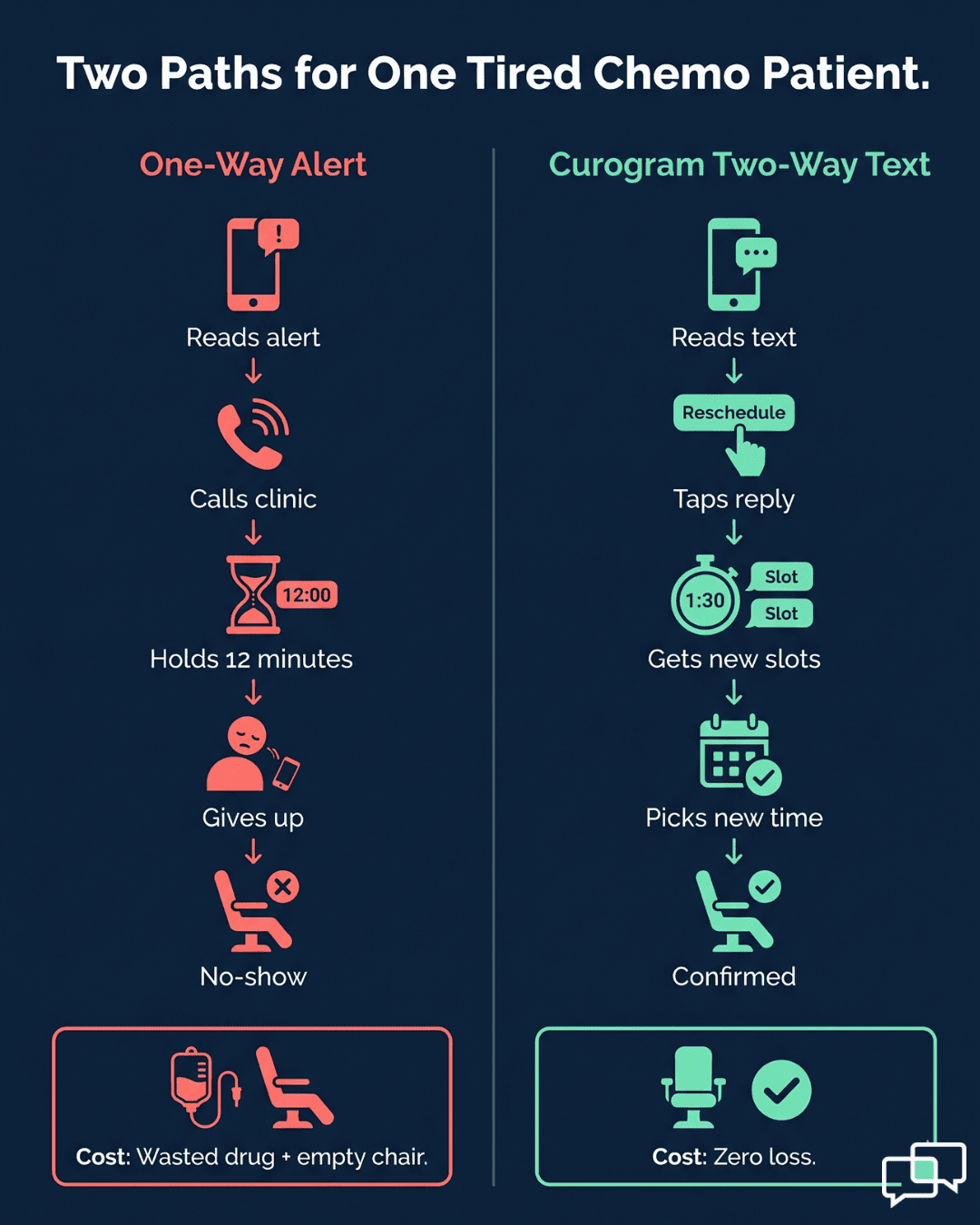
Side-by-side flowchart comparing one-way alerts versus Curogram two-way texts for chemo patient rescheduling

How It Ties Back to Flatiron Health

Curogram does not replace Flatiron Health. It sits next to it. Flatiron Health is where the schedule, protocols, and clinical notes live. Curogram is the layer that lets the patient respond.

When a patient confirms by text, that confirmation flows back to OncoEMR. There is no double entry. When a patient reschedules, your staff updates OncoEMR while still on the text thread. The new time then goes out as a fresh confirmation message.

Your clinical workflow does not change. Your staff just stops chasing patients by phone.

What the Patient Gets

Here is how the patient experience compares before and after two-way texting.

Before Curogram

With Curogram

One-way alert, no reply option

Clear question with simple reply choices

Calls and waits on hold

Texts back in seconds, gets a quick answer

Reschedules outside the system or skips

Reschedules in the same thread, synced to OncoEMR

Feels like a number on a list

Feels heard and respected


The Flatiron Health patient reminder experience oncology teams have always wanted is one where the patient feels like a partner. Two-way texting makes that real. It gives the patient a voice that fits in 12 characters or less. It gives your staff a real-time view of who is coming and who needs help.

This is what The Text That Listens Back means. It is not a tool. It is a small act of respect, sent at the right time.

The Success: No More Guessing Who Will Show

Based on our internal data, Curogram users see an average appointment confirmation rate above 75% across current clients. That alone reshapes the workflow. When three out of four patients confirm or update before the day of service, your day starts with clarity, not guesswork.

The Numbers Tell a Real Story

Look at what happened at Covina Arthritic Clinic, which runs a high-volume specialty schedule. Before two-way texting, they confirmed about 369 appointments per month using manual outreach. After Curogram, that number jumped past 1,100 confirmed appointments per month, with peaks above 1,300.

That is not a small lift. It is a 3x to 4x change in how many patients give a clear answer before showing up. For an oncology practice running infusions, that level of certainty means fewer wasted drugs, fewer empty chairs, and a calmer infusion suite.

Metric

Before Two-Way Texting

After Curogram

Monthly confirmations

369

1,100–1,300+

Confirmation rate

Low and slow

>75% on average

Staff time on confirmations

Heavy, manual

Light, automated


Now look at no-shows. Atlas Medical Center cut their no-show rate from 14.20% in March 2023 to 4.91% in June 2023, based on our internal research. That is a drop of more than 9 percentage points in three months.

Across all Curogram clients, no-show rates run 53% lower than the industry average. For oncology, that is huge. Each prevented no-show is a saved infusion drug, a saved staff hour, and a treatment that stays on schedule.

What the Schedule Looks Like, Day by Day

Picture a Monday morning at an oncology clinic. The schedule has 28 infusion slots booked across two pods.

Without two-way texting, the lead nurse walks in not knowing who will show. The team makes coffee, then starts calling. By 10 a.m., they have reached 12 patients. Three have already left voicemails saying they cannot come. Two are no-shows the team did not see coming. Two infusion bags are mixed for patients who never arrive.

With two-way texting, the picture shifts. By Sunday night, 22 of the 28 patients have already replied. Eighteen said Yes. Three said Reschedule and have already been moved to Tuesday slots. One said Unsure, and the team called her at 8 a.m. to check in. The remaining six get a quick Are you still on for today? text at 7 a.m.

By the time the team arrives, they know the day. The pharmacist mixes drugs only for confirmed patients. The nurse manager fills two open slots from the standby list. The day starts with calm, not chaos.

Beyond the Numbers: What Staff Notice

Numbers are easy to count. Mood is harder. But staff often notice the change first.

The phones ring less. The voicemail box clears faster. The infusion suite feels less rushed in the morning. Schedulers stop chasing and start planning. The clinical team has more time to focus on the patient in the chair, not the patient who did not show.

Patients notice too. They feel like the clinic is paying attention. They feel like their reply matters. That builds the kind of trust that keeps them on protocol, even when treatment gets hard.


Calm oncology infusion suite prepped for confirmed patients with nurses reviewing tablets in soft morning light

Why Curogram Fits Oncology Teams Better Than One-Way Tools

Curogram was not built as a generic reminder tool. It was built around the messy reality of patient communication, then sharpened for high-stakes specialties like oncology. That focus shows up in three ways.

First, Curogram is fully two-way by default. Every reminder is a short conversation, not a broadcast. Patients reply in the same thread, and staff sees responses on a single dashboard tied to OncoEMR. There is no app for the patient and no second screen for your team.

Second, Curogram speaks to Flatiron Health directly. Confirmations flow back into OncoEMR with no double entry. Reschedules update the chart in real time. Your clinical source of truth stays clean while patients get the freedom to reply.

Third, Curogram treats security as a baseline, not an upsell. Every text runs under a full HIPAA Business Associate Agreement and SOC 2 Type II controls. Audit logs, encryption, and consent tracking are built in from day one.

Based on our internal data, the impact stacks up fast. Curogram clients hit a >75% average confirmation rate. Atlas Medical Center cut no-shows from 14.20% to 4.91% in three months. Covina Arthritic Clinic moved from 369 to over 1,100 confirmed appointments per month. Across all clients, no-show rates run 53% lower than the industry average.

For oncology, those numbers translate into fewer wasted drugs, calmer infusion days, and patients who feel partnered with rather than pushed through. Your scheduler stops chasing. Your nurses start their shift with a clear board. Your patients text back the way they already text everyone else.

That is the difference between a reminder system that talks and one that listens. Curogram listens.

Conclusion: Respect the Patient's Reality

One-way reminders treat patients like a list. Two-way confirmation treats them like people. That is the core shift here.

When a patient gets a CareSpace alert with no reply option, the practice is saying, We will tell you what to do. When a patient gets a Curogram message with a Reply YES, NO, or RESCHEDULE prompt, the practice is saying, We want to know what works for you. Same channel. Very different message.

Flatiron Health is built for clinical decisions. It holds the chart, the protocol, and the schedule. It is the brain of the oncology practice.

Curogram is built for patient response. It is the voice that asks, listens, and acts. Together, they cover both sides of care: the clinical plan and the human reality of carrying it out.

For oncology patients, that human reality is heavy. They are managing fatigue, side effects, lab visits, and big emotions. The last thing they need is a phone tree. The first thing they need is a way to say I cannot make Tuesday without spending energy they do not have.

Two-way texting gives them that. It is small. It is simple. It is the kind of dignity that costs your practice almost nothing and gives back trust, time, and revenue. Stop asking tired patients to navigate hold music. Let them text back.

Give your chemo patients the dignity of a reply button. Schedule a demo and watch real two-way text threads from oncology practices already using Curogram.


Frequently Asked Questions

How will my patients know what to text back?
The prompt does the work for you. Curogram messages spell it out: Reply YES, NO, or RESCHEDULE. Most patients reply correctly on the first try because the choices are short and clear. If a patient is unsure, your staff can follow up with a quick text or call.
How does staff handle a patient who texts Reschedule?
Staff sees the reply on the Curogram dashboard within seconds. They can text back open times right there: Wednesday 10 a.m. or Thursday 2 p.m.? The patient picks one. Staff updates OncoEMR once and sends a fresh confirmation. The whole exchange usually takes under two minutes and skips the phone call.
How does Curogram stay HIPAA-compliant during text confirmations?

Curogram operates under a full HIPAA Business Associate Agreement and is SOC 2 Type II certified. All texts are encrypted, logged, and tied to an audit trail. Patients opt in at enrollment and can text STOP any time to opt out. Compliance is built in from the start.

Why do oncology patients respond better to texts than to portals?

Portals require a login, a password, and often an app. After a hard chemo session, that is too many steps. Texting is what patients already do all day, every day. Meeting them in that channel removes friction at the worst possible moment to add it.

How fast can my practice see results after switching?

Most practices see meaningful changes within the first 30 to 60 days. Based on our internal research, Atlas Medical Center cut their no-show rate from 14.20% to 4.91% in just three months. Confirmation rates above 75% are common across our active clients within the first quarter.