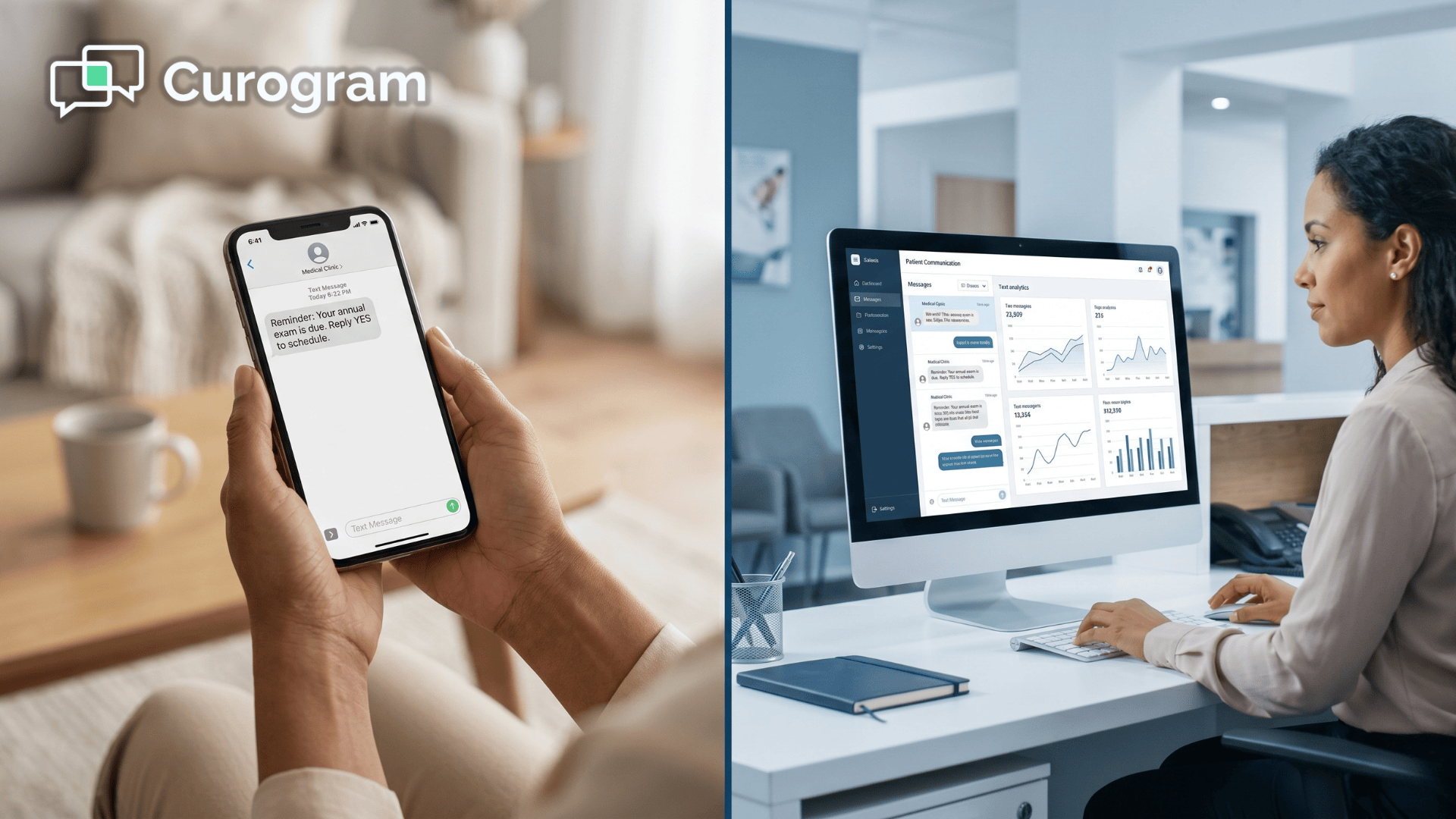
8 min read
Veradigm EHR Mass Messaging | Reach 100% of Your Panel
Aubreigh Lee Daculug
:
April 24, 2026
FollowMyHealth campaigns only land with 20–35% of your panel — the ones who downloaded the app.
Curogram sends broadcast text messages to every patient with a phone number, no portal login required.
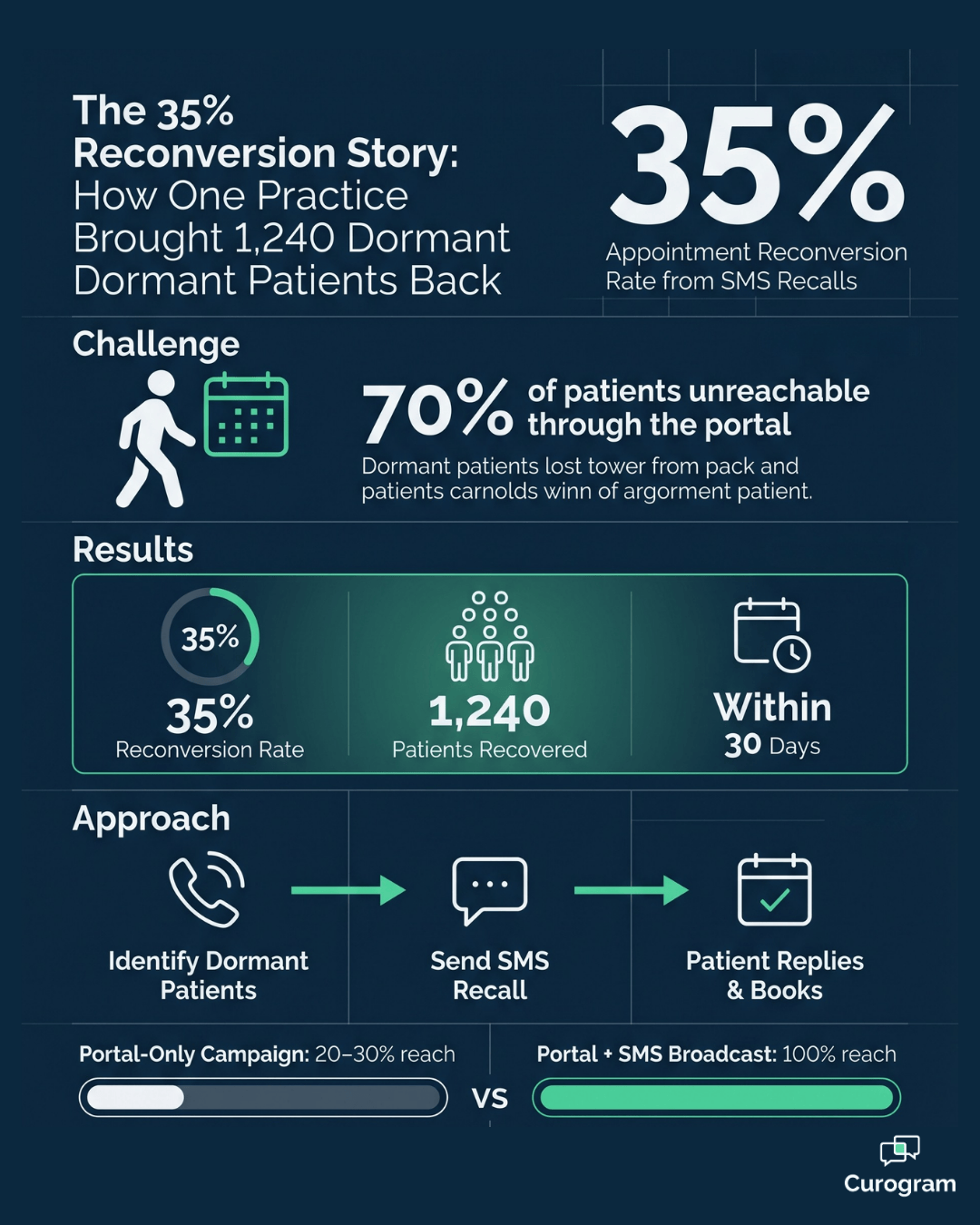
Practices using text-based recalls have hit a 35% appointment reconversion rate and recovered 1,240+ dormant patients.
Together, FollowMyHealth plus Curogram give you 100% panel coverage in one simple communication strategy.
Picture this.
Your team just spent three weeks building a beautiful annual wellness recall campaign in FollowMyHealth.
The copy is polished. The timing is perfect. You hit send.
Then you check the dashboard. Only 28% of your patients even received it.
The other 72%? They never downloaded the portal app. They never created a login. Your campaign is invisible to them.
This is the quiet frustration running through medical practices on Veradigm EHR right now. You built your practice to serve a full panel of patients. But your best engagement tools only reach the slice that opted into digital tools.
Meanwhile, the patients who need recalls most — the ones who haven't booked a preventive visit in a year, the ones skipping annual exams, the ones ghosting their care plan — are exactly the patients least likely to use a portal.
It sounds like a technology problem. It isn't. It's a reach problem.
A Veradigm EHR mass messaging recall campaign patient outreach text strategy only works if it actually lands in the place where patients look. And for 70% of your panel, that place is a text message — not a portal notification buried inside an app they never opened.
This guide walks through why portal-based campaigns fall short, what complete-panel coverage actually looks like, and how practices are quietly adding a broadcast messaging layer that turns dormant patients into scheduled appointments.
You'll see real numbers, real workflows, and a clearer path to engaging every patient in your database.
Not just the 30% who already love you. All of them.
Why Your Best Campaigns Are Reaching the Wrong People
Where Portal-Based Campaigns Hit a Wall
FollowMyHealth is a strong patient engagement platform. The Mobile Patient Experience (MPE) gives you annual exam reminders, wellness recalls, seasonal campaigns, and reactivation outreach — all built into a clean digital experience.
The tool isn't the problem. The delivery channel is.
Every campaign routes through the patient portal or the mobile app. If a patient enrolled, created a login, and kept the app installed, your message lands. If they didn't, your message effectively disappears into a system they don't check.
Industry data from ONC puts patient portal adoption in ambulatory settings somewhere between 20% and 35% of the average panel.
That means if your practice has 10,000 active patients, your campaigns are actively reaching around 2,000 to 3,500 of them. The remaining 6,500 to 8,000 are sitting outside your digital reach.
And here's the part that stings.
The patients outside your portal reach tend to be the ones with the highest recall value:
- Patients overdue for annual exams
- Patients skipping preventive wellness visits
- Dormant patients who haven't scheduled in 12–18 months
- Older patients less likely to adopt mobile apps
Your most valuable outreach targets are your hardest patients to contact. That's the gap worth solving.
The Manual Workaround Nobody Budgets For
When portal campaigns fall short, staff fill the gap manually. Phone calls to confirm annual exams. Printed letters for flu shot reminders. One-off emails for patients who never opted in.
This costs most Veradigm practices between 5 and 10 hours per week, per location. For a 10-location group, that's easily 60 to 100 staff hours every week spent on tasks a text message could handle in seconds.
| Outreach Method | Typical Response Rate | Staff Time Required |
|---|---|---|
| Portal notification | 15–25% | Low (automated) |
| Phone call | 10–20% | High (5–10 min per call) |
| Printed letter | 5–10% | Medium (materials + mailing) |
| Broadcast text | 60–80% | Low (automated) |
For your team, this means the manual workaround isn't just inefficient. It's pulling staff away from revenue-generating tasks like scheduling, intake, and patient-facing service.
The Revenue Leak Hiding in Plain Sight
Dormant patient reactivation is one of the highest-ROI activities in an ambulatory practice.
Every missed annual exam.
Every skipped preventive visit.
Every unrecommended wellness service. They all represent 3–6 months of lost revenue per patient.
Here's a realistic example.
A practice with 10,000 active patients and a 70% unreachable rate through the portal has around 7,000 patients it can't campaign to effectively.
If just 5% of those patients would book a $200 appointment from a text recall, that's $70,000 in a single campaign cycle.
For multi-location practices running seasonal recalls two to four times a year, the annualized gap often lands between $50,000 and $150,000.
That's real money being left on the table because the campaign never reached the inbox.
The Broadcast Messaging Layer Built for Complete Coverage
A Second Channel That Doesn't Depend on the Portal
Here's the simple idea behind an Allscripts Professional mass text patient recall strategy that actually works. If your campaign tool depends on portal enrollment, you need a second layer that doesn't.
That's where Curogram fits in.
Curogram is a HIPAA-compliant broadcast messaging platform that sends text reminders, recalls, and seasonal campaigns to every patient with a phone number.
No portal login. No app download. No opt-in preregistration.
The message lands in the SMS inbox — the one place almost every patient checks every day.
Think of it this way.
FollowMyHealth is the rich engagement layer for your digital-first patients.
Curogram is the complete-panel broadcast layer for everyone else. Used together, they solve the Veradigm patient outreach beyond portal problem in one clean strategy.

How the Integration Actually Works
Curogram syncs patient contact data from your Veradigm EHR in real time. Phone numbers, communication preferences, appointment history — all flowing automatically into the messaging platform.
You build a campaign once, then set the audience you want to reach:
- All active patients across the practice
- Patients overdue for an annual exam or preventive visit
- Patients tied to a specific location, provider, or specialty
- Dormant patients who haven't scheduled in 12+ months
Schedule the send, and Curogram handles the rest. When patients reply — confirming, rescheduling, asking a question — those responses flow back into Curogram's dashboard.
Critical actions like appointment confirmations can sync with your Veradigm scheduling and practice management system, so your front desk isn't retyping information into two places.
For practices running a medical practice recall campaign text SMS strategy across multiple sites, this matters.
You get centralized broadcast control with location-level flexibility. Send a network-wide flu shot campaign in October.
Layer a site-specific annual exam reminder for Location 4. Track response rates across every campaign in one dashboard.
Built for Multi-Location Ambulatory Groups
Ambulatory groups with 5–20 locations face a specific challenge. You need campaign consistency across all sites, but also the ability to run local campaigns when needed.
Curogram supports both.
Account-level campaigns push a single message to every patient across the entire network.
Location-specific campaigns let individual sites handle their own seasonal outreach without creating duplicate work at the corporate level.
In practice, this means your October flu campaign reaches every patient in your full panel the same day. Your December annual exam push reaches only patients overdue for a preventive visit. Your reactivation campaign targets only dormant patients.
All through broadcast text. All tracked in one place.
.png?width=1920&height=1080&name=Veradigm%20EHR%20mass%20messaging%20recall%20campaign%20patient%20outreach%20text%20-%20landscape%20(1).png)
What Complete Coverage Looks Like in Real Numbers
A Real Practice, Real Results
Let's talk about what actually happens when practices add broadcast text to their campaign strategy.
One multi-location Curogram client ran a text-based recall campaign targeting dormant patients who hadn't booked a follow-up within the recommended timeframe.
The result?
A 35% appointment reconversion rate and 1,240 patients recovered from recall messages alone.
Compare that to portal-only campaigns, which typically see 10–20% response rates among enrolled patients, and a reach ceiling of 30% of the panel.
The Math of 30% vs 100%
The shift from portal-only to a two-layer strategy changes almost every metric that matters.
Panel reach jumps from 20–35% to nearly 100%.
Average response rates climb from 10–20% into the 60–80% range.
Appointment confirmation rates move from 20–30% up to 75% and higher.
Dormant patient recovery stops being a low, inconsistent effort and becomes a predictable, scalable revenue stream. Staff time per campaign drops from 5–10 hours per week to under 1 hour.
In practice, this means abandoned appointment slots start filling. Preventive care recommendations actually drive bookings. Dormant patient recovery turns into a steady revenue stream instead of a monthly round of phone tag.
The Veradigm EHR Broadcast Messaging All Patients Effect
The real unlock isn't just about reach. It's about the compounding effect of reaching your entire panel every time you run a campaign.
When you can run Veradigm EHR broadcast messaging all patients consistently, every seasonal campaign becomes an opportunity. Every annual exam window becomes a revenue moment. Every reactivation push connects with patients your portal can't touch.
For a practice seeing 10,000 patients a year, shifting from 30% panel reach to 100% means roughly 7,000 additional patients can receive a timely recall. If even 5% of those book a visit at an average of $200, that's $70,000 in recovered revenue per campaign.
Run four campaigns a year and you're looking at $280,000 annually — from patients already in your database.
That's not new patient acquisition. That's recovering the patients you already have.
Stop Running Campaigns That Reach 30%
Here's the bottom line.
A FollowMyHealth campaign reach limitations problem isn't solved by working harder inside the portal. It's solved by adding a second layer that reaches the patients the portal can't.
You built a practice to serve a complete panel. Your campaigns should reach one too.
Curogram slots into your Veradigm EHR workflow as the broadcast messaging layer that closes the gap. Portal-enrolled patients keep getting the rich FollowMyHealth experience. Everyone else gets a clean, direct text message that lands in the inbox they actually check.
The result is simple. Higher response rates. Lower staff workload. Appointment slots that used to sit empty now filled. Dormant patients who used to slip through now coming back for care.
For practices running multi-location recall campaigns, seasonal outreach, or network-wide reactivation initiatives, this is the difference between a campaign that reaches a sliver of your panel and one that reaches all of it.
You don't have to rip out FollowMyHealth. You don't have to rebuild your workflows. You just have to stop leaving 70% of your patients outside your reach.
One integrated communication strategy. Two layers. 100% of your patients engaged.
The campaigns you've already built can do so much more. They just need to reach everyone.
Schedule your demo today and see the difference broadcast messaging makes — starting with your next recall campaign.
Frequently Asked Questions
Curogram's SMS infrastructure is fully HIPAA-compliant and built around TCPA-compliant consent and opt-out workflows. Messages are encrypted in transit and at rest. Patient phone numbers pull directly from your Veradigm EHR under the existing care relationship, which qualifies for the established-relationship consent standard. Patients can reply STOP at any time to unsubscribe from future messages. For pure marketing campaigns like reactivation outreach to long-dormant patients, explicit opt-in consent is required, and Curogram's workflows handle that tracking for you. Compliance documentation and integration guidance come standard during onboarding.
Yes, and this is one of the biggest differences from portal-only campaigns. Curogram enables full two-way texting. When a patient replies to a recall or campaign message, the response lands in the Curogram inbox where your staff can reply in real time. They can answer quick questions, handle rescheduling, and process opt-outs without picking up the phone. For Veradigm EHR practices, critical actions like appointment confirmations or clinical questions can be escalated to the right staff or logged back to the chart based on your workflow setup.
Curogram is complementary, not a replacement. Keep FollowMyHealth for the 30% of patients actively using the portal — they get the full suite of features including messaging, scheduling, records access, and telehealth. Add Curogram for the 70% who haven't adopted the portal and likely never will. The combined setup is far more powerful than either tool alone. FollowMyHealth handles rich engagement for your digital-first patients. Curogram handles universal reach for everyone else. One integrated patient communication strategy, 100% panel coverage.
Most practices are up and running in under two weeks. Implementation includes connecting Curogram to your Veradigm EHR through the open API, syncing patient contact data, and configuring your first campaign templates. Staff training typically takes about 10 minutes per user because the interface is built to feel familiar — it works like a standard texting app on the front end. There's no need to migrate off FollowMyHealth, rebuild your existing campaigns, or pause your current outreach. You keep running your portal campaigns while Curogram layers broadcast text coverage on top for the patients FollowMyHealth can't reach.
Yes. Curogram supports flexible audience segmentation that pulls directly from your Veradigm patient data. You can target by location (all patients at Site 3), by appointment history (everyone overdue for an annual exam), by provider (patients assigned to Dr. Chen), or by custom criteria you define (patients who haven't scheduled in 12+ months). For multi-location ambulatory groups, this means one practice can run a network-wide flu campaign while individual sites run location-specific recalls — all from the same dashboard. Segmentation is the difference between blasting every patient with the same message and sending the right message to the right patient at the right time.