

9 min read

Opus EHR Review Management for Referrals | Close the Google Gap

Opus EHR Review Management for Referrals | Close the Google Gap
💡 Opus EHR has no built-in review management tools. This leaves behavioral health and SUD treatment facilities exposed at the most important moment in the referral process: the Google search.

Hospital discharge planners, court liaisons, and EAP coordinators check your Google profile before sending patients your way. A thin profile with old reviews quietly kills referrals you never knew you had.

Curogram fills this gap by automating post-appointment surveys via SMS. Happy patients get routed to Google Reviews. Unhappy patients get routed to private feedback.

The system runs in the background alongside Opus EHR, with no extra work for clinical or admin staff. One multi-location practice generated 1,064 new 5-star reviews in just 3 months, based on our internal data.

Your clinical director just spent 45 minutes on the phone with a hospital discharge planner. She walked through your IOP curriculum, your staff credentials, and your treatment outcomes. The planner sounded impressed. She promised to keep your facility top of mind.

Two weeks pass. Nothing shows up in the referral log.

Here's what happened. The planner Googled your facility. She saw 18 reviews and a 3.4-star rating.

She also saw a 1-star review from 2021 about a billing dispute. The facility across town had 340 reviews and a 4.8-star rating. She sent the patient there instead.

This is the referral blind spot. Program directors invest heavily in referral relationships, then lose those referrals at the Google search stage.

The cause? Opus EHR has no native review management workflow. There is no automated patient survey system. There is no way to turn clinical wins into public proof.

For behavioral health and SUD treatment facilities, this gap is brutal. Each empty residential bed costs $10,000 to $20,000 per month.

Each unfilled IOP slot runs $250 to $400 per session. Stigma also keeps many recovery patients from posting reviews on their own.

This is where Opus EHR automated review management referral reputation behavioral health workflows change everything. Curogram integrates alongside Opus EHR to send post-appointment SMS surveys.

Satisfied patients route directly to Google. Dissatisfied patients route to private feedback. Program directors keep building referral relationships, while the Google profile silently closes the deal.

The result? One multi-location practice generated 1,064 new 5-star reviews in 3 months, based on our internal data.

In this article, you'll learn how this works, why it matters for SUD treatment, and what your team needs to do next. 

The Villain: The Referral Blind Spot

Program directors often assume referrals come from relationships alone. The truth is more uncomfortable.

Nearly every referral source Googles your facility before completing the recommendation. Without a system to manage that public profile, your best outreach work gets undone in seconds.

The Reality of the Opus EHR Gap

Opus EHR gives behavioral health programs the clinical tools they need. You get intake, documentation, e-prescribing, and billing through PracticeSuite.

What you don't get is any native review solicitation, patient survey system, or reputation workflow.

So program directors build referral pipelines the old way. They attend conferences. They host lunch-and-learns with hospital social workers. They meet with court liaisons. They assume the relationship drives the referral.

The blind spot sits in plain sight. Every referral source checks Google before finishing the recommendation.

A thin profile with 18 reviews and a 3.4-star rating quietly kills referrals the program director never learns about.

Why Stigma Makes This Worse

Behavioral health patients rarely post reviews on their own. The stigma of addiction and mental health treatment keeps them quiet.

Without a private, respectful nudge, their stories stay invisible. Meanwhile, the rare disgruntled patient is much more likely to post unprompted.

What Referral Sources Actually See

Hospital discharge planners look at recency, volume, and star rating. A facility with 340 fresh reviews looks alive.

A facility with 18 stale reviews looks like a question mark. Court liaisons and EAP coordinators do the same scan.

The Agitation: A Day in the Life of a Lost Referral

Picture this. Your clinical director finishes that 45-minute call. The planner promises to keep the facility in mind. Two weeks later, nothing.

She didn't forget. She did her homework. She Googled your name, saw a 3.4-star rating, and clicked the listing across town instead. Your relationship-building got undermined by a Google profile no one on your team is managing.

This referral development online reputation behavioral health gap is the silent killer. Marketing pours budget into outreach.

Clinical leaders pour hours into relationship work. The Google Business Profile sits unmanaged.

The Consequence: Empty Beds and Lost Revenue

For behavioral health facilities, empty beds are a financial emergency. Each unfilled residential bed runs $10,000 to $20,000 per month. Each missed IOP session costs $250 to $400.

Healthcare prospect data shows facilities with 1.8, 2.5, and 2.9-star ratings actively shopping for reputation tools. Their low scores are directly hurting patient acquisition. The referral drought is invisible, which makes it worse.

The Result: Wasted Outreach

Your program deserves a better online presence. Your treatment outcomes already speak for themselves.

But without a system to turn patient satisfaction into Google reviews, the funnel leaks at the validation stage.

The best referral development in behavioral health falls flat if the Google profile doesn't close the deal.

Strong program director of reputation management in Opus workflows fix this. They turn every appointment into a quiet chance to build proof.

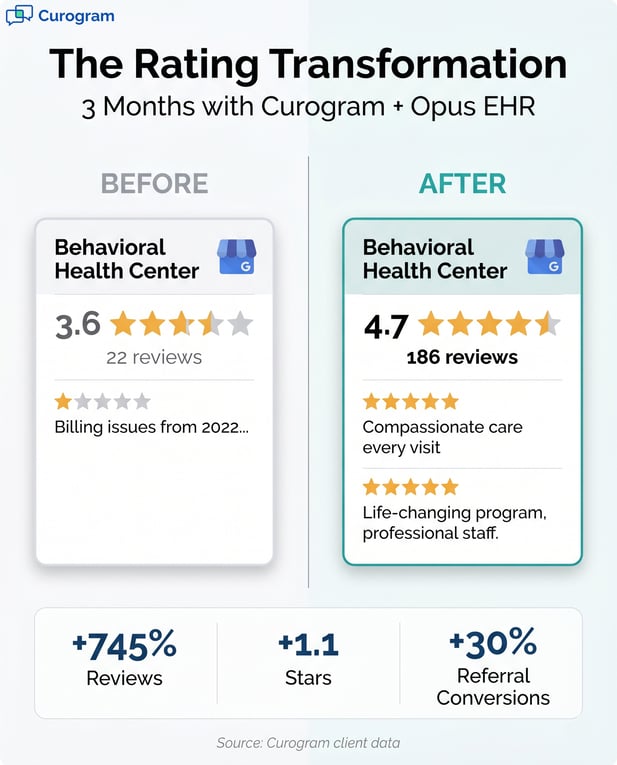
Before/After comparison of behavioral health center Google rating and review count increase

The Guide: The Referral Closer

Closing the Google gap doesn't require more staff hours. It requires a system that runs in the background.

Curogram serves as the referral closer for Opus EHR practices, building the public proof your referral sources already check.

The Solution: Automation Without Extra Work

Curogram is an automated reputation management system designed for behavioral health and SUD treatment facilities. It sends post-appointment surveys via SMS.

Satisfied patients route directly to Google Reviews. Dissatisfied patients route to private feedback for service recovery.

The system runs after every appointment. There are no manual emails, no awkward in-person asks, and no extra steps for clinical staff.

Program directors keep their focus on referral relationships while the Google profile gets stronger every week.

Why SMS Works for Recovery Patients

Text messages get opened. Email gets ignored. For behavioral health patients, a quick, private text feels safer than a public ask in the lobby.

Why Survey-First Matters

The survey gate is the secret. Patients self-identify their experience before they reach Google. That structure protects your rating while still respecting the patient voice.

The Feature: Automated Patient Survey and Review Pipeline

Curogram's automated review solicitation behavioral health workflow runs in three steps. First, the patient receives a text asking about their experience. Second, happy patients tap once and land on your Google Reviews page.

Third, unhappy patients are routed to private feedback. This gives your team a chance to address concerns before they go public. The result is an honest Google profile built from real positive experiences.

This review management workflow addiction treatment design respects both patient privacy and clinical reality. Patients who want to share, share. Patients with concerns get heard privately first.

The Integration: Background Operation Alongside Opus EHR

Curogram plugs into the Opus EHR appointment workflow. When an appointment is marked complete, the survey triggers automatically. Staff do not need to remember anything.

The system runs continuously, generating reviews at a steady pace. This sends a clear signal to Google's algorithm: this practice is active and trusted. Steady review velocity is one of the strongest local search ranking factors there is.

Implementation takes days, not months. Staff training runs under 10 minutes.

The Google Business Profile referral conversion SUD pipeline starts working from the first completed appointment.

The Behavioral Health Referral Fit

For SUD treatment facilities, the referral ecosystem is more concentrated than general medicine. Hospital discharge planners, court liaisons, EAP coordinators, and insurance case managers each influence dozens of placements per month. A single referral source might send 5 to 10 patients per quarter.

When that source Googles your facility and finds a strong profile, the referral closes. When they find a thin profile, it doesn't. The math is simple and the stakes are high.

The referral source Google validation Opus EHR pipeline is the missing link. Curogram builds the profile that backs up every conversation your program director has.


The Success: The Referral Multiplier

When the Google profile finally matches the clinical reality, something shifts. Referrals stop leaking at the validation stage. Outreach starts converting. This is the referral multiplier effect.

The Metric: Real Numbers from Real Practices

A multi-location practice using Curogram generated 1,064 new 5-star reviews in just 3 months, based on our internal data.

Roughly 90% of surveyed patients left 5-star reviews. The practice grew from about 993 baseline reviews to 8,159 total reviews.

You don't need numbers that big to see results. Even 50 new 5-star reviews in the first month can push your rating above 4.5 stars.

That single shift transforms what every referral source sees when they validate your facility.

What Volume Signals to Google

Google's algorithm favors review volume, recency, and rating. A steady stream of new reviews tells Google your practice is active. That signal boosts your visibility in local Maps results.

What Volume Signals to Referral Sources

Hospital discharge planners look at the same signals. A practice with 300 recent reviews looks busy and trusted. A practice with 22 old reviews looks dormant.

The Shift: From Relationship-Only to Relationship-Plus-Proof

The transformation comes from pairing two things. Your program director still builds referral relationships through conferences, lunch-and-learns, and direct outreach.

But now every conversation gets backed up by a Google profile that closes the deal.

Hospital discharge planners Google your facility and find proof of what your team claimed in meetings. Court liaisons see a facility that other patients publicly recommend. EAP coordinators see review velocity that signals active, quality treatment.

This is the visible difference automated review management delivers. The clinical reality and the online reality finally line up.

The Outcome: A Real Quarterly Review

Picture the quarterly referral review at an Opus EHR behavioral health facility running Curogram.

Three months ago, the Google profile had 22 reviews and a 3.6-star rating. Today, it has 186 reviews and a 4.7-star rating.

Metric

Before Curogram

After 3 Months

Change

Total Google Reviews

22

186

+745%

Average Star Rating

3.6

4.7

+1.1 stars

Referral Conversions

Baseline

+30%

Significant

New Referral Relationships

None tracked

2 inbound

Organic


The admissions director reports a 30% increase in referral conversions. This is not from more outreach. It's from more referrals completing the validation stage successfully.

Two new referral relationships were also formed organically. Hospital discharge planners found the facility through Google Maps and reached out directly. The Google profile became the silent closer that the program director always needed.

That's the power of treating reputation as infrastructure, not as a marketing afterthought. Steady automation builds proof over time. And proof builds referrals at scale.

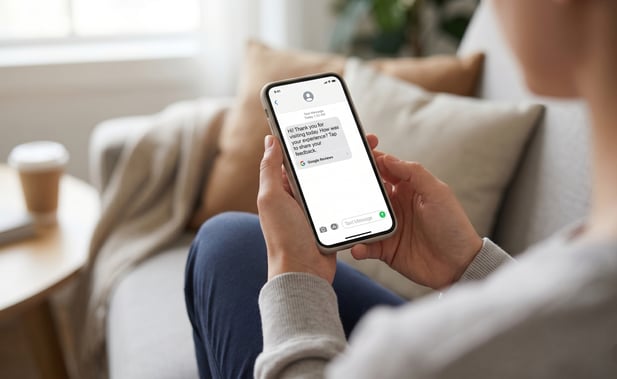
Close-up of patient on couch holding smartphone with automated feedback request via SMS text

Conclusion: Close the Google Gap in Your Referral Pipeline

Your referral sources are Googling your facility right now. The question is simple: Does what they find help close the deal or kill it?

For behavioral health and SUD treatment facilities, this is not a small marketing issue. It's a revenue and access issue.

Empty beds, unfilled IOP slots, and lost referrals all trace back to the same weak link: an unmanaged Google Business Profile.

The villain is the referral blind spot. Program directors invest in referral source relationships, then lose those referrals at the Google search stage. Opus EHR provides excellent clinical tools but no native review management workflow.

The guide is Curogram. The automated patient survey and review pipeline runs in the background alongside Opus EHR.

Satisfied patients route to Google. Unhappy patients route to private feedback.

The success is the referral multiplier. One multi-location practice generated 1,064 new 5-star reviews in 3 months, based on our internal data.

A typical Opus EHR practice saw a 30% increase in referral conversions over a single quarter.

Opus EHR is for your clinical outcomes. It supports the treatment that changes lives. Curogram is for their validation, the online reputation that proves to referral sources what your team demonstrates in meetings.

Both matter. Neither replaces the other. Together, they close the gap between treatment quality and treatment visibility.

The behavioral health and SUD treatment market is more competitive than ever. New facilities open every quarter with bigger marketing budgets and louder online presences. Your clinical excellence cannot stay invisible.

Stigma also keeps your patients quiet by default. Without a respectful, private system to invite reviews, the only voices online will be the rare unhappy ones. A strong review profile gives your patients an easy way to help others find quality care.

Referral sources are not waiting. They're scanning Google profiles right now. They're making placement decisions in minutes, not days.

Your referral sources are Googling your facility before recommending it. Make sure what they find closes the deal, not kills it. That work starts with one short conversation.

A 15-minute demo will show you exactly how this works. You'll see how every completed appointment becomes a chance to strengthen the online reputation referral sources trust. You'll see the dashboard your program director will check each week.

You'll also see how Curogram fits alongside Opus EHR without creating new staff tasks. No extra training. No workflow disruption.

Just steady, automated proof building behind every referral relationship your team works hard to develop.

The referral drought is invisible until it isn't. Don't wait until census drops to fix the Google gap.

Book a Demo and see how Curogram turns referral relationships into admissions. Your clinical excellence deserves to be seen.  


Frequently Asked Questions

How does automated review solicitation comply with HIPAA and 42 CFR Part 2 for behavioral health patients?

Curogram's review request SMS never identifies the facility as a behavioral health or SUD provider. It simply asks about the patient's experience at the facility by name.

All SMS communications run through Curogram's HIPAA-compliant platform with a signed BAA in place. Patients choose what to share in their own words, with no treatment details disclosed at any step.

Why won't this create extra work for our program directors or clinical staff?

The automated survey triggers after appointment completion with zero staff involvement. No one needs to ask, remind, or follow up with patients. Program directors get a weekly dashboard showing review volume, average rating, and flagged feedback. Implementation takes days, not months, and staff training runs under 10 minutes.

How does the system handle negative reviews without filtering or manipulating feedback?

The survey-first approach routes patients who report a negative experience to private feedback channels. This gives your team a chance to address concerns directly before they reach Google.

This is service recovery, not review suppression, which is fully aligned with Google's review policies. The strong volume of authentic positive reviews provides context for any negative reviews that do appear publicly.

Why do behavioral health patients hesitate to leave Google reviews on their own?

Stigma around addiction and mental health treatment keeps many patients quiet. Most don't want to publicly identify themselves as recovery patients.

A private SMS invitation feels safer than an in-person ask or a public prompt. Patients also control exactly what they share, which respects their privacy at every step.

How quickly can our facility see results after launching Curogram alongside Opus EHR?

Most practices see meaningful review growth within the first 30 days of going live. Even 50 new 5-star reviews in month one can push a rating above 4.5 stars.

Referral conversion improvements typically show up in the second or third month as more sources find the stronger profile. Implementation runs in days, so the timeline to first results is faster than most expect.