


9 min read
Automated Reminders for Opus EHR: Keep IOP Groups Full & No-Shows Down
Jo Galvez
:
May 27, 2026
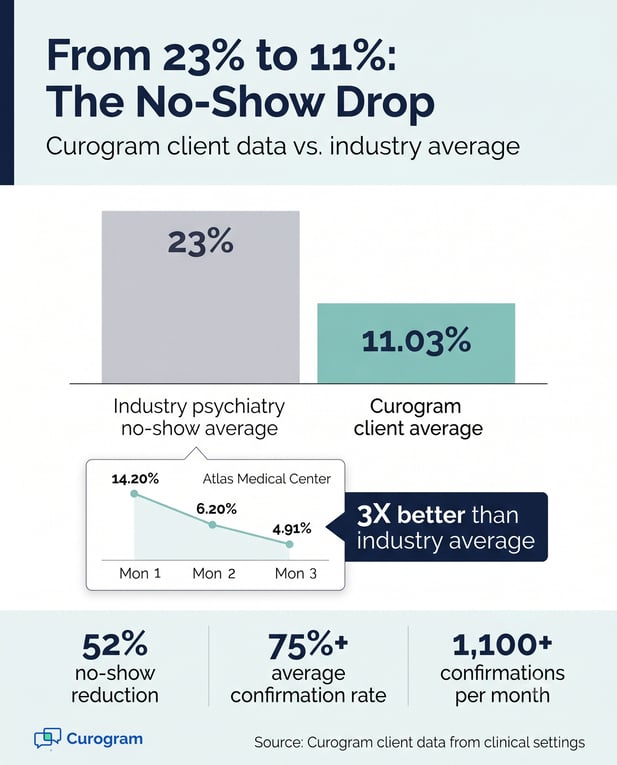
The system works for IOP groups, MAT visits, and PHP day programs. Patients confirm or reschedule by text, and staff see updates in real time. Based on our internal data, Curogram clients cut psychiatry no-show rates to 11.03% versus the 23% industry average. That is a 52% drop, with zero manual staff effort needed daily.
It is 8 AM on a Monday. The PHP coordinator scans the schedule and sees 18 patients booked for the day. By 9 AM, only 14 walked through the door. The other four never got their reminder, or got one at 2 AM.
This is not a small issue. In behavioral health, every empty chair carries weight. IOP groups need a full cohort for the therapy to work as designed. MAT visits cannot be missed without risking relapse.
Opus EHR users have flagged this gap for a while. Reminders that should land the evening before sometimes arrive in the middle of the night. PHP day programs lose their flow when the headcount is off.
That timing alone can rattle a patient in early recovery. Sleep disruption, anxiety, and confusion are the last things a fragile schedule needs.
Curogram steps in as the fix. It pairs with Opus EHR to send automated SMS reminders at the right hour, every time.
Patients reply yes or reschedule with one tap. Staff stop chasing confirmations and start running groups.
This guide walks through what breaks, what works, and what changes when reminders show up on time. You will see how automated SMS reminders addiction treatment programs trust can reduce no-shows behavioral health Opus EHR users have struggled with for years.
We will cover MAT appointment confirmation Opus workflows, IOP group attendance automation, and the behavioral health scheduling reminders SUD programs rely on. Real client data and clear use cases follow.
The Villain: The 3 AM Reminder Problem
Opus EHR appointment reminder bugs are not new to its users. The platform ships with a reminder feature, which is the right call for any behavioral health tool.
But the timing fails often, and the messages are sometimes never sent. Below, we break down what goes wrong and why it matters more in addiction care than in other fields.
What Users Report About Opus Reminders
User feedback shows a pattern of late-night sends, often between 1 AM and 4 AM. Some patients get no message at all.
The schedule looks fine on the back end, so the staff assumes the reminder went out. By the time the empty seat is noticed, the group has already started.
Why Timing Matters in Behavioral Health
Sleep is part of the treatment. A buzz at 3 AM can shake a patient who is days into recovery. Routine and calm are clinical tools, not just nice-to-haves.
A broken reminder does more than annoy. It can knock a person off balance during the most fragile stretch of care.
The Hidden Cost of False Confidence
When staff trust a reminder went out, they stop calling. When the reminder did not actually land, the patient does not show.
The gap between what the system says and what the patient saw is where revenue and care both leak. This is the trap of false confirmation.
The Daily Damage to Census and Revenue
Picture a busy SUD facility on a normal weekday. The IOP team expects 15 patients for the afternoon group. Three reminders went out at 2 AM. One never arrived.
By the time group starts, four chairs are empty. The math gets ugly fast. Outpatient no-show rates in SUD programs often run 30% to 50%.
For an IOP billing $250 to $400 per session and 40 daily slots, a 30% no-show rate means 12 empty seats a day.
|
Daily No-Show Impact (IOP Program) |
Lost Revenue Per Day |
Lost Revenue Per Month |
|
12 empty seats at $250 |
$3,000 |
$60,000 |
|
12 empty seats at $400 |
$4,800 |
$96,000 |
That is just the financial side. The clinical side is worse. IOP group therapy depends on a steady cohort to build trust and shared work.
When five out of fifteen seats sit empty, the dynamic shifts for everyone who did show up.
Why Staff Cannot Fix This by Hand
The first instinct is to assign someone to call every patient the night before. That works for small caseloads. It falls apart at 40, 60, or 100 daily appointments.
Manual calls also eat clinical hours. The MAT coordinator on the phone is not running medication checks. The PHP lead leaving voicemails is not prepping the day program.
Every minute spent chasing patients is a minute not spent on care, which makes the no-show problem feel like a staff problem instead of a tool problem.

The Guide: The On-Time Confirmation Fix
Curogram acts as a steady safety net beside Opus EHR. It does not replace the scheduling work your team already does in Opus.
It just makes sure the patient hears about the visit at the right hour, with a simple way to reply. Below is how the system works and why it fits SUD care so well.
How Automated SMS Reminders Work With Opus EHR
Curogram pulls appointment data straight from your Opus EHR schedule. There is no double entry. When a slot is booked, moved, or canceled in Opus, the reminder flow updates on its own.
Multi-Stage Reminders by Program Type
Reminders are set up by appointment type and timing. An IOP group can get a 24-hour and a 2-hour heads-up.
MAT visits can include medication notes. PHP day programs can send a morning roll-call text every weekday.
Two-Way Replies in Real Time
Patients reply to confirm or reschedule from their phone. The status updates on the dashboard right away.
If a patient needs to move the slot, staff see the request and act without the back-and-forth phone tag.
Why This Fits Addiction and Behavioral Health Care
In SUD treatment, reminders are not just polite nudges. They protect the rhythm of care. IOP needs 3 to 5 sessions per week to work. MAT depends on steady weekly or biweekly visits with no gaps.
Miss those and clinical progress stalls. Automated SMS reminders addiction treatment teams trust do more than fill seats.
They keep treatment plans on track. The system runs in the background so clinical staff focus on what they were trained to do.
What the Workflow Looks Like in Practice
Here is a side-by-side view of a typical day with and without Curogram.
|
Daily Step |
Without Curogram |
With Curogram |
|
Night before |
Hope reminder fires |
Reminder sent at 6 PM |
|
Patient reply |
None tracked |
Yes or reschedule by text |
|
Morning prep |
Staff calls to confirm |
Dashboard shows headcount |
|
Group start |
Empty chairs counted |
Group runs at capacity |
The shift is not just about speed. It is about trust in your own schedule. When the dashboard says 14 of 15 are confirmed, you can plan staffing, group flow, and clinical work around a real number.
Built-In Tools That Reduce No-Shows Behavioral Health Opus EHR Practices Need
MAT appointment confirmation Opus workflows tie into Curogram with no code work. IOP group attendance automation runs by default once the rules are set. PHP teams get daily census views every morning.
Behavioral health scheduling reminders SUD programs depend on are the core of the system.
Each rule can be tuned by program, time, and message style. The result is a reminder layer that fits how your facility actually runs, not a one-size-fits-all script.
The Success: What The Full Group Looks Like
When reminders land on time, the rest of the program steadies. Census becomes a real number, not a guess.
Clinical teams plan around facts, not hopes. Below are the metrics and the day-to-day shifts our clients report.
The Numbers Behind the Shift
Curogram client data from clinical settings shows clear gains across specialties. Psychiatry clients average an 11.03% no-show rate. The industry average sits near 23%. That is a 52% drop in missed visits.
Atlas Medical Center Case Snapshot
Atlas Medical Center cut no-show rates from 14.20% to 4.91% in just three months. That is roughly 3X better than the industry mark.
The change came from steady SMS reminders and two-way confirmation, with no added staff time.
Confirmation Volume at Scale
Curogram client data also shows confirmation volume holding strong at scale. One multi-specialty client confirms over 1,100 appointments per month through fully automated workflows. The average confirmation rate across clients sits above 75%.
Revenue Recovery for SUD Programs
The financial side adds up fast. For an IOP program losing $60,000 to $96,000 each month to no-shows, even a 50% cut is meaningful. That is $30,000 to $48,000 back in the budget every month.
|
No-Show Reduction Scenario |
Monthly Loss Before |
Monthly Loss After 52% Drop |
Revenue Recovered |
|
Low end ($250/session) |
$60,000 |
$28,800 |
$31,200 |
|
High end ($400/session) |
$96,000 |
$46,080 |
$49,920 |
Those numbers fund staff, group materials, and clinical growth. They also stop the daily stress of watching the schedule slip.
The Clinical Win That Matters Most
Money matters, but the clinical shift is the deeper win. When IOP groups start full, the therapy itself improves. Trust builds faster.
Shared work lands harder. Patients see the same faces each week, which is part of how recovery sticks.
PHP programs also stabilize. Daily headcounts hit by 8 AM, so staffing and group planning settle into a rhythm. MAT teams stop scrambling for missed dose visits, which is critical for medication safety.
A Thursday Morning, Reimagined
Picture the same SUD facility from earlier, now running Curogram. The IOP coordinator opens the dashboard at 8 AM.
Tomorrow's afternoon group shows 14 of 15 confirmed. The 15th asked to reschedule by text the night before and got moved to Monday.
The MAT coordinator sees all 12 Friday medication visits confirmed. PHP has 16 confirmed for today's full day, so staffing is set.
The clinical director checks the monthly report and sees the no-show rate down from 31% to 13%.
The phones are quiet. The groups are full. The reminders did their job.
That is the shift Curogram brings to Opus EHR practices. Not a louder reminder, but a smarter one.
Conclusion: Stop Starting Every Group With an Empty Chair Count
Opus EHR does a lot of things well. It handles clinical notes, e-prescribing, and billing for behavioral health and SUD programs. But the reminder layer has gaps that hurt both census and care.
The fix is not to rip out what works. It is to add a reliable layer on top. Curogram fills that gap with timed, two-way SMS reminders built for IOP, MAT, and PHP workflows.
Your treatment plans are clinically sound. The protocols, the staff, the groups, all built with care. The reminder system should match that same standard.
When the last mile of communication fails, everything upstream feels shakier. When it works, the clinical team gets to focus on the actual work of recovery.
That is the shift automated IOP appointment reminders Opus EHR behavioral health teams adopt with Curogram brings to the day.
Here is what changes when reminders land on time, and patients can reply by text.
- No-show rates drop by up to 52%, based on Curogram client data from clinical settings.
- IOP groups start at or near full capacity, which protects the therapeutic dynamic.
- MAT visits hold steady, which protects medication safety and treatment retention.
- PHP teams get a real headcount by 8 AM, which steadies staffing and group flow.
- Staff stop chasing confirmations by phone and focus on clinical work.
The financial side follows the clinical side. When chairs fill, revenue stabilizes, and growth becomes possible again.
This is not about pushing patients harder. It is about meeting them where they already are, on their phone, with a message that arrives at a reasonable hour. Two-way text reminders feel less clinical and more like a normal conversation.
For patients in early recovery, that lower friction matters. A simple yes tap is easier than a phone call when anxiety is high. The system supports the relationship, not the other way around.
If you run an Opus EHR practice and your reminder system feels shaky, you do not have to live with it. The fix is not a full platform swap. It is a layer that sits next to Opus and handles the last mile with care.
Curogram has helped behavioral health, SUD, and many other practice types move from missed visits to confirmed ones.
The setup is fast. The learning curve is short. The change shows up in the data within the first few months.
Your IOP groups, MAT visits, and PHP day programs deserve a reminder system that works as hard as your clinical team does. On-time reminders are not a luxury. They are the floor of good care.
Book a Demo to see how Curogram and Opus EHR work together to keep your schedule full.
Frequently Asked Questions
Curogram runs its own reminder layer on top of Opus EHR, so the timing is set by Curogram, not by Opus. You pick the hour and cadence for each program, like 24 hours before for IOP groups or 48 hours before for MAT visits.
Messages are sent at the time you set, every time. The Opus reminder bug stops affecting your patients because Curogram handles the send.
IOP, MAT, and PHP each have their own rhythm and clinical risk. IOP needs steady weekly attendance to keep group dynamics strong. MAT depends on no-gap medication visits to keep patients safe. PHP needs a daily headcount by morning, so each program benefits from its own reminder schedule and message style.
A one-way reminder hopes the patient saw it. A two-way message lets the patient reply yes or reschedule with one tap. That reply updates the dashboard right away, so staff know who is coming. Patients in early recovery often find a text easier than a phone call, which lifts confirmation rates.
In SUD care, sleep and routine are part of treatment. A buzz at 3 AM can rattle a patient who is days into recovery and trigger anxiety. Missed MAT visits can lead to relapse risk. Missed IOP groups can break the cohort therapy depends on, so reminder timing carries clinical weight.
Patients in early recovery often face unstable housing, frequent phone changes, and heavy cognitive load. Each of those factors makes app-based tools fragile.
A login screen is a small task for a stable user and a wall for a patient in detox. SMS sidesteps all of it, which is why reach in this group jumps when the channel changes.