
7 min read

Therapy Practice Google Reviews | Automate Without Staff Effort

Therapy Practice Google Reviews | Automate Without Staff Effort
💡 Therapy practice Google Reviews automation staff workflow TherapyNotes can run hands-free. Curogram sends a short text after each session. Happy clients go to Google. Unhappy ones go to a private form. No one on staff lifts a finger.

Most TherapyNotes practices have fewer than 50 reviews. The reason is simple. TherapyNotes has no review tools. Clinicians feel odd asking. Front desks are too busy. So reviews stall at one or two a month.

Automation fixes the gap. One practice earned 1,064 new 5-star reviews in just 3 months, based on Curogram client data from clinical settings. The result is a steady stream of reviews and a stronger spot in local search.

Your best clients would gladly leave a review. They just need a nudge. Not from you, though. From a text.

Here is the hard truth. Google search is the top source of new clients for therapy practices. And most people check your Google profile before they ever click your site. Yet your profile sits at 12 reviews while a rival down the street shows 200.

It is not that your clients are unhappy. Far from it. The problem is the ask itself. Asking a client for a review right after a raw, vulnerable session feels wrong. It cuts against the trust you just built.

So the request never happens. Or it happens once, feels clumsy, and stops. The front desk means well, but they are buried in calls and scheduling. A small sign in the lobby goes unseen. An email gets lost.

TherapyNotes does not help here. It runs your notes and your billing well. But it offers no review tool, no post-session survey, and no link to your Google profile. Reputation is simply not its job.

That leaves a gap. And in that gap, your practice stays quiet while louder ones win the click. The good news is that this is a process problem, not a people problem. Process problems can be automated away.

This guide shows you how. We will name the real villain behind your low review count. Then we will walk through a way to grow reviews without adding a single task to your team.

By the end, you will see how reputation can grow on its own, quietly, in the background. 

The Villain: The Awkward Ask

The thing blocking your reviews is not your clients. It is a quiet operations gap. No one owns the ask, so the ask never gets made.

Let us break down how this plays out and what it costs you.

The Barrier: No Tool to Lean On

TherapyNotes was built for clinical work. It tracks notes, claims, and schedules. It does not send review requests. There is no built-in survey and no tie to your Google Business Profile.

So the job falls to people. Either the clinician asks, or the front desk does. Neither has a system for it. This is why many teams look for a way to automate review requests that therapy practice owners can trust.

The Clinician's Bind

A therapist holds space for hard feelings. Then the hour ends. Asking for a Google star in that moment feels off.

It can even bruise the bond you worked to build. So most clinicians ask once, cringe, and never try again.

The Front Desk Crunch

Your front desk fields calls, books slots, and chases forms. A busy desk can field 80 calls a day.

Asking them to handle TherapyNotes front desk review generation on top of that is not realistic. The task slips to the bottom and stays there.

The Agitation: Trying by Hand

Picture the manual fix. A small sign goes up in the lobby. The front desk sends the odd email. The clinician mentions it now and then. Each piece fails for its own plain reason.

The sign blends into the wall. The email drowns in a full inbox. The verbal ask feels forced, so it fades.

After a month of effort, the practice has two new reviews. The plan gets dropped.

The Bottleneck and the Real Cost

Without a system, reviews are a task no one truly enjoys. The manager knows it matters. The clinician knows it matters. But knowing is not doing, and reviews stall at one or two a month.

Meanwhile, your rivals pull ahead in local search. To keep up, many practices pour money into Google Ads. That can run 500 to 2,000 dollars a month. It is cash that could go to hiring or care.

The cost of doing nothing is not just lost reviews. It is the ad spend you keep paying to make up for them. A steady flow of organic reviews would shrink that bill.


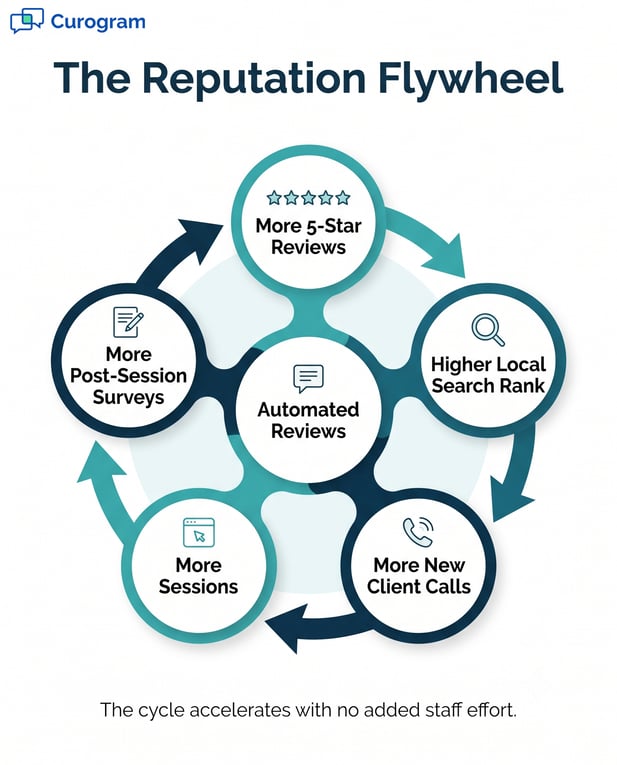
Portrait infographic diagram for a 'Reputation Flywheel' showing a self-feeding growth cycle

The Guide: The Hands-Free Review Engine

Curogram closes the gap with zero staff effort. It acts as a hands-free review engine. After each session, it sends a short, warm text. The system sorts the replies and routes them, all on its own.

The Solution: How the Engine Works

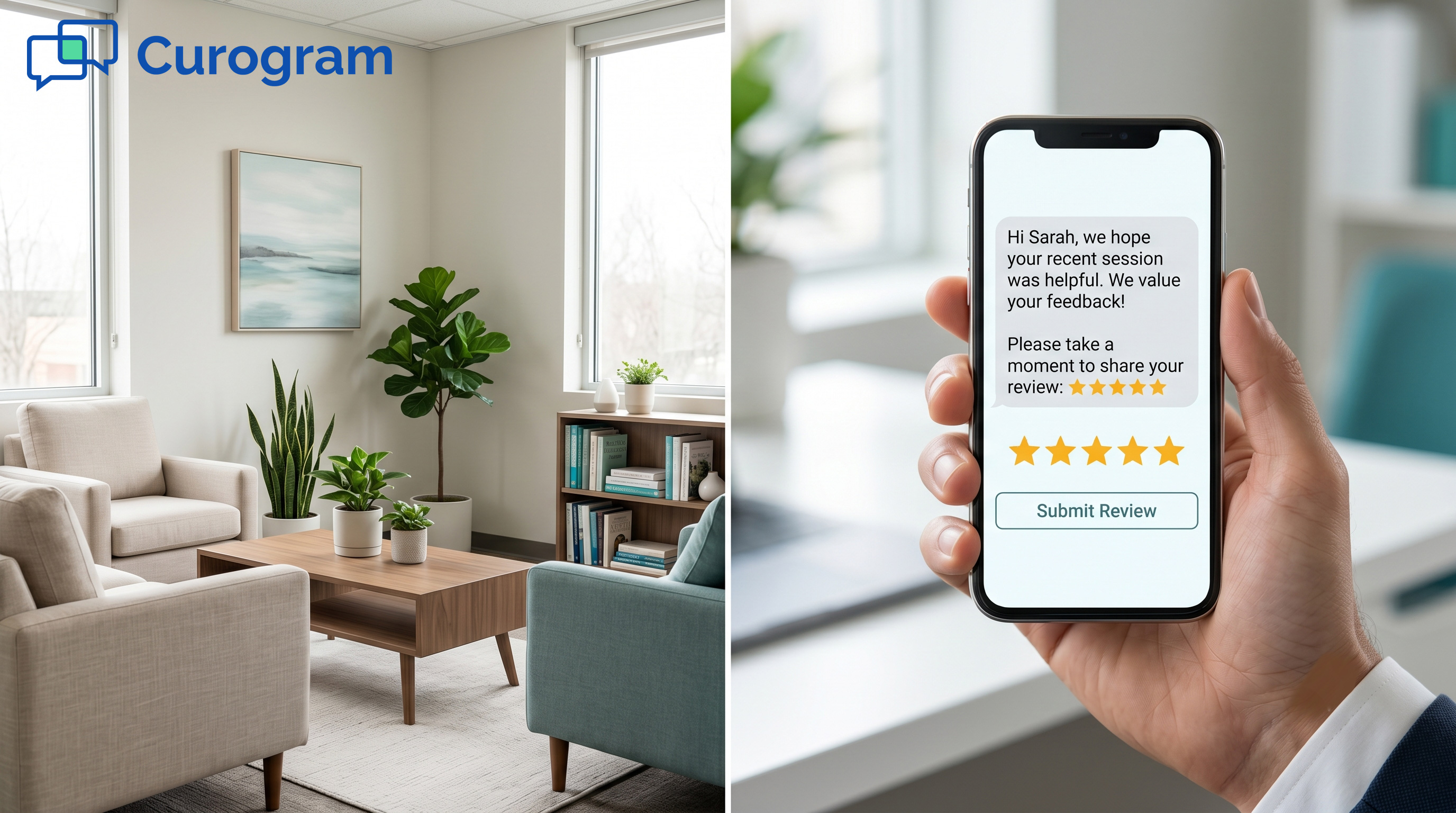
The flow is simple. A client finishes a session. A bit later, a text asks how things went. Happy clients get pointed to your Google profile. Less happy ones get a private feedback form instead.

This means good reviews go public and grow your rank. Concerns stay private, so you can act on them.

No staff member starts, watches, or chases any of it. That is the heart of staff-free review solicitation therapists actually want.

Smart Routing, Built In

Not every reply belongs on Google. Curogram reads the sentiment first. Glowing replies head to your public profile. Quiet concerns head to a private inbox. You protect your rating and still hear the truth.

Set It Once, Then Forget It

During onboarding, you set the timing, the wording, and the routing rules. After that, the set-and-forget survey runs in the background.

There are no daily logins and no manual sends. The automated review workflow behavioral health teams need just hums along.

It Works Right Alongside TherapyNotes

Here is the part that surprises people. Curogram needs no API tie to TherapyNotes. The survey trigger is time-based. For example, it can fire two hours after a session ends.

Your team keeps its normal flow inside TherapyNotes. Curogram adds the review layer on top, unseen. One system runs your clinic. The other grows your name. They do not need to talk to each other to work.

Why This Fits Behavioral Health

For mental health teams, hands-free is more than handy. It is the right thing to do. Clinicians should not carry out marketing tasks during clinical hours. The therapeutic bond comes first, always.

This is why good TherapyNotes reputation management staff workflows remove the human ask. Your team stays focused on care. The reviews still grow. No one has to choose between the two. 


The Success: Reviews That Generate Themselves

So what does hands-free look like in real numbers? It looks like reviews pile up while your team does its normal work. Below is the proof, and the cycle that keeps it going.

The Numbers Behind It

One multi-location practice earned 1,064 new 5-star reviews in just 3 months, based on Curogram client data from clinical settings. In that same group, 90% of surveyed clients left a 5-star rating.

Many practices start with 20 to 30 total reviews. Within a quarter, they cross 100. And not one staff member asked a single client by hand. The numbers below show the shift at a glance.

Profile Snapshot

Before Automation

After Automation

Total reviews

12

120+

Star rating

4.2

4.9

New reviews per month

1 to 2

Dozens, hands-free

Staff time spent

Constant, draining

Near zero

Figure: A typical shift in a Google profile after switching to automated post-session surveys.

The Reputation Flywheel

Reviews do not just add up. They compound. This is the reputation flywheel, and once it spins, it speeds up on its own. Each turn feeds the next.

More reviews lift your local rank. A higher rank brings more new client calls. More clients mean more sessions.

More sessions mean more surveys, which mean more reviews. Round and round it goes, no extra effort needed.

A Real-World Outcome

Picture a 10-clinician counseling group. They set up the automated reviews in a 30-minute onboarding call. Then they go back to their normal week. The system takes it from there.

Three months on, they have 140 new reviews and a 4.9-star average. They rank in Google's top three for their main search terms. New client calls are up 35%.

As the owner put it, "I didn't even know this was running until I checked our listing."

This is what it looks like to increase Google Reviews counseling practice owners once thought were stuck.

A smiling woman reviewing positive text feedback on a smartphone in a bright modern cafe

Conclusion: Stop Asking. Start Automating.

Let us bring it home. Review generation should never be a staff task. It is a process, and processes can run themselves. That is the whole idea.

TherapyNotes handles your clinical work with care. Curogram handles your reputation in the background.

One system runs your practice. The other grows it. Neither needs the other's API to do its job well.

Think about the math for a second. Every session you hold is a possible 5-star review. Right now, many of those slip away. They slip not because clients are unhappy, but because no one wants to ask.

Automation removes the ask. The text goes out on its own. Your happy clients do the rest. Their words speak for the care you already give.

And the cost of waiting is real. Each month without a system is another month of slow reviews and rising ad spend. Your rivals are not waiting. Their profiles fill while yours stays thin.

You do not need to add work to fix this. You need to remove it. Take the ask off your clinicians. Take the chase off your front desk. Let the system carry the load.

The setup is short. The upkeep is near zero. The payoff builds week after week, like interest. Start now, and in a quarter you may not recognize your own Google profile.

Book your personalized demo. Your client satisfaction is ready to speak. Let it.  


Frequently Asked Questions

How much staff time does setup and upkeep really take?

Setup runs about 30 minutes during a guided onboarding call. After that, the system runs on its own. There are no daily logins, weekly reports, or manual sends. Staff may glance at private feedback now and then, but that is useful data, not busywork.

Why do therapists find it so hard to ask for reviews?

A therapy session is a vulnerable space. Asking for a public review right after can feel transactional. It clashes with the trust at the core of care. Automation solves this by moving the ask off the clinician and onto a simple text.

How does the system protect client privacy?

The survey text stays warm and neutral. It never names therapy, mental health, or any treatment. A client might just see, "Thank you for visiting today. How was your experience?" That keeps confidentiality safe by default.

Why do reviews matter so much for getting new clients?

Google search is the top source of new therapy clients. And 90% of prospects check your Google profile before your website. A profile with many strong reviews builds instant trust. A sparse one quietly sends people to a rival.

How does this work for practices with many locations or clinicians?

Curogram supports multi-location teams with location-specific routing. Each review lands on the right profile on its own. You can also view satisfaction data by provider. That helps internal quality work without exposing any one clinician's ratings.