
8 min read

Imaging Center Review Dashboard | Multi-Location Management

Imaging Center Review Dashboard | Multi-Location Management
💡 Managing Google reviews across multiple imaging locations is a real challenge. Without a central system, some locations thrive online while others fall behind.

Curogram connects to your Exa RIS and automates post-study review requests across every facility. Administrators get one dashboard to track ratings, spot low performers, and drive steady review growth, with no extra staff needed.

Based on our internal data, one multi-location imaging network grew from 993 to 8,159 Google reviews and added 1,064 new 5-star reviews in just 3 months. That is what a proper review monitoring dashboard does for your imaging operations.

You manage three imaging centers, maybe five, maybe ten. Each one delivers the same level of care. The same trained staff. The same imaging equipment. But open Google and it tells a different story.

One location has 300 reviews and a 4.8-star rating. Another has 22 reviews and sits at 3.9 stars. The third is somewhere in between. None of your front desk teams did anything wrong. They just have no system to collect reviews after every study.

That gap in your online reputation costs real money. Referring physicians notice star ratings. Patients search before they book.

A low-rated location does not just look bad online, it loses referrals to competitors who may not even offer better care.

The fix is not more staff. The fix is the right system.

Curogram gives imaging center administrators a centralized reputation command center. It connects to Exa RIS, detects completed studies, and sends automated review request texts to patients at every location.

No manual work. No per-location management burden. Just steady, predictable review growth across your entire network.

In this article, we break down why scattered review management fails imaging networks, how automated reputation tools work in practice, and what real results look like when the system runs at scale. 

The Villain: The Reputation You Can't See

Most imaging center admins do not realize there is a reputation problem until it is already doing damage. The issue is not care quality. It is visibility. Without a centralized view, online reputation becomes a guessing game.

The Scattered Snapshot

When you manage multiple imaging locations, you likely do not have one place to see all your Google ratings at once. You might log into each Google Business Profile one by one, or worse, you find out about a low rating only when a referring physician mentions it.

Here is what this usually looks like across a mid-size imaging network:

Location

Total Reviews

Average Rating

Review Trend

Location A

218

4.7 stars

Growing

Location B

21

3.9 stars

Flat

Location C

47

4.3 stars

Slow

Location D

9

4.1 stars

No activity


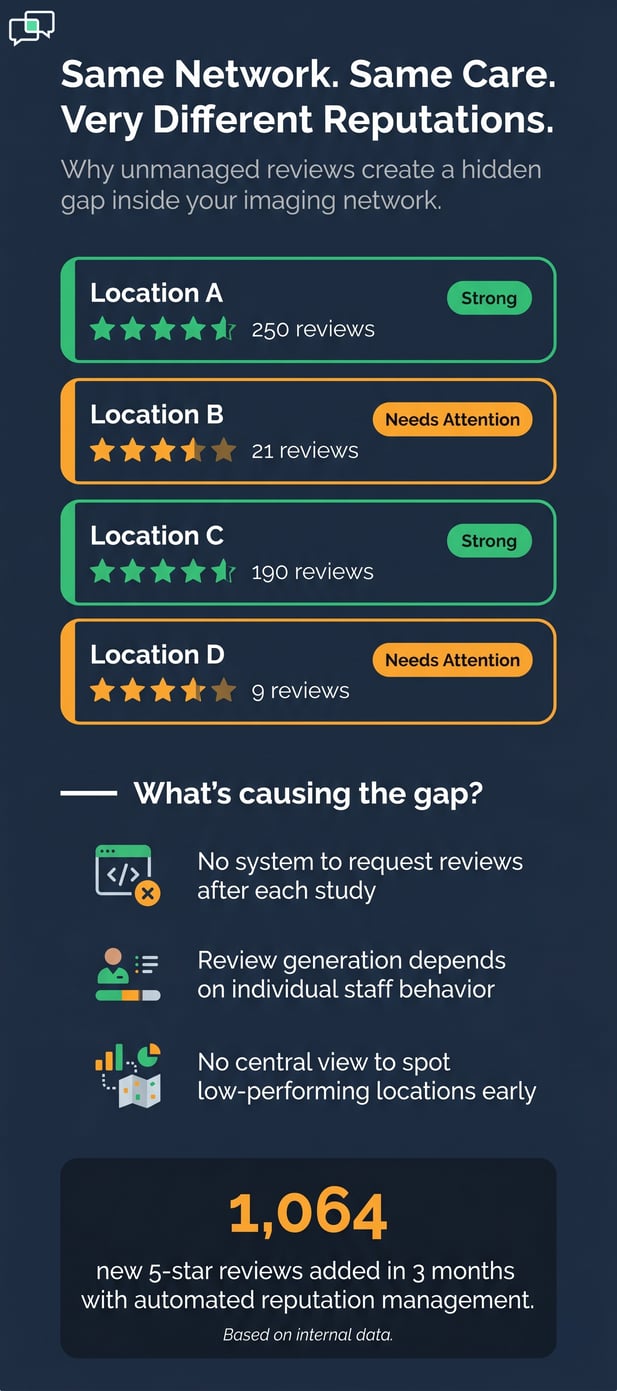
Locations B and D are not giving patients a bad experience. They just have no process for asking happy patients to leave a review. The result is a distorted online image that does not match actual care quality.

Why Exa RIS Does Not Solve This

Your Exa PACS/RIS is built for imaging workflow: scheduling, study management, billing, and referring physician tools. It is excellent at what it does.

But it does not track Google ratings. It does not send review requests. Reputation data lives in a completely different system, and most imaging networks have no bridge between the two.

What Gets Left to Chance

Without automation, review generation depends on individual staff behavior. If one front desk team member happens to care about asking for reviews, that location builds a strong profile. Everyone else stays flat. This is not a performance issue. It is a systems gap.

The Revenue Impact

A 3.9-star rating is not just an aesthetic problem. It affects referral decisions. Referring physicians want to send patients to facilities with strong reputations because it reflects on their own practice.

Imaging studies range from roughly $200 to well over $1,500 each, depending on modality. Even a small shift in referral volume between a high-rated and a low-rated location adds up fast.

A location that loses just five referrals a week at an average of $600 per study is losing around $156,000 in annual revenue. That is the real cost of unmanaged online reputation.

The math gets more serious when you consider that reviews compound over time. A location stuck at 20 reviews looks uncertain next to one with 250. Patients and physicians use volume as a proxy for trust.

The Administrator's Frustration

You know your care is consistent. You have the protocols, the equipment standards, and the radiologist quality to back that up. But the Google profile at Location B tells a different story, and you have no system to fix it.

Manual management is not realistic across 5 or 10 locations. Assigning a staff member at each facility to handle radiology administrator reputation tools individually would require dedicated headcount, which most imaging budgets do not include. The task gets pushed to the back burner, and the reputation gap widens.

Infographic showing reputation gaps in an imaging network due to unmanaged reviews

The Guide: The Centralized Reputation Command Center

This is where the approach shifts. Instead of chasing reviews location by location, Curogram gives administrators one system to manage review generation everywhere at once. It runs quietly in the background, attached to your existing imaging workflow.

How the Platform Works

Curogram serves as the imaging center multi-location Google review management layer on top of your Exa operations. It connects to each location's Exa RIS via API, detects when a study is completed, and triggers a review request text to that patient automatically. No staff action required.

The patient receives a short, friendly text after their imaging study. The message guides satisfied patients toward leaving a Google review.

Patients with concerns get directed to a private feedback channel instead, which protects your public ratings while still capturing useful information.

One Dashboard for Every Location

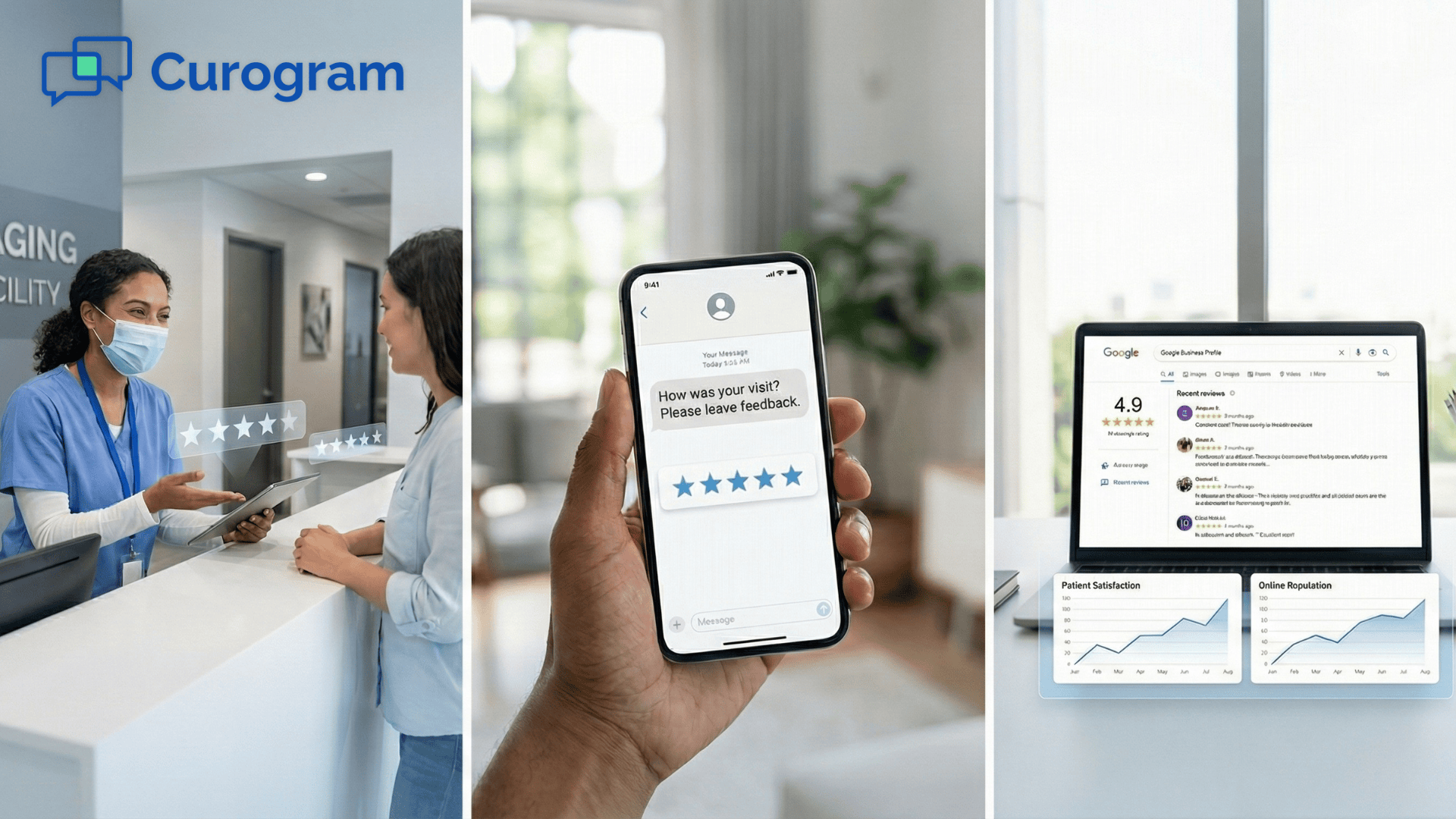
Administrators see every location's review volume, star rating, response rates, and trends from a single interface. There is no need to log into multiple Google accounts or build manual spreadsheets. If Location D is lagging behind, you see it immediately, not after a referring physician calls.

This is what a proper imaging center review monitoring dashboard looks like in practice. Metrics are live. Trends are visible. Underperforming locations are flagged early so you can investigate quickly.

HIPAA Compliance and SOC 2 Certification

All patient communication through Curogram is HIPAA compliant. The platform is SOC 2 Type II certified, meaning data security and privacy controls have been independently verified.

Patient data stays isolated per location. The administrator dashboard shows only aggregate reputation metrics, not individual patient records.

Network-Wide Setup Without the Complexity

Setting up Curogram across multiple imaging locations does not require a long IT project. Each location gets its own configuration to match its Google Business Profile and branding. After that initial setup, the system runs on its own.

Most multi-location imaging networks are fully configured within one to two days. After that, automated review response flows begin across every location simultaneously. There is no ongoing manual work and no staff training required beyond the initial setup.

Task

Without Curogram

With Curogram

Review requests

Manual, per patient

Automatic after every study

Reputation monitoring

Log in to each profile

One dashboard, all locations

Negative feedback

Publicly visible on Google

Routed to private channel

New location setup

Months to build reviews

Review velocity from Day 1

Staff involvement

High, inconsistent

None after initial config


The Operations Fit

For imaging center administrators already running multi-location operations through Exa, adding Curogram means reputation management runs with the same efficiency as your imaging workflow. It does not require a separate team or a new set of logins.

Think of it this way: Exa is for your scanners. Curogram is for the online reputation that keeps your scanners busy. Both systems can run in parallel, each doing what it does best.


The Success: Every Location a 4.8-Star Facility

Real results are the best proof. When a multi-location imaging network runs automated reputation tools across every facility, the numbers shift fast, and they stay shifted.

What the Numbers Show

Based on our internal data, a multi-location practice using Curogram's automated post-study review requests grew from 993 to 8,159 total Google reviews across their network. In just 3 months, they added 1,064 new 5-star reviews. That is not a slow build. That is a clear, measurable jump.

The chart below shows total Google reviews over time for this practice:

Month

Total Reviews

August 2023

993

September 2023

1,000

October 2023

1,540

November 2023

1,858

December 2023

2,260

January 2024

2,662

February 2024

3,090

March 2024

3,457

April 2024

3,874

May 2024

4,334

June 2024

4,771

July 2024

5,237

August 2024

5,784

September 2024

6,546

October 2024

7,347

November 2024

7,801

December 2024

8,159

Source: Based on our internal data.

Across our internal research, 90% of patients who receive a review request leave a 5-star rating. That kind of consistency is only possible when the request goes out reliably after every completed study, not just when staff remember to ask.

The Weakest Location Improves First

This is one of the most important patterns in automated Exa imaging center operations reviews: the location with the fewest reviews gains the most ground in the shortest time.

When a facility is starting from 15 reviews, every new review moves the needle significantly. The velocity feels fast because the base is low.

A location stuck at 3.9 stars with 18 reviews does not stay there once review requests start going out after every study. Within 60 to 90 days, most low-rated facilities see a visible improvement in both volume and star rating.

From Reputation Roulette to a Repeatable System

Before Curogram, review generation was a personality-driven activity. One great front desk staffer at Location A kept asking patients for reviews. Nobody at Location C did. The result was a reputation gap that had nothing to do with care quality.

With network-wide automation, every location generates reviews at the same predictable rate. The system does not have good days and bad days. It runs after every completed study, every time.

What This Means for Referring Physicians

When every location in your imaging network shows strong ratings and solid review volume, referring physicians have no reason to hesitate.

They can send patients to any of your facilities with confidence. New locations reach competitive review levels within two to three months of launch, not years.

Physicians who already trust your network are more likely to expand their referral patterns when every location looks the same online: consistent, high-rated, and well-reviewed. That consistency signals operational quality.

The Administrator's View

Imagine opening one dashboard and seeing green across every location. A 4.7 or higher rating at each facility. Two hundred or more reviews at even your newest location. Positive trends across the board.

That is what radiology multi-location reputation management looks like when it runs as a system instead of a manual task. Administrators spend their time on scanner utilization, scheduling efficiency, and physician relationships, not chasing down review metrics location by location.

Smiling medical front desk staff handing a patient feedback tablet to a male patient

Conclusion: Manage Reputation Like You Manage Operations — Systematically

Online reputation for multi-location imaging centers does not manage itself. But with the right system in place, it does not require extra staff, manual effort, or constant monitoring either.

Exa PACS/RIS is built for imaging operations: study scheduling, workflow management, billing, and referring physician tools. It handles the clinical side of your business exceptionally well.

Curogram handles the part that determines whether your scanners stay busy, which is the online reputation that patients and physicians check before they ever walk through your doors.

These two systems are not in competition. They work in parallel. Exa manages what happens inside your facilities. Curogram manages how your facilities are perceived outside them.

When review requests go out automatically after every completed study, three things happen at once. First, review volume grows steadily at every location.

Second, your lowest-rated facility starts catching up because the review velocity is highest when starting from a low base. Third, administrators stop spending time on reputation monitoring and get back to running operations.

The imaging network administrator who used Curogram grew from under 1,000 total Google reviews to over 8,000, adding 1,064 five-star reviews in just 3 months, based on our internal data. That kind of growth is not a one-time event. It compounds as the system keeps running.

See how Curogram fills the Exa engagement gap. Schedule a free demo today.


Frequently Asked Questions

How does Curogram keep patient data safe across multiple locations?

Curogram maintains strict data separation between locations, in full compliance with HIPAA. The administrator dashboard shows only aggregate reputation metrics such as review counts, ratings, and trends. Each location's patient communication stays isolated and encrypted. Curogram is also SOC 2 Type II certified, meaning its security controls have been independently verified.

How does automated review routing work for negative feedback?

When a patient receives a post-study review request, Curogram's smart routing system detects signals of a poor experience and redirects that patient to a private feedback channel instead of Google. This protects your public ratings while still capturing patient concerns for your team to address.

Positive experiences are guided toward Google, where they can be seen by referring physicians and new patients. The result is a public profile that reflects your real patient satisfaction, not just the occasional unhappy outlier.

Why does the lowest-rated location benefit the most from review automation?

A location starting from a low review count sees the biggest visible change in a short time because every new review carries more weight. When a facility has 15 reviews and gains 50 more, the rating stabilizes, and the profile looks far more credible.

Automated review request tools ensure that review velocity is consistent at every location from day one, not just at the ones with engaged front desk staff. This equalizes reputation across the network without requiring any extra effort from individual teams.

How long does it take to set up Curogram across multiple imaging locations?

Each location gets its own initial configuration to match its Google Business Profile, branding, and review request templates. Most multi-location imaging networks complete the full setup in one to two days.

After that, the system runs automatically with no ongoing manual input needed. Administrators can monitor all locations from a single dashboard from the moment setup is complete.

How does Curogram connect to Exa RIS to trigger review requests?

Curogram connects to each location's Exa RIS instance via an API integration. When a study is marked as complete in Exa, Curogram detects that event and sends a review request text to the patient automatically. The integration runs in the background without disrupting any existing imaging workflow. Each location maintains its own Google Business Profile, while all reputation data feeds into the administrator's central dashboard.