GE Centricity Reputation Management: Boost Reviews With Curogram
💡 Clinics using GE Centricity face a tough challenge with reputation management in GE Centricity. Getting patients to leave reviews takes time and...
10 min read
Aubreigh Lee Daculug
:
January 20, 2026
Table of Contents
A front desk coordinator at a busy imaging center schedules 40 MRI appointments a day. She knows every insurance quirk and helps anxious patients feel at ease. Yet despite excellent care, online reviews don’t reflect reality—patients forget or get busy.
Down the street, a competitor with older equipment and longer waits has twice the reviews simply from being open longer. Online, they look more trustworthy, and appointments go their way.
This happens across multi-location imaging networks. Older sites collect hundreds of reviews, while newer locations may have only a handful despite identical quality. Online, those numbers create the illusion of better care.
Manual review requests rarely solve this problem. Front desk staff juggling appointment scheduling, insurance verification, and patient check-in can't consistently ask every patient for feedback. Some days it happens, other days it doesn't. The result? Scattered reviews that fail to represent actual patient experience across your network.
Automated feedback collection changes everything. Integrated with Medstreaming, review requests reach every patient at the right moment—automatically, without adding staff workload. This guide shows how imaging centers turn scattered feedback into a systematic reputation engine that drives results across every location.
Ten years ago, patients went wherever their doctor referred them for imaging services. Today's patients research everything first. They compare Google ratings, read reviews about wait times and staff friendliness, and make choices based largely on what other patients report.
The numbers tell the story. A center with 4.8 stars and 150 reviews draws far more clicks than one with 3.9 stars and 30. That visibility gap directly affects bookings, even when your pricing, location, or equipment are better.
Review content matters too. Patients read about calm technologists, clear explanations, easy parking, and short waits. These real experiences build trust in ways polished marketing never can.
Multi-location networks face unique challenges here. Google treats each physical address as a separate business. Your downtown location's stellar reputation provides zero benefit to suburban sites 20 miles away. Every imaging center needs its own review base to compete in local search. There's no corporate-level rating that helps all locations equally.
This imbalance creates real operational challenges. It’s hard to evaluate performance when one location has ten times more reviews than another. Without balanced feedback, decisions are based on incomplete data—not actual service quality.
Most negative reviews aren’t about clinical care. They stem from communication gaps—long waits without explanation or unclear prep instructions. Operational breakdowns drive poor feedback far more often than imaging quality.
High-deductible plans amplify the impact. Patients paying hundreds out of pocket research carefully and rely on reviews to judge overall experience. Centers with weak online presence lose these patients early.
Referring physicians notice reputations too. Complaints about delays or billing can make doctors hesitant to refer, since patient experience reflects on their judgment.
Google also rewards consistency. Centers with steady, recent reviews rank higher than those with outdated or sporadic feedback. Continuous review generation is key to staying visible and competitive.
Workflow issues can sour the experience even when clinical care is excellent. A patient checks in on time, waits 45 minutes without explanation, and starts forming a negative review—no matter how well the scan goes.
Wait times hurt satisfaction more than almost anything else. The difference is communication. A simple update about delays sets expectations, while silence turns minor waits into major frustrations.
These communication gaps drive poor reviews far more than clinical quality issues. A patient might receive excellent diagnostic imaging but leave frustrated because no one explained the delay, or prep instructions weren't clear, or they couldn't get answers about billing. Patients blame the imaging center regardless of where the actual breakdown occurred.
The system works seamlessly behind the scenes. A patient finishes their CT scan at 3:00 PM, and the technologist marks the appointment complete in Medstreaming. That simple status update triggers Curogram to start a carefully timed sequence—no staff involvement required, no manual data entry, no chance of forgetting.
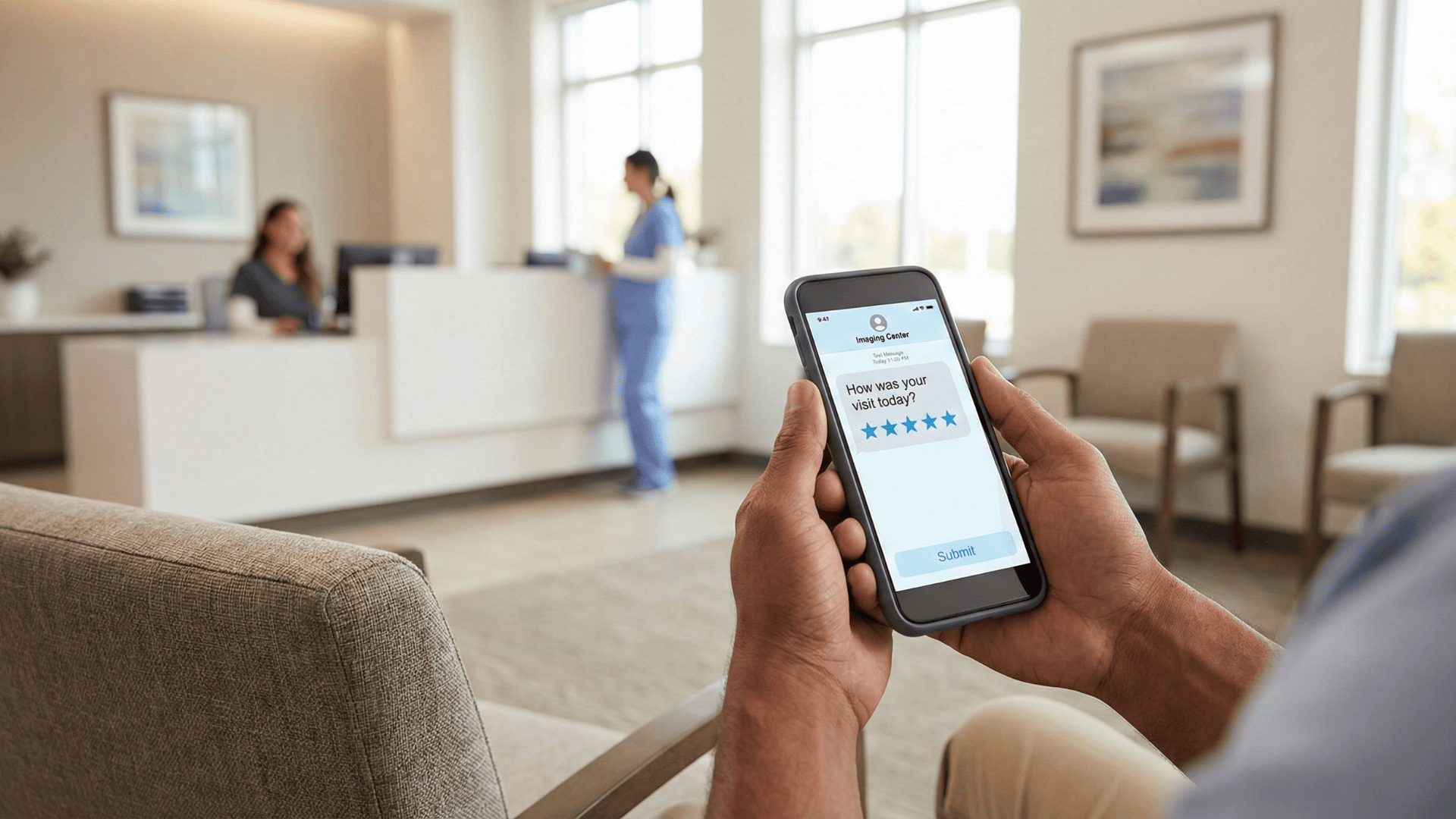
Around 5:30 PM, the patient receives a short text thanking them and asking one question: How would you rate your experience today? The timing matters—close enough to stay fresh, but late enough to reflect. Response rates are far higher than requests sent days later.
If they tap 5 stars, a follow-up appears instantly: Would you mind sharing this on Google? One click opens the correct review page, ready to post. What once took effort now takes seconds.
If they tap 2 stars, no public review is requested. Instead, the site manager gets an alert with the reason—long wait, no communication. This creates a chance to respond, resolve the issue, and often prevent a negative review altogether.
This two-step filtering protects your reputation while capturing valuable feedback. Internal surveys happen first, before any public review invitation. High ratings flow toward Google. Low ratings trigger private resolution. You're maximizing positive visibility while handling problems through channels where you can actually address them.
The Medstreaming integration makes all this happen seamlessly. Appointment data flows automatically between systems. The software knows which location the patient visited, what type of exam they had, and who to alert if issues arise. Key technical features include:
Survey questions stay deliberately simple. One 1-5 rating question, maybe one follow-up about a specific aspect of care. The entire process takes under a minute. This respects patient time while maximizing response rates. Long surveys get abandoned. Quick ones get completed.
Analytics dashboards give real-time visibility into response rates, satisfaction scores, and review volume by location. Trends surface quickly.
A Monday-morning dip may point to scheduling or staffing issues. Consistent praise for a technologist highlights performance worth recognizing.
The platform scales effortlessly. A practice with three imaging centers uses the same system as a regional network with 50 locations. Adding new sites requires minimal setup. The underlying architecture was designed for enterprise operations from day one, so growth doesn't create technical headaches or performance degradation.
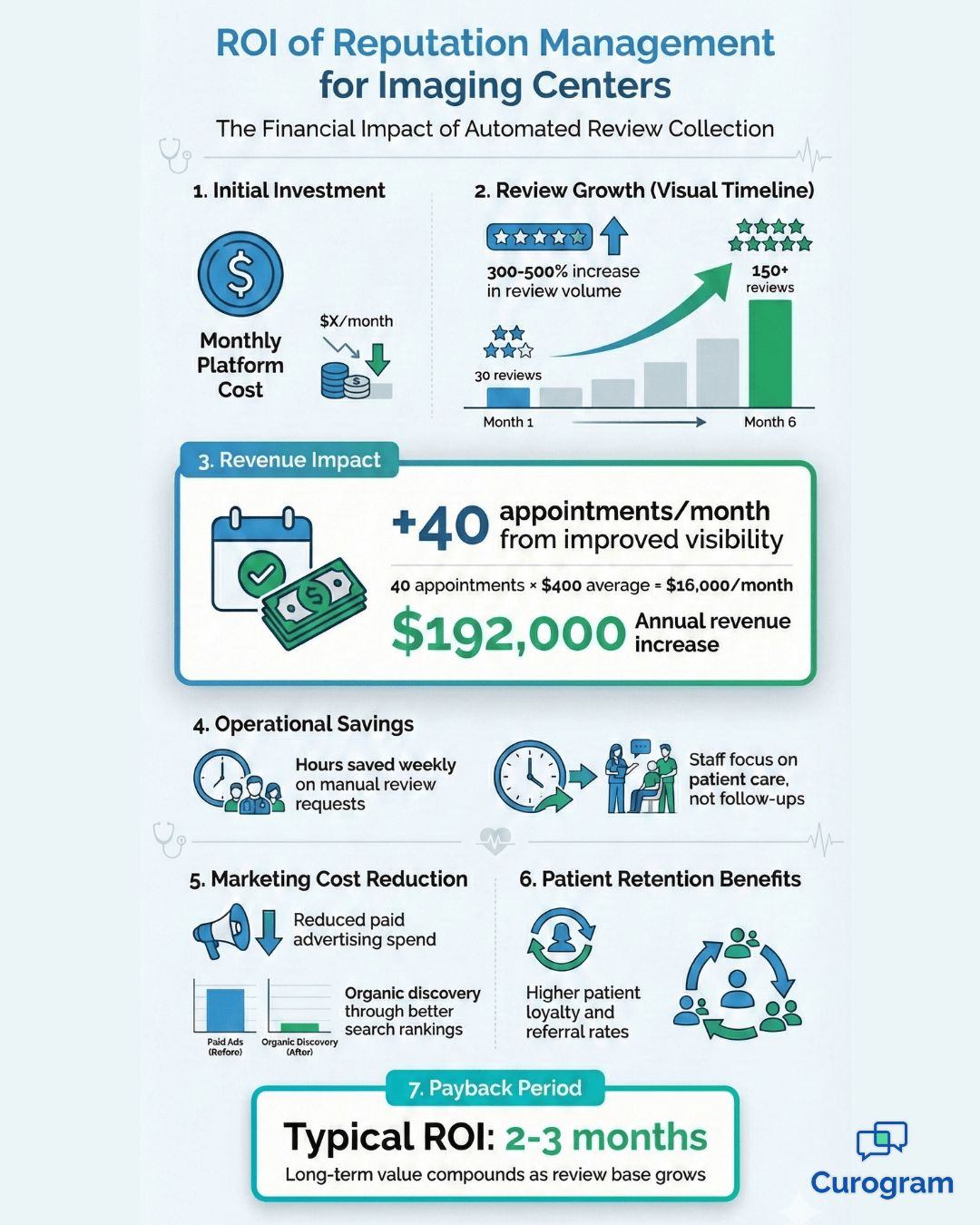
The results from automated review collection consistently surprise imaging center managers. Within the first month, review volume typically jumps 300-500%. That's not a projection—it's what actually happens when you ask every patient at the optimal time instead of hoping someone remembers to leave feedback days later.
Volume isn’t the whole story—review quality improves too. Feedback captured within hours includes specific details about staff, check-in, and comfort, making reviews more credible to prospective patients.
Local search rankings rise naturally. Consistent, recent reviews signal quality to Google, boosting visibility and driving more bookings from patients who might not have found you otherwise.
The financial impact becomes clear quickly. One regional imaging network calculated they were gaining roughly 40 additional appointments monthly from improved search visibility alone. At an average revenue of $400 per exam, that's $16,000 in monthly revenue directly attributable to better online reputation. The system paid for itself many times over.
Patient loyalty grows in subtle but meaningful ways. Asking for feedback shows patients their experience matters. That sense of being heard strengthens trust, encourages return visits, and drives word-of-mouth referrals.

Not all imaging exams feel the same. MRIs can be stressful, CTs may involve uncomfortable contrast, and ultrasounds often carry emotional weight.
Smart automation adapts accordingly. Post-visit questions match the exam type—communication for MRIs, IV and prep clarity for CTs, comfort and explanations for ultrasounds—producing more meaningful feedback than generic surveys.
The real strength of private feedback loops is stopping issues before they go public. When a patient rates their visit poorly and mentions a long wait without explanation, your team is alerted within minutes. That allows you to investigate quickly, reach out the same day, and often resolve the issue before a negative review is posted.
Early feedback also exposes patterns. If multiple patients flag the same problem in a short period—missed reminders or a training gap—you can fix it immediately instead of uncovering it months later through public complaints.
Smaller imaging centers finally get a fair chance at building local reputation. When every patient receives a review request, smaller sites collect fewer reviews—but at the same steady rate. A well-run suburban center can reach a 4.9-star rating with dozens of reviews in months, not years.
That local credibility attracts patients who might assume bigger is better. Strong, recent reviews help neighborhood centers compete effectively, turning geography into an advantage.
Ongoing feedback shows how service quality shifts over time. If scores dip after new scheduling software launches, you can spot training gaps early. If scores rise after adding front desk staff, the data confirms the investment paid off.
This real-time insight makes your organization more agile. Instead of relying on delayed surveys or isolated complaints, you see issues and improvements as they happen—so decisions are driven by data, not anecdotes.
A patient dreaded their first MRI after hearing it was loud and claustrophobic. The day before, they received clear texts explaining what to wear, where to park, when to arrive, and what to expect. A reminder the morning of the exam reinforced the prep.
Check-in was smooth because they arrived ready. During the scan, the technologist explained each step, exactly as promised. The experience felt organized and respectful.
When the feedback request arrived a few hours later, they gladly gave five stars and shared a detailed review praising the clear communication.
This scenario illustrates how communication transforms experience. Clear expectations reduce anxiety dramatically. When people understand what's happening and why, they feel more comfortable and in control. That emotional comfort translates directly into higher satisfaction scores and more enthusiastic reviews.
Automated appointment reminders ensure patients arrive fully prepared. Messages sent before the visit cover arrival time, parking, prep instructions, and required paperwork. This clarity reduces confusion, prevents last-minute issues, and keeps check-in moving smoothly.
Real-time delay notifications show respect for patient time. When schedules run behind, automated updates let patients adjust their arrival, manage other tasks, or simply know what to expect. Even unavoidable delays feel less frustrating when communication is clear.
Fast, consistent responses build confidence. Automated systems answer common questions about hours, insurance, and prep instantly. More complex questions reach staff with full context, eliminating repeat explanations and making patients feel heard and valued.
Better communication at check-in reduces bottlenecks and stress. When patients arrive with clear instructions and required documents, front desk staff process them quickly. This creates smooth flow that prevents long lines and the tense atmosphere those lines create. Everyone's day improves when communication prevents problems before they start.
Healthcare communication walks a careful line. You need to engage patients and collect feedback, but you must protect privacy absolutely. HIPAA violations carry serious penalties—both financial and reputational. Even unintentional breaches damage patient trust in ways that are difficult to repair.
Smart systems handle compliance by design, not as an afterthought. Review requests never include protected health information or reference specific procedures, diagnoses, or clinical details. Patients receive a neutral message about a recent visit—recognizable, relevant, and fully compliant.
Secure delivery protects information throughout the process. Curogram uses encrypted channels for every message, ensuring patient data never passes through unsecured systems. Even in the unlikely event of interception, the content remains unreadable.
Opt-out management follows federal requirements exactly. Every message includes clear opt-out instructions, and patient preferences update instantly across all communication channels. This respects patient choice while maintaining regulatory compliance.
Comprehensive audit trails document every interaction. The system logs messages sent, delivery status, and patient responses, creating verifiable records for audits and internal quality reviews. These safeguards protect patients and give imaging centers confidence in their compliance posture.
Generic review collection tools weren’t built for healthcare. They’re designed for retail and restaurants, where privacy rules are minimal and workflows are simple. When imaging centers try to adapt them, they run into constant friction—awkward workarounds, compliance risks, and processes that don’t fit daily operations.
Curogram was built differently. Its team spent time inside real imaging centers, observing front desk workflows, scheduling complexity, and common communication breakdowns. That firsthand understanding shaped a platform designed specifically for radiology operations.
Medstreaming integration works seamlessly because it was built for that environment. Appointment data flows automatically between systems. Status updates trigger the right messages without staff involvement. There’s no manual exporting, no duplicate data entry, and far fewer opportunities for error.
High-volume imaging environments demand reliability at scale. Curogram supports thousands of daily messages across multi-location networks without performance issues. Adding new sites is straightforward because scalability was designed into the platform from the start.
Results follow quickly. Imaging centers report significant increases in review volume within the first quarter, along with higher average ratings as satisfied patients finally share their experiences. Satisfaction scores improve as private feedback helps teams address issues early.
Training remains minimal because the system aligns with existing workflows. Front desk staff learn the basics in minutes, mostly monitoring dashboards while automation does the heavy lifting. Adoption stays consistent across locations.
Support teams understand healthcare communication deeply. Questions about HIPAA compliance, message timing, or workflow configuration are handled by specialists familiar with imaging operations. This guidance helps centers realize value quickly, without months of trial and error.
The imaging center market has fundamentally changed. Online reputation now determines which centers win and which struggle to fill schedules. Patients make decisions based primarily on Google reviews and star ratings—often before they even consider factors like location, pricing, or equipment quality.
Multi-location networks face this reality across every market they serve. Each site needs its own strong reputation to compete in local search. Corporate-level marketing doesn't solve individual location visibility problems. Systematic, automated feedback collection does. Every patient receives a review request at the optimal time without staff involvement.
This two-step approach protects your reputation while building visibility. Internal surveys surface issues before they turn into public complaints, while satisfied patients are guided to share positive reviews online. Negative feedback triggers immediate alerts, giving management a chance to resolve concerns privately and protect your public image.
Results come fast. Most centers see review volume increase within weeks, with new Google reviews appearing days after visits. Internal feedback arrives within hours, providing immediate insights. Over time, reviews compound, ratings stabilize, and online visibility steadily improves.
Implementation happens quickly with minimal operational disruption. The Curogram platform connects directly with Medstreaming through proven integration methods. Configuration takes hours rather than weeks. Training requires minutes instead of days. Most imaging centers start collecting systematic feedback within their first week after setup.
Ready to see how it works? Book a demo with Curogram to explore how the platform integrates with your Medstreaming workflow.
Automated systems ask every patient at the optimal time—within hours of their visit when the experience remains fresh. Manual collection fails because staff forget during busy moments and patients forget days later. Most imaging centers see 300-500% increases in monthly reviews simply because nobody gets missed. Every patient receives a request at the right time through their preferred channel.
Google treats each physical address as an independent business in local search. When someone searches for imaging services near them, they only see nearby locations ranked by individual reputation. Your downtown location's 200 reviews don't help your suburban site at all. Each location must build its own review base to compete in its local market.
Patients complete an internal survey before seeing any public review request. High ratings (4-5 stars) trigger Google review invitations. Low ratings (3 stars or below) generate private management alerts instead. This filters unhappy patients into resolution channels where you can address concerns directly, often preventing negative reviews entirely while maximizing positive public feedback.
Generic platforms were built for restaurants and retail—they don't understand HIPAA compliance or healthcare workflows. Curogram was designed specifically for healthcare operations. It integrates directly with Medstreaming, handles compliance automatically, adapts to different imaging procedures, and scales from single practices to enterprise networks. Support teams understand healthcare operations rather than reading generic scripts.
Results start immediately. Most centers see increased review volume within weeks. New Google reviews appear within days of patient visits. Internal feedback provides instant insights since patients respond within hours. Local search ranking improvements typically become visible within 60-90 days. By month six, most centers have dramatically different online presence with substantially higher review counts and ratings.
💡 Clinics using GE Centricity face a tough challenge with reputation management in GE Centricity. Getting patients to leave reviews takes time and...
💡 Reputation management in StreamlineMD helps radiology, vascular, and IR practices build a stronger online presence through automated feedback...
💡 Imaging centers face unique trust issues. A single bad review can damage referral flow and hurt revenue across multi-site networks.Reputation...