
1 min read
Reputation Management in Veradigm with Curogram
 Jo Galvez : Jan 5, 2026, 8:00:00 AM
💡 Imaging centers face unique trust issues. A single bad review can damage referral flow and hurt revenue across multi-site networks.Reputation...

💡 Clinics using GE Centricity face a tough challenge with reputation management in GE Centricity. Getting patients to leave reviews takes time and effort.
This helps radiology centers and specialty clinics build stronger online presence. More reviews mean better rankings on Google. Higher rankings bring more new patients to your practice. The process protects patient privacy while boosting your reputation across every clinic location you operate.
Online reviews shape how patients choose their healthcare providers today. A single bad review can drive potential patients away from your practice. Most patients check Google ratings before booking appointments.
Radiology centers and specialty clinics face unique challenges here. These practices often run multiple locations across different areas. Each location needs a strong review profile to attract local patients. But collecting reviews manually takes too much time and effort.
Staff members already handle packed schedules and heavy workloads. Asking them to chase down reviews adds stress to their day. Many patients want to help but forget to leave feedback once they get home. Others don't know where to post their reviews online.
This leads to an unfair problem. Your team provides excellent care every day. Yet your online presence fails to show this quality. Some locations might have only a few reviews while others have none. New patients see these gaps and worry about care quality.
Reputation management in GE Centricity needs a better approach. The solution must work with your existing systems. It should collect GE Centricity patient reviews without adding work for staff. And it needs to maintain patient privacy at all times.
Automated feedback collection makes this possible. The system connects directly to your GE Centricity platform. It sends review requests at the right moment when patients feel most engaged. This timing increases response rates across all your locations.
The best part? Your staff doesn't lift a finger. Everything runs in the background while they focus on patient care. More reviews flow in steadily. Your online reputation grows stronger each month. New patients find your practice more easily and trust your quality of care.
The healthcare market gets more crowded every year. Radiology centers and specialty clinics compete for the same pool of patients. Your online reputation often makes the difference between growth and decline.
Studies show that 84% of people trust online reviews as much as personal recommendations. Patients search Google before choosing where to get imaging done or see a specialist. They look at star ratings first, then read recent reviews to judge quality.
A practice with few reviews faces an uphill battle. Even worse, locations without any reviews appear abandoned or unprofessional. Potential patients skip right past these listings to competitors with stronger profiles.
Radiology markets face particularly tough competition. Most areas have several imaging centers within a short drive. Patients choose based on convenience, insurance coverage, and perceived quality. Reviews become the main way they judge quality before their first visit.
Specialty clinics deal with similar pressures. Dermatology, orthopedics, and other specialties cluster in medical districts. New patients evaluate multiple options online before booking appointments. Strong reviews help you stand out from the crowd.
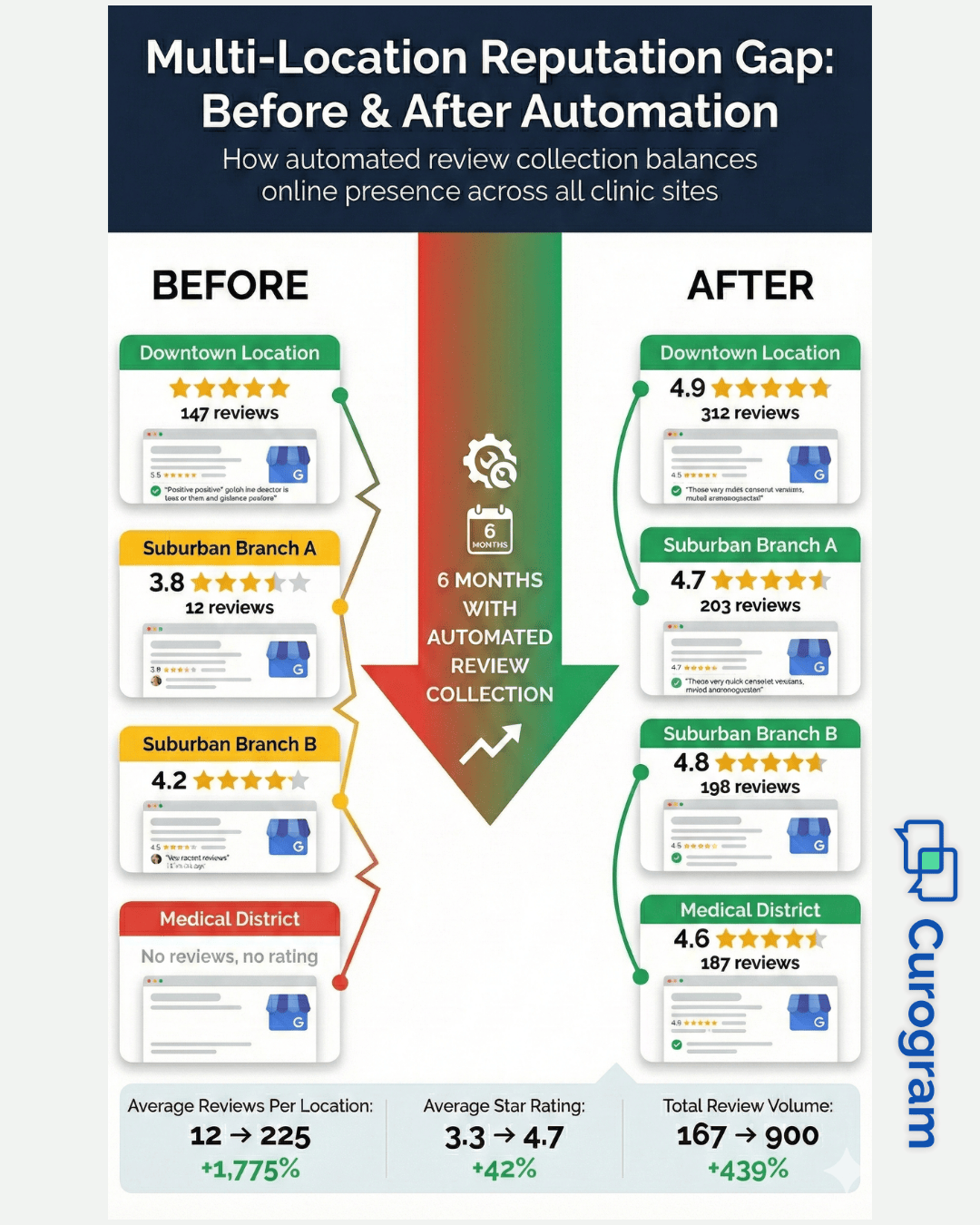
Multi-location practices face an extra layer of difficulty. Each site needs its own review profile to attract local patients. A downtown location might have great reviews while a suburban branch sits at zero. This creates visibility gaps across your network.
Google's local search algorithm favors businesses with more recent reviews. Fresh feedback signals to the search engine that your practice stays active and relevant. Practices that collect reviews regularly rank higher in local search results.
Higher rankings mean more clicks and more new patient bookings. A study found that the top three Google results capture 75% of all clicks. If your practice doesn't appear in those top spots, you miss out on most potential patients searching in your area.
Review volume also affects patient decision-making. A practice with 200 reviews looks more established than one with 20 reviews. Even if both have similar star ratings, patients trust the higher volume option more.
Negative reviews hurt less when you have plenty of positive ones. A single one-star review among 150 five-star ratings barely impacts your overall score. But that same bad review stands out dramatically if you only have 10 total reviews.
The review gap also affects staff morale. Your team works hard to provide excellent patient care. When this effort doesn't show up in online ratings, it feels frustrating. Building a strong review profile validates their daily work and dedication.
Insurance networks pay attention to online reputation too. Some plans now factor patient satisfaction scores into their provider networks. Strong reviews help secure better contract terms and maintain network status.
Reputation management in GE Centricity addresses all these challenges. The right system helps you collect more reviews consistently. This builds the volume and freshness that both patients and search engines value. Your practice gains the visibility it deserves across every location.
Communication breakdowns hurt patient experience more than any other factor. These problems start small but grow into bigger issues that damage your reputation.
Delayed responses frustrate patients at every touchpoint. Someone calls to schedule an appointment and waits on hold for 15 minutes. Another patient sends a message about test results and hears nothing for days. These delays make people feel ignored and undervalued.
The impact multiplies across multiple locations. A patient might have a great experience at one site but struggle to reach another. This inconsistency confuses patients and makes your practice seem disorganized. They wonder if the quality of care varies as much as the communication.
Confusing instructions create another major pain point. Patients receive prep instructions for imaging appointments that leave them with questions. The documents use medical terms without clear explanations. People show up unprepared or miss appointments entirely because they misunderstood the requirements.
Pre-appointment anxiety runs high for many procedures. Patients want reassurance and clear guidance about what to expect. When they can't get quick answers to their questions, stress levels spike. This negative emotional state colors their whole experience with your practice.
Missed follow-ups represent a critical gap in care coordination. A radiologist spots something that needs follow-up imaging. The system fails to communicate this clearly to the patient. Weeks pass before someone realizes the patient never scheduled the recommended scan.
These lapses harm both patient health and practice reputation. Patients feel abandoned when no one checks in after their visit. They assume your team doesn't care about their outcomes. This perception spreads through word-of-mouth and negative reviews.
Multi-location support adds complexity to communication challenges. A patient visits one location but needs to contact another for records or billing. They call the wrong office and get transferred multiple times. Each transfer increases frustration and wastes everyone's time.
Staff members juggle too many communication channels poorly. Phone calls, faxes, patient portal messages, and emails all compete for attention. Important messages slip through the cracks. Patients repeat themselves across different channels trying to get help.
The problem grows worse during busy periods. Morning hours see phone lines jammed with appointment calls. Staff members rush through conversations to handle the volume. Patients sense the hurry and feel like they're bothering the office.
After-hours communication creates another black hole. Patients need help outside business hours but find no options. Voicemail boxes fill up. Portal messages sit unread until the next business day. Urgent questions go unanswered when patients need help most.
All these communication failures directly affect review generation. Frustrated patients don't leave positive feedback. Many skip reviews entirely because they'd rather forget the whole experience. The few who do review often focus on communication problems rather than clinical quality.
Even patients with positive clinical outcomes hesitate to recommend your practice. They remember the hassle of getting questions answered. The excellent medical care gets overshadowed by poor communication experiences.
This creates an unfair representation of your practice online. Your clinical team provides top-quality care. But online reviews highlight communication gaps instead of medical expertise. Potential new patients see these complaints and choose competitors who appear more responsive.
Fixing communication issues must come first. Better patient interactions lead to higher satisfaction. Satisfied patients naturally want to share their positive experiences. This creates the foundation for strong reputation management in GE Centricity.
Automated feedback collection transforms how practices gather GE Centricity patient reviews. The system works behind the scenes to request reviews at the perfect moment. Your staff never needs to remember or manually send anything.
The integration connects directly to your existing GE Centricity platform. This means no duplicate data entry or separate systems to manage. Everything flows naturally from your current appointment workflow.
Timing makes all the difference in getting reviews. Ask too soon and patients haven't processed their experience. Wait too long and they forget about their visit. The sweet spot happens within 24 hours after an appointment ends.
Curogram monitors your GE Centricity system for completed appointments. The moment a visit closes in your EMR, it triggers the review request sequence. This automation ensures perfect timing without any manual tracking.
The system recognizes different appointment types and adjusts accordingly. A quick imaging appointment might trigger a review request two hours later. A longer consultation might wait until the next day. This flexibility matches the natural patient experience.
Patients receive requests when they're most engaged with your practice. The visit stays fresh in their mind. They remember specific details about their care and interaction with staff. This clarity leads to more detailed and authentic reviews.
Automated Survey and Rating Workflowsentralized Message Routing
Each review request follows a carefully designed path. Patients first receive a simple satisfaction survey via text message. The message comes from your practice's phone number, so it feels familiar and trustworthy.
The survey asks one key question: How satisfied were you with your visit today? Patients tap a star rating from one to five. This takes about five seconds to complete. The low friction encourages high response rates.
Happy patients who give four or five stars see a follow-up request. The system politely asks them to share their experience on Google. A direct link takes them straight to your Google Business Profile. They can write their public review in just a few more taps.
Patients who give lower ratings follow a different path. They receive a private feedback form instead of a public review request. This protects your online reputation while still collecting valuable insights. You can address their concerns before they become public complaints.
The survey workflow adapts to each location separately. Downtown patients see their location's specific Google profile. Suburban patients get directed to their local site. This builds targeted reviews for every practice location you operate.
Response rates climb significantly with this approach. Traditional paper surveys or email requests see 10-15% response rates at best. Text-based surveys achieve 30-40% responses or higher. The mobile-friendly format meets patients where they already spend time.
No Manual Staff Involvement
Staff burnout affects every medical practice today. Adding more tasks to already overwhelmed teams creates resistance and mistakes. The best solutions remove work rather than add it.
Curogram requires zero ongoing effort from your staff. Once the initial setup completes, the system runs independently. Front desk staff don't need to remember to ask for reviews. Medical assistants don't need to hand out survey cards. Everyone focuses on their actual job responsibilities.
The automation extends to review monitoring and response. Your practice receives alerts when new reviews appear. The dashboard shows all feedback in one place across every location. Managers can track trends and spot issues before they escalate.
This hands-off approach actually increases consistency. Manual processes depend on individual staff members remembering to complete tasks. Busy days lead to forgotten requests. Staff turnover disrupts established patterns. Automation eliminates these variables entirely.
Your team still maintains full control when needed. The system flags negative feedback immediately. Staff can reach out personally to address concerns. But the baseline review collection happens automatically without any intervention.
PHI-Free Requests to Ensure Compliance
Healthcare compliance adds critical requirements to patient communication. HIPAA violations carry massive penalties and damage practice reputation. Any system touching patient data must protect privacy absolutely.
Curogram's review requests contain zero protected health information. Messages never mention appointment types, diagnoses, or treatment details. They simply thank patients for their visit and invite feedback.
The text messages arrive from your practice's business number. Patients recognize the sender without any identifying medical details. The request looks like any other appointment reminder they receive.
Survey responses flow into a secure, HIPAA-compliant database. Only authorized staff members can access the feedback. The system maintains complete audit trails of who viewed what information and when.
Public Google reviews remain separate from your internal systems. Patient identities don't connect to specific appointment records. This separation protects privacy while still building your online presence.
The compliance design extends to every workflow step. Review invitations, survey questions, and follow-up messages all avoid any PHI exposure. Your practice collects authentic feedback while maintaining bulletproof compliance standards.
This careful design lets practices collect reviews confidently. You don't need to worry about accidentally violating HIPAA. The system handles all compliance considerations automatically. Your reputation grows without creating any legal risks.
Multi-location practices gain specific advantages from automated reputation management. These benefits compound across your entire clinic network to drive real business results.
Consistent review volume across all sites levels the playing field. Every location builds reviews at a steady pace regardless of staff differences or patient populations. Your downtown flagship and newest suburban branch both develop strong online presence.
This consistency matters for patient perception. People view your practice as an organized network rather than disconnected offices. They trust that care quality remains high at every location they might visit.
Higher patient satisfaction scores follow naturally from better communication. Quick responses to questions reduce anxiety. Clear instructions prevent confusion. Timely follow-ups show you care about outcomes. These improvements show up directly in review ratings.
Improved online visibility transforms your local search performance. Google rewards fresh reviews with higher rankings. Each new five-star rating boosts your position in search results. More patients discover your practice when searching for local care options.
The ranking boost compounds across locations. A patient searching for imaging near their home sees your suburban branch ranked higher. Someone downtown sees your central office appear prominently. Every location benefits from consistent review generation.
Accurate representation of clinic quality finally matches reality. Your excellent patient care shows through clearly in online profiles. The review volume and ratings reflect the dedication your team brings to work every day.
This accuracy helps in competitive markets. Patients compare multiple options carefully. Your authentic positive reviews stand out against competitors with sparse or inconsistent feedback. The volume and detail signal genuine quality rather than fake reviews.
Different appointment types create unique opportunities for review collection. Smart timing and targeting boost response rates significantly.
Imaging visits offer excellent review opportunities. Most exams finish quickly with minimal discomfort. Patients leave feeling relieved to have completed the procedure. This positive emotional state makes them more likely to leave feedback.
The system can time requests based on imaging type. A quick X-ray triggers a review request two hours later. An MRI appointment might wait until the next day. This timing acknowledges the different patient experiences.
Specialty consultations involve deeper patient engagement. Patients spend more time with providers discussing treatment options. These meaningful interactions create strong memories worth sharing in reviews.
Survey requests after consultations can ask more specific questions. Did the provider explain everything clearly? Do you understand your next steps? These insights help improve care delivery while building review volume.
Rolling out automated feedback collection across locations happens smoothly. The central team configures the system once. Every site automatically receives the same professional review request workflows. No location gets left behind or forgotten.
The private feedback pathway catches problems before they become public. Unhappy patients vent their frustration in a controlled environment. Your team can respond quickly to address concerns and potentially recover the relationship.
This early warning system protects your reputation proactively. You fix issues and often prevent negative Google reviews entirely. The patient feels heard and valued. Your public ratings stay strong while you continuously improve care.
EMR-integrated automation sets Curogram apart from generic review platforms. The direct connection to GE Centricity eliminates manual processes entirely. Everything flows naturally from your existing appointment workflows.
Scalability for enterprise environments supports multi-location networks. Configure the system once and roll it out across dozens of sites. Each location benefits from the same professional review collection process.
Radiology and specialty-focused workflows understand your unique needs. The timing, messaging, and survey questions fit imaging centers and specialist practices perfectly. Generic tools require awkward customization that never quite works right.
The full suite of patient engagement tools extends beyond reviews. Two-way texting, appointment reminders, digital forms, and feedback collection all work together. You get comprehensive communication improvement rather than a single-purpose tool.
Ready to transform your online reputation across all clinic locations? The setup process takes minimal time and delivers immediate results. Our team handles the technical integration with your existing GE Centricity system while you maintain focus on patient care.
Your staff receives simple training on the feedback dashboard and response tools. Everything runs automatically once configured. Start collecting more reviews within days of going live without adding work to your team's schedule.
See your Google rankings improve as fresh feedback builds momentum each month. Transform your online reputation while your team focuses on what matters most - excellent patient care. Watch your practice grow through authentic patient reviews.
Your practice deserves an online reputation that reflects the quality care you deliver every day. Patient reviews drive growth in today's digital healthcare market. The practices that win are those that make feedback collection effortless and automatic.
Reputation management in GE Centricity no longer requires manual effort or staff overtime. Automated systems handle the entire process from appointment completion to published reviews. Your team stays focused on patient care while your online presence grows stronger each month.
Multi-location networks see the greatest impact from these solutions. Consistent review collection across all sites creates balanced visibility.
Book your demo today to see Curogram and GE Centricity work together seamlessly
1 min read
Jo Galvez : Jan 5, 2026, 8:00:00 AM
💡 Imaging centers face unique trust issues. A single bad review can damage referral flow and hurt revenue across multi-site networks.Reputation...

1 min read
 Aubreigh Lee Daculug : Jan 6, 2026, 8:00:01 PM
💡 Automated reputation management drives revenue growth for GE Centricity clinics through increased review volume and better online visibility.
1 min read
.jpg?width=30&name=square-formal-photo%20(1).jpg) Mira Gwehn Revilla : Jan 6, 2026, 2:00:00 PM
Mira Gwehn Revilla : Jan 6, 2026, 2:00:00 PM
💡 Reputation management in StreamlineMD helps radiology, vascular, and IR practices build a stronger online presence through automated feedback...