

9 min read

Exa Imaging Center Reviews | Automated Reputation Management

Exa Imaging Center Reviews | Automated Reputation Management
💡 Imaging centers running Exa PACS/RIS deliver strong clinical results. But Exa has no tools for managing online reputation. That leaves many centers with thin Google profiles that do not reflect their actual quality.

Curogram solves this. It connects to your Exa workflow and sends automated post-study text requests to patients after every completed study. Patients who had a good experience are guided to leave a Google review. Those with concerns go to a private feedback channel instead.

Based on our internal data, one multi-location practice grew from 993 to 8,159 Google reviews in just three months, including 1,064 new 5-star reviews. That growth builds real radiology referral authority.

Referring physicians check your Google rating before sending patients. Curogram makes sure your profile matches the quality of your imaging work, with no extra steps for your staff.

Your Exa PACS/RIS system is running well. Studies are done on time. Image quality is sharp. But if someone searches your center on Google right now, what do they find?

For many imaging centers, the answer is disappointing. A few dozen reviews, a middling rating, and no recent activity. That is not a reflection of care quality. It is a sign of a missing system.

Most imaging centers invest heavily in equipment and staff. That is the right call. But based on our internal research, 90% of new patients check a Google Business Profile before choosing a provider. A thin profile can cost you referrals before patients ever pick up the phone.

The same holds true for referring physicians. When deciding between two centers in the same network, many choose the one with more reviews. A strong referring physician Google rating is no longer a bonus. It has become a deciding factor.

Here is the problem. Exa PACS/RIS was built to manage imaging workflow. It does that well. But the radiology imaging center's online reputation is simply not in its scope. There is no built-in review tool, no patient feedback loop, and no way to turn a completed study into a Google review.

That is where Curogram fits. It integrates with your Exa system and sends automated post-study text requests to patients after each visit. Nothing changes in your current workflow. Staff do not need to ask patients for reviews. The process runs quietly in the background.

The result is steady, ongoing imaging center review generation. Month by month, your Google profile grows stronger. Patients notice. Physicians notice.

This article covers why the gap exists, how Curogram fills it, and what real results look like for imaging centers like yours. 

The Villain: The 30-Review Reputation

Imaging centers pour resources into diagnostic equipment and skilled staff. Yet many have Google profiles that tell a completely different story. The gap between clinical quality and online presence is costing centers patients and referrals every single day.

The Equipment Is Excellent. The Profile Is Not.

Most imaging centers invest millions in their technology. MRI machines, CT scanners, ultrasound systems, PET scanners. These tools produce high-quality studies that support accurate diagnoses. But none of that shows up when someone searches your name on Google.

What shows up is a Google Business Profile with 30 reviews and a 4.1-star rating. Based on our internal research, 90% of patients check that profile before choosing a provider. They do not see your scanner specs. They see your review count, your average rating, and whether anyone has responded to recent feedback.

What Exa PACS/RIS Does and Does Not Do

Exa PACS/RIS handles your imaging workflow with precision. Scheduling, image storage, radiology reporting, and billing all run through the platform. It is the right tool for managing what happens inside your center. But it has no built-in function for managing your reputation outside of it. There is no review request feature and no way to turn a completed study into a Google review.

This is not a flaw in Exa. Managing online reputation simply falls outside its purpose. That distinction matters because the absence of a system means the problem does not get fixed on its own.

The Real Cost of a Thin Google Profile

A sparse Google profile is not just a perception issue. Imaging centers losing referrals to competitors with stronger profiles can lose $200 to $1,500 or more per redirected study. For a center doing 50 to 80 studies per day, even two or three daily redirections add up fast.

hat is tens of thousands of dollars each month going to the center with better Google reviews for imaging centers, not necessarily better equipment.

Two Channels You Are Losing Without Knowing It

Most imaging centers think of online reputation as a patient-facing concern. In fact, it affects two separate groups who make decisions about your center. A weak Google profile quietly works against you in both.

The Referring Physician Blind Spot

Referring physicians increasingly check Google before recommending an imaging facility. A hospitalist choosing between two MRI centers in the same network will often go with the one that shows 500 reviews and a 4.8-star rating.

Your Exa dashboard shows strong throughput and clean imaging results. But that physician never opens your RIS. They do a quick search, check the referring physician Google rating, and move on.

Exa RIS patient engagement reputation tools simply do not exist within the platform. This means the referral channel goes unmanaged by default, and the impact compounds every week without anyone noticing.

When Staff Cannot Help

No one on your team has time to ask patients for reviews after their study. The technologist is preparing the room for the next patient. The front desk is managing calls, check-ins, and paperwork at the same time. Review requests get skipped every day.

Negative comments collect unanswered. The online reputation gets worse over time, not because of poor care, but because no process exists to maintain it. The reputation deteriorates by default, not by design. 


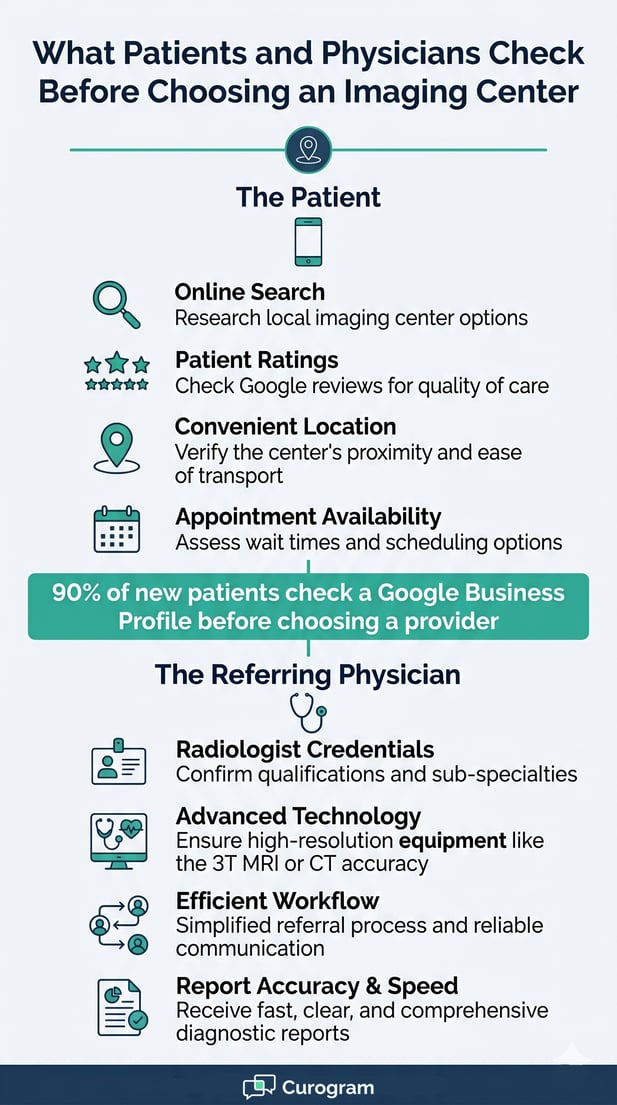
Comparison of imaging center selection criteria for patients and physicians

The Guide: The Automated Review Engine

Fixing the reputation gap does not require more staff, a new marketing budget, or manual outreach. The solution is a system that works in the background, every day, after every study. That is what Curogram brings to Exa-powered imaging centers.

How the System Works

Curogram links to your Exa imaging system through an API connection. When a study is marked complete, the system triggers a short text message to the patient.

That message arrives while the visit is still fresh, after the patient has left, but before the experience fades from memory. Automated review requests radiology centers use through Curogram are timed to land at exactly the right moment.

The process is fully automated. No staff involvement. No manual triggers. No reminders needed. The system handles everything after study completion.

The Smart Review Request Workflow

The text does not go straight to a Google review link. It starts with a simple check on how the patient felt about their visit. Patients who share a positive experience are given a direct link to leave a Google review.

Patients who share a concern are routed to a private feedback channel instead. This smart routing means your Google Business Profile only receives real, positive reviews.

Meanwhile, your team gets to hear about any concerns before they become public complaints. It is a smarter way to grow Google reviews for imaging centers while protecting the rating you have already built.

Exa Integration Without Disruption

Curogram connects through Exa's API platform. It detects completed studies and sends review requests without touching your PACS or RIS workflow.

No changes to your scheduling system. No updates to your billing process. No new logins or interfaces for your team to manage.

The review engine runs entirely in the background. Your front desk and radiology techs keep doing what they do without adding a single new task. The system works hardest when your team is most focused on patient care.

Why Imaging Centers Are the Ideal Setting

Not all medical visits produce the same kind of reviews. Imaging appointments are a different experience. They tend to leave a strong impression, which makes radiology one of the best settings for generating authentic, detailed patient feedback.

The Emotional Weight of Imaging Visits

Patients arriving for an MRI or CT scan are often anxious. They may not know what to expect. A technologist who takes time to explain the process, stays calm, and answers basic questions makes a real difference to that person. That kind of experience tends to produce detailed, heartfelt reviews.

It is far more memorable than a standard primary care checkup. Exa RIS patient engagement reputation work through Curogram captures that natural review potential. The kind of feedback that other clinical settings rarely receive.

Turning Every Completed Study Into a Review Opportunity

An imaging center doing 50 to 80 studies per day has 50 to 80 chances daily to generate a new review.

Without a system like Curogram, most of those chances are simply lost. With it, each completed study becomes a potential 5-star review.

Imaging center review generation at that volume adds up quickly. The results compound over time as more reviews lift your overall rating, which in turn makes each new review more visible. The process builds on itself.


The Success: The 500-Review Authority

Automated review requests do not just add numbers to your Google profile. They shift how your center is perceived by patients, physicians, and anyone searching your market. The results come faster than most imaging centers expect.

What the Numbers Show

The results of automated post-study review requests are measurable and consistent. Based on our internal data, a multi-location practice started with 993 Google reviews and grew to 8,159 in just three months.

That included 1,064 new 5-star reviews added during that period. The practice did not overhaul its care or hire a marketing agency. It added a review request system that worked automatically after every appointment.

From 993 to 8,159 Reviews in Three Months

The jump from under 1,000 reviews to over 8,000 in a single quarter shows what scale looks like when the process is automated. Based on our internal data, 90% of patients who received a review request left 5-star feedback.

That kind of conversion rate is only possible when the request goes out at the right time, to the right patient, through a trusted channel like SMS.

The growth was steady and predictable. New reviews came in each week. The overall rating stayed strong because the smart routing system filtered concerns away from the public profile.

What That Looks Like for a Radiology Center

Applied to a busy imaging center, the math is clear. A center doing 50 to 80 studies per day could generate 200 to 400 new reviews per month with a strong conversion rate. That is a potential increase of 2,400 to 4,800 reviews per year.

Review Growth Snapshot: Curogram Multi-Location Practice Client

Metric

Before Curogram

After 3 Months

Total Google Reviews

993

8,159

New 5-Star Reviews Added

0

1,064

Patients Leaving 5-Star Reviews

N/A

90%

Source: Based on internal data from a Curogram multi-location practice client.

From Invisible to Indispensable

A high review count does more than look good on a search results page. It changes how patients and physicians perceive your center before they ever contact you. That shift in perception has real, measurable effects on referrals and new patient volume.

How Referring Physicians Respond

When your center has 500 or more reviews and a 4.8-star rating, it stops being just an option on a list. Referring physicians begin mentioning it by name when discussing imaging options with patients.

The Google profile becomes an active part of your referral pipeline, not just a passive listing. The difference between 30 reviews and 800 is often the difference between a referral and a missed opportunity.

Strong Google reviews for imaging centers also reassure patients when a referral is made. A physician saying "they have great reviews" turns a recommendation into a confident choice.

The Outcome for Your Center

Your Exa PACS/RIS delivers diagnostic precision. Your Curogram review engine makes that precision visible to the people who matter. Million-dollar scanners backed by a 4.8-star Google rating carry real weight in a competitive market.

Referring physicians send patients without hesitation. New patients choose your center because the reputation matches the quality.

Imaging center review generation is not a vanity project. It is a revenue strategy. A strong online profile reduces the cost of acquiring new patients and increases the value of every referral relationship you have already built.

Doctor viewing physician search results on a tablet.

Conclusion: Build the Reputation Your Imaging Quality Deserves

Exa PACS/RIS manages your imaging workflow. Curogram manages the online reputation that determines whether patients and physicians choose your center in the first place. Both matter. Only one is easy to overlook.

The two systems do different jobs, and both are necessary. Exa runs the clinical side of your imaging center with precision, from study scheduling to radiology reporting.

Curogram handles the side that most patients and referring physicians see first, which is your Google Business Profile. Together, they cover both what your center does and how it appears to the outside world.

Reputation management for radiology centers is not a marketing add-on. It is a core part of how patients choose where to go and how physicians decide where to send them.

Before patients arrive for their MRI or CT scan, they search your name. Before referring physicians send a patient, they may check your rating. The first impression does not happen in your waiting room. It happens on a phone screen, often within seconds of a quick search.

Automated post-study text requests are what keep that first impression strong over time. Each review that comes in raises your rating, increases your visibility, and adds social proof that the next patient or physician will see.

Some imaging centers have looked at platforms like openDoctor for patient engagement. But openDoctor, priced at around $2,500 per month, does not include reputation management tools.

Curogram offers a full openDoctor alternative with built-in review generation, HIPAA-compliant messaging, and direct Exa integration. You get more value from your patient engagement budget without needing a separate reputation platform.

Starting with Curogram is straightforward. It connects to your Exa workflow without disruption. Review requests go out automatically after each completed study. Most imaging centers see measurable review growth within the first two weeks.

See how Curogram fits your imaging workflow. Schedule a free demo today.


Frequently Asked Questions

How do automated review request texts stay HIPAA compliant?

Curogram is SOC 2 Type II certified and fully HIPAA compliant. Review request texts contain no protected health information. They simply ask about the patient's experience and include a direct Google review link. Curogram signs a Business Associate Agreement with every imaging center before going live.

Why does smart routing prevent negative reviews from appearing on Google?

Curogram sends a satisfaction check before directing anyone to leave a public review. Patients who share a concern are routed to a private feedback channel rather than to Google. This protects your public rating while giving your team a chance to address issues directly. Most imaging centers see their average rating increase after enabling the system, not decrease.

How does Curogram connect to an Exa PACS/RIS system?

Curogram integrates through Exa's API platform to detect when studies are completed. No changes are needed to your RIS workflow, scheduling process, or billing setup. The integration runs in the background and triggers review requests automatically. Your team does not need to take any additional steps for it to work.

Why do referring physicians pay attention to Google ratings for imaging centers?

Referring physicians use Google to quickly compare facilities when making recommendations. A center with hundreds of positive reviews signals consistent patient satisfaction, which matters when a physician puts their own name behind a referral. A strong rating also reassures patients when the recommendation is made, which increases follow-through. A weak profile, by contrast, can quietly redirect those referrals to a competitor week after week. 

How quickly can an imaging center expect to see review growth with Curogram?

Most imaging centers begin to see measurable review growth within the first two weeks of going live. The rate depends on daily study volume, but a center doing 50 to 80 studies per day has strong potential for 200 to 400 new reviews each month. Based on our internal data, one multi-location practice grew from 993 to 8,159 Google reviews in just three months. Results compound over time as the review base grows and your overall rating strengthens.