

11 min read

AdvancedMD Google Reviews | From Survey Scores to Search Visibility

AdvancedMD Google Reviews | From Survey Scores to Search Visibility
💡 AdvancedMD includes a built-in reputation module that automates post-visit surveys. But patient feedback collected this way stays inside the system. It never becomes the public Google reviews that drive local search rankings and new patient decisions.

Curogram fills this gap. Its automated post-visit text requests send patients a direct link to the practice's Google Business Profile. The review takes less than 60 seconds to complete.

Review count, star rating, and recency all affect how a practice ranks in local search. Based on our internal data, one practice grew from under 1,000 Google reviews to over 8,000 in just three months. That kind of visibility changes how patients find and choose a provider.

Curogram works alongside AdvancedMD's reputation tool. One system captures feedback. The other puts it on the map.

Your patients are happy. You know this because AdvancedMD tells you so. But here is the question: Does Google know it, too?

Search your practice name right now. You might see a solid star rating. Maybe 40 reviews. Maybe 60. But your nearest competitor? They have 250.

To a patient scanning Google Maps, that gap tells a clear story. It says one practice is trusted and chosen by others. The other is still unknown.

That is the core problem with keeping satisfaction data inside a system. AdvancedMD's reputation module does its job well.

It sends post-visit surveys, captures feedback, and gives you useful data for staff improvement and patient experience tracking. Practices have relied on it for years.

But a survey response and a Google review are not the same thing. One lives in your dashboard. The other lives on the internet, where patients are searching.

Over 90% of patients check Google reviews before choosing a provider. Review count, star rating, and review recency all affect how your practice ranks in local search. More reviews, posted more often, mean a better position on Google Maps.

AdvancedMD Google review generation using automated post-visit text requests is how practices turn satisfied patients into visible, searchable proof.

Not scores in a report. Real reviews that prospective patients see when they look for care in your area.

This article explains why the survey-to-review gap exists and how automated review requests work within the AdvancedMD ecosystem.

It also covers what real results look like when a practice commits to building review volume.

If your reputation management efforts are producing feedback but not Google reviews, you are headed in the right direction. You are just stopping one step too early.

The Villain: The Survey That Stays Internal

AdvancedMD includes a reputation module that has been available longer than many competitors' tools. It sends surveys, collects scores, and tracks patient sentiment over time.

For internal reporting, it works well. But for building a strong Google Business Profile, it was never designed to do that job. This section explains what that gap costs your practice every single day.

The Feedback-to-Review Gap

AdvancedMD's reputation module sends post-visit surveys automatically. Patients rate their visit, leave comments, and submit feedback with little friction. For staff reviews and quality improvement, this data is very useful. But there is a catch.

What AdvancedMD's Reputation Tool Was Built For

The tool was designed to measure satisfaction, not generate public reviews. Survey responses go directly into the dashboard. They become metrics, not endorsements.

A 5-star survey score and a 5-star Google review may look the same on paper. But only one of them is visible to a prospective patient searching for a doctor.

Why Feedback Has to Be Public to Matter

A patient who rates you 5 stars in a survey becomes a data point. A patient who posts a 5-star Google review becomes a marketing asset. The difference is not about effort.

It is about where the feedback ends up. Internal scores improve operations. Public reviews improve search visibility. Both matter, but only one of them attracts new patients.

The Visibility Deficit

Two practices can deliver the same quality of care. But if one has 300 Google reviews and the other has 50, they will not rank the same in search results.

Review volume is a local search ranking factor. So is star rating. So is recency. This is not just a perception issue. It is how the algorithm works.

How Review Count Affects Your Search Position

Google's local search algorithm uses review count as a signal of trust and activity. More reviews suggest to Google that a business is active and well-regarded.

A practice with 300 reviews will often outrank one with 50, even when other factors are similar. This affects how often your profile appears in "near me" searches on Google Maps.

What a Thin Review Profile Costs You

A prospective patient comparing two practices will tend to choose the one with more reviews. It reads as social proof. More patients have been there.

More people have vouched for the experience. A thin review profile, even with a high star rating, can make a practice look newer or less established than it actually is.

The Recency Problem

Total review count is not the only metric that matters. How recently reviews were posted carries just as much weight. Google gives more value to fresh reviews than old ones.

Patients notice review dates too. A review from three years ago carries far less impact than one posted last week.

Why Old Reviews Lose Their Value

A practice with 150 reviews built up over five years may generate only two or three new reviews each month. That slow pace signals to both Google and patients that activity has stalled.

Competitors generating 20 to 30 new reviews per month appear more active, more current, and more trusted in the algorithm.

How Stale Review Profiles Lose Ground

Without a steady flow of new reviews, a profile ages out of relevance. Your total count may look fine on the surface.

But Google's algorithm is looking at velocity, not just volume. A competitor who generates more reviews each week will gain ground in local search rankings, even if your overall count is currently higher.

The Manual Ask Problem

Many practices try to collect Google reviews by asking patients at checkout. The idea sounds simple. In practice, it rarely produces consistent results at scale.

Why Verbal Requests Fall Short

Front desk staff are busy. They forget to ask. Patients nod and then move on without following through. Even when the ask happens, there is no follow-up and no way to track who was asked, who actually posted, or what the conversion rate is. That makes the process nearly impossible to improve.

The Case for Automating the Ask

Manual review requests generate 5 to 10 new reviews per month at best. Automated Google review requests to AdvancedMD patients, sent right after a visit, produce far more.

The ask is immediate. The link is right there. Patients are still thinking about their experience. That combination drives much higher completion rates than any verbal request can match.    

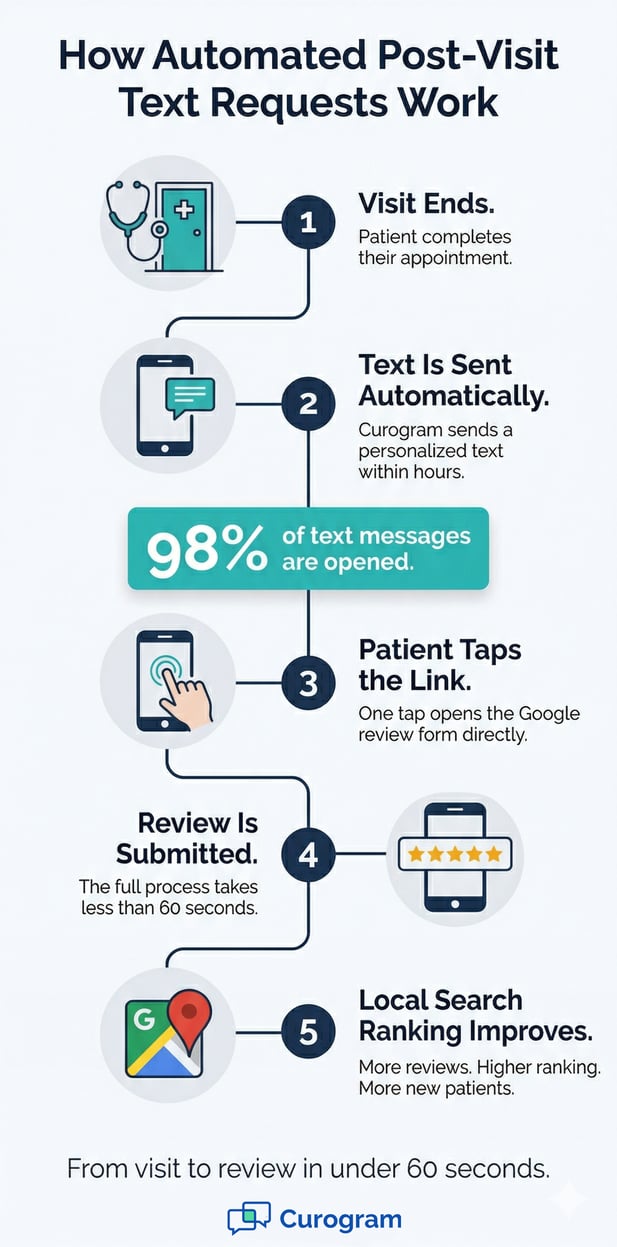
Automated healthcare review requests: 5-step infographic for practice growth

The Guide: The Review Volume Engine

There is a better way to generate Google reviews. It does not require staff training, extra steps at checkout, or changes to how your team works.

It runs automatically, triggered by the same appointment data already in AdvancedMD. This section explains how the process works from start to finish.

The Solution

Curogram sends a short text message to patients after their visit ends. The message includes a direct link to the practice's Google Business Profile review page. No login is required. No apps to download. One tap opens Google's review form.

How Automated Text Requests Work

The text is sent within hours of the appointment, while the experience is still fresh. It reads simply: "Thank you for visiting [Practice Name] today. We would love to hear about your experience: [link]."

The entire interaction takes less than 60 seconds. Patients tap the link, choose their star rating, optionally add a comment, and submit.

What the Patient Experience Looks Like

Patients do not need to search for the practice on Google. They do not need to find the review button on their own. The link takes them directly to the review form.

This small change in friction makes a big difference in how many patients actually complete the process versus those who intend to but never do.

Sentiment-First Routing

Not every post-visit experience is positive. Sending all patients directly to Google, regardless of how they felt, creates real risk to your star rating.

Curogram's Sentiment-First Routing adds a brief check before the Google link is shared. This is one of the key features that separates automated review tools from a simple bulk text blast.

How Routing Protects Your Star Rating

Patients first receive a simple satisfaction question. Those who report a positive experience get the Google review link right away.

Those who report a less-than-positive experience are directed to an internal feedback form instead. This keeps the public review pipeline populated by satisfied patients, which protects the practice's overall star rating over time.

Why Private Feedback Matters Too

Routing unhappy patients to a private form is not about hiding problems. It is about handling them before they go public. The practice gets a chance to reach out, address the concern, and resolve the issue.

This builds trust with the patient and often prevents a negative public review that could have been avoided with a simple follow-up.

The Integration

Curogram connects directly to AdvancedMD's appointment schedule. No manual steps are needed once the initial setup is complete.

When a visit is marked done, Curogram automatically queues the review text at the configured time interval. The integration works in the background, without disrupting any existing workflows.

How Curogram Connects to Your AdvancedMD Schedule

The system pulls the patient's name and phone number from the appointment record. It personalizes the message and sends it at the right time.

Staff do not need to do anything extra. The whole process is triggered by what already happens inside AdvancedMD, making it easy to adopt without changing how the team operates.

What Multi-Provider Practices Get

For practices with multiple providers or locations, each provider can have their own review request settings.

Different timing, different message templates, different Google Business Profile links. This makes it easy to track review activity by provider and to make sure each location builds its own distinct review presence on Google.

The Scale Factor

Text messages have a 98% open rate. Compare that to email, which averages 20 to 30%. When a review link arrives by text, most patients see it. And because the link goes directly to Google, most patients who open it can complete a review in under a minute.

Text vs. Email vs. Manual: A Comparison

Channel

Avg. Open Rate

Est. Monthly Reviews (30 pts/day)

Manual (verbal)

N/A

5–10

Email

20–30%

10–15

SMS Text

~98%

50–60+


What High Review Volume Does for Local Search

For a practice seeing 30 patients per day, automated review texts can generate 50 to 60 or more new Google reviews each month.

At that pace, a profile that once looked thin can become one of the most reviewed practices in the area within a few months. AdvancedMD review generation at scale through automated post-visit text is the only practical way to reach that kind of velocity.  


The Success: Visible, Chosen, Growing

Automated review requests produce measurable results. The impact shows up quickly, and it compounds over time.

This section looks at what happens when a practice commits to building review volume and why the shift from internal feedback to public proof is one of the most important moves a practice can make for long-term growth.

The Metric

Based on our internal data, one multi-location practice generated 1,064 new 5-star Google reviews in just three months.

Their total review count grew from 993 to 8,159. That is not a gradual improvement. That is a complete transformation of how the practice appears online.

What a Review Surge Looks Like in Practice

A review surge changes more than the number on a profile. It improves local search ranking on Google Maps. It increases click-through rates when patients search for a provider nearby.

It drives more calls to the front desk and more new patient appointments booked online. Every new review adds to a compounding effect that makes the profile more visible and more trusted over time.

The Connection Between Reviews and New Patients

90% of new patient leads see a Google Business Profile before they ever visit the practice website. Reviews are the first impression.

A profile with hundreds of recent, positive reviews signals that others have been there, had good experiences, and trusted the practice enough to say so publicly. That kind of social proof is hard to replicate through any other channel.

The Shift

When automated review requests are in place, the practice's approach to reputation changes in a meaningful way.

It moves from collecting internal satisfaction scores to generating visible, public proof. Both types of data still exist and both still matter. But now they serve different and complementary purposes.

Moving From Satisfaction Scores to Public Proof

Survey scores are valuable for operations. They tell you where care can improve and how your team is performing. But they do not help a prospective patient decide whether to book an appointment.

Google reviews do that. AdvancedMD reputation management paired with Google review generation through automated text creates a complete picture: internal insight and external visibility working together.

How Review Profiles Reflect Real Care Quality

A practice that provides excellent care deserves to be found. But Google cannot measure care quality directly. It reads signals like review count, star ratings, and how recently reviews were posted.

When a practice builds a strong, active review profile, it is not working around the system. It is making sure the system can see what patients already know about the quality of care they received.

The Outcome

When review velocity is high and sustained, the Google Business Profile begins to reflect the practice's actual reputation. Hundreds of recent reviews. A 4.8-plus star rating. Fresh posts every week.

The profile does the marketing work that paid ads often cannot, because patients trust it more.

What a Strong Google Profile Looks Like

Prospective patients searching for a provider in the area see a practice that is clearly active and widely trusted. Multiple recent reviews. A high star rating. Consistent positive feedback across different providers and specialties.

This kind of profile does not just attract clicks. It removes doubt. Patients feel confident before they even pick up the phone.

Why Reviews Outperform Ads for New Patient Trust

Advertising tells patients what you want them to think. Reviews tell patients what other patients already thought. The difference in credibility is significant.

Patients trust peer opinions far more than marketing messages. AdvancedMD Google Business Profile reviews built through automated text requests do that trust-building work around the clock, without ongoing ad spend.


Patient fills out a digital patient satisfaction survey after medical appointment


Satisfaction Is Internal. Reviews Are Visible.

Everything in this article points to one core idea. Satisfied patients are your most powerful marketing asset.

But satisfaction that lives in a survey dashboard does not attract new patients. Visibility does. This final section brings it all together and outlines what to do next.

AdvancedMD measures patient satisfaction well. That has always been one of its strengths.

But measuring satisfaction and generating Google reviews are two different jobs, and they require two different tools.

Every day a satisfied patient leaves without receiving a Google review request is a missed chance to build visibility.

A competitor generating 50 new reviews per month gains ground in local search rankings, regardless of their actual care quality. Visibility compounds over time. And so does the cost of falling behind.

Curogram does not ask you to replace AdvancedMD's reputation module. It extends what that module already does. Keep collecting survey data for internal improvement.

Add automated review texts to make that satisfaction visible where patients are searching. Together, the two tools give your practice both internal insight and external credibility.

Your satisfied patients are your most credible marketing voice. Not because they are loud, but because they are real.

A 5-star Google review from a patient who just had a great experience carries more trust than any ad. The only question is whether you have a system in place to ask for it.

A patient who receives a review request within hours of their visit is far more likely to respond. The experience is still fresh. The positive feeling is still there.

A request sent days later gets much less engagement. Automated post-visit text requests are timed to catch that window, without requiring any extra effort from your team.

Think about what 50 new reviews per month does to a profile over a year. That is 600 new reviews, most of them 5-star, all of them recent.

After 12 months, a practice that once had 80 reviews now has nearly 700. That growth in review volume and local search visibility is simply not achievable through manual requesting alone.

You have already invested in AdvancedMD. You are already collecting patient feedback. The next step is making sure that feedback reaches the patients who need to see it most: the ones who have not visited you yet.

Schedule a demo today to see how Curogram compares to your current Google review velocity. You will get a clear picture of what is possible for a practice like yours, based on real data from similar practices in your specialty and market.

Frequently Asked Questions

How does Curogram generate more Google reviews than AdvancedMD's built-in reputation tool?

Curogram sends automated text messages directly to patients right after their visit. Each message includes a one-tap link to the practice's Google Business Profile.

Text messages carry a 98% open rate, far above what email or verbal requests can achieve. That combination of timing, channel, and low friction drives far more reviews per patient contact than any manual method.

How does Sentiment-First Routing protect a practice's star rating?

Before a patient receives the Google review link, Curogram sends a short satisfaction check. Patients who report a positive experience are sent to Google right away. Patients who report a negative experience are routed to a private feedback form instead. This keeps the public review pipeline filled mainly by satisfied patients, while concerns are handled privately before they go public.

Why do review recency and volume both affect local search rankings?

Google's local search algorithm uses review data as a signal of trust and ongoing activity. Practices with more reviews, higher star ratings, and more recently posted reviews tend to rank higher on Google Maps. Recency signals to both Google and prospective patients that the practice is active and current. Without a steady stream of new reviews, even a strong overall rating can start to lose ground.

How does automated Google review generation work within the AdvancedMD workflow?

Curogram connects directly to the AdvancedMD appointment schedule. When a visit is marked complete, Curogram queues a review request text to be sent at the configured time. Staff do not need to take any extra steps. The system personalizes each message using the patient's name and appointment data already stored in AdvancedMD, making the process entirely hands-free.

Why does review volume matter more than star rating alone?

A high star rating backed by only a handful of reviews does not carry the same weight as a high rating supported by hundreds. Volume tells patients that many people have visited and had positive experiences. It also tells Google that the practice is active and trusted, which improves local search rankings. A strong star rating combined with high review volume creates the most powerful Google presence a practice can build.


Why eCW Patients Review by Text | Post-Visit Timing That Works

Why eCW Patients Review by Text | Post-Visit Timing That Works

💡 When a patient leaves a good visit, that positive feeling fades fast. An eClinicalWorks patient text review request sent 1–2 hours after the...

Read More
PF Patient Review Requests | One-Tap Google Review via Text

PF Patient Review Requests | One-Tap Google Review via Text

💡 Practice Fusion patient Google reviews are often left unwritten, not because patients are unhappy, but because the process is too hard.Curogram's...

Read More
PF Automated Review Requests | Zero Staff Effort at Checkout

PF Automated Review Requests | Zero Staff Effort at Checkout

💡 For small clinics running on Practice Fusion, asking patients for Google reviews at checkout is one of those tasks that almost never gets done....

Read More