
Why eCW Patients Review by Text | Post-Visit Timing That Works
💡 When a patient leaves a good visit, that positive feeling fades fast. An eClinicalWorks patient text review request sent 1–2 hours after the...
Your patients like you. Most of them would say so — if someone just made it easy enough to ask. That's the gap Practice Fusion clinics face every day.
A patient leaves your office feeling good. The visit was smooth. The doctor listened. The plan was clear.
But by the time they get home, make dinner, and answer a few messages, the idea of writing a Google review has long passed. It's not that they don't care. It's that nobody caught them at the right moment.
This is the quiet problem behind most thin Google profiles. It's not poor care. It's poor timing. Patients who had a great visit rarely think to open their browser, search for your practice by name, find the right Business Profile, and navigate a review form on their own. That process has too many steps and zero momentum.
Meanwhile, the patients who had a bad experience? They find a way.
They are motivated. So your Google rating ends up telling the wrong story. One shaped by the unhappy minority, not the satisfied majority.
That's where the Post-Visit Text comes in. Curogram's tool sends a direct Google review link to patients within minutes of their appointment, right when satisfaction is highest.
No app download. No patient portal. No staff involvement. Just a simple text from your office number, caught at the right moment.
This article walks through how the tool works, why timing matters so much, and what happens when a practice finally makes it easy for happy patients to speak up.
Most clinics assume their patients just aren't the type to leave reviews. That's rarely true. The real issue is that the path to leaving a Google review is longer than most people realize. Understanding that path — and where it breaks — is the first step to fixing it.
Think about what a patient has to do on their own to leave a Google review. They need to remember the visit, open Google, type in the practice name, find the correct Business Profile among any similar results, click the review button, write something, and hit submit. That's six to seven steps with no natural trigger.
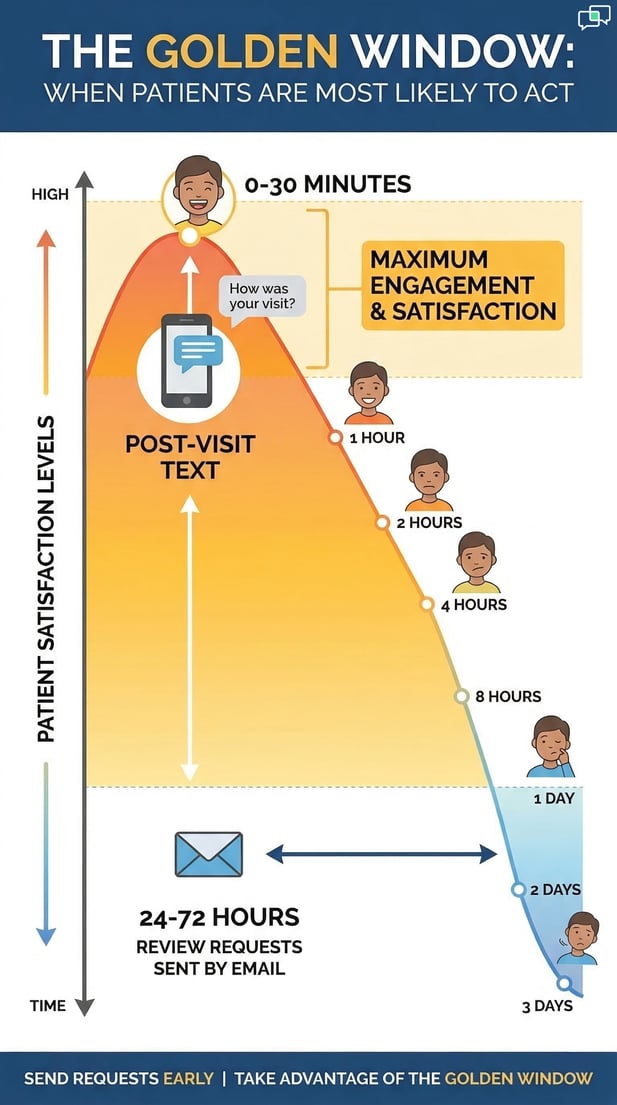
Research shows that patient satisfaction peaks within 15 to 30 minutes of leaving a clinic. After the first hour, the chance they'll take action drops fast.
Life gets in the way. They pick up their kids. They check emails. They start dinner. The visit becomes a good memory — but just a memory.
The gap between “I had a great visit” and “I left a great review” is simply too wide for most patients to cross on their own.
That's not a reflection of how much they value the practice. It's a reflection of how much friction stands between the feeling and the action.
When a practice depends on patients to find their Google Business Profile on their own, it's asking them to solve a search problem they weren't thinking about.
Even loyal patients who visit regularly may not know the exact name of the practice, which city it's listed under, or how to distinguish it from similar entries. A direct link removes every one of these barriers in one step.
Unhappy patients are motivated. They know exactly what they want to say, and they'll go out of their way to say it publicly. Satisfied patients, by contrast, need a nudge.
Without one, the reviews that get written skew negative — not because most visits went poorly, but because the process only favors the most determined voices.
This creates a dangerous pattern: a practice delivering excellent care can still end up with a weak Google rating.
The rating doesn't reflect quality. It reflects who had enough frustration to push through the six-step review process.
Fixing this doesn't require asking every patient to leave a review manually. It requires removing the friction at exactly the right moment — and doing it consistently, for every patient, after every visit.
Curogram's Post-Visit Text is built around one idea: catch patients while the visit is still fresh, and make it as easy as possible for them to share their experience.
Each part of the tool is designed to lower the barrier between satisfaction and action.
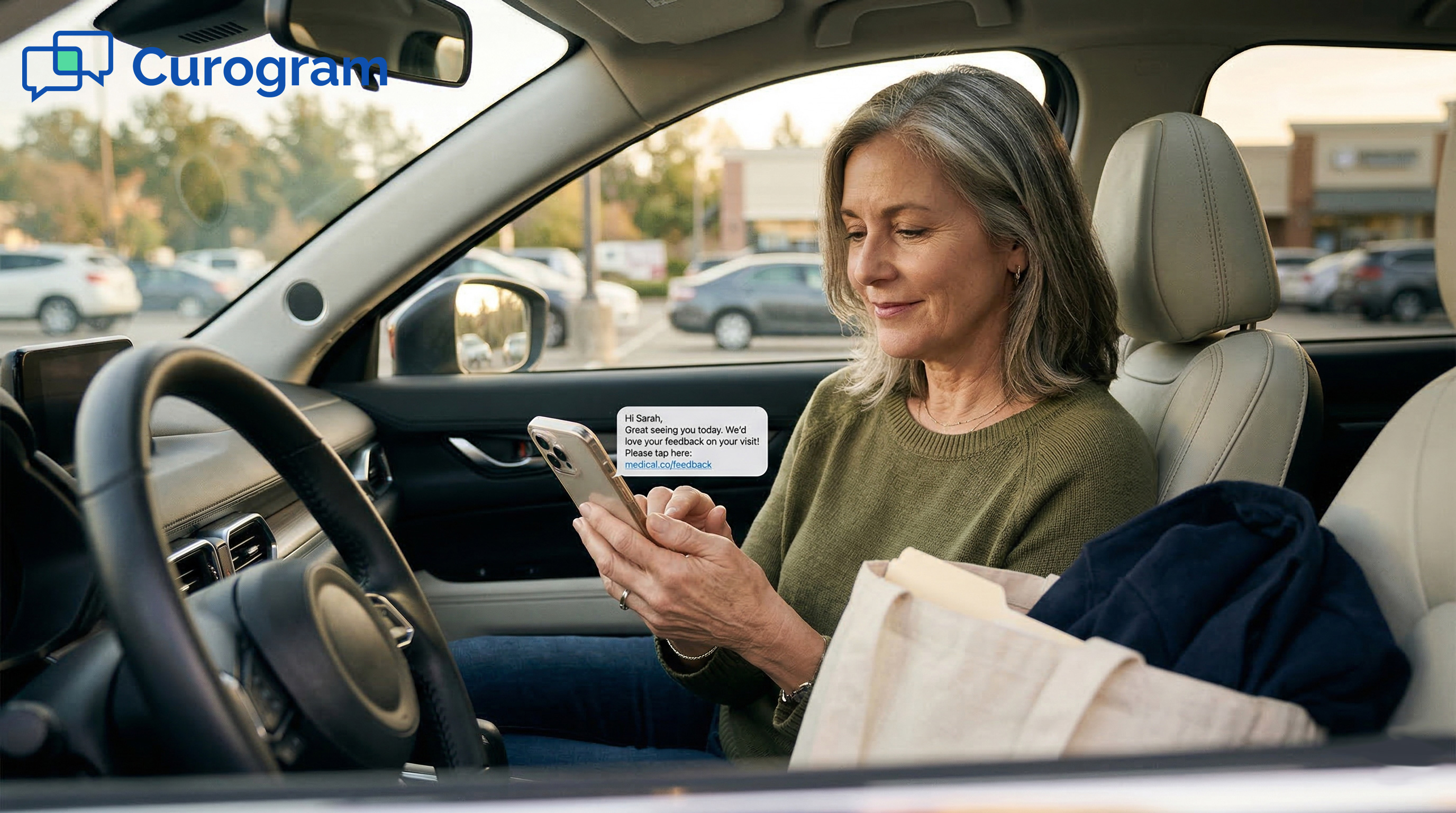
Within 15 to 30 minutes of a patient's appointment, they receive a text from the practice's own phone number. The message is short and friendly: a thank-you for visiting, and a direct link to leave a Google review.
The patient taps the link. Google opens with the practice's Business Profile already loaded and a review form ready to fill out. They write a sentence or two, tap the stars, and hit submit.
Total time from receiving the text to submitting the review: under 60 seconds. Compare that to the six-step process a patient would have to go through on their own, and the difference is clear.
This is the difference between a 5% conversion rate and a 90% conversion rate. Not because the tool is pushy, but because it removes every step that causes people to give up.
The text is sent during what practitioners often call the golden window — the 15 to 30 minutes after a patient leaves the office. During this time, the experience is still vivid.
The patient remembers exactly how they felt. They haven't been pulled into another task yet. A message that arrives during this window catches them at their most receptive.
A review request sent three days later by email will almost always be ignored. The emotion has faded. The patient has moved on. Timing isn't just a nice-to-have — it's the entire strategy.
One of the biggest reasons patients don't engage with clinic outreach is that it requires them to do something unfamiliar. Download an app. Log into a portal. Create an account. These steps feel like work, and most patients won't bother.
The Post-Visit Text works in the patient's native messaging app. The review link opens in their phone's browser. If they're already logged into Google on their phone — which most smartphone users are — the review is submitted with their existing account.
No new login required. No new platform to learn. It feels exactly like texting a restaurant or hotel rating.
The familiar number the text comes from — the same one the patient called to book their appointment — makes it feel natural, not like a cold marketing message.
Not every visit goes perfectly. Curogram's Post-Visit Text includes sentiment routing, which means patients who indicate a less-than-positive experience are directed to a private feedback form instead of the public Google review page. This gives the practice a chance to address concerns before they go public.
Based on our internal data, when sentiment routing is active, over 90% of reviews generated through the Post-Visit Text are 4- or 5-star ratings.
Negative feedback is captured privately — where it can lead to real improvements — rather than becoming a permanent mark on the practice's Google profile.

The best way to see how the Post-Visit Text works is to follow one patient through the experience.
Mrs. Tran's story isn't unusual — but it shows exactly how a small change in process can turn a loyal patient into a vocal advocate.
Mrs. Tran is 52 years old and runs a restaurant in suburban Portland. She's been a patient at a small two-provider internal medicine clinic on Practice Fusion for four years.
She uses text messaging every day for her business. But she has never left a Google review for any business — not a restaurant, not a hotel, not a doctor's office.
"I don't really do reviews," she said. "I wouldn't even know where to go to leave one."
She's not indifferent. She's just never been given a clear path to do it.
Mrs. Tran came in for a routine follow-up to check on her thyroid medication. The visit went well. Her doctor adjusted her dosage, walked her through the lab results, and answered all her questions. She left feeling confident about her care — the same way she'd felt after most visits.
About 15 minutes later, while waiting in a parking lot for her son, she got a text from the clinic's number. It said: "Thank you for visiting us today, Mrs. Tran! If you had a great experience, we'd appreciate a quick Google review. Tap here: [link]."
She tapped the link. Google opened with the clinic's page and a review form already loaded.
She typed a few sentences: "Dr. Ngo is excellent. Always explains everything clearly. The office is clean and the staff is friendly. Highly recommend."
She tapped 5 stars and hit submit. The whole thing took about 45 seconds.
Mrs. Tran never opened Google on her own. She never searched for the practice. She never navigated any unfamiliar interface.
She left her first-ever Google review because the path was so short and so clear that the distinction between "someone who leaves reviews" and "someone who doesn't" stopped mattering.
When asked about it later, she shrugged: "It was easy. They sent me the link, I tapped it, I wrote something nice. Took less than a minute."
That's the point. When the process is that easy, even first-time reviewers say yes.
Mrs. Tran's review is now visible to every person who searches for the practice on Google. One 45-second action from one loyal patient can influence dozens of future decisions.
Multiply that across 20 to 30 patients per day, and the effect on a practice's online reputation can be transformative — based on our internal research, practices using the Post-Visit Text can collect over 1,000 new 5-star reviews within just three months.
Mrs. Tran's experience isn't just a feel-good story. It illustrates three things that every practice manager and physician owner should understand about how patients actually behave — and what that means for the clinic's reputation.
The biggest misconception about online reviews is that the patients who don't leave them are somehow less loyal or less satisfied. That's almost never true.
Mrs. Tran had been a patient at the practice for four years. She had a positive visit nearly every time. She just didn't know how to leave a review — and no one had ever made it easy enough for her to try.
The barrier isn't willingness. It's friction. A direct text link removes that friction in one step. When practices wait for patients to take the initiative, they're waiting for something that will rarely happen. When they remove the obstacles, satisfied patients respond quickly — often within minutes.
The Post-Visit Text works in part because of when it arrives. The golden window — that 15 to 30 minutes right after an appointment — is when the visit is most vivid and the patient's satisfaction is highest. That's the moment to ask.
A review request sent three days later lands in a cluttered inbox. The visit is a distant memory. The urgency is gone.
Even patients who had a wonderful experience are unlikely to act. The timing of the Post-Visit Text is not incidental — it's the core of why the tool converts so well.
Google is how most people find a new doctor. Based on our internal research, 90% of new patient leads look at a practice's Google Business Profile before ever visiting the website.
That means a thin review profile — or one with too many negative reviews — can quietly cost a practice dozens of new patients every month.
Mrs. Tran's one 45-second review is now part of what every prospective patient sees. It signals that this practice is caring, communicative, and worth visiting.
One review from one loyal patient can tip a decision for many future patients. Across a full day of 20 to 30 appointments, those decisions add up fast.
A practice that collects consistent 5-star reviews doesn't just look better online — it ranks higher in local Google search results.
More reviews, especially recent ones, signal activity and trustworthiness to Google's algorithm. That means more visibility, which means more new patients finding the practice in the first place.
The Post-Visit Text doesn't just improve ratings. It creates a compounding effect: better reviews lead to higher rankings, which lead to more visibility, which lead to more new patients. All of it starts with a single text sent at the right moment.
Tracking the right numbers helps practices see whether the Post-Visit Text is working — and where there's room to improve. These are the core metrics that matter most.
This is the most direct way to measure success: what % of patients who receive the text actually tap the review link?
Based on our internal data, practices using Curogram's Post-Visit Text see up to 90% of recipients leave a 5-star review.
Even more conservative results — a 30% to 50% conversion rate — are far ahead of what any manual ask process can reliably achieve.
If response rates are lower than expected, the timing and message content are the first things to look at. A message sent too late, or one that feels impersonal, will convert less well than one sent promptly with the patient's name included.
This tracks how quickly patients leave a review after receiving the text. Most reviews come in within 10 minutes of the message being sent, which confirms that the golden window timing is working. If there's a significant delay, it may suggest the text is arriving too late to catch patients while the visit is still fresh.
Like Mrs. Tran, a meaningful share of patients who leave reviews through the Post-Visit Text have never left a Google review before.
Tracking this number shows the real reach of the tool. It's not just capturing the patients who were already inclined to review. It's opening the door for the silent majority who simply needed a clear, easy path.
With sentiment routing enabled, the star distribution of reviews should skew heavily positive — 90% or more at 4 to 5 stars, based on our internal research.
Monitoring this distribution over time can reveal patterns. A sudden drop in positive reviews, for instance, could indicate a service issue worth investigating.
|
Metric |
Benchmark |
Why It Matters |
|
Response Rate |
Up to 90% |
Shows how well the text converts recipients into reviewers |
|
Time-to-Review |
Under 10 min |
Confirms the golden window timing is working |
|
Positive Rating Share |
90%+ at 4–5 stars |
Tracks review sentiment after routing is applied |
|
First-Time Reviewer Rate |
Significant share |
Measures reach beyond typical reviewers |
Turn Every Great Visit Into a 5-Star ReviewIf your Practice Fusion clinic is delivering good care but not seeing it reflected online, the problem is rarely the care itself. It's the process — or the lack of one.
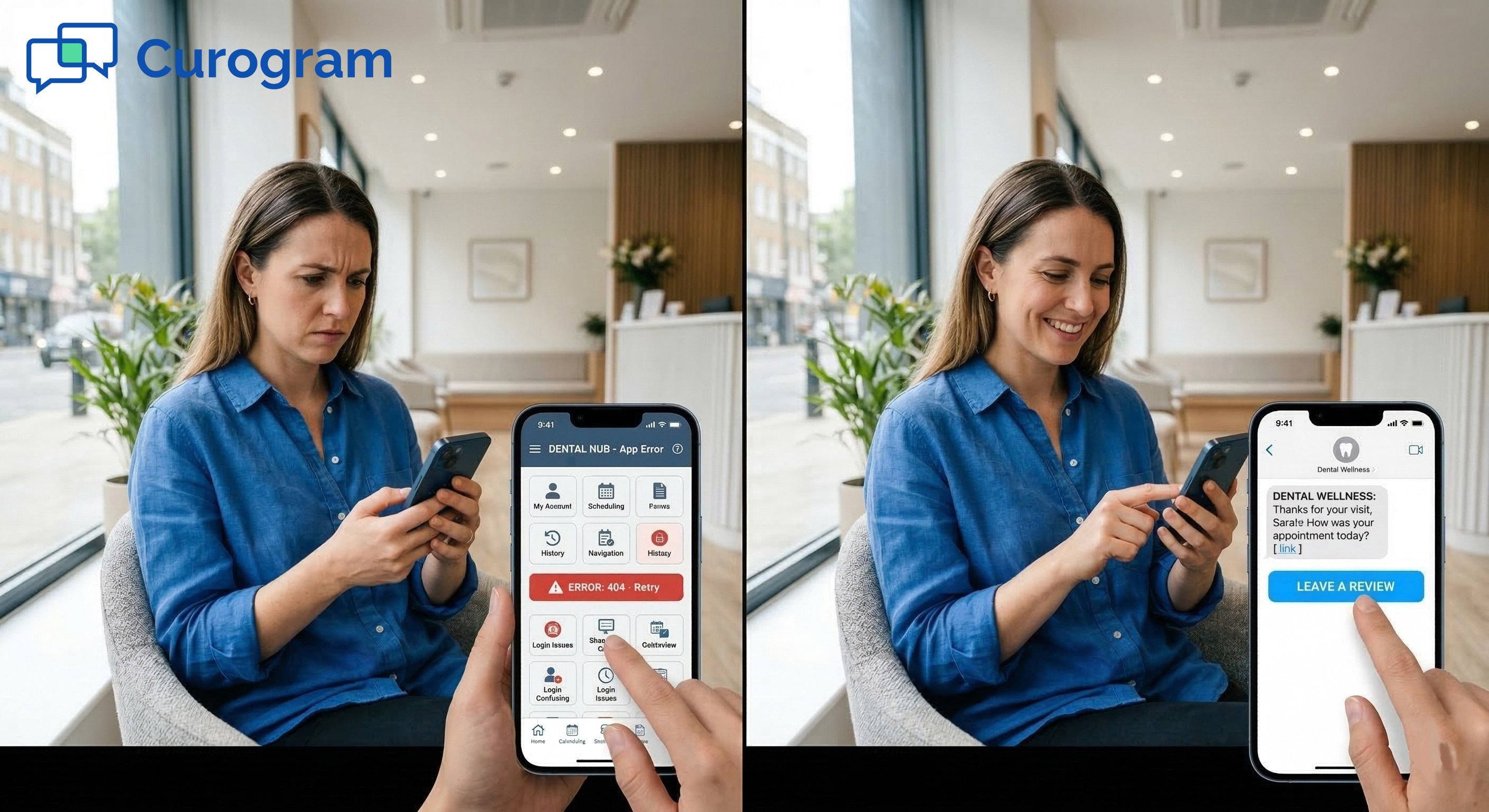
Patients leave satisfied. The reviews just don't follow. Not because patients won't say something good, but because no one made it easy for them at the right time.
Curogram's Post-Visit Text closes that gap. It works with your existing Practice Fusion setup. It sends automatically after each appointment.
There's no extra work for your front desk and no new step for your patients. They get a text from a number they recognize, with a link that takes them straight to your Google review page. Most of them tap it within minutes.
Based on our internal data, practices using the Post-Visit Text have generated over 1,064 new 5-star reviews in just three months — without any manual outreach, staff effort, or patient friction.
That kind of growth changes how a practice shows up in local Google search results, which directly affects how many new patients find you.
Your satisfied patients are ready to speak. They just need one tap to do it.
Schedule a demo to see how Curogram's Post-Visit Text works with Practice Fusion — and how quickly your Google profile can start reflecting the care you're already delivering.
Curogram connects directly with Practice Fusion to track appointment status. When a visit is marked as complete in Practice Fusion, the Post-Visit Text is sent automatically — usually within 15 to 30 minutes. No manual trigger is needed from staff. The timing is built into the workflow.
When patients have to search for a practice on their own, the process involves six or more steps. Most people won't complete that journey, even if they have a great visit.
A direct link reduces those steps to just two: tap the link and submit the review. That difference in friction explains why direct-link requests convert at rates far higher than manual asks.
When a patient receives the Post-Visit Text and indicates a negative experience, sentiment routing redirects them to a private feedback form rather than the public Google review page. This gives the practice a chance to address the issue directly.
Only patients with positive experiences are directed to leave a public Google review. Based on our internal data, this results in over 90% of published reviews being 4- or 5-star ratings.
Patient satisfaction is highest in the 15 to 30 minutes right after a visit. During that window, the experience is vivid, and the patient is still in a positive frame of mind.
Requests sent hours or days later arrive when the emotion has faded, and distractions have taken over. The golden window is the only window that reliably produces high review conversion rates.
The Post-Visit Text is designed to work for any smartphone user who is already logged into Google on their device — which covers the vast majority of patients.
Since the link opens directly in the phone's browser with the review form pre-loaded, there's nothing new to learn or install. Patients like Mrs. Tran, who had never left a review for any business, find it easy enough to complete in under a minute.
💡 When a patient leaves a good visit, that positive feeling fades fast. An eClinicalWorks patient text review request sent 1–2 hours after the...
💡 Practice Fusion automated Google review requests, powered by Curogram's Review Engine, send a post-visit text to every patient after each...

💡 For small clinics running on Practice Fusion, asking patients for Google reviews at checkout is one of those tasks that almost never gets done....