

Automated SMS Reminders for eClinicalWorks | Reduce No-Shows at Scale
💡 eClinicalWorks automated SMS appointment reminders that reduce no-shows at enterprise scale replace manual confirmation calls with multi-cadence...
14 min read
Jo Galvez
:
March 17, 2026
Table of Contents
Your Practice Fusion appointment reminders are going out. Patients get the text. They read it. And then nothing happens. No reply. No confirmation. Just silence.
That silence has a cost. Your front desk arrives each morning and starts calling patients one by one just to find out who is coming in. This is the confirmation scramble, and it happens at practices across the country every single day. It is not a workflow problem. It is a system problem.
Practice Fusion's built-in reminder system does its job: it sends the message. But it was not built to receive a reply. There is no 2-way link. The patient gets the reminder, but the practice gets nothing back. Staff fill that gap with phone calls, which eat up hours of the day and still do not catch every no-show.
No-shows are not just an annoyance. Each missed appointment costs a practice between $150 and $300 in lost revenue. For a small practice with 30 scheduled visits a day and a 15% no-show rate, that adds up fast. We are talking about $16,000 to $20,000 in lost revenue every month, month after month.
The fix is not more phone calls. The fix is a closed loop. When patients can reply YES, CANCEL, or RESCHEDULE by text, and when those replies update the schedule automatically, the entire system changes. That is exactly what Curogram's Confirmation Loop does for Practice Fusion practices.
This guide walks through why one-way reminders fall short, how 2-way smart reminders work, what the numbers actually look like, and how a real practice made the shift. If your team is still chasing confirmations by phone, this is the read that shows you why there is a better way.
Practice Fusion includes reminders as part of its platform. Text, voice, and email notifications go out before each visit. On the surface, that checks the box.
But there is a critical gap: the reminders only go one way. The patient gets the message. The practice gets silence. No confirmation, no cancellation, no reply of any kind.
That is the black hole. Reminders go in. Nothing comes out. And every unanswered reminder triggers a phone call.
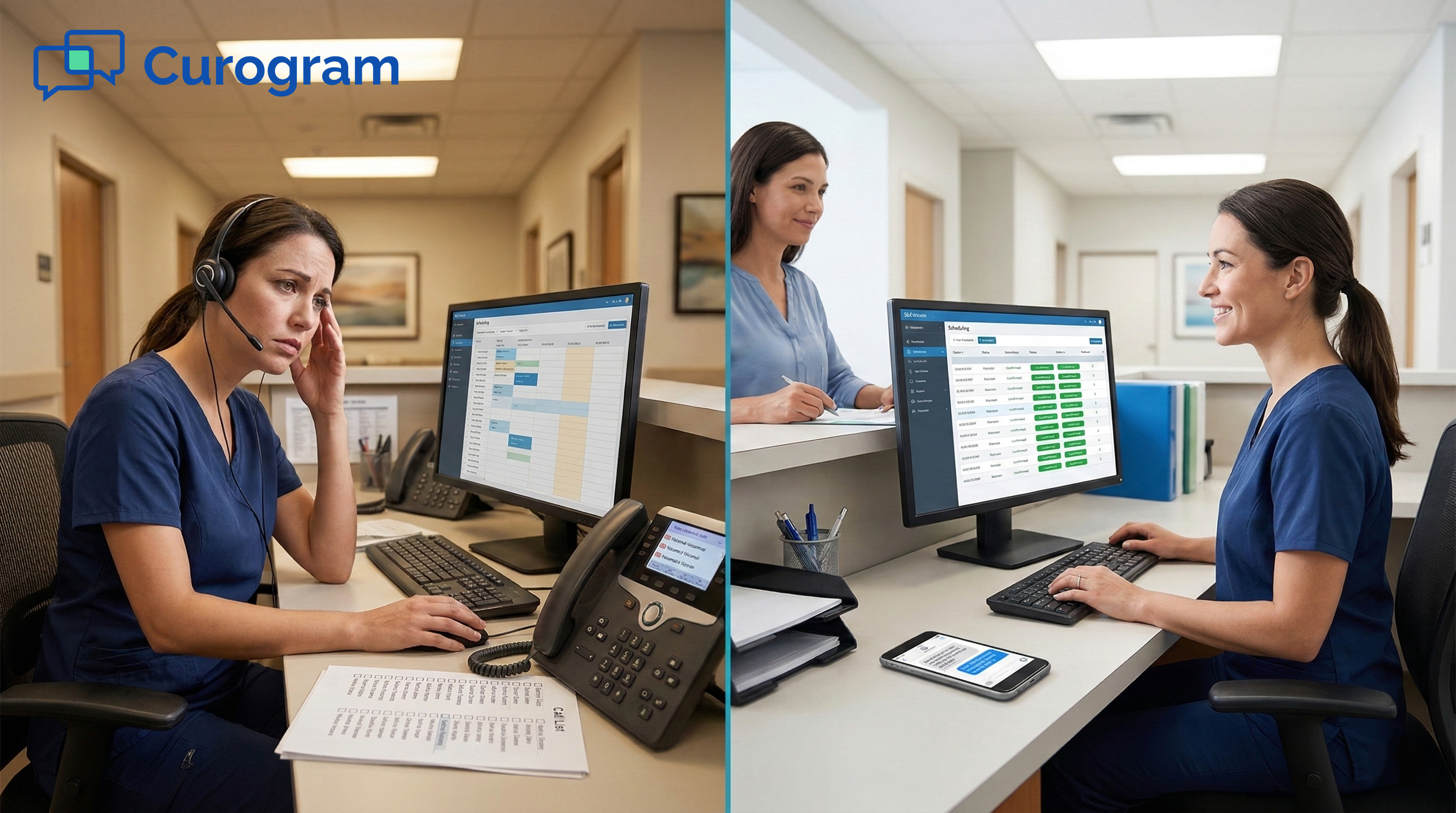
For most Practice Fusion practices, the morning starts the same way. Staff print the day's schedule, open the phone, and start dialing. Twenty, thirty, maybe forty appointments, and not one of them confirmed.
They call through the list, reach voicemail half the time, get transferred on the calls they do connect, and spend two to three hours on a task that gives zero clinical value.
This is not a staffing issue. It is a system issue. The reminder went out, but it was never designed to close the loop. Every unanswered message just shifts the work onto the person at the front desk.
Industry no-show rates typically run between 10% and 50%, depending on the specialty. For a primary care practice running 30 appointments a day at a 15% no-show rate, that is four to five missed slots daily.
At $200 per visit, the practice is losing $800 to $1,000 every single day. That is $16,000 to $20,000 per month, not counting the staff hours spent trying to prevent it.
Some practices turned to Updox for stronger reminders. But Updox runs as a separate platform from Practice Fusion, which means staff switch between two dashboards just to track who confirmed.
The added features come with added monthly cost on top of the Practice Fusion subscription. For budget-conscious practices that chose Practice Fusion for its affordability, layering on another paid tool just adds to the frustration.
The core issue remains the same: one-way notifications notify patients but do not confirm them. Sending a reminder is not the same as closing the loop. Every message that goes unanswered just creates more work, not less.
A front desk person spending two to three hours per day on confirmation calls is using 25% to 35% of their working capacity on a single task.
For a small practice paying $18 to $25 per hour, that labor cost runs $700 to $1,200 per month just for manual confirmations. That is money spent doing something a smart reminder system can handle on its own.
The real cost of one-way reminders is not just the no-shows. It is the staff hours burned on phone calls that should not need to happen.
It is the revenue lost to missed slots that could have been filled. And it is the quiet, steady drain that most practices never add up because it is baked into the daily routine.
Curogram's Confirmation Loop was built for exactly this problem. It takes Practice Fusion's existing reminder system and adds the missing piece: a reply.
Patients get a text. They respond. The schedule updates. No phone call needed. No manual entry. The loop closes itself.
This is not just a reminder upgrade. It is a full shift from broadcast messaging to a live, two-way confirmation workflow.
When an appointment is scheduled in Practice Fusion, Curogram sends a reminder text from the practice's own phone number. The message is short and easy to act on: "Reply YES to confirm, RESCHEDULE to change, or CANCEL." Patients can respond in five seconds from any phone, no app needed, no portal login.
When the patient replies YES, Curogram updates the appointment status in Practice Fusion right away. When they reply CANCEL, that slot opens for backfill.
When they reply RESCHEDULE, Curogram continues the conversation by text, finds a new time, and writes that new appointment back to the schedule. Staff do not re-enter anything.
One reminder is rarely enough. Curogram sends a configurable sequence: seven days out, two days before, and the morning of the appointment.
If a patient does not reply by text, Curogram can follow up with a voice reminder. Each touchpoint gives the patient another chance to confirm, which means fewer surprises on the day of the visit.
Practices using multi-touch sequences see confirmation rates above 75%, compared to near-zero from one-way reminders. That gap is not small. It is the difference between starting the day with a full, confirmed schedule and starting with a list of unknowns.
When a patient cancels by text, the practice knows right away, often 24 to 48 hours in advance instead of finding out when the patient simply does not show up.
That early notice means the slot can be offered to the waitlist or to a patient who needs to be seen sooner. A cancellation that used to mean lost revenue now becomes a recovered appointment.
This is one of the most underrated benefits of a closed-loop system. The earlier you know about a cancellation, the more likely that slot gets filled.
Based on our internal research, practices that implement this system see a 10% to 20% increase in overall revenue from recovered slots alone.
Curogram is not an add-on. It replaces the patchwork of tools many practices have built around Practice Fusion's limitations.
Two-way reminders, automated confirmations, schedule write-back, and multi-touch sequencing all come from a single platform that also handles texting, patient intake forms, payments, and reputation management.
One subscription replaces several. The total communication cost goes down. The confirmation rate goes up. And staff can stop toggling between dashboards.
Feature Comparison: One-Way vs. 2-Way Reminder System
|
Feature |
Practice Fusion (One-Way) |
Curogram Confirmation Loop |
|
Patient can reply by text |
No |
Yes |
|
Schedule updates automatically |
No |
Yes |
|
Cancellations known in advance |
Rarely |
24-48 hrs earlier |
|
Multi-touch sequencing |
No |
Yes (7 days, 2 days, day-of) |
|
Confirmation rate |
Near 0% |
75%+ |
|
Staff phone calls needed |
Daily (2-3 hrs) |
Near zero |

Most practice owners know no-shows are a problem. Fewer have actually done the math. When you break it down, the numbers are hard to ignore.
When you add in the staff time spent on manual confirmations, the real cost is much higher than it looks.
Here is what the numbers actually say for a small Practice Fusion practice.
Every no-show costs the practice the full value of that visit, typically $150 to $300 depending on the specialty and visit type. A primary care practice running 30 appointments a day with a 15% no-show rate loses four to five slots every single day. At an average of $200 per visit, that is $800 to $1,000 in lost revenue daily, or $16,000 to $20,000 per month.
For a five-provider practice, the numbers scale fast. Even at the lower end, a 10% no-show rate across a full schedule can mean $20,000 to $30,000 in lost monthly revenue.
That is revenue the practice already worked to earn, only to have it disappear at the last minute.
No-shows are the visible cost. The hidden cost is the staff time spent trying to prevent them. A front desk person spending two to three hours per day on confirmation calls is consuming 25% to 35% of their daily capacity on a single task.
For a staff member earning $18 to $25 per hour, that labor spend runs $700 to $1,200 per month, just for manual confirmation calls.
That is money spent on a problem that a smart reminder system can solve automatically. When you add both costs together, the case for switching becomes very clear.
Based on our internal research, Atlas Medical Center cut no-show rates from 14.20% to 4.91% in just three months after switching to an automated reminder system with 2-way confirmation. That is a 65% reduction.
For a practice losing $16,000 to $20,000 per month to no-shows, a 65% drop recovers $10,000 to $13,000 each month.
Curogram's subscription costs less than two missed appointments per month. The return on investment is not a small gain at the margin. It is a dramatic shift in how much revenue the practice actually keeps.
No-Show Cost Calculator: 5-Provider Practice Example
|
Metric |
Without Smart Reminders |
With Curogram |
|
Daily no-shows (15% rate, 30 appts) |
4-5 slots |
1-2 slots |
|
Monthly revenue lost |
$16,000-$20,000 |
$5,600-$7,000 |
|
Monthly revenue recovered |
- |
$10,000-$13,000 |
|
Staff hours on confirmation calls |
2-3 hrs/day |
Near zero |
|
Monthly labor cost (confirmation calls) |
$700-$1,200 |
Minimal |
|
No-show rate (internal data benchmark) |
14.20% |
4.91% |
If the practice is currently paying for Updox premium reminders plus a separate messaging service plus staff hours on the phone, Curogram replaces all of it.
One platform. One inbox. One confirmation workflow. The total cost of running communications goes down, while the results go up.
When you line up the full picture, the question is not really whether the practice can afford a 2-way reminder system.
Based on what one-way reminders actually cost, the question is whether the practice can afford to keep things the way they are.
Numbers tell part of the story. But the clearest way to understand what a closed-loop reminder system actually changes is to walk through what it looks like for a real practice.
This is the story of a solo family medicine practice in suburban Phoenix that had been running on Practice Fusion for five years.
The practice had one front desk staff member, Janice. She handled everything: check-in, scheduling, insurance, billing follow-up, and confirmation calls.
The practice's Practice Fusion appointment reminders went out as scheduled, but patients had no way to reply. The reminder was sent. Then Janice picked up the phone.
With 25 to 30 appointments daily and a no-show rate hovering around 18%, Janice would typically reach about half the list before the first patient walked in.
"I'd send the reminder and then call them anyway," she said. "What's the point of a reminder if I still have to call everyone?"
The practice was losing an average of four to five appointments per week to no-shows. At $175 per visit, that was $700 to $875 per week, or more than $3,000 each month in revenue that simply walked out the door.
Janice activated Curogram's Confirmation Loop. Smart reminders were configured to go out three days before and the morning of each appointment.
Patients received texts from the practice's existing phone number with clear reply options. The setup took under ten minutes, and Janice was running the new system on the same day.
No new hardware. No complex training. No extra platform to log into. The system connected to Practice Fusion and handled the confirmation workflow from there.
Within three weeks, confirmation calls had virtually stopped. Over 80% of patients confirmed by text reply before Janice arrived in the morning. She would open the schedule and see confirmations already there, no calls needed.
No-shows dropped from 18% to under 6%. The four to five weekly missed appointments became one or fewer.
Janice reclaimed two or more hours per day and redirected that time to check-in, insurance verification, and billing follow-ups she had been putting off for months.
The practice recovered over $2,500 per month in previously lost revenue. Staff capacity was reallocated from reactive calls to proactive work. And the practice's schedule became something Janice could actually rely on rather than scramble through each morning.
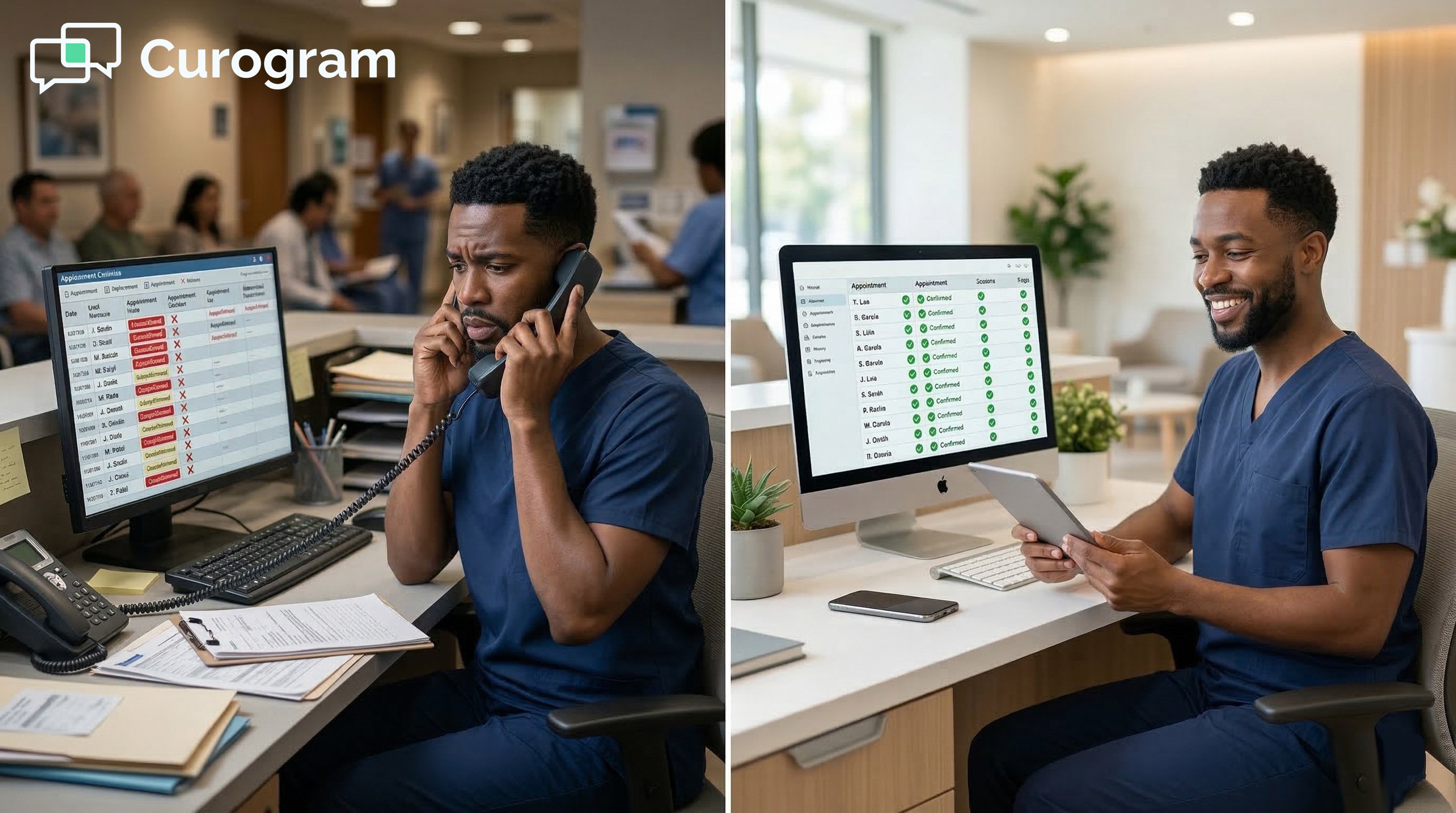
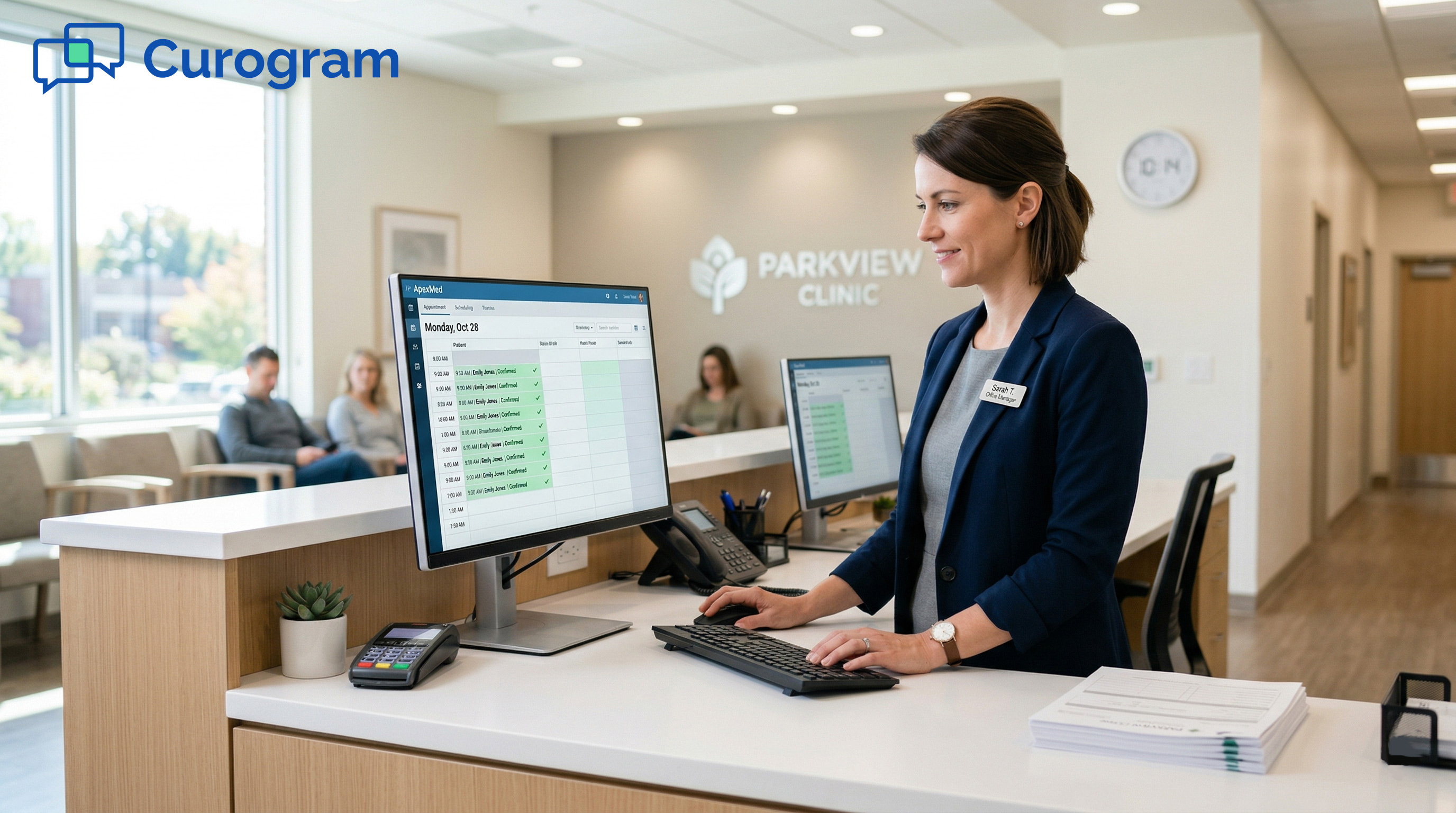
"I don't make confirmation calls anymore," Janice said. "The patients do it themselves. I just check the dashboard and see green checkmarks. It's the best change we've made in five years on Practice Fusion."
That is what a closed-loop system actually looks like in practice.
Moving to 2-way text reminders raises a fair question for any practice: is this safe? Appointment data is protected health information.
Any system that handles it needs to meet HIPAA standards. Curogram was built with that in mind from the start.
Here is how the compliance side works, and why it actually simplifies things for most practices.
Every reminder sent through Curogram is encrypted and handled in line with HIPAA requirements. Curogram signs a Business Associate Agreement with every practice before the system goes live.
That agreement puts the proper safeguards in place for how patient data is stored, transmitted, and protected.
Appointment information is sent securely, with the same protections that apply to clinical data. Practices do not need to add any extra steps or tools to stay compliant. The protection is already built into the system.
Texting patients also brings TCPA requirements into the picture. Patients must have the ability to opt out of text messages at any time.
Curogram handles opt-in and opt-out workflows automatically. Patients can text STOP at any time to stop receiving reminders. The system logs it and removes them from future messages.
For practices that have been managing opt-outs manually or through a spreadsheet, this is a significant simplification. The compliance risk is managed by the system, not by whoever happens to be at the front desk that day.
One of the most practical compliance advantages is also one of the simplest: Curogram does not require a patient app.
Systems like Patient Fusion and FollowMyHealth ask patients to download an app and create an account before they can interact with their provider. Most patients never complete that step.
Curogram's reminders use the patient's native text messaging. Any patient with a phone can receive a reminder and reply. There is no download, no login, no setup.
This means higher response rates, broader reach, and no barrier for patients who are less comfortable with apps or online portals.
The most common compliance question practices ask is whether patients need to give consent before receiving text reminders. The answer depends on the type of message and how it is sent.
Curogram's system is configured to work within established TCPA and HIPAA guidelines, and the onboarding process walks practices through the right setup for their situation.
The short version: the compliance framework is already built. Practices do not need to become legal experts to use 2-way reminders safely. Curogram handles the structure. The practice handles the care.
Switching to a 2-way reminder system is a meaningful change. Like any change, it is worth measuring. The right metrics tell you whether the system is doing its job, and they show you the exact dollar value of what has improved.
These are the numbers every Practice Fusion practice owner and office manager should be watching.
Not every metric is worth tracking closely. But four numbers capture the full impact of a closed-loop confirmation system. Together, they give a clear picture of what changed and what it is worth.
This is the most direct measure. Track your no-show rate before and after switching systems. The industry average runs between 10% and 50% depending on the specialty.
Based on our internal data, Curogram brings that rate below 5% for most practices. Atlas Medical Center reached 4.91%, which is three times better than the industry average.
Every percentage point drop in your no-show rate translates directly to recovered revenue. If your practice runs 30 appointments a day at $200 per visit, a single percentage point improvement is worth roughly $1,800 per month.
With one-way reminders, your confirmation rate at the start of the day is effectively zero. The reminders went out, but no responses came back.
With Curogram's 2-way system, practices typically see 75% or more of appointments confirmed by text before staff even arrive.
Starting the day with a mostly-confirmed schedule changes everything. Staff are not scrambling. They are executing.
Count how many outbound confirmation calls your front desk makes each day. Multiply by five minutes per call. That is your daily labor cost for a task the Confirmation Loop handles automatically.
The target after switching is near zero. Every call eliminated is three to five minutes of staff time returned to work that actually matters: patient check-in, insurance tasks, billing follow-up, or just being present and helpful when patients arrive.
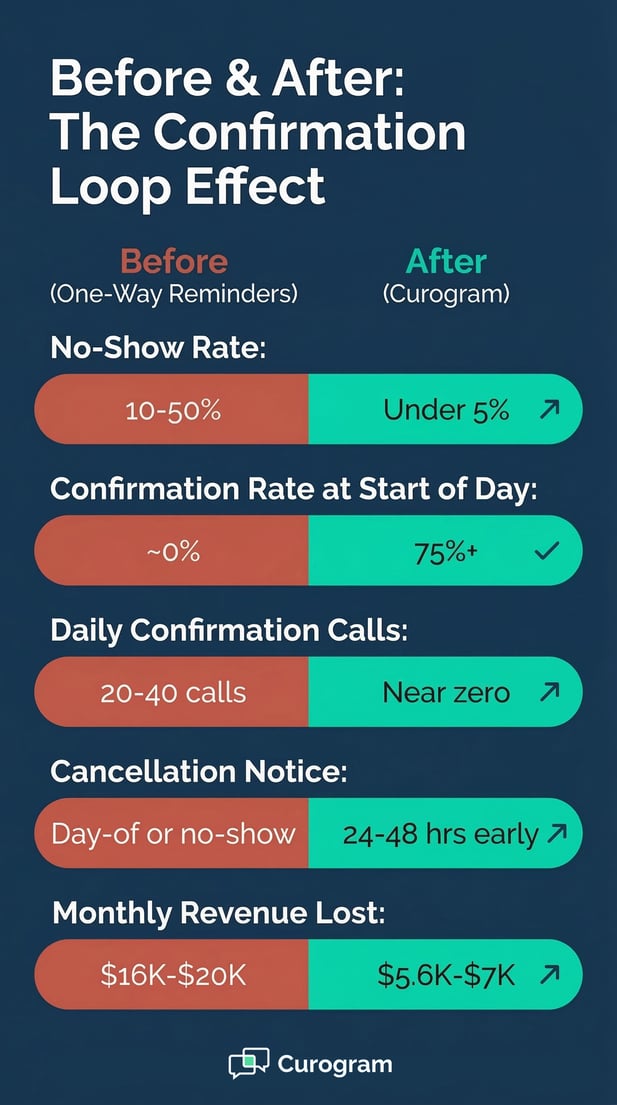
Key Metrics: Before and After the Confirmation Loop
|
Metric |
Before (One-Way) |
After (Curogram) |
What It Means |
|
No-show rate |
10-50% |
Under 5% |
Revenue recovered |
|
Confirmation rate (start of day) |
~0% |
75%+ |
Predictable schedule |
|
Daily confirmation calls |
20-40 calls |
Near zero |
2-3 hrs staff time back |
|
Cancellation notice (advance) |
Day-of or no-show |
24-48 hrs early |
Slot can be refilled |
|
Monthly revenue lost to no-shows |
$16K-$20K |
$5.6K-$7K |
$10K-$13K recovered |
Track how far in advance cancellations are coming in. With phone-based systems, the practice often finds out about a cancellation when the patient simply does not show up. With text cancellations, practices learn about it 24 to 48 hours earlier.
That lead time is the window for filling the slot. An empty slot with 24 hours of notice has a much better chance of being filled than one that goes empty without warning. Over a month, those recovered slots add up to meaningful revenue.
The gap between sending a reminder and knowing the patient will show up is where revenue gets lost.
Practice Fusion's built-in reminders are a solid starting point, but they were never designed to close that gap on their own. They notify. They do not confirm.
Curogram's Confirmation Loop fills that gap. Patients reply by text. The schedule updates on its own. Staff stop chasing confirmations and start doing work that matters. The loop closes, and the practice runs better because of it.
Small practices using 2-way smart reminders have seen no-show rates drop to under 5%, confirmation rates climb above 75%, and front desk staff reclaim two or more hours each day.
Based on our internal research, practices see a 10% to 20% lift in revenue after implementing a closed-loop confirmation workflow. For many, that is $10,000 or more in recovered revenue every single month.
The system works alongside Practice Fusion, not against it. No new EHR. No extra platform to learn.
Curogram connects to what is already there and adds the 2-way layer that makes the whole system actually work.
Schedule a demo to see how Practice Fusion appointment reminders work with Curogram's Confirmation Loop.
Curogram integrates directly with Practice Fusion through the EHR's available connection options. When a patient confirms, cancels, or reschedules by text, Curogram writes that response back to the Practice Fusion schedule automatically. Staff do not need to manually update anything, and there is no need to log into a separate system.
A standard reminder tells the patient about the appointment but asks nothing of them. A 2-way reminder asks for a direct response, which creates a small but meaningful commitment. When patients actively confirm by text, they are more likely to follow through. Based on our internal data, practices using 2-way smart reminders see no-show rates drop by 53% or more compared to one-way systems.
When a patient replies RESCHEDULE, Curogram continues the conversation via text to find a new time. Once the patient selects a new slot, Curogram writes the updated appointment back to Practice Fusion. The original slot opens for another patient. No phone call is needed, and staff do not have to touch the schedule manually.
An early cancellation is a recoverable slot. When a practice finds out about a cancellation 24 to 48 hours in advance, there is time to contact the waitlist or offer the opening to a patient who needs to be seen sooner. A same-day cancellation or no-show leaves almost no time to fill that gap, which means the revenue is simply lost.
Curogram encrypts all message content and operates as a HIPAA-compliant platform. Before any practice goes live, Curogram signs a Business Associate Agreement that covers how patient data is handled. The system also manages TCPA opt-in and opt-out automatically, so patients can text STOP at any time and the practice stays protected without any manual tracking.
💡 eClinicalWorks automated SMS appointment reminders that reduce no-shows at enterprise scale replace manual confirmation calls with multi-cadence...
💡 eeClinicalWorks patient text appointment confirmation is faster and more reliable than phone calls or healow notifications.When a practice calls...
💡 Rural patients miss appointments for practical reasons — distance, transportation, and appointments booked weeks in advance that simply fade from...