14 min read

Practice Fusion Text-to-Pay | SMS Payment Links Replace Paper Billing

Practice Fusion Text-to-Pay | SMS Payment Links Replace Paper Billing
💡 Small practices using Practice Fusion text-to-pay SMS payment links are moving away from paper billing for good. Traditional paper statements cost $800 to $1,000 per month and collect only 20% of what patients owe.

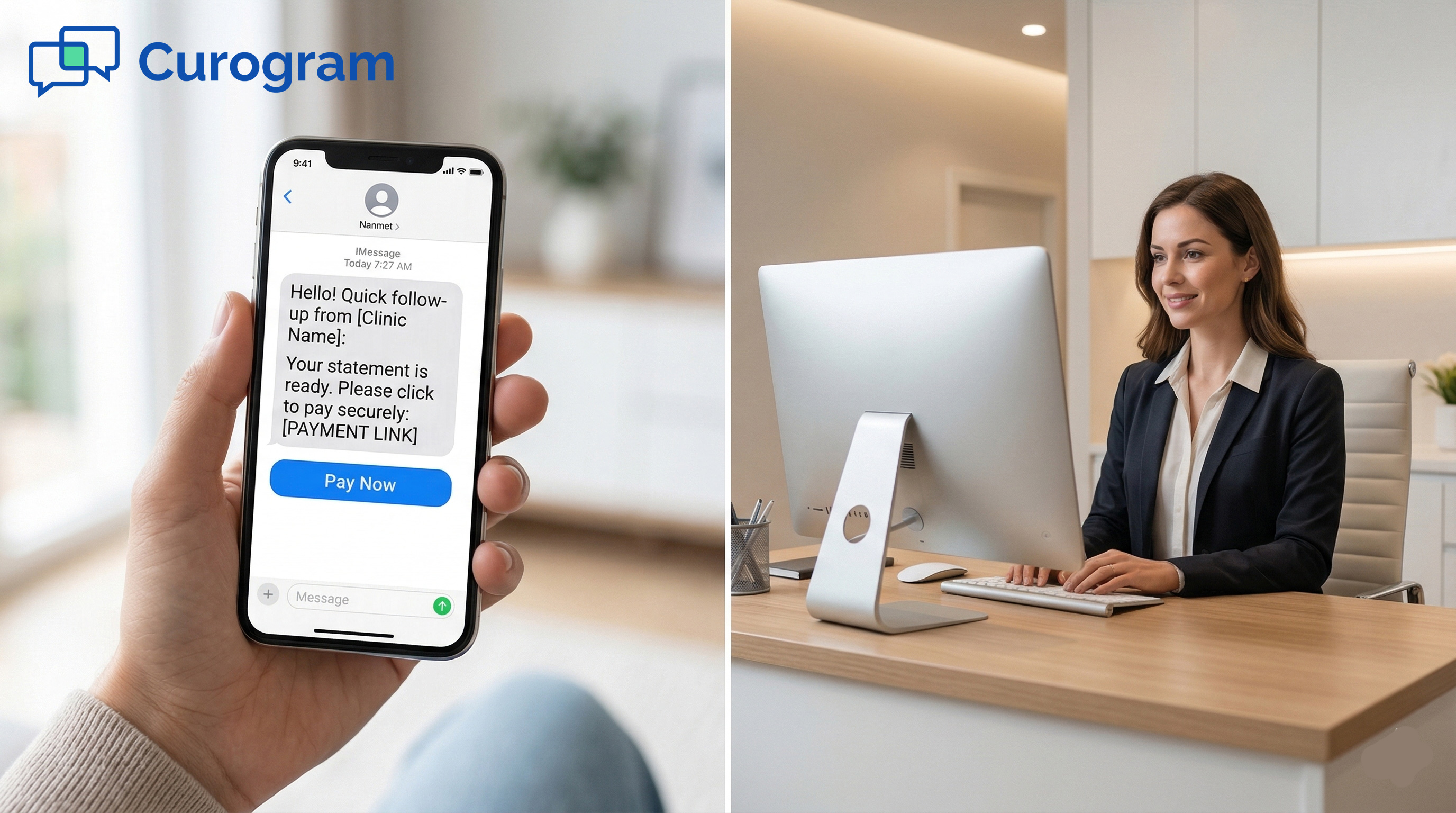
Curogram's SMS payment links send patients a secure link by text. Patients pay in two taps, and the payment posts back to Practice Fusion right away.

Collection rates jump to 60%+, money arrives in 2 to 3 days, and printing costs drop to zero. For any practice drowning in unpaid bills and staff overtime, this is the billing fix that works.
 

Here is a hard truth about small medical practices: the way you bill patients is probably costing you more than you think.

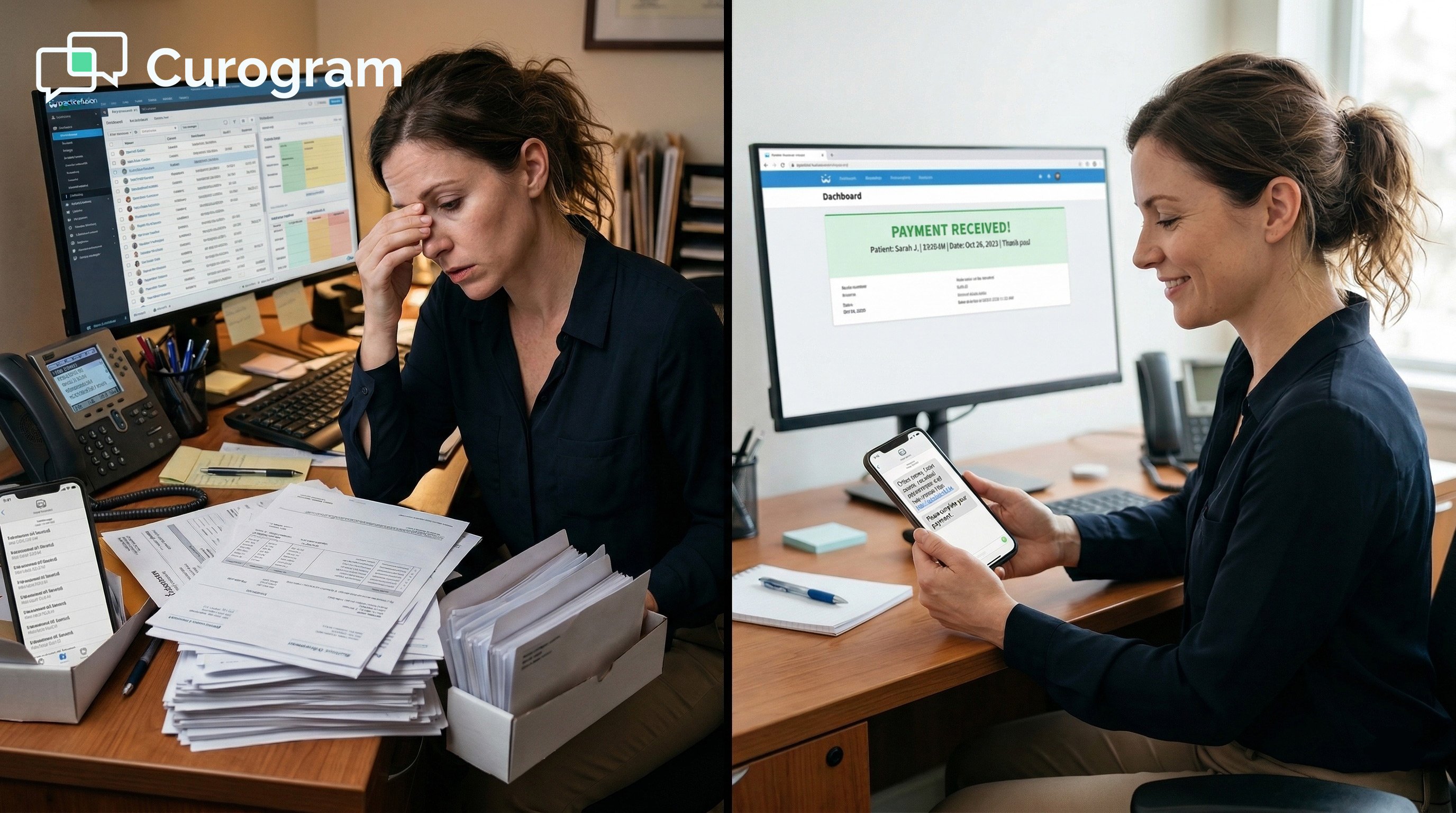
Every month, staff print statements, stuff envelopes, add stamps, and send them out. Then they wait. And wait. Based on our internal data, the average paper statement gets a 20% payment rate. That means 8 out of 10 invoices go unpaid.

Printing and mailing 400 to 500 statements a month costs $800 to $1,000. Not in some far-off scenario. Right now. And the staff time spent on collection calls? That is on top of it.

This is not a patient loyalty problem. Most patients want to pay. They just find the process frustrating. Open an envelope, read a bill, find the payment page, log in, submit. It is too many steps. So they put it off.

What if paying took two taps on a phone?

That is what Practice Fusion text-to-pay SMS payment links make possible. Curogram sends patients a secure text with a payment link.

The patient taps it, enters card details, and done. Payment posts back to Practice Fusion with no manual entry needed.

Practices using this approach are seeing collection rates above 60%, with payments arriving in 2 to 3 days. Staff stop chasing balances and start focusing on claims. Cash flow becomes steady instead of unpredictable.

This guide covers how the system works, why the numbers are so strong, and what it looks like when a real practice makes the switch.

The Paper Billing Trap: Why Small Practices Lose Money Every Month

Paper billing is so common in medical practices that most teams do not question it. But when you look at the numbers, the real cost of paper statements is hard to ignore. The problem is not just the printing bill. It is the entire chain of events that follows.

The Hidden Cost of Every Envelope

It is easy to assume paper statements are cheap. But the full cost adds up fast. Each statement costs roughly $1.50 to $2.00 once you count paper, ink, envelopes, postage, and staff time. For a practice sending 400 to 500 statements a month, that is $600 to $1,000 gone before a single payment arrives.

Now factor in what comes back. Paper patient billing collections deliver a 20% return rate. So for every 100 statements sent, only 20 patients pay. The other 80 sit unpaid. The practice spent the money to mail them. It still does not see a return.

A $500 balance that costs $2 to mail and goes uncollected is not just a small loss. Multiply that across hundreds of patients each month, and it becomes a serious cash flow problem.

What the 80% Silence Really Means

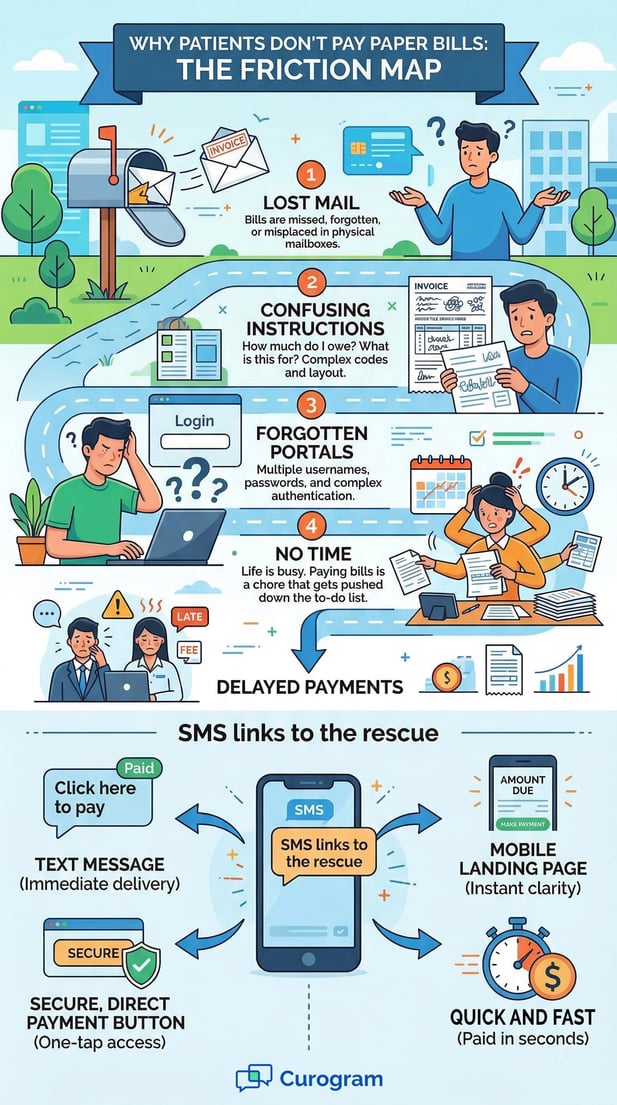
The 80% of patients who do not respond to paper statements are not all trying to avoid paying. Many of them lost the envelope. Some forgot. Others found the payment steps too confusing. A portion did not recognize the sender or assumed it was junk mail.

None of these patients is gone forever. They are just stuck behind friction. And friction is something you can fix.

The Three-Part Damage to Your Practice

Paper billing does not just drain money in one way. It creates three overlapping problems that compound over time.

Cash Flow Delays That Hurt Operations

When statements go out by mail, the average collection window stretches to 30 to 45 days, often longer. Practices that run lean cannot wait that long. Bills pile up. Staff time gets burned. And the practice manager spends more time on AR aging reports than on running the office.

Cash flow delay is especially painful for solo providers and small groups. There is no large billing team to absorb the slowdown. Every unpaid balance felt directly affects what the practice can do each week.

Text-based billing through Curogram collapses that window. Payments come in within 2 to 3 days on average. The practice stops living 45 days behind its own revenue.

The SMS Payment Link Solution: How the Two-Tap Payment Works

Replacing paper statements does not have to mean a complex tech overhaul. Curogram's approach is built to be simple for both the patient and the billing team. The goal is to remove every step that causes patients to pause or put the bill aside.

The Patient Side: From Text to Paid in Seconds

The patient experience is short by design. When a balance is due, they get a text from the practice. The message includes the amount owed and a secure payment link. One tap opens the link. A second tap confirms the payment. That is it.

There is no portal to log into. No username to remember. No mailing address to find. The patient sees the text, taps twice, and gets a confirmation. Most patients complete payment in under 60 seconds.

This matters because most patients own smartphones and use them constantly. Texting is the communication channel they already trust. Meeting them there is not a gimmick. It is just good design.

Why Two Taps Change the Psychology of Paying

Behavioral research shows that the more steps a task takes, the more likely people are to delay it. Paper statements require at least six steps before a payment is made. SMS payment links require two.

When you cut the effort that almost in half, patients who meant to pay but kept putting it off actually follow through. The intention was always there. The barrier was the process. Curogram removes the barrier.

The Billing Team Side: Less Work, More Results

For the billing team, the workflow stays simple. The billing person triggers a text-to-pay link from within the Practice Fusion billing module. Curogram generates a secure link and sends it via SMS. When the patient pays, the transaction posts back to Practice Fusion with no manual data entry required.

No printing. No envelope stuffing. No postage runs. No logging into separate systems. The process fits into the existing workflow without adding new steps or training requirements.

Staff who used to spend 8 to 10 hours a month on collection calls now spend 1 to 2 hours. That recovered time goes toward claim follow-up, where the financial impact is much higher.

Practice Fusion Integration That Does Not Require a Tech Team

One concern practices often raise is whether new tools will work with their current setup. Curogram is built to run alongside Practice Fusion without disruption. The integration does not require IT involvement or a complicated onboarding process.

The billing module stays the same. The staff workflow stays the same. The only change is that sending a payment request means clicking to send a text instead of printing a statement.

Detailed winding infographic map showing patient friction points, delayed payments, and comprehensive SMS solutions

The Economics: Why Text-to-Pay Wins the ROI Argument

For small Practice Fusion practices, the financial case for text-to-pay comes down to two things: what you stop spending and what you start collecting. Both sides of that equation move strongly in the practice's favor.

Comparing the Real Numbers

Here is a side-by-side look at what paper billing costs versus what Curogram's SMS payment links deliver.

Category

Paper Billing

Curogram Text-to-Pay

Monthly send cost

$800 to $1,000

Low per-transaction fee

Collection rate

~20%

60%+

Time to collect

30 to 45 days

2 to 3 days

Staff hours on collections

8 to 10 hrs/month

1 to 2 hrs/month

Manual data entry

Yes

None

Patient friction

High (6+ steps)

Low (2 taps)


The numbers speak clearly. You are already spending $1,000 a month to collect 20%. Text-to-pay costs a fraction of that and collects 60%+.

The ROI Reframe for Small Practice Owners

The pricing question that comes up most often is about per-transaction fees. It is a fair concern. But the right comparison is not the fee itself. It is what you currently spend to collect a dollar versus what you will spend with Curogram.

A practice mailing 400 statements per month at $800 and seeing 20% collection is spending $4 in printing and mailing for every payment that comes in. With Curogram, the per-transaction cost is well below that, and the collection rate is three times higher.

Most small practices see positive ROI within 30 days of switching. Not after a full quarter. Not after a year. Within the first month.

What Recovered Balances Mean for a Solo Practice

Take a solo pediatrician sending 400 statements a month. At a 20% collection rate, 320 of those statements go unpaid. If the average patient balance is $150, that is $48,000 in revenue walking out the door each month.

Boost the collection rate to 60%, and recovery jumps dramatically. The math changes the entire financial picture of the practice. And the printing cost savings of $800 to $1,000 per month adds up to $10,000 or more per year.

Pricing That Scales With Your Practice

Curogram charges per transaction, which means the cost scales with usage. A smaller practice sending fewer links pays less. A growing practice sending more still sees strong margins because the collection rate grows with the volume.

There are no large upfront costs or long-term commitments required to get started. The economics are transparent, and the ROI is visible from the first billing cycle.

Addressing Skepticism: Will Patients Actually Pay via Text?

This is the question that comes up in almost every conversation with practice owners. It is a fair one. Asking patients to change their habits feels risky. But the data tells a clear story, and it is not what most people expect.

The Behavior Data Behind SMS Payments

Based on our internal data, practices using Curogram's SMS payment links see adoption and payment rates above 60% within the first 3 days of sending. That is three to four times better than what paper billing delivers.

This holds across different patient populations, including older patients. The assumption that older patients will not respond to texts is not backed up by what happens in practice. Patients of all ages use smartphones. They may not use every app, but they read text messages.

The key insight is this: patients are not avoiding payment. They are avoiding the friction of paper. When you remove the friction, most patients pay.

Older Patient Populations and SMS Adoption

It is true that older patients may be less familiar with some digital tools. But SMS is not a new technology. Text messaging is one of the most used features on any phone, regardless of age group.

A secure payment link in a text from a trusted provider is not confusing. It is just a link. And for those patients who prefer to call or pay by check, that option still exists. Text-to-pay is an added channel, not a forced replacement.

Why Familiar Tech Drives Adoption

Patients already receive appointment reminders by text. They get prescription alerts and delivery updates by text. Receiving a bill by text fits naturally into that same pattern.

When something feels familiar, people trust it. When they trust it, they act. The adoption rate for SMS payment links is not surprising once you understand that patients already live in a text-first world.

What Happens to Patients Who Do Not Respond

Not every patient will pay via text, and that is okay. Those who do not respond can still be followed up with a phone call or a mailed statement. Text-to-pay adds a faster, higher-converting first step. It does not remove any existing options.

But once a practice sees that 60%+ of patients pay within 3 days of receiving a text, the follow-up list gets much shorter. Staff spend less time chasing. The 40% who need more outreach get more focused attention.

The Narrative: How a Solo Dental Practice Killed the Paper Chase

Numbers are convincing. But sometimes the clearest way to understand a solution is to see it work for a practice that looks like yours.

The Practice and the Problem

A solo dental practice in the Midwest was running Practice Fusion with one part-time office manager. She handled billing, insurance follow-ups, scheduling, and patient communication all at once. The practice mailed 150 to 200 patient statements every month.

Monthly printing and postage costs ran to $900. Patient balances averaged 45 to 60 days to collect. The office manager spent 8 to 10 hours per month making collection calls. Many small balances in the $50 to $200 range were written off because chasing them cost more than they were worth.

The Moment That Prompted the Change

The solo dentist ran the numbers one afternoon. She added up 12 months of printing costs, estimated the time spent on collection calls at a reasonable hourly rate, and compared it against what the practice actually collected from those statements.

The conclusion was hard to ignore: she was spending thousands of dollars per year to run a billing process that collected only 1 in 5 patient balances. Something had to change.

What Changed After Curogram

The practice activated Curogram's SMS payment links. Within the first month, over 60% of patient invoices were paid within 2 to 3 days of the text going out. Printing costs dropped to near zero. Collection call time fell from 10 hours a month to 2 hours.

After 90 days, the results were clear. Monthly cash flow improved by over $12,000, driven by recovery of previously uncollected patient balances. The $900 monthly printing bill was gone. The office manager had time for claim resolution instead of follow-up calls.

Perhaps most surprising: patient satisfaction went up. Patients found text billing faster and less intrusive than paper. Several mentioned they preferred it. The practice had solved its billing problem and improved the patient experience at the same time.

The Bigger Lesson

The solo dentist reflected on the change in a simple way: she was not running a patient behavior problem. She was running a billing friction problem. The moment she fixed the friction, the behavior changed.

That is the story for most small practices. Patients will pay. They need it to be easy. Text-to-pay makes it easy.

Pre-Close Objections and Reframes

Every practice owner considering a switch from paper billing will have questions. These are the three most common ones, along with the honest answers that address each concern directly.

Objection 1: Per-Transaction Pricing Feels Expensive

It is natural to focus on the new cost and overlook the existing one. Per-transaction pricing sounds like an ongoing expense. But the comparison should not be zero versus something. It should be what you spend now versus what you would spend with Curogram.

Right now, you are spending $800 to $1,000 per month on printing and postage alone. Add the staff hours spent on collection calls. Add the revenue lost to the 80% of statements that go unpaid. That is the real baseline.

Curogram's per-transaction fees are a small fraction of your current monthly printing cost. And when you collect 60%+ instead of 20%, the revenue recovered more than covers the difference. The math works out every time.

Running the Numbers With Your Real Data

The best way to quiet the pricing objection is to use actual practice numbers. How many statements do you send per month? What is your current collection rate? What is the average patient balance? Plug those into a side-by-side comparison and the ROI becomes concrete, not hypothetical.

Objection 2: Patient Adoption in Older Populations

The concern about older patients and SMS adoption is real but overstated. Based on our internal research, practices with older patient populations still see 60%+ payment rates when using SMS links. Age is not the barrier. Friction is.

Text messages are read. They do not sit in a pile of mail. They do not require remembering a login. A payment link in a text is one of the simplest digital actions a patient can take.

And again: text-to-pay does not replace other payment options. Patients who prefer to call or send a check can still do that. You are simply adding a faster lane for the majority who are willing to use it.

What Early Adopters Inside the Practice Can Show

Practices that test text-to-pay with even a small batch of 10 to 20 invoices often see results within 72 hours. That real-world proof inside their own patient panel does more to address adoption doubts than any external data.

Objection 3: Concerns About Practice Fusion Integration

Practices often worry that adding a new tool will break something in their current setup. With Curogram, that concern does not apply. The integration works with Practice Fusion billing as it is, without any custom configuration or IT involvement.

Text-to-pay links are triggered from inside the Practice Fusion billing module. Payments post back automatically. Staff do not need to learn new software, and the billing workflow does not need to be redesigned.

Competitive Positioning 

When evaluating billing tools, small practices often compare a few options. Here is how Curogram's approach differs from the main alternatives.

Curogram vs. Updox

Updox offers SMS communication for medical practices, including some messaging features. But Updox does not offer text-to-pay payment links as a core billing feature. Practices using Updox for messaging still rely on paper statements or separate portals to collect patient payments.

Curogram replaces the full paper statement workflow. The patient does not need to go to a portal. They do not need to log in. The payment link arrives in the same text channel that Updox uses for messaging, but Curogram closes the loop with actual payment collection.

Where Updox Stops and Curogram Continues

Updox handles communication. Curogram handles communication and payment collection in one step. That distinction matters when the goal is not just to notify patients but to get them to pay.

Curogram vs. Patient Fusion and FollowMyHealth

Patient Fusion and FollowMyHealth offer patient engagement tools that include portal-based payment. The challenge is that portal payments add friction. Patients have to remember a username and password. They have to navigate a portal interface. Many simply do not bother.

Curogram's SMS payment links bypass the portal entirely. The payment link lands directly in the patient's text inbox. No login required. That single difference explains the gap between 20% portal payment rates and 60%+ SMS payment rates.

The Core Difference: Direct vs. Portal-Based Payment

Portal tools assume patients will seek out a payment experience. SMS links bring the payment experience to the patient. In a world where attention is limited and patience is short, the approach that reduces steps wins.

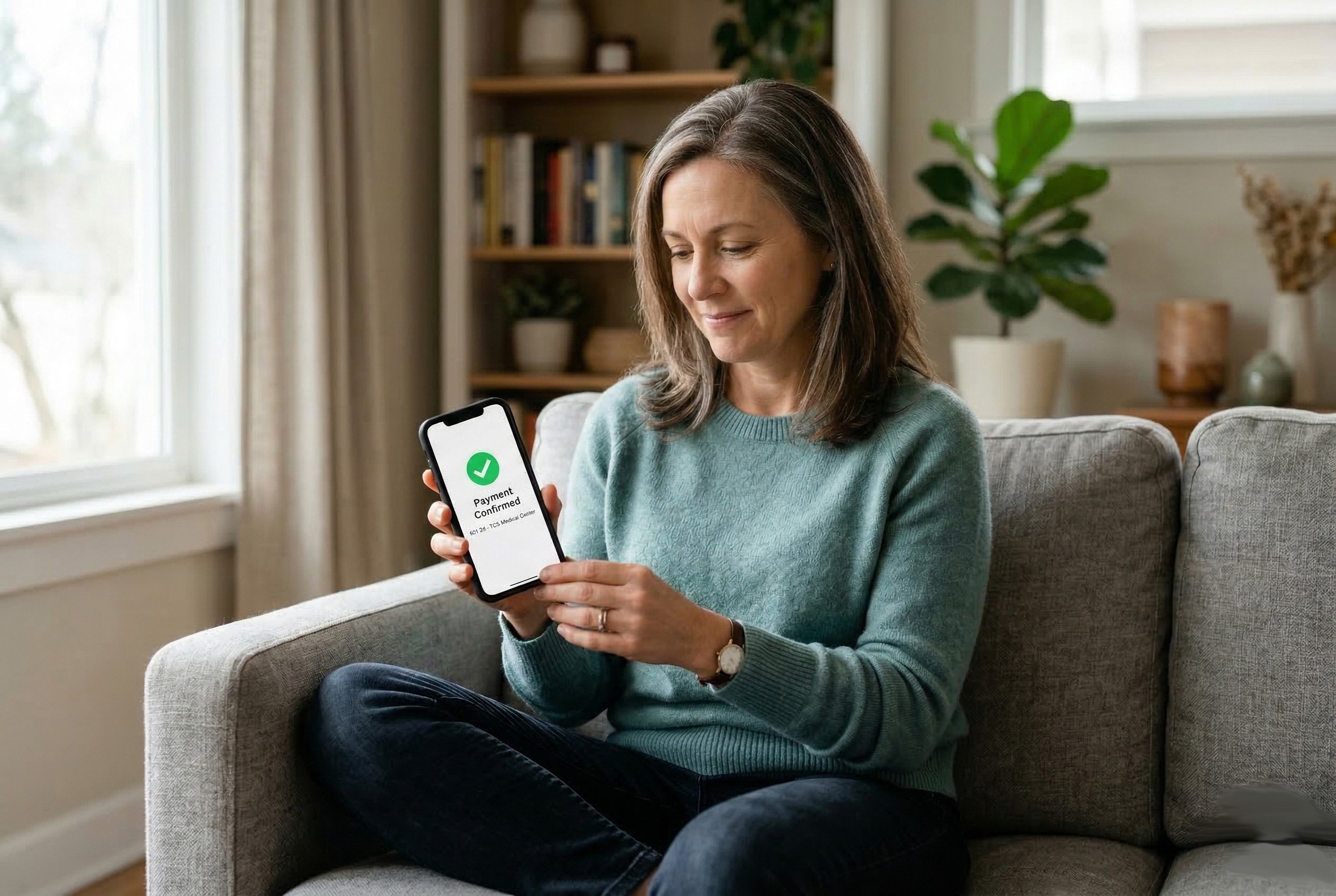
Woman on sofa showing mobile payment confirmation on smartphone

The Path to Close Getting Started With Text-to-Pay

Moving from paper statements to text-to-pay does not require a long implementation process. The path from curiosity to results can happen in a matter of days.

Step 1: Quantify What Paper Billing Is Costing You

Before making any decision, it helps to see the current cost clearly. Add up your monthly printing and postage spend. Estimate the staff hours going to collection calls. Look at your average collection rate and what your aging AR report shows.

Most practice owners are surprised when they total it up. The paper billing cost is often higher than it appears because it is spread across printing, supplies, postage, and time. Making it visible is the first step.

Building a Simple Baseline

You do not need a complex spreadsheet for this. A rough calculation works. Monthly statements x $1.75 average cost + collection call hours x hourly rate = your monthly baseline. Compare that against a 60%+ collection rate scenario to see the gap.

Step 2: See It Work With a Live Demo

The most convincing proof is sending a test payment link to your own phone during a demo. You see the patient experience firsthand. You tap the link. You see how simple it is. That 30-second experience answers more questions than a slide deck could.

A demo also shows how the Practice Fusion billing module connects to Curogram, how links are triggered, and how payments post back automatically. It is short, specific, and designed to show the workflow your team would actually use.

Why a Demo Beats a Free Trial

A free trial can create ambiguity. Is this working? Am I using it right? A guided demo gives you the full picture in one session, with a team member walking through your specific setup. Questions get answered in real time, not after a 14-day window closes.

Step 3: Pilot With Your Next Batch of Statements

After the demo, the fastest way to see results is to activate text-to-pay with your next round of patient invoices. Send 10 to 20 SMS payment links. Wait 3 days. Look at how many payments came in.

That small pilot does more to confirm the ROI than any case study. You are looking at your own patients, your own balances, your own practice. And you are seeing real results within 72 hours.

Most practices that run this pilot do not go back to paper billing. The difference in collection rate and payment speed is immediate and measurable.


Stop Mailing Bills That Do Not Get Paid

The paper billing system most small practices use was built for a different era. It costs too much, collects too little, and consumes staff time that could go toward real revenue work.

Practice Fusion text-to-pay SMS payment links replace paper patient billing collections with something that actually works. Patients get a text. They tap a link. They pay. Done.

The data is consistent: 60%+ collection rates, 2 to 3 day payment windows, and significant savings on printing and postage. Practices that make the switch do not just save money. They recover balances they had already given up on.

The first step is just seeing how it works. Schedule a demo, send a test link to your own phone, and let the experience speak for itself.


Frequently Asked Questions

How do Practice Fusion text-to-pay SMS payment links work for patients?

When a patient balance is due, the practice sends a text message with a secure payment link through Curogram. The patient taps the link, enters their card details, and payment is confirmed in seconds. No portal login is required, and the transaction posts back to Practice Fusion automatically.

Why do paper patient billing collections have such low collection rates?

Paper statements require patients to complete at least six steps before a payment is made: receiving the mail, opening the envelope, reading the statement, finding payment instructions, logging into a portal or writing a check, and sending it back. Each step is a chance to delay. Most patients intend to pay but put it off, and the balance ages unpaid.

How does Curogram integrate with Practice Fusion's billing module?

Curogram connects directly to Practice Fusion's billing module without requiring IT support or custom configuration. Billing staff triggers text-to-pay links from within Practice Fusion, and when a patient pays, the transaction posts back automatically. The team does not need to learn a new system or change its core workflow.

Why do SMS payment links collect more money than paper statements?

SMS payment links reduce the number of steps a patient takes from six or more down to two. Patients already use text messaging constantly and trust the channel.

When paying is fast and easy, most patients follow through. Based on our internal data, practices using SMS links see 60%+ collection rates within 3 days of sending, compared to the 20% rate typical for paper billing.

How long does it take to see results after switching to text-to-pay?

Most practices see measurable results within the first 72 hours of sending their first batch of SMS payment links. A pilot with just 10 to 20 invoices is enough to show real payment activity from your own patient panel. Many practices recover their first month's cost within the first billing cycle.