10 min read

Office Ally Text-to-Pay | SMS Patient Payment Links

Office Ally Text-to-Pay | SMS Patient Payment Links
💡 Office Ally text-to-pay is a patient billing solution that pairs with Curogram to send secure SMS payment links directly to patients' phones. 

Most small practices using Office Ally rely on the Patient Ally portal for payment, but only 20-40% of patients ever log in. The rest? Their balances just sit there.

Curogram fixes this by texting patients a direct payment link tied to their balance. No login. No paper statement. No phone call needed. Patients tap the link and pay in under 60 seconds.

For small Office Ally practices, this means 50-70% faster collection and 30-40% higher payment compliance. It works alongside Practice Mate's billing workflow and adds a text channel for the patients who never touch the portal. 

For solo providers, physical therapists, and mental health practitioners, it turns a passive billing process into one that actually gets paid.

Here's a question most small practices don't want to think about: if a patient owes you $75 from their last visit, what are the odds they'll actually log into the patient portal to pay it?

The honest answer is: not great.

Patient Ally, Office Ally's patient-facing portal, gives patients a way to view records and manage their bills online. But only about 20-40% of patients at small practices ever log in. That leaves 60-80% of your outstanding balances sitting untouched, visible in the system, but going nowhere.

So what happens next? You print a statement. You mail it. You wait 30 to 60 days. Maybe they pay. Maybe they don't.

For solo chiropractors, physical therapists, and mental health providers, patient responsibility can make up 20-40% of total revenue. That's not a small slice. When those balances don't get collected, the effects show up fast: cash flow tightens, AR aging climbs, and your front desk spends more time chasing payments than helping patients.

This is the problem Office Ally text-to-pay through Curogram is built to solve.

Curogram sends a text message with a secure payment link straight to the patient's phone. No portal. No paper. No awkward phone call.

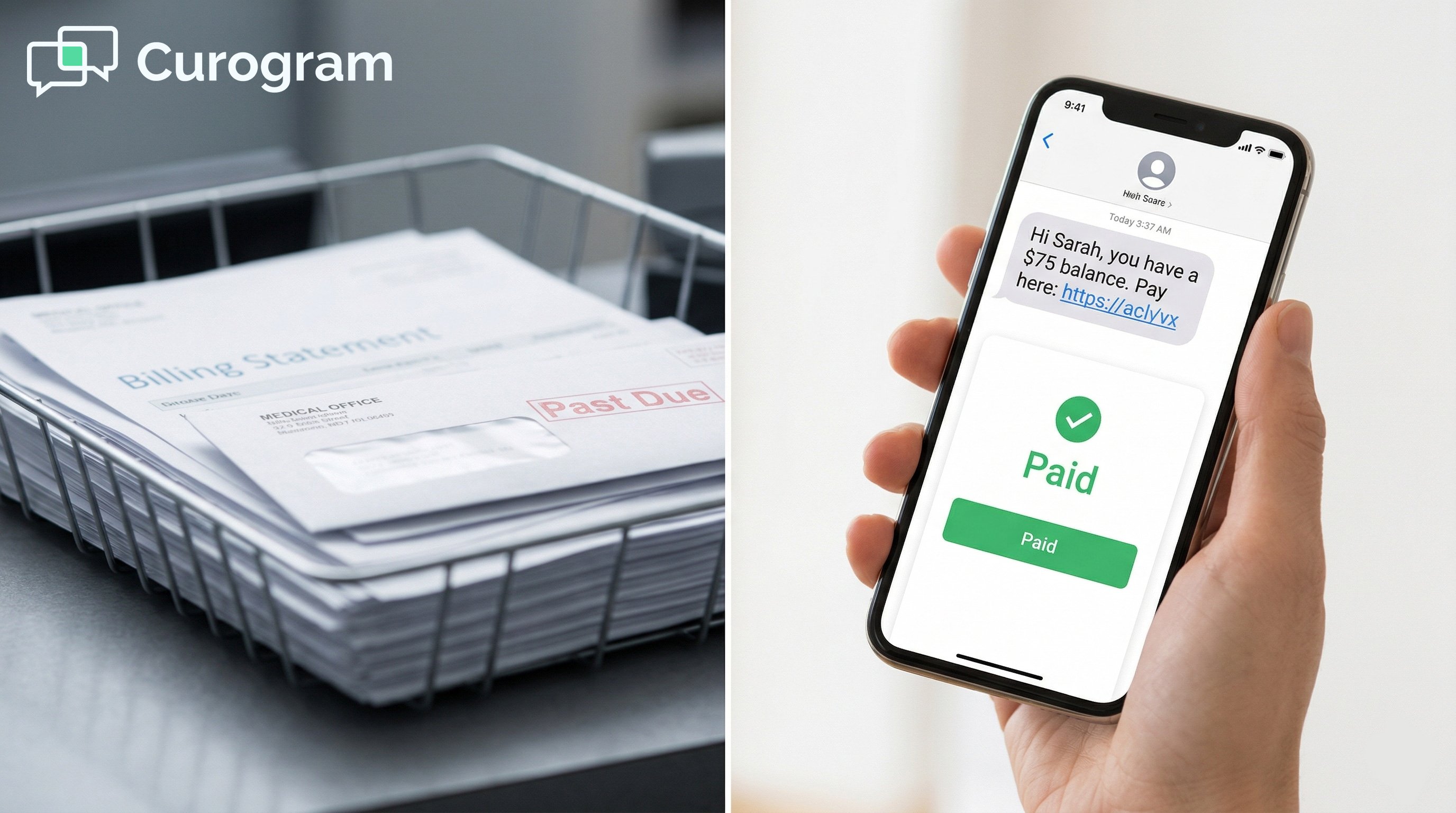
The message looks something like this: "Hi Sarah, you have a $75 balance from your visit on March 3rd. Pay securely here: [link]."

Sarah taps the link. She enters her payment info. She's done in under 60 seconds.

For practices already using Office Ally and Practice Mate, this isn't a replacement. It's the missing piece. Curogram adds a text-based collection channel that reaches the patients your portal never does, and it collects balances 50-70% faster than paper statements alone.

The rest of this guide breaks down exactly why portal-based billing falls short, how SMS payment links work, and what the results look like for real practices.

The Villain: The Balance That Sits on the Portal

Small Office Ally practices often assume that because a payment option exists in Patient Ally, patients will use it. In practice, that's rarely what happens.

This section breaks down the three ways traditional patient balance collection fails, and why the problem is bigger than most providers realize.

Why Portal Payments Don't Happen

The Patient Ally portal is free. It offers payment tools. On paper, it should work. But there's a gap between "the option exists" and "patients actually use it."

To pay through the portal, a patient has to create an account, remember their login, navigate to billing, and start the payment. For someone who owes $75 from a chiropractic visit, that's five steps just to pay a bill. Each step is a chance to give up.

The Drop-Off Problem

Portal adoption at small practices sits at 20-40%. Payment completion rates through portals are even lower than that. The billing infrastructure is there. The patients just aren't using it.

What 60-80% Non-Use Really Costs

If your practice has 200 outstanding patient balances and only 40% of patients log in, you're starting from a place where 120 of those balances will never be touched through the portal. At an average of $50 per balance, that's $6,000 sitting in your AR with no clear path to collection.

The Paper Statement Drain

When the portal doesn't produce payment, most practices fall back on paper. A single statement costs $3-$5 to print, stuff, stamp, and mail. For 200 outstanding balances, that's $600-$1,000 per month just to ask for payment.

Statements arrive in a pile of other mail. About half are opened. A fraction of those actually produce payment. The average paper statement takes 30-60 days to generate a response, if it generates one at all.

The 90-Day Drop-Off

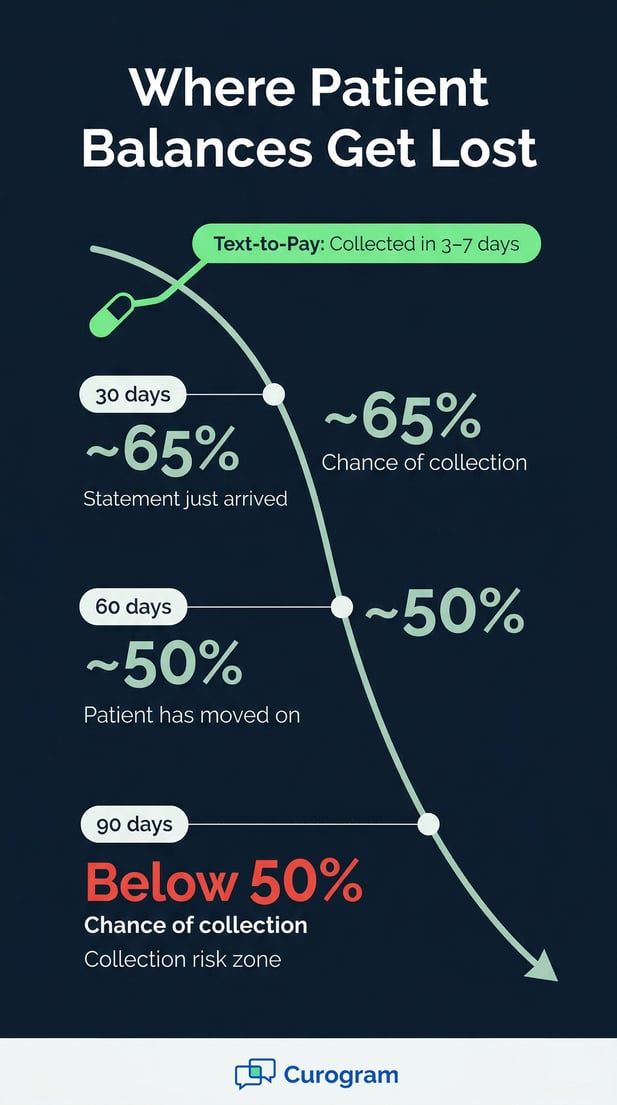
Once a balance passes the 90-day mark, the odds of collecting fall below 50%. The practice spent $5 to send a request for a $75 bill that may never come back. That math does not work in anyone's favor.

Hidden Costs Beyond Postage

The real cost of paper statements isn't just postage. It's the staff time to print and prep them, the delays built into monthly billing cycles, and the weight of tracking which statements went out and which produced payment. For a single front desk person managing a solo practice, that time adds up fast.

The Phone Collection Trap

Some practices skip the statement and go straight to calling patients. Each call takes 3-5 minutes. Half go to voicemail. The ones that connect often end with the patient promising to pay "sometime next week."

The calls feel uncomfortable for both sides. Staff members don't enjoy asking for money. Patients don't enjoy getting those calls.

For a solo provider or a small front desk team, 30+ minutes a day on collection calls is time pulled away from scheduling and patient care.

The Cash Flow Compression

Here's what all of this looks like in numbers. A solo physical therapist seeing 20 patients per day with a $50 average patient responsibility can accumulate $200-$400 in unpaid balances every single day. In a month, that's $4,000-$8,000 stuck in accounts receivable.

For small practices running on lean margins, that gap is real. A full schedule doesn't always mean a healthy bank account, especially when patient responsibility collection is stuck in a system that 60-80% of patients never use.

The good news: the problem isn't that patients don't want to pay. It's that the current process makes it too hard for them to do it.


Chart showing patient collection rates decreasing from 65% at 30 days to under 50% by 90 days

The Guide: The Payment Link That Skips the Login

The core idea behind Curogram's approach to Office Ally patient billing SMS collection is simple: instead of waiting for a patient to log in, the payment comes to them.

This section covers how that works in practice, and why it removes the friction that kills portal-based collection.

How Text-to-Pay Works

When a patient has an outstanding balance, Curogram sends a text message with a secure payment link. The message is short, clear, and personal.

It might look like this: "Hi David, you have a $50 balance from your PT session on March 5th. Pay securely here: [link]."

David gets the text. He taps the link. He enters his card or selects a saved method. He confirms. The balance is paid. All of that happens in under 60 seconds, from a device he already has in his pocket.

The practice sees the payment in real time through the Curogram dashboard. The billing specialist moves on to the next item. No follow-up needed.

Why Text Works When Portals Don't

Texts have a 98% open rate. Emails hover around 20%. Portal login requests often don't even get that far. When you send a payment request through text, it reaches the patient where they already are, on their phone, usually within minutes.

The Office Ally patient billing SMS link from Curogram doesn't ask the patient to remember a username or create an account. It asks them to do one thing: tap and pay. That's a different ask entirely.

The Two-Tap Payment Experience

Curogram's payment page is built for mobile. It's secure, PCI-compliant, and shows the practice name so patients know exactly who they're paying. There's no confusion, no hesitation, and no reason to abandon the page halfway through.

From the patient's side, the experience is as simple as paying for coffee with Apple Pay. From the practice's side, it's a solved collection problem.

How It Fits Into Your Office Ally Workflow

Curogram doesn't replace Practice Mate or the Patient Ally portal. It works alongside them. The practice uses Practice Mate's billing reports to identify outstanding patient balances, and Curogram handles the outreach and collection.

Patients who prefer to pay through Patient Ally can still do that. Curogram simply adds a second channel that reaches the 60-80% who never open the portal.

Most practices find that the text channel quickly becomes the primary one, because patients prefer the simplicity.

Real-Time Visibility

Payment confirmations appear in the Curogram dashboard as they happen. The billing specialist doesn't need to cross-reference statements or wait for a monthly report. They can see, at any moment, which balances have been collected and which need follow-up.

Automated Follow-Ups

If a patient doesn't pay after the first text, Curogram can send automatic follow-up reminders at intervals the practice sets. A second message might go out after 7 days. A third after 14.

Based on our internal data, text follow-ups resolve more than 80% of outstanding balances without any manual effort from staff.

What This Means for Solo Providers

For the solo chiropractor who handles billing after hours, or the small practice mental health provider with no dedicated billing staff, this changes the daily experience of practice ownership.

No more evening phone calls about unpaid balances. No more printing statements at the front desk. No more awkward conversations at checkout about past-due amounts.

Small practice text payment collection through Curogram doesn't just improve cash flow. It removes one of the most draining parts of running a small practice: chasing money that should have come in weeks ago.


The Success: Texted. Tapped. Paid.

Switching to text-based patient balance collection isn't just a convenience upgrade. It changes the financial path of a practice.

This section shows what the results actually look like, with numbers and a real-world example.

The Metrics That Matter

Text-to-pay achieves 50-70% faster collection on patient responsibility balances compared to portal-only or paper-based billing. Practices that add the SMS channel see 30-40% higher overall payment compliance.

To put that in dollar terms: a practice with $5,000 per month in outstanding patient balances that improves collection by 30% recovers $1,500 per month. Over a year, that's $18,000 that would otherwise have been written off or sent to a collections agency.

From Passive to Active Collection

The shift in strategy is the bigger change. Paper statements are passive. You mail them and hope. An Office Ally patient payment text message is active. You send a payment link and patients act on it.

AR aging, the average number of days a balance sits unpaid, drops from 60-90 days with traditional methods to 3-7 days for text-collected balances. That's not a small improvement. That's a fundamentally different cash flow situation.

What Happens to the Billing Team

When most balances are collected through text, the billing specialist's job shifts. Instead of manually chasing 80% of patients who just need an easier way to pay, they focus on the 10-20% who have genuine issues: disputed charges, insurance questions, or financial hardship cases.

That's a better use of everyone's time.

Method

Avg. Collection Time

Cost Per Statement

Collection Rate

Portal (Patient Ally)

30-60+ days

Minimal

20-40% of patients

Paper Statement

30-60 days

$3-$5 each

Low, drops after 90 days

Phone Call

Variable

Staff time (3-5 min)

Unpredictable

Curogram Text-to-Pay

3-7 days

Low

50-70% faster vs. paper


A Real Practice Example

Consider a solo mental health practitioner who has been using Office Ally with the standard billing approach: post balances to Patient Ally, mail statements, and follow up by phone when needed.

Last quarter, that practitioner had $4,200 per month in uncollected patient balances. Statements cost $350 per month to mail. Collection calls took 15+ hours of staff time each month.

After adding Curogram's text payment channel:

  • Uncollected balances dropped to $1,100 per month, a 75% reduction
  • Statement mailing costs fell to zero
  • Collection calls stopped entirely

The payment texts go out automatically after each session. Most patients pay within 48 hours. Based on our internal research, results like this are consistent across small practices that replace passive billing with active SMS-based collection.

Why Patients Pay Faster by Text

The reason text works isn't mysterious. People check their phones dozens of times a day. A text about a $50 balance doesn't require them to remember a login, open a browser, or find a checkbook.

It's right there, with a link. The path from "I should pay this" to "I paid this" is one tap.

Paper statements require patients to handle mail, open an envelope, find a way to pay, and follow through. Most don't. It's not that they're unwilling. The process has too many steps.

Small Practice, Big Impact

For a solo physical therapist or chiropractor, a 75% reduction in uncollected balances isn't a minor win. It changes whether the practice can hire help, invest in equipment, or simply feel stable month to month. That's the real outcome of getting patient balance collection right.

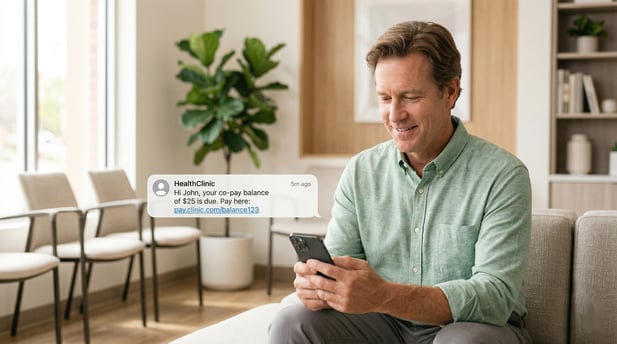
Patient in a waiting room smiles as he receives a mobile text message for a $25 co-pay balance

Stop Mailing Statements. Start Texting Payment Links.

Most small Office Ally practices aren't losing patient revenue because of a billing software problem. They're losing it because of a delivery problem. Patient Ally's portal works. Patients just don't use it.

Here's what the traditional billing process looks like at most Office Ally practices.

A balance posts to Patient Ally. The patient never logs in. A paper statement goes out 30 days later. It costs $3-$5 to send. It takes another 30-60 days to produce payment, if it produces payment at all.

Meanwhile, the practice's AR grows, cash flow tightens, and staff time gets eaten up by follow-up calls that rarely go well.

Curogram's Practice Mate patient balance collection text breaks that cycle. Instead of posting a balance and hoping someone logs in, the practice texts a secure payment link. Patients pay in under 60 seconds. Balances clear in 3-7 days instead of 60-90.

Think of it this way: Practice Mate handles billing. Patient Ally handles the portal. Curogram handles collections, specifically the text-delivered payment link that reaches the patients who never log in, never open statements, and never call back about their balance.

They work together. Not against each other.

Most practices notice the change within the first billing cycle. AR aging drops. Statement costs go to zero. Collection calls stop. The billing specialist's day looks different. Instead of chasing balances, they're managing exceptions.

That shift matters more than any individual payment. It means the practice's revenue cycle is no longer dependent on patient behavior that isn't happening.

If your practice uses Office Ally and you're still relying on Patient Ally's portal or paper statements to collect patient balances, the data is clear: 60-80% of your patients will never take the step you're asking them to take.

Curogram adds the channel that works. A direct text. A secure link. A payment completed in under a minute.

Small practices run on tight margins and real human effort. Every uncollected balance is money your team earned, money your practice needs.

For small practices where patient responsibility makes up 20-40% of revenue, getting the collection channel right is a practical next step, not a luxury.

Your patients want to pay. They just need a link that doesn't require a login.

See how Curogram completes your Office Ally setup. Schedule a demo.


Frequently Asked Questions

How does Curogram's text payment link work with an Office Ally billing setup?

Curogram works alongside your current Office Ally workflow without replacing it. Your team uses Practice Mate to identify outstanding patient balances, and Curogram handles the outreach by texting a secure payment link to the patient. Payments are tracked in the Curogram dashboard in real time. Patient Ally remains available for patients who prefer the portal.

Why do patients pay faster through text than through a patient portal?

Patients receive dozens of texts per day and typically open them within minutes. Paying through a portal requires logging in, finding billing, and completing several steps. A text with a direct payment link cuts that down to one tap, removing the friction that causes most portal payments to never happen in the first place.

How does the text payment process protect patient financial data?

Curogram's payment links are PCI DSS compliant and use standard encryption. The text itself contains no financial information, just a link to a secure payment page.

Patient card data is processed through a certified payment processor and is not stored on Curogram's servers. The security standard meets or exceeds what patients experience when paying through any online portal.

Why do paper statements fail to collect balances effectively for small practices?

Paper statements cost $3-$5 each to print and mail, and they typically take 30-60 days to produce a payment response. After 90 days, the odds of collecting that balance drop below 50%. Statements also compete with junk mail, get lost, or get set aside and forgotten, making them one of the least reliable billing channels for small practices.

How do automated follow-up texts improve collection rates without adding staff work?

Curogram can be set up to send a second text after 7 days and a third after 14 if a balance remains unpaid. These reminders go out automatically, without any manual effort from your team. Based on our internal research, this follow-up sequence resolves more than 80% of outstanding balances without a single phone call or paper statement.