
eClinicalWorks Text-to-Pay | SMS Payment Links for Enterprise RCM
💡 eClinicalWorks text-to-pay SMS patient payment billing sends secure links to patients right after a visit. Patients pay in seconds from their...
11 min read
Jo Galvez
:
March 14, 2026
Mr. Torres, 43, left the doctor's office feeling fine. The visit went well. Then, two weeks later, a paper bill arrived in the mail.
To pay it, he had three options: write a check, call the billing line, or log into a portal he barely remembers creating. So the bill sat on the kitchen counter. Then a second one arrived.
This story plays out millions of times each week across the country. Patients are not refusing to pay. They are avoiding a process that feels clunky and outdated.
The gap between how people pay for everything else in their lives and how they are asked to pay for healthcare is wide, and it costs medical practices real money.
For enterprise eCW networks, that gap shows up directly in slower cash flow, more billing calls, and higher bad debt. The good news: the fix is simple.
Patients already know how to tap a text link and confirm a payment. They do it every day for coffee, groceries, and rides. The same ease can apply to a medical bill.
Curogram's text-to-pay gives patients at eCW networks a one-tap mobile payment option with no app download, no portal, and no login needed.
The patient sees the amount, taps to pay, and gets a confirmation text. That is it.
This article walks through why the old payment process fails, how the text-link approach works, and what enterprise networks can expect when they make the switch.
Paying a medical bill should not require effort. But for most patients at enterprise eCW networks, it does.
The current billing experience puts up obstacles at every step, and those obstacles add up to delayed payments and frustrated patients.
Let’s go back to Mr. Torres. He just left a 40-provider orthopedic group. He works long hours, and his phone is how he does everything. A paper bill arrives two weeks after his visit.
To pay it, he has to write a check he does not have, call a billing office he can only reach during work hours, or log into a portal he has not used in months.
Each option feels like work. So the bill sits on the counter. A second one arrives. That one sits too. Meanwhile, the practice has an unpaid $85 balance growing older by the day.
A paper statement asks the patient to take multiple steps before they can pay. Find the bill. Locate the account number. Go to a website or find a stamp. Enter card details or wait on hold.
Every extra step is a chance for the patient to put it off. Research in patient billing consistently shows that friction is the main reason balances go unpaid, not unwillingness to pay.
For large eCW networks, the scale of this problem is significant. With thousands of patients across dozens of providers, even a modest improvement in payment speed translates to major gains in cash flow. The issue is not a bad patient. The issue is a bad process.
Delayed payments are the obvious cost. But there are hidden costs too. Every unpaid statement generates follow-up calls, second notices, and staff time spent tracking down balances.
The billing team spends hours each week on calls that exist only because the first payment option did not work.
There is also a loyalty cost. Patients who find it hard to pay their medical bills tie that frustration to the practice, not just the billing department. In competitive markets, a clunky billing process is a quiet churn driver.
Patients talk about their experiences. A seamless clinical visit paired with a painful billing process creates a mixed memory, and the painful part often wins.
Many enterprise eCW networks assume the patient portal solves this problem. After all, healow and similar tools offer online bill pay options for patients who use the app.
But paying through a portal is not as easy as it sounds. It still requires the patient to download the app if they have not already, log in, find the billing section, and enter payment details.
For patients who rarely use the portal, which is the majority at most large networks, this process is just as slow as writing a check. In fact, it can be worse.
At least a check only requires finding a stamp. The portal requires remembering a password, and one failed reset attempt is often enough to make the patient give up entirely.
The promise of digital healthcare payments is that they should be easier, not just different. But a portal that requires a login every time, across multiple providers, with separate accounts for each patient in the household, is not a convenience upgrade.
It is just a digital version of the same old friction. The patient still has to work for it.
The mobile bill pay for healthcare text message approach changes this completely. No new app. No new account. The link arrives in the patient's existing messages app, where they already spend time every day.
The payment page is optimized for a phone screen. The whole experience matches how patients pay for everything else in their lives.
Mr. Torres, who struggles with the portal, tapped his phone to pay for coffee that morning. He split dinner with friends via a notification. He bought work boots online in two taps.
Then he received a paper bill from his doctor asking him to write a check or log in to a portal. That gap stings, and patients feel it.
Patient payment convenience in enterprise healthcare is not just a nice-to-have feature. It is a direct driver of collection speed, patient satisfaction, and practice revenue.
The practice that closes that gap first wins on both fronts: it gets paid faster and keeps patients happier.

Curogram's text-to-pay flips the payment process. Instead of asking patients to come to the bill, the bill goes to the patient, in the channel they already use every day. No extra steps. No new accounts. One tap to pay.
After a patient's visit, Curogram sends a text message with their balance and a secure payment link. The message includes the patient's name, the provider's name, and the visit date.
When the patient taps the link, they see a clean, mobile-optimized page showing exactly what they owe and to whom.
From there, the patient chooses how to pay. Options include Apple Pay, Google Pay, a credit or debit card, or an HSA or FSA card. For patients who use Apple Pay or Google Pay, the payment takes one tap and a fingerprint.
For those entering card details manually, the form is short and simple. The full process, from opening the text to receiving a confirmation, takes about 30 seconds.
The payment page is built for clarity. It shows the provider's name, the visit date, and the balance amount. There are no billing codes, no insurance jargon, and no multi-page forms.
For patients who have questions, they can reply directly to the text. Their message routes to the billing team through Curogram's smart routing, so they get a faster answer than waiting on hold.
For larger balances, the billing team can configure a payment plan option directly on the payment page. The patient sees the installment option without needing to call anyone.
This keeps the entire patient SMS payment experience within the text thread, which reduces inbound calls and speeds up resolution.
The payment platform is PCI DSS compliant and SOC 2 Type II certified. Every text is sent from a number linked to the practice, and the message includes visit-specific details that only a real source would know.
This personalization, patient name, provider name, exact visit date, and exact balance, helps patients trust the message and reduces the risk of confusion with spam or scam texts.
Patients can verify the text by calling the practice directly if they have any doubts. The combination of a recognized sender number, real visit details, and a secure, encrypted payment page makes the experience feel trustworthy rather than suspicious.
Because Curogram integrates with eClinicalWorks' billing module, the payment text pulls accurate balance data directly from the patient's account.
The patient does not receive a generic message saying they have a balance. They receive the specific amount, from the specific provider, for the specific visit.
This level of detail matters. A vague message gets ignored or deleted. A precise message that matches what the patient already knows from their visit feels legitimate and prompts action.
The eClinicalWorks pay by text no login approach removes the step where a patient has to find their account number or log in to confirm what they owe.
When the patient pays, the transaction posts to eCW immediately. The balance closes without any action from the billing team. No manual entry. No reconciliation at the end of the day.
The billing staff can focus on edge cases and patient questions rather than processing routine payments one by one.
This automation also eliminates the lag time between when a patient pays and when the practice's system reflects that payment. In a large network processing thousands of transactions per month, that real-time sync is a meaningful operational improvement.
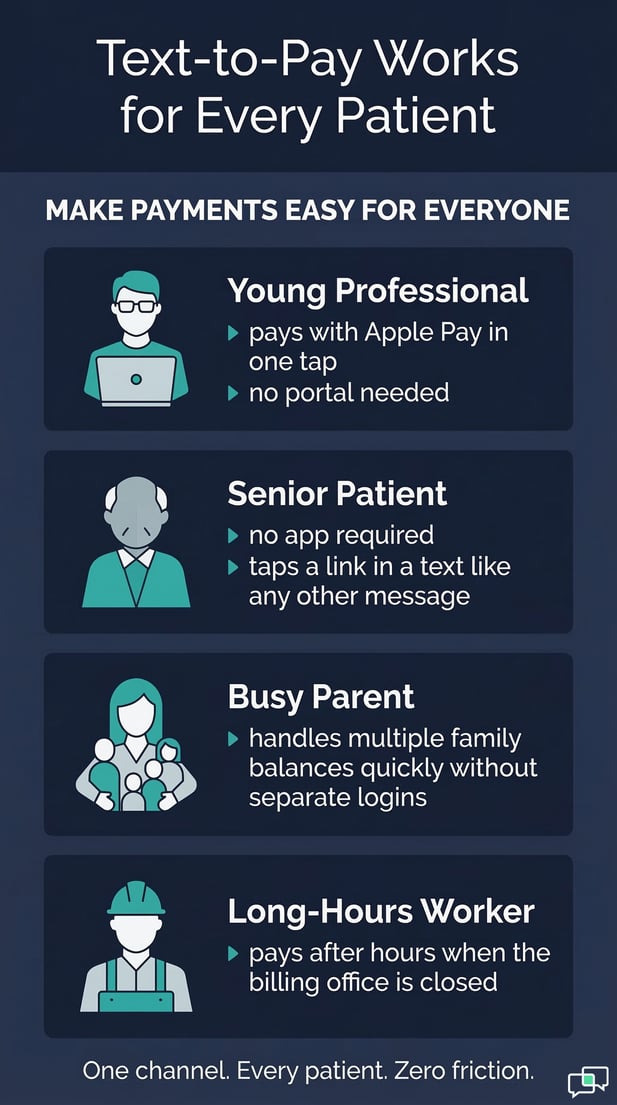
One-tap medical bill payment via SMS works across every patient demographic. The 28-year-old who uses Apple Pay for everything. The 72-year-old who does not use apps but knows how to tap a link in a text.
The working parent juggling three kids' appointments, who cannot spend 15 minutes in a portal for each one. Text messaging reaches all of them through the one channel they share.
For enterprise eCW networks with diverse patient populations, this breadth matters. A healow alternative patient payment text link approach does not require patients to adopt new behavior.
It meets them exactly where they already are, in their messages app, doing what they already do every day.
The goal of any payment system is simple: get paid faster, with less effort, and without damaging the patient relationship.
Text-to-pay delivers on all three. Here is what the shift looks like in practice, and what the numbers show.
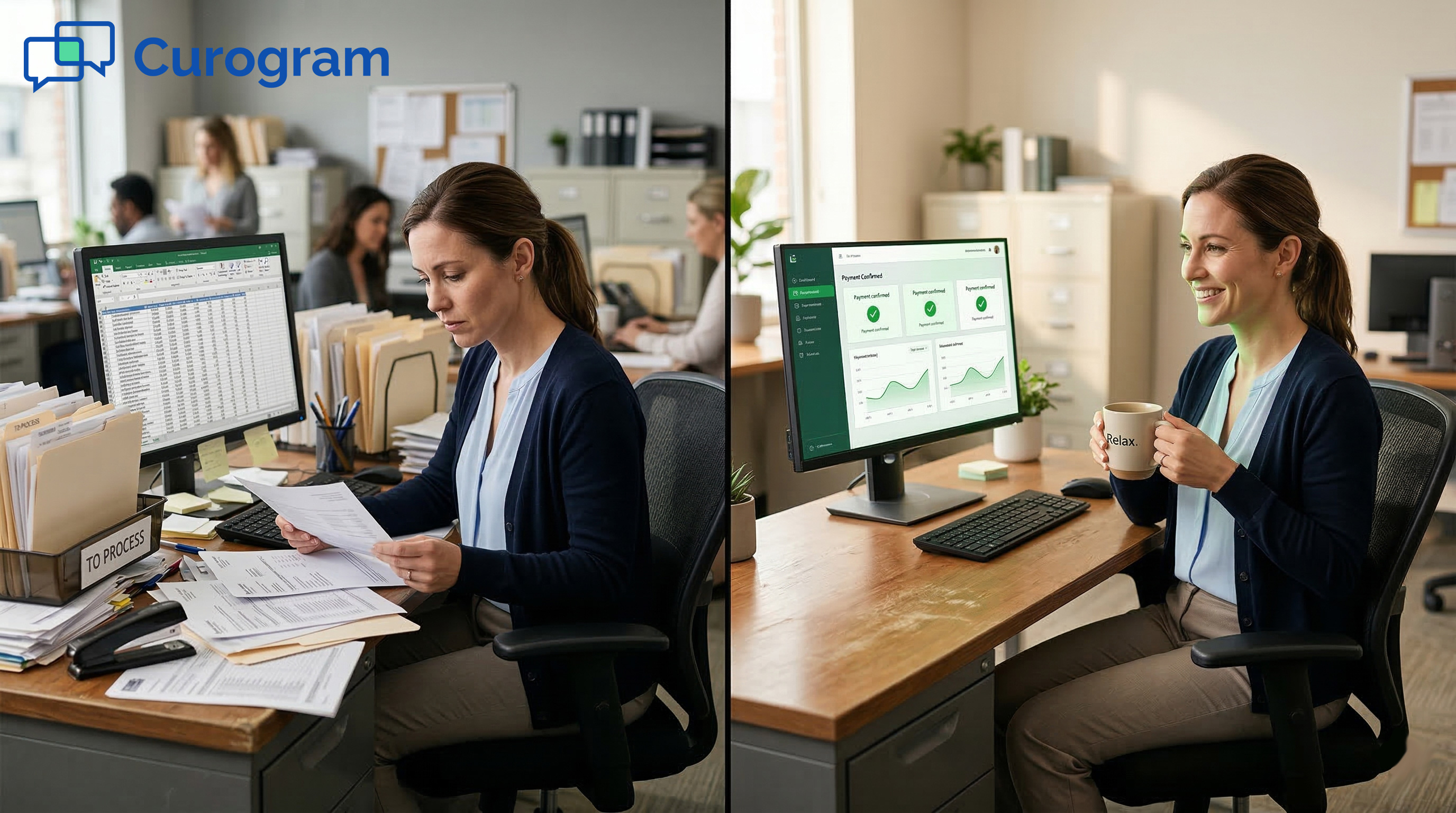
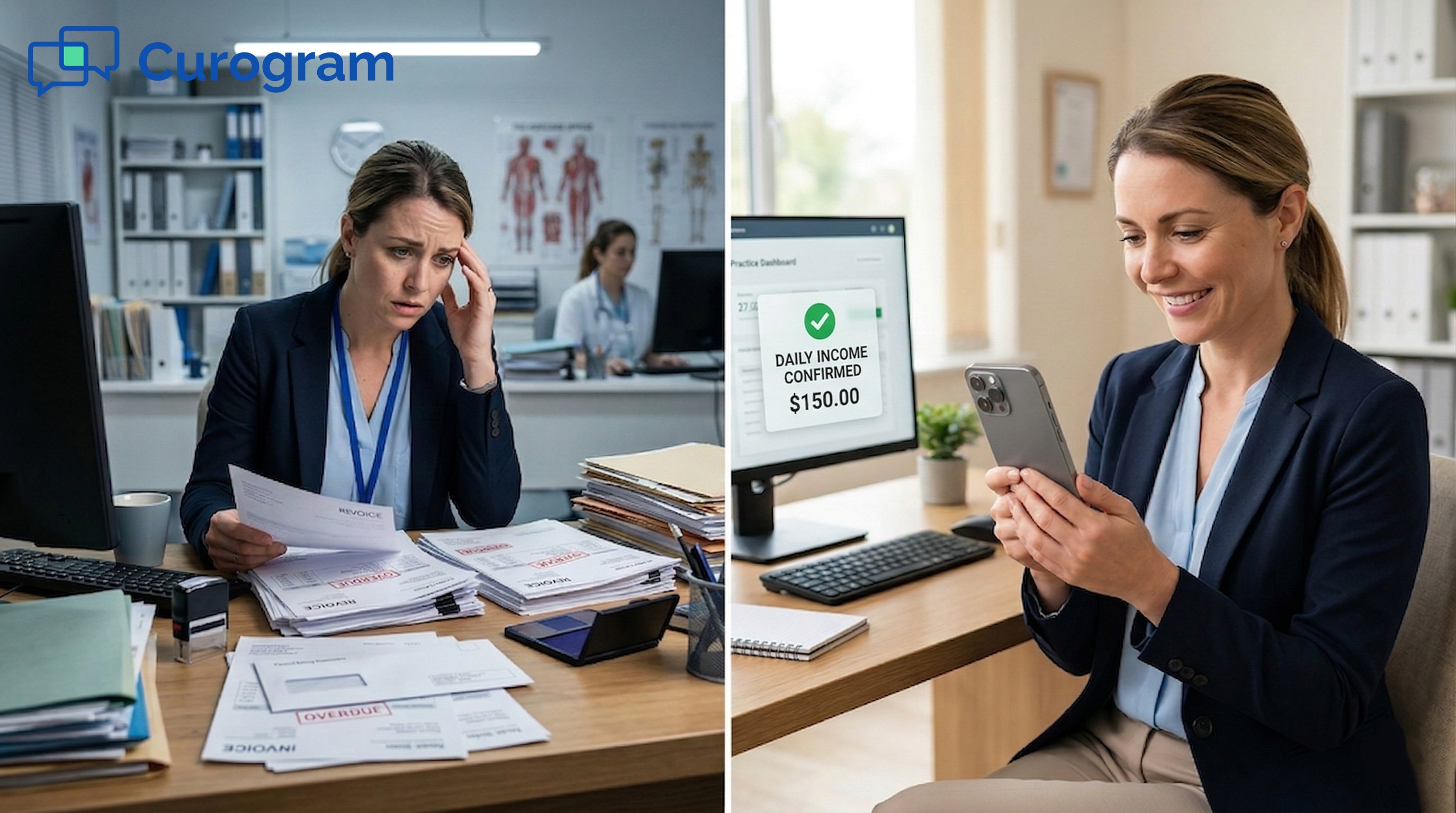
Before text-to-pay, Mr. Torres, who had a smooth clinical visit, often had a frustrating billing experience. He waited for a paper statement, set it aside, got a second one, and eventually either paid reluctantly or called the billing office. The emotional tone of that process was stress and friction.
After text-to-pay, he gets a text at 5:45 PM while waiting to pick up his daughter from soccer practice. He sees his $85 balance, his provider's name, and today's date.
He taps Apple Pay, holds his thumb on the sensor, and gets a confirmation text. Total time: 15 seconds. He does not even think about it, which is exactly the point.
Convenience drives behavior. Patients who receive an SMS payment link pay at higher rates and faster than those who receive paper statements alone. The text message removes the procrastination loop.
There is nothing to file, no password to remember, and no hold music. The patient sees the balance when it is fresh in their mind, shortly after the visit, and pays in the moment.
Based on our internal data, SMS-based patient communication tools significantly reduce the time to collect on outstanding balances.
When the payment channel matches how patients already manage money, the barriers that cause balances to age simply disappear.
|
Payment Method |
Average Days to Collect |
Patient Action Required |
Staff Follow-Up Needed |
|
Paper Statement |
30-60+ days |
High |
Often |
|
Portal Login |
14-30 days |
Medium |
Sometimes |
|
SMS Text Link (Curogram) |
Same day to 3 days |
Low (one tap) |
Rarely |
Source: Based on our internal research.
Across a 40-provider network, reducing average collection time from 45 days to 3 days is not a small gain. It is a cash flow transformation. The billing team fields fewer calls, the bad debt bucket shrinks, and patients associate the practice with ease rather than hassle.
Every billing call the team does not have to take is time they can spend on work that actually requires their expertise. When patients pay via text link, the volume of inbound payment calls drops.
The billing staff is not chasing statements or reading card numbers over the phone. They are handling exceptions, answering real questions, and closing complex cases.
Based on our internal data, practices that adopt SMS-based payment tools reduce phone call volumes by as much as 50%.
For an enterprise network handling thousands of transactions each month, that is a meaningful reduction in labor cost and staff stress.
Patients who have a smooth billing experience are more likely to return, more likely to leave positive reviews, and less likely to switch providers.
The billing touchpoint is the last impression a practice makes after each visit. A frustrating billing experience can undo an otherwise excellent clinical encounter.
The clinical care and the billing experience are two halves of the same patient relationship. Enterprise eCW networks that invest in a better payment experience are investing in patient loyalty, not just accounts receivable. A patient who pays easily is a patient who comes back.
Patients who pay easily and feel good about their billing experience are far more likely to leave a positive online review. The billing moment, which most practices treat as purely administrative, is actually a reputation moment.
A text that says 'Payment received. Thank you!' is a small but real act of gratitude that leaves the patient with a positive final impression.
For enterprise eCW networks building their reputation in crowded markets, these moments add up. A smooth payment flow feeds directly into the review pipeline. Patients who feel respected in the billing process are more willing to take 30 seconds to say so online.

Patients at enterprise eCW networks delay payments because the process is outdated, not because they do not want to pay.
The fix is not more statements or more collection calls. The fix is meeting patients where they already are, in their messages app, with a payment experience that takes 30 seconds or less.
eClinicalWorks handles the clinical side of care. Curogram handles the payment side, in a way that actually works for patients. The quality of the billing experience should match the quality of the clinical care. When it does, patients notice. They pay faster, complain less, and come back more often.
Sending patients an SMS payment link is not a small upgrade. It is a shift in the relationship between the practice and the patient at the most friction-filled moment in the healthcare journey. Removing that friction has real financial value and real loyalty value.
Every paper statement is a request for the patient to do work. Every portal login is a barrier. Text-to-pay removes both.
Give patients the payment experience they expect from every other part of their financial life, and they will give the practice what it needs: faster payment with fewer follow-ups.
Enterprise networks using Curogram's patient payment convenience tools have found that patients respond quickly when the process is simple.
That speed translates directly into improved cash flow and a billing team that can actually focus on high-value work.
Schedule a demo today then compare the collection speed and patient satisfaction against the paper statement process. The results will speak for themselves.
Frequently Asked Questions
Curogram integrates directly with the eCW billing module to pull accurate balance data from each patient's account. When a patient pays, the transaction posts back to eCW in real time, closing the balance without any manual entry from the billing team.
This means the billing module stays current without extra work from staff. The whole process is automated from the moment the text is sent to the moment the payment is confirmed.
A text arrives while the visit is still fresh in the patient's mind. It requires one tap and no login, so there is nothing to put off. Paper statements, by contrast, arrive weeks later and ask the patient to take several steps before paying. Convenience drives behavior. When the path to payment is short, patients take it right away instead of setting the bill aside.
Curogram's payment texts come from a recognized number linked to the practice and include specific details like the patient's name, the provider's name, the visit date, and the exact balance amount.
Generic scam messages never include this level of detail. The payment page itself is encrypted and PCI DSS compliant. Patients who still have doubts can call the practice directly to verify before tapping.
The billing team can configure a payment plan option directly on the payment page for larger balances. When the patient taps the link, they see the installment option alongside the full payment option.
If they have questions, they can reply to the text and their message routes to the billing department through smart routing. This keeps the whole process within the text thread without requiring a phone call.
The healow portal requires the patient to have the app installed, remember their login, and navigate to the billing section before they can pay. Most patients at large networks do not regularly use the app, so this process adds multiple steps.
Text-to-pay skips all of that. The link arrives in the patient's existing messages app, the page is optimized for mobile, and payment takes about 30 seconds with no new account or login needed.
💡 eClinicalWorks text-to-pay SMS patient payment billing sends secure links to patients right after a visit. Patients pay in seconds from their...
💡 eClinicalWorks billing teams spend a large part of their time managing paper statements, chasing balances, and posting payments by hand. This...
💡 Clinics using Osmind EMR can boost their Osmind EMR ROI for patient payments by switching from paper billing to secure SMS payment links....