

Text-to-Pay in Veradigm with Curogram
💡 Text-to-pay in Veradigm helps imaging centers collect payments faster and reduce admin work. This mobile payment method sends secure links...
12 min read
Jo Galvez
:
March 24, 2026
Table of Contents
It is the same day every month. Statement day.
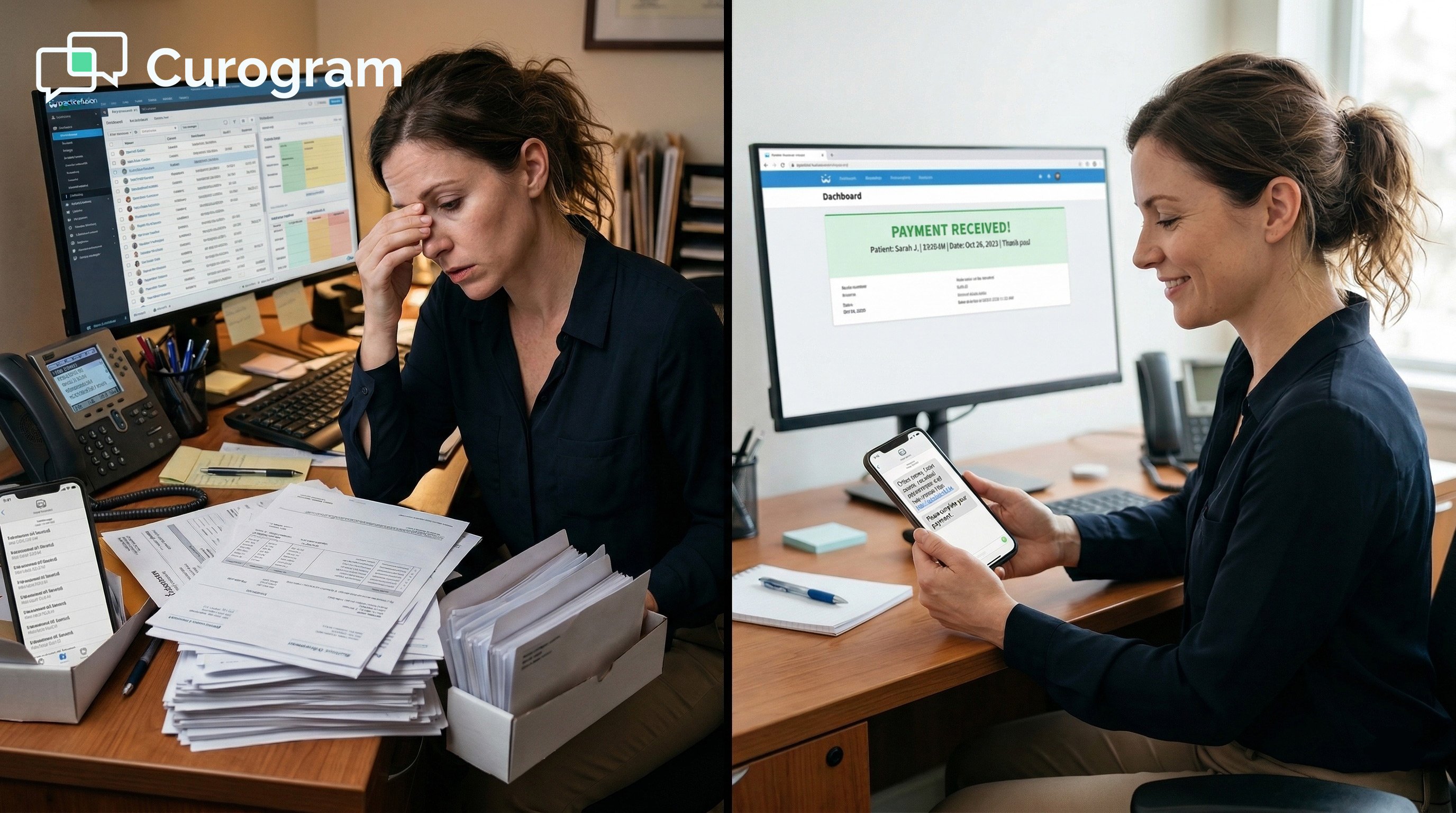
The billing person pulls the unpaid balance report, filters it, exports the list, and then prints a stack of statements. Then comes the folding, the stuffing, the stamping, the mailing.
Days later, the phones ring. Or they do not. And then the follow-up calls begin.
For billing staff at small practices, this cycle repeats every single month. It eats time. And worse, it barely works. Paper-based collections recover only about 20% of what is owed. That means 80% of the time and money spent on statements produces nothing.
This is not a small problem. For a practice sending 400 statements a month, that manual process takes 20 to 30 hours of staff time. That is more than half a work week, spent on something that fails most of the time.
The good news is that a better option exists. Curogram's text-to-pay payment links replace the entire printing-and-mailing workflow with a single step.
Billing staff send an SMS from inside Practice Fusion. Patients tap a secure link and pay. The payment posts automatically.
No more printing. No more envelopes. No more chasing.
This article breaks down how the old statement workflow drains your team, how SMS-based payment collection changes the picture, and what billing staff can actually do with 20 to 30 recovered hours each month.
Most people outside of billing do not see the full weight of statement day. It looks simple from the outside. But for the person doing the work, it is a slow, repetitive drain that takes up a huge share of the workweek.
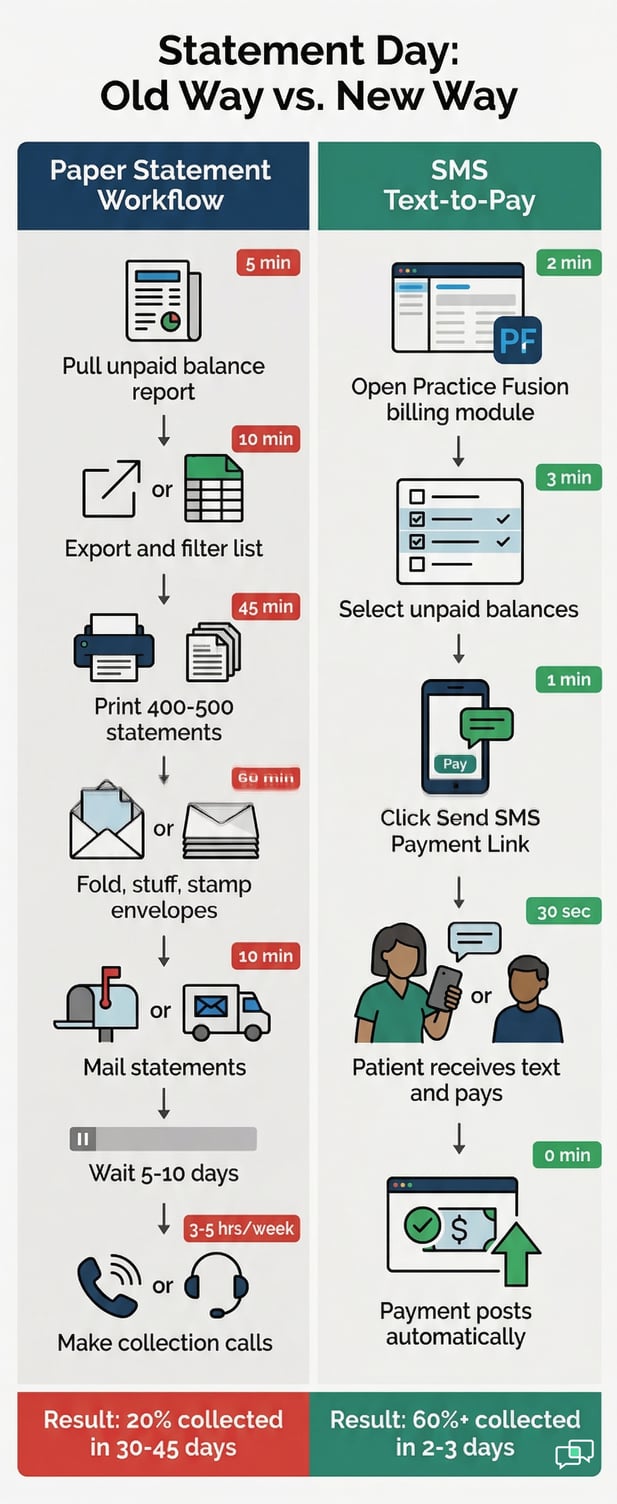
The process follows the same steps every time. Pull the unpaid balance report from Practice Fusion. Filter for balances above a set threshold, often $25 or $50.
Export the list. Print the statements. A small practice might print 400 to 500 pages in a single run.
Then comes the physical work. Fold the pages. Stuff the envelopes. Stamp them. Drop them in the mail. For a solo billing person, this alone can take several hours.
After mailing, there is a 5 to 10 day wait. Some patients call in after getting their statement. Many do not. A large share simply ignore the paper in the mail.
So the billing person starts calling. These are not quick conversations. They require looking up accounts, confirming visit dates, explaining charges, and negotiating. Each call can take 5 to 15 minutes. Multiply that by 20 to 40 calls a week and the math gets painful fast.
Based on our internal research, the average small practice spends 20 to 30 hours per month on the statement workflow alone.
That covers printing, mailing, and follow-up calls. And at the end of all that effort, only about 20% of what was mailed ever gets paid.
That is not a process. That is a time sink disguised as a business process. Billing staff are stuck doing work that fails four times out of five, while higher-value tasks like claim denial follow-up and insurance verification sit waiting.
Statement runs are not hard. They are tedious. And that distinction matters, because tedious work can be replaced.
Skilled billing staff are capable of work that grows the practice. The question is whether the practice gives them the time to do it.
Every hour spent on statement runs is an hour not spent on revenue recovery. Here is a look at what billing staff could be doing instead:
|
High-Value Task |
Revenue Impact |
Why It Gets Skipped |
|
Follow up on denied claims |
Can recover thousands per month |
No time after statement workflow |
|
Verify insurance before visits |
Prevents bad-debt write-offs |
Statement calls take priority |
|
Contact carriers on aging claims |
Speeds up 30+ day unpaid claims |
Too many collection calls to make |
|
Audit payment arrangements |
Catches missed plans early |
Rarely has time to review holistically |
The statement workflow is not hard work. It is low-value work. And when a billing person spends 20 to 30 hours a month on it, the practice loses something it cannot buy back: the chance to collect on denials, catch eligibility issues early, and keep the revenue cycle moving.
Insurance companies deny claims for small errors. A billing person with time can call the carrier, correct the claim, and recover that revenue. But if their day is full of collection calls, those denials age out. They expire. The money is gone.
There is a human cost as well. Billing staff who spend most of their time on work that fails are not happy workers. When you make 25 collection calls and recover payment from just 5 of them, the job feels thankless.
High turnover in billing roles is a real problem for small practices. Replacing a billing person costs time and money. Keeping them engaged with work that succeeds is a smarter investment.
In a large health system, statement work is spread across a team. In a small practice, it often falls on one person.
That person is also handling scheduling, insurance checks, and patient questions. When statement work expands, everything else compresses.
The result is a billing function that is always behind, always reactive, and never quite catching up. The statement workflow is not just inefficient. It is a structural drag on the whole practice.

Curogram's text-to-pay feature does not add a step to the billing workflow. It replaces the broken one. Instead of printing statements and waiting, billing staff send a secure SMS payment link. Patients tap it and pay. The transaction posts to Practice Fusion. Done.
From the billing person's point of view, the shift is simple. The starting point is the same: identify patients with outstanding balances in Practice Fusion. But from there, everything changes.
Instead of exporting, printing, and mailing, the billing person selects the patient accounts and triggers an SMS through the Practice Fusion billing module.
Curogram generates a secure, HIPAA-compliant payment link and sends it via text to each patient. When the patient pays, the transaction posts back to Practice Fusion automatically.
The entire multi-day, multi-step statement process collapses into a single action. No printing. No envelopes. No postage. No waiting 5 to 10 days before following up.
Patients receive the text, recognize the balance, and pay from their phone. Most do it within 24 to 48 hours.
Based on our internal data, practices using SMS payment links see collections happen within 2 to 3 days, compared to the 30 to 45 days typical of paper statements.
The billing person still works inside Practice Fusion. There is no new system to learn. No separate login. No manual data entry after a payment is made. The workflow just becomes faster, simpler, and far more effective.
This is important for staff adoption. Billing teams do not want another platform. They want the one they already use to work better. That is exactly what this integration does.
The difference in outcome is not subtle. Here is how paper statements compare to SMS payment links across the key metrics:
|
Metric |
Paper Statements |
SMS Payment Links |
|
Collection rate |
~20% |
60%+ |
|
Time to collection |
30 to 45 days |
2 to 3 days |
|
Staff time on collections |
20 to 30 hrs/month |
2 to 5 hrs/month |
|
Cost per statement |
~$2.00 (print + mail + labor) |
Lower per-transaction cost |
|
Follow-up calls needed |
High (weekly) |
Minimal (disputes only) |
Source: Based on our internal data.
The ROI is clear. A 3x improvement in collection rate, combined with a 70 to 80% reduction in staff time on collections, makes the case on its own.
Getting time back is only valuable if it gets used well. When the statement workflow disappears, the billing staff do not just get a lighter schedule. They get the capacity to do work that directly grows the practice's revenue.
To understand the real impact, it helps to look at how different billing teams use the time they recover when text-to-pay handles the collections workflow.
Maya manages a small gastroenterology practice on her own. She handles scheduling, billing, insurance checks, and patient communication. Statement day takes a large chunk of her week, and collection calls fill the rest.
After switching to text-to-pay, Maya spends about 10 minutes a day sending SMS payment links through the Practice Fusion billing module.
Her collection calls drop from 20 to 25 per week to just 3 to 5, reserved for real disputes and payment plan requests. She now has 15 to 20 hours each month for claim denial follow-up and insurance verification.
Based on our internal data, practices in her situation see claim collection improve by 8 to 12% within 90 days.
That translates to $18,000 to $25,000 in added annual revenue. The statement workflow did not just disappear. It got replaced with work that actually moves money.
A 3-provider primary care practice has one full-time billing staff member. Before text-to-pay, she processes 600 to 700 statements each month and makes 40 to 50 collection calls per week. Statement printing and mailing alone takes 10 to 15 hours monthly.
After activating text-to-pay, SMS payment links are sent with a single click per batch. Collection calls drop by 70 to 80%. She redirects her freed time to claim research, prior authorization follow-ups, and carrier dispute resolution.
Based on our internal data, the practice's denial rate drops from 8% to 3%. Net result: more than $40,000 in added annual revenue without adding staff.
When billing staff have time, they use it in ways that have a real dollar value. The most common redirections include claim denial follow-up, proactive insurance eligibility checks before visits, and contacting carriers on aging accounts. Each of these activities directly impacts what the practice collects each month.
The math is straightforward. A billing person who recovers even one denied claim per week, at an average value of $200 to $300, adds $10,000 to $15,000 to annual revenue. That is the value sitting inside those 20 to 30 recovered hours.
Numbers matter when making a case for change. Billing staff and office managers need to show practice owners that this switch is worth it.
The data below, based on our internal research, makes that case clearly.
Curogram clients report consistent results after moving from paper-based statements to SMS payment links. The improvements show up in three key areas: how much gets collected, how fast it comes in, and how little staff time it takes.
Collection rates rise from around 20% with paper statements to 60% or more with text-to-pay. That is a 3x lift.
Time to collection drops from 30 to 45 days to just 2 to 3 days. Staff time on collections shrinks from 20 to 30 hours per month to just 2 to 5 hours.
Paper statements ask patients to do several things: open the envelope, read the statement, find a checkbook or log into a portal, and mail a payment or call the office. Most patients do not complete all those steps.
An SMS payment link asks patients to do one thing: tap a link on their phone. The payment takes about 30 seconds. That is why the collection rate is so much higher. The barrier is almost gone.
The cost difference between paper statements and SMS links is not just about postage. When you factor in labor, the gap is even larger:
|
Cost Type |
Paper Statement Workflow |
SMS Text-to-Pay |
|
Printing supplies |
Yes (paper, ink, envelopes) |
None |
|
Postage |
~$0.68+ per statement |
None |
|
Labor (printing/mailing) |
8 to 10 hrs/month |
Near zero |
|
Labor (collection calls) |
10 to 20 hrs/month |
1 to 2 hrs/month (disputes only) |
|
Total monthly staff hours |
20 to 30 hours |
2 to 5 hours |
For a practice owner, this comes down to a simple question: would you rather pay for a process that collects 20% of what it targets, or one that collects 60%? The answer is obvious.
A practice collecting $10,000 per month from patient balances under the old model would collect $30,000 under the new one, assuming the same balance pool.
That extra $20,000 per month does not require new patients. It just requires a better way to collect from the ones you already have.
The numbers matter, but so does the daily experience of the billing person. When you spend hours on a process that fails most of the time, the job gets demoralizing. Text-to-pay changes that.
Think about what it feels like to make 25 collection calls and reach a payment from only 5 of them. You hung up the phone 20 times with nothing to show for it. That is a hard way to spend a workday.
Now imagine sending 20 SMS payment links and seeing 12 of them result in payment within 48 hours. The same task. A completely different outcome. That shift from 20% to 60% collection is not just a financial win. It is a morale win.
Billing staff who use text-to-pay consistently report the same thing: the job feels better. Not because it is glamorous work, but because it works. When the tool you use succeeds most of the time, the job feels worth doing.
The collection calls that remain are the productive kind. Real disputes. Payment arrangements that need a human conversation.
These calls have a purpose and often a clear resolution. That is very different from making calls to patients who simply never opened their mail.
Billing turnover is a known problem in small practices. When the job is repetitive, low-success, and high-volume, burnout follows.
Replacing a billing person takes time, money, and weeks of onboarding. Keeping them is far cheaper.
When billing staff are freed from the statement grind and redirected to claim research and denial follow-up, job satisfaction rises. The work has a more visible impact. People stay longer when they see their effort lead to results.
Practices that have made the switch describe the change in simple terms. The billing person is no longer behind.
Statement day is no longer a multi-hour ordeal. Collection calls go from daily noise to a small, manageable task.
The overall feeling, reported consistently by billing staff, is relief. Not just from the workload, but from the frustration of doing work that failed. When your tool works, you work better.
One of the biggest concerns when introducing any new tool is the learning curve. Will the team need training?
Will there be a new login? Will it slow things down before it speeds them up? With Curogram's text-to-pay, the answer to all of these is no.
Curogram's text-to-pay payment links work inside the Practice Fusion billing module. There is no separate app to open and no separate dashboard to monitor.
The billing person goes to the same screen they already use to review balances, and they find a new option: send SMS payment link.
From there, Curogram handles everything. It generates a secure, HIPAA-compliant link, sends the SMS to the patient, tracks the payment, and posts the transaction back to Practice Fusion. The billing person does not touch any of it after clicking send.
For most practices, activating text-to-pay is a short process. Curogram connects to Practice Fusion through an existing integration.
There is no long implementation timeline. No complex IT setup. Staff are typically ready to use it within the same day it is enabled.
Training time is minimal. Based on our internal data, staff at new practices are comfortable with the workflow in as little as 10 minutes. There is very little to learn because the system does most of the work.
Every payment link sent through Curogram is HIPAA-compliant. Patient financial data is protected throughout the transaction.
Practices do not need to verify this themselves. Compliance is built into the platform.
This matters especially for small practices that do not have a dedicated compliance officer. Curogram handles the security layer so the billing person can focus on getting payments collected, not on whether the tool they are using is legally sound.
Here is the step-by-step process from the billing person's view:
Six steps. Most of them are automated. The billing person's active role takes minutes, not hours.

The case for text-to-pay is not complicated. It collects more money, faster, with far less staff time.
For billing staff and office managers, it removes the most frustrating part of the job and replaces it with a process that works.
If you are a billing person drowning in statement runs and collection calls, this is not just a tool upgrade.
It is a way out of a broken system. And you are in a strong position to make it happen.
The conversation with your practice owner is simple. Show them the numbers. Paper statements cost time and postage and collect 20% of what is owed.
SMS payment links collect 60% or more, in 2 to 3 days, with 2 to 5 hours of staff time instead of 20 to 30. The ROI is positive within 30 days. Within 90 days, the practice has recovered unpaid balances and improved cash flow.
Text-to-pay does not replace your role. It upgrades it. It frees you from work that fails and gives you time for work that succeeds. That is good for the practice and good for you.
Schedule a demo today to see how easy text-to-pay can change your billing process.
Text-to-pay is integrated directly into the Practice Fusion billing module. The billing person selects unpaid patient balances and clicks to send an SMS payment link. Curogram generates a secure link and texts it to the patient. When the patient pays, the transaction posts back to Practice Fusion automatically.
Paper statements require patients to open mail, read a document, and take several steps to pay. SMS links reduce that to a single tap on a phone. The easier it is to pay, the more patients follow through. Based on our internal data, SMS links achieve collection rates of 60% or more, compared to roughly 20% for paper statements.
Billing staff who currently handle 400 to 700 statements per month typically spend 20 to 30 hours on printing, mailing, and collection calls. With text-to-pay, that drops to 2 to 5 hours per month. The remaining collection work is limited to real disputes and payment arrangement conversations.
Setup is quick. Curogram connects to Practice Fusion through an existing integration, and most practices are up and running the same day. Staff training typically takes as little as 10 minutes because the workflow is simple and the system handles most of the process automatically.
Billing staff feel the pain of the old statement workflow directly. They know how much time it takes and how often it fails. That makes them the most credible voice for change. Armed with collection rate data and time-savings numbers, a billing person or office manager can make a clear ROI case to any practice owner.
💡 Text-to-pay in Veradigm helps imaging centers collect payments faster and reduce admin work. This mobile payment method sends secure links...
💡 Text-to-pay changes how imaging centers handle billing. This system lets centers collect payments from Veradigm users through simple text links.
💡 eClinicalWorks text-to-pay SMS patient payment billing sends secure links to patients right after a visit. Patients pay in seconds from their...