

A single text changes that. It reaches patients at the right moment, when their visit is still fresh. If they had a great experience, they can post a Google review in seconds. If they had a concern, their feedback goes to a private channel for follow-up. No app. No portal. Just a tap.
Most patients who finish an MRI or CT scan feel something. Relief. Gratitude. Maybe a little anxiety. But when they walk out the door, that feeling fades fast, and so does the chance for your imaging center to hear about it.
Here is the problem. Patients who had a great experience rarely leave a review. They have no reason to.
Nobody asked. Nobody made it easy. The patients who do leave reviews without being prompted are often the ones who had a complaint.
That leaves imaging centers in a tough spot. A Google profile full of one-sided feedback does not tell the real story. It creates a reputation gap, where the care is good but the ratings do not show it.
A simple text message sent after the study can change that. It reaches the patient while the experience is still fresh.
It gives every patient, not just the frustrated ones, a voice. And it does all of this in 30 seconds or less.
This article breaks down why that gap exists, what it costs your center, and how a text-based review request closes it. Imaging centers connected to Exa PACS/RIS can use Curogram to send these messages automatically, right after each study is done.
The Villain: The Experience That Disappeared
Every imaging study has two parts. There is the clinical side, the scan, the images, the report. Then there is the patient's side, the nerves before the procedure, the relief after, the way the tech talked them through it.
Exa handles the clinical side well. But who captures the patient's side? Most of the time, no one does.
The Silent Majority
Picture a patient who came in for an MRI. She was anxious about small spaces. The technologist noticed, took time to explain each sound, and made her feel safe. The scan went well. She left feeling genuinely grateful.
Did she leave a Google review? No. No one asked. She went home, ate lunch, and moved on with her day. That five-star experience, the kind that would bring in new patients, disappeared without a trace.
This is not a rare case. It is the norm. Most patients who walk away happy never share it online. Not because they do not care, but because there is no easy path to do so. Based on our internal data, 90% of patients who receive a post-appointment text leave five-star reviews. The intent is there. The channel is not.
Why Satisfied Patients Stay Quiet
Happy patients have no urgency. Their need was met. Life moves on. Leaving a review takes effort, and without a prompt, most people simply forget. The window closes in hours, not days.
Why Frustrated Patients Speak Up
Frustrated patients feel a need to warn others. That feeling drives action. Without a system to capture the broader patient voice, the loudest voices shape your reputation by default.
The Angry Exception
Unprompted reviews skew negative. Not because the care is bad, but because frustration creates urgency.
A patient who waited too long, had trouble reaching the front desk, or got a confusing bill is far more motivated to leave a review than one who had a smooth, positive visit.
The result is a Google profile that reads like a complaint board. Even if 95% of your patients are happy, the 5% who are not tend to be the only ones writing about it. This is the reputation gap in practice.
Imaging centers with fewer than 50 Google reviews are especially at risk. Every new negative review carries more weight when there are not enough positive ones to balance it out.
The Radiology Disconnect
Primary care patients come back. They build a relationship with their provider over time. That ongoing contact creates natural moments for feedback. Radiology is different.
Most radiology visits are one-time events. The patient gets their scan. The results go to the referring physician. The imaging center never hears from that patient again. There is no next appointment, no follow-up call, no built-in feedback loop.
If radiology patient satisfaction data is not captured right after the study, it is lost. The window for honest, fresh feedback is narrow, often just a few hours. Miss it, and the chance is gone.
The Invisible Impact
Patients choosing between imaging centers check Google reviews before they book. They look at the star rating, the number of reviews, and what people are saying.
A center with 30 reviews and a 4.1 average loses patients to one with 400 reviews and a 4.7, even if the quality of care is the same or better.
|
Profile Type |
Review Count |
Avg. Rating |
Patient Impression |
|
Low-visibility center |
30 reviews |
4.1 stars |
Hard to trust; looks inactive |
|
High-visibility center |
400+ reviews |
4.7 stars |
Trusted; looks established |
|
After text-based outreach |
500+ reviews |
4.8 stars |
Strong signal; easy to choose |
The patient who had a great experience at your center never posted about it. So the next person searching for imaging center patient experience feedback sees a sparse profile and books somewhere else. The cycle repeats.

The Guide: The Post-Study Voice
The fix is not complicated. It is a text. Sent at the right time, to every patient, with a clear and simple path to share their experience. That one step turns a silent majority into an active voice for your center.
How the Review Request Works
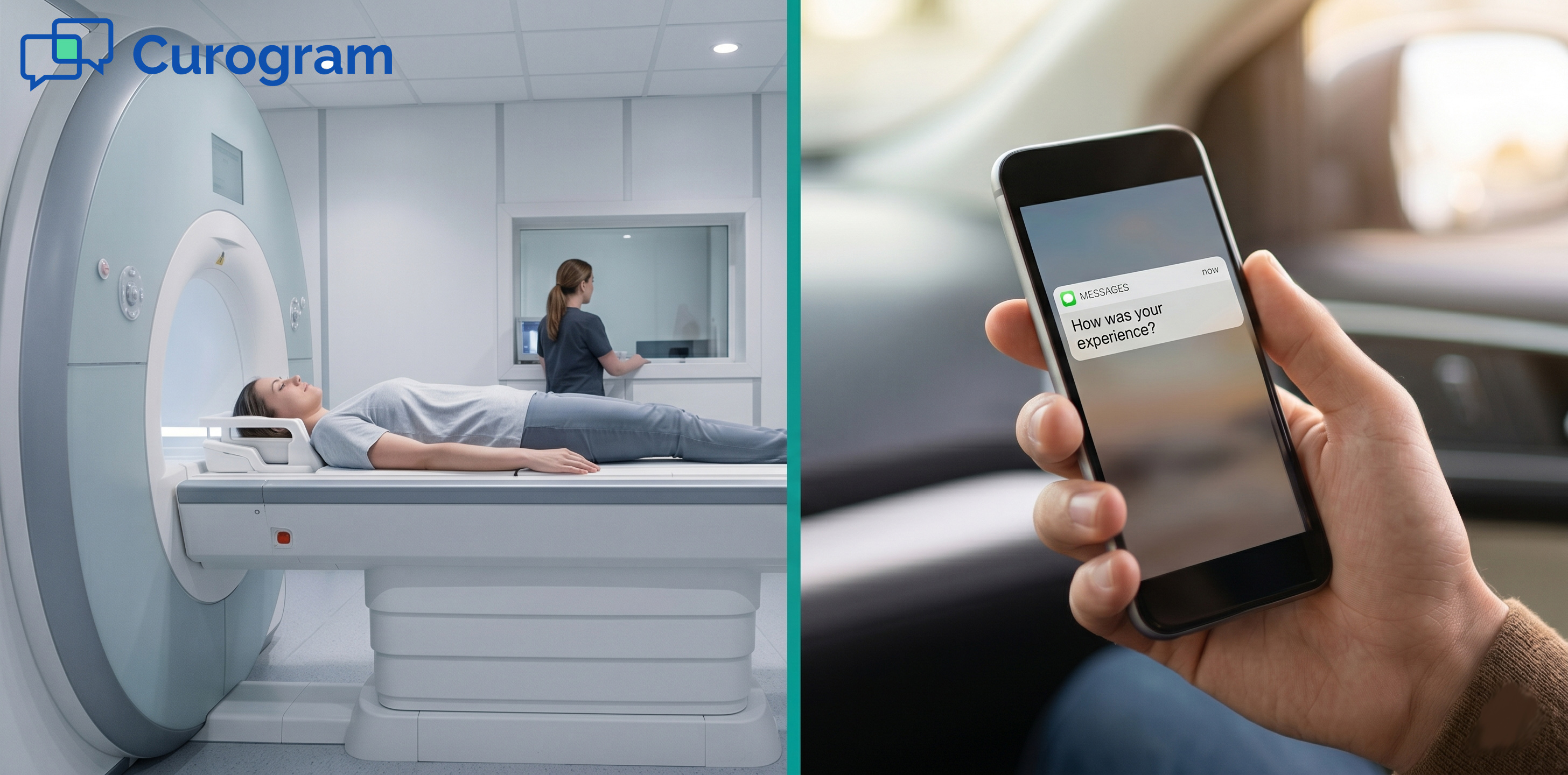
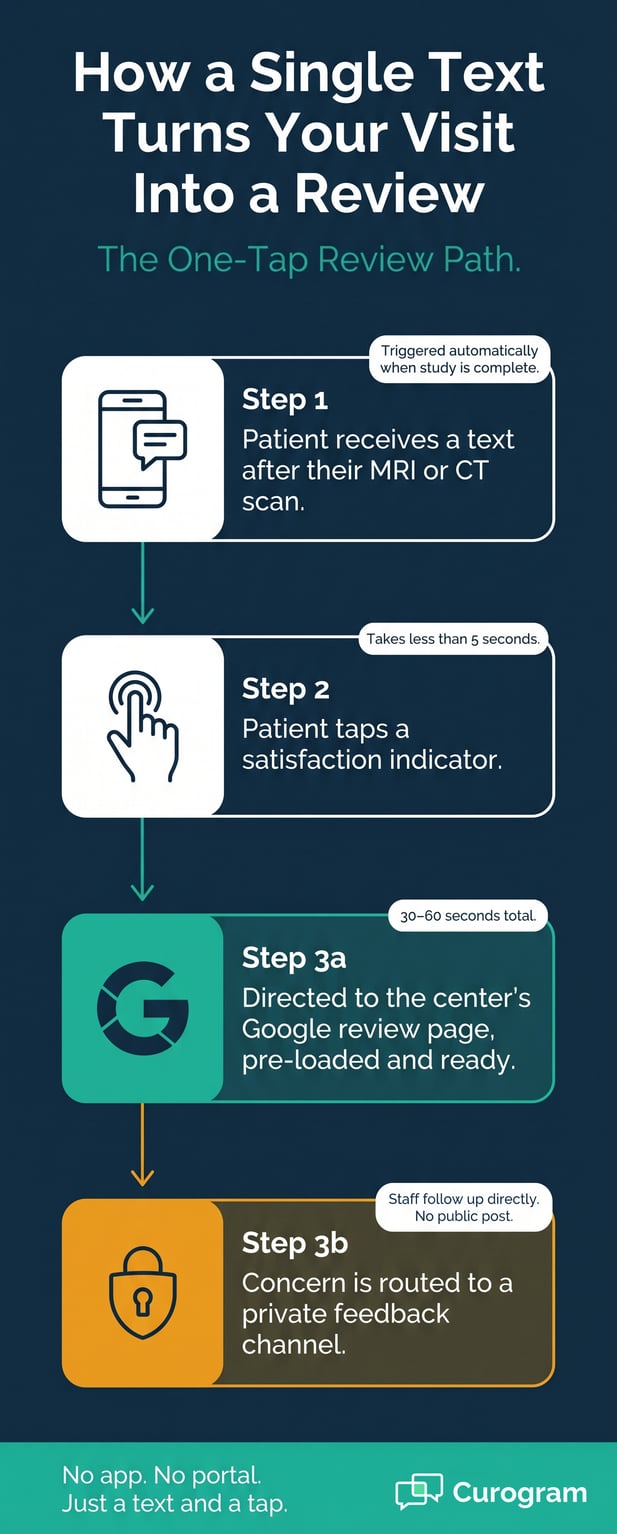
After a patient's study is complete, Curogram sends a short text to their phone. No fancy language, no long forms. Just a simple message asking how their visit went. The patient taps a response, and the system handles the rest.
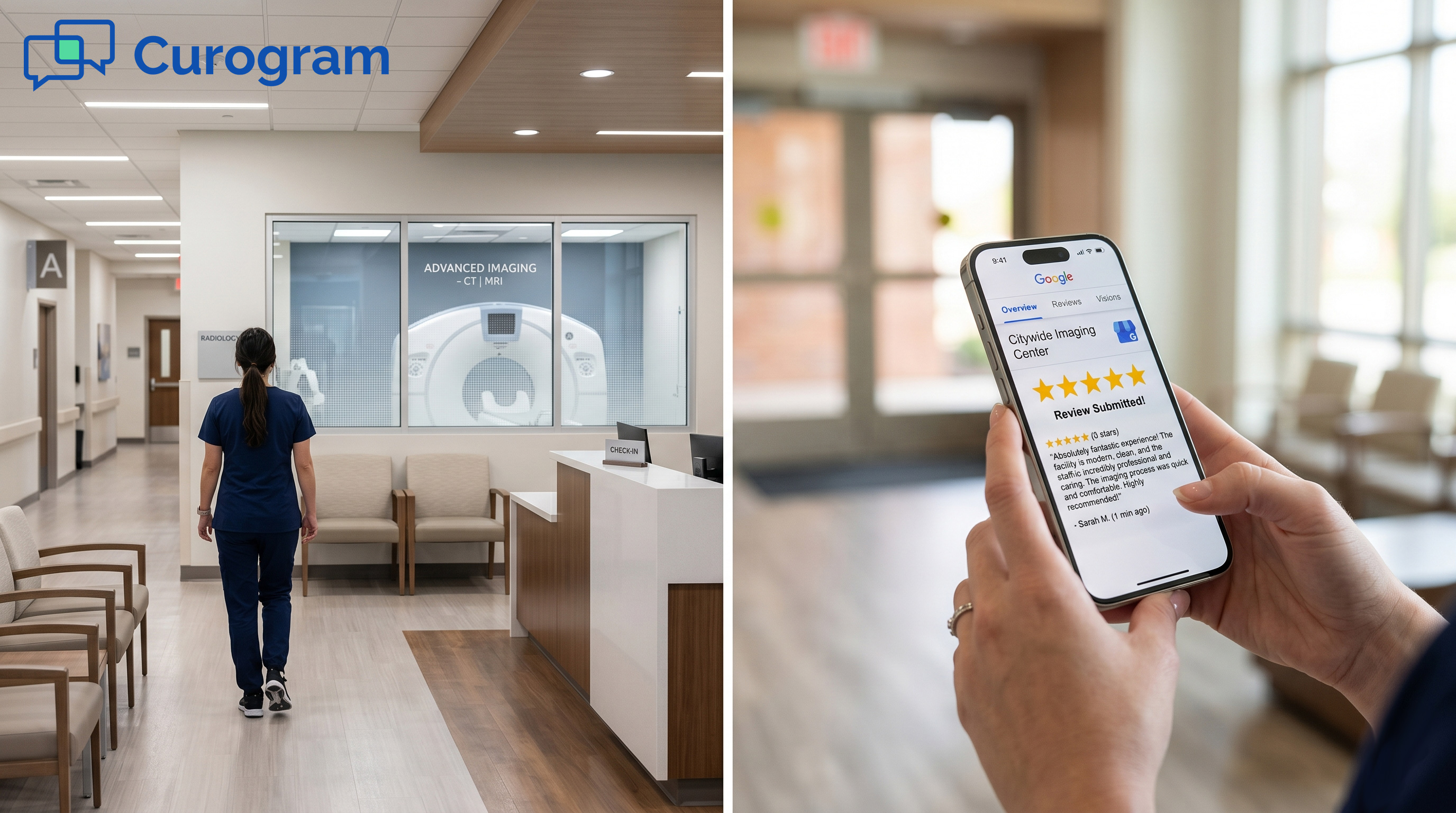
If the patient had a positive experience, they are taken directly to the imaging center's Google review page. It is pre-loaded and ready to go.
The whole process takes about 30 to 60 seconds. No app to download, no portal to log into, no account to create.
If the patient flags a concern, their feedback goes to a private channel instead of a public review. That gives the center a chance to follow up and resolve the issue before it turns into a one-star post online.
What Happens With Positive Feedback
The patient is guided to Google with one tap. The review page opens on their phone. They type a few sentences, hit post, and they are done. The whole thing feels as easy as sending a text to a friend.
What Happens With Negative Feedback
The patient's concern is routed to a private inbox for the center's staff. No public post goes up. The center can reach out directly, offer a resolution, and turn a potential complaint into a recovered relationship.
Timing That Makes Sense
When a patient receives a text after imaging study completion, timing matters. Too soon, and the patient is still driving home or stressed about results. Too late, and the memory has faded.
Curogram connects with Exa's API to detect when a study is marked complete, then triggers the review request at just the right moment.
The text goes out after the patient has left the facility, giving them space to reflect. But it arrives while the experience is still vivid.
This timing is automatic and consistent, which means every patient gets the same prompt, not just the ones whose staff remembered to ask.
Why Text Works Best for Radiology
Text-based review requests work well in the radiology context for a few reasons. Most patients have their phone with them. Text messages have open rates near 98%, far above email. And radiology patients, having just completed something emotionally significant, are primed to share.
An MRI or CT scan is not a routine errand. Patients remember it. They remember how the technologist treated them.
They remember whether the wait was short or long. Giving them a fast way to capture that memory, through a channel they already use every day, increases the chance that they will act on it.
Curogram's radiology patient satisfaction text approach removes every barrier. No portal login. No paper forms. No follow-up calls. Just a text and a tap.
The Success: Your Experience, Amplified
A post-study text does more than collect reviews. It builds a truer picture of your imaging center over time. One patient voice at a time, your Google profile starts to reflect the actual quality of care you deliver every day.
What Changes After the First 90 Days
The shift happens faster than most centers expect. Based on our internal research, practices using Curogram's automated review outreach generated 1,064 new five-star reviews in just three months. Total review counts grew from under 1,000 to over 8,000.
That kind of growth changes how your center looks in search results. More reviews signal trust. A higher rating signals quality.
Patients searching for an MRI or CT near them see a center that real people have talked about, and they are more likely to book.
From 30 Reviews to 500
For many imaging centers, the starting point is discouraging. A handful of reviews, a mixed rating, and no clear path to improving it. The team delivers good care every day, but the Google profile tells a different story.
After consistent use of a text-based review request, that story changes. Patients who were happy but silent now have a voice. Their Google review after MRI or CT scan joins dozens, then hundreds of others. The profile becomes a genuine reflection of patient experience feedback, not just an outlier collection.
The Compounding Effect Of Volume
More reviews mean more credibility. A center with 500 reviews at 4.7 stars is seen as established and trustworthy. A center with 30 reviews at the same rating looks unproven. Volume matters as much as the rating itself.
How New Patients Use Reviews
New patients read reviews the way they read word-of-mouth recommendations. They look for patterns. If dozens of people mention a kind technologist or a fast check-in, that detail sticks. A rich review profile gives them the confidence to book.
Reputation as a Referral Signal
Referring physicians also pay attention to patient experience. A primary care doctor recommending an imaging center to a patient will often check how that center is perceived online.
A strong Google profile with consistent positive reviews reinforces the referral and builds trust with the physician's patient.
This creates a second layer of benefit. Better reviews do not just attract direct patient bookings. They also strengthen the relationships with the physicians and clinics that send patients your way.
|
Outcome |
Before Text Outreach |
After Text Outreach |
|
Total Google reviews |
Under 1,000 |
Over 8,000 |
|
New 5-star reviews in 90 days |
Minimal |
1,064+ |
|
Patient visibility in search |
Low |
High |
|
Referring physician trust |
Unclear |
Stronger |
Conclusion: Your Experience Deserves to Be Heard
Every scan is more than a clinical event. It is a patient experience. And that experience has value, not just for the patient, but for every future patient trying to decide where to go. Capturing it should be easy.
Exa PACS/RIS handles the clinical side of your imaging operation: study management, diagnostic tools, and referring physician communication. It is built for the workflow inside your center.
Curogram handles the patient's side. The text that goes out after the study. The review request gives every patient a chance to share.
The private feedback channel that catches concerns before they go public. Together, they cover both sides of the imaging experience.
The reputation gap is not caused by poor care. It is caused by missing infrastructure. When no system exists to ask for feedback, only the loudest voices fill the silence. A simple, automated text after each study closes that gap.
Your imaging quality deserves a Google profile that shows it. Your patients, the ones who leave grateful and relieved every day, deserve a way to say so.
Curogram gives them that path. It takes one tap and 30 seconds. That is all it takes to turn a silent majority into a visible, authentic reputation.
See how Curogram fills the Exa engagement gap. Schedule a free demo today.
Frequently Asked Questions
Curogram connects directly with Exa's API platform to detect when a patient's study is marked as complete. Once that signal is received, the review request text goes out automatically. There is no manual step required from your staff. The timing is built to reach the patient after they have left the facility, while the experience is still fresh.
Radiology visits tend to be one-time events with no built-in follow-up. Unlike primary care, where patients return regularly and build ongoing relationships, radiology patients often complete one study and never return to that center again.
Without a prompt, there is no natural moment that leads to a review. A text-based review request creates that moment artificially, right after the visit.
If a patient indicates a negative experience, their feedback is routed to a private channel rather than a public Google review page. This gives the imaging center's staff a chance to follow up directly, address the concern, and resolve it. The goal is to turn a potential complaint into a handled situation before it affects your public reputation.
Text messages have open rates near 98%, which is far higher than email. Most patients also have their phones with them immediately after leaving the imaging center. A text arrives in a familiar, low-friction space. Email can wait, get buried, or go to spam. A text gets seen right away, when the experience is still recent and the patient is most likely to act on it.
Based on our internal research, most centers using automated post-study review outreach see a meaningful increase in review volume within the first two weeks. Over three months, some practices have generated over 1,000 new five-star reviews. The exact pace depends on patient volume, but the results tend to compound quickly as more reviews build on each other.