
1 min read
Reputation Management in DrChrono with Curogram
💡 Reputation management in DrChrono helps small clinics grow their practice. They can attract new patients effortlessly through the following...
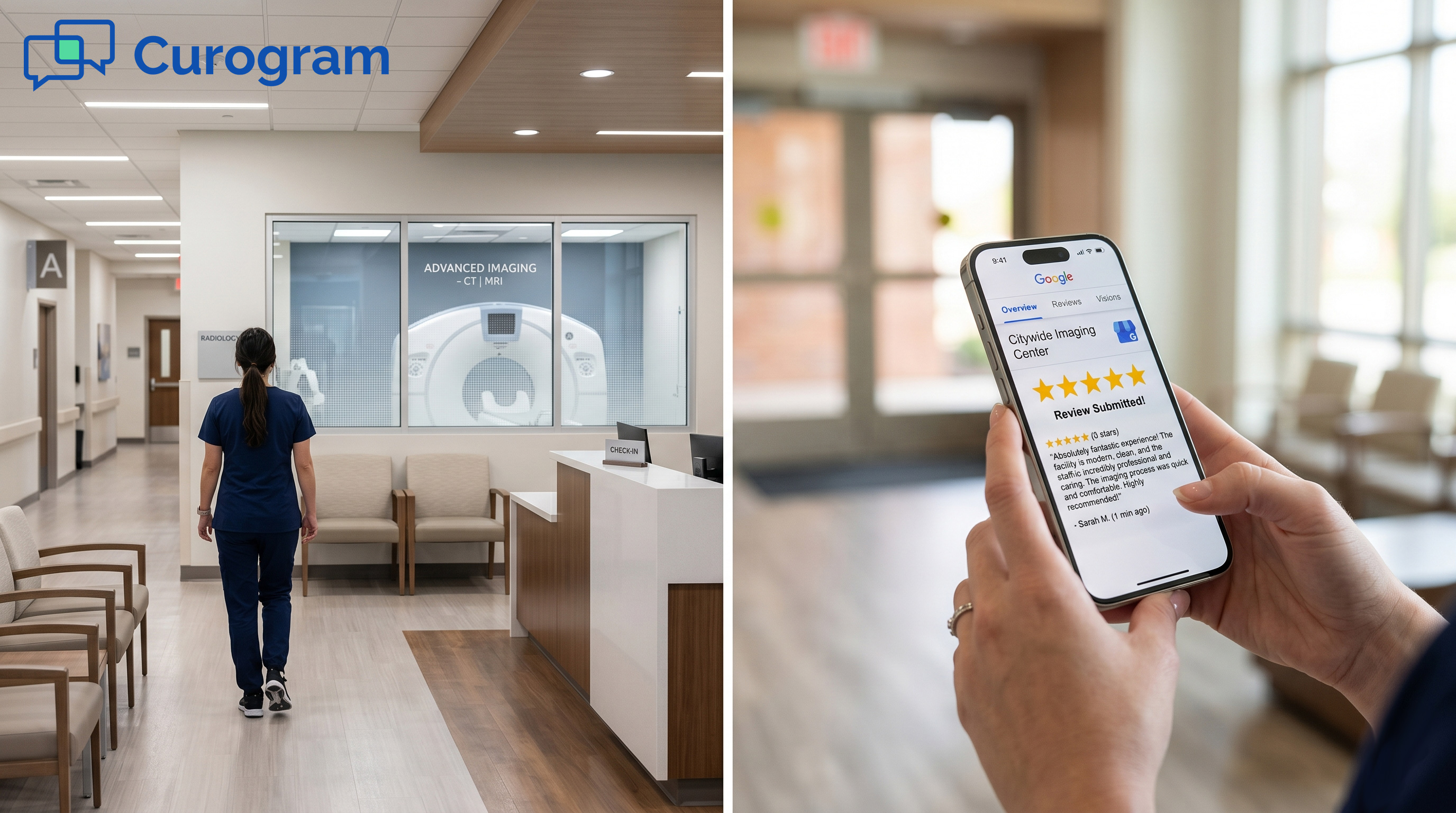
Your imaging center may run circles around the local hospital. You provide faster scheduling, cleaner workflows, and better patient service. But why doesn’t it translate to referrals?
They keep on landing at the hospital outpatient site down the road. The reason is rarely clinical. It almost always lives on the Google profile. Patients search the web before they ever show up at your door.
Referring physicians do the same. They want to send each case to a trusted partner. When your profile shows four reviews, and the hospital shows 400, the pick feels obvious. That is the reputation gap.
The gap is quiet, slow, and very expensive. A small center can lose 60 to 120 referrals each year from this single weakness. At $1,200 per study on average, the loss runs into six figures. None of it ties back to care quality.
The gap exists for a clear reason. About 95% of imaging patients are happy with their visit. But only 2 to 3% post a Google review on their own. Friction kills the rest of the goodwill.
In imaging, Google reviews for imaging centers reputation management is no vanity metric. It is a referral engine.
A fresh profile builds trust at the moment a patient or doctor picks a site. Hospitals know this, which is why their listings are stacked.
This guide walks through the fix. You will see how reputation management for radiology practices can run on its own.
You will learn how a reputation management imaging center integration with StreamlineMD turns happy patients into reviewers in seconds. You will also see real results from clinics that did it.
The goal is simple. Close the gap, match the hospital on Google, and win back the referrals you have already earned. Once your profile reflects your work, the rest of the funnel falls into place.
Most imaging centers do not lose referrals because of poor care. They lose them because their Google profile looks empty.
The hospital across town has hundreds of reviews, while you may have four. That single fact shapes where new patients and referring doctors end up.
A lot of patients check Google before they choose an imaging center. The path is short and quick. A primary care doctor sends an order for a CT or MRI. The patient pulls out a phone and types “CT scan near me.”
What they see next decides the visit. They scan star ratings. They read a few recent reviews. They tap the highest-rated place that looks active.
Hospital imaging departments win this match almost every time. Their parent health systems gather hundreds of reviews from many service lines. Independent centers, even strong ones, look like an unknown bet next to that wall of social proof.
Referring physicians notice the result. Their orders often come back from hospital imaging instead of the local center they meant to support. Patients self-select based on what Google shows them. The order slip rarely overrides what the phone shows.
|
Factor |
Hospital Imaging |
Your Independent Center |
|---|---|---|
|
Google reviews |
200+ |
4 to 10 |
|
Star rating |
4.6 to 4.9 |
3.0 to 3.5 |
|
Service lines feeding profile |
Many |
One |
|
Marketing reach |
System-wide |
Local |
The reputation gap eats revenue without making any noise. There is no monthly bill for it. There is no bad-review wave to point to. It just shows up as a slow drip of lost cases.
A small center can lose 5 to 10 referrals each month to this gap. That is 60 to 120 cases a year that should have been yours. At $1,200 per study, the math gets ugly fast. You are looking at $72,000 to $144,000 a year that walks into a hospital bay.
This is not a clinical problem. The center is doing nothing wrong with patients. The work is solid, the team is sharp, and the equipment is modern. The only weak link is what shows up on a phone screen.
The gap also makes everything else harder. New referring providers stay loyal to the hospital, since their patients keep choosing it.
Marketing dollars work less well, since paid traffic still lands on a thin profile. Hiring takes a hit, too, since job seekers Google your name before they apply.
Each lost case also raises your fixed cost per study. Idle scanner time, idle staff hours, and unused slots push the cost line higher. Over a few years, the gap can shape your whole growth curve. The good news is that none of this is fixed. The gap is solvable with the right workflow.
The fix is not about asking more loudly. It is about asking at the right moment, in the right way, with no friction.
This is where reputation management for radiology practices stops being a side task and becomes a real workflow. Curogram fills that role inside the StreamlineMD reputation management workflow.
Curogram client data from clinical settings shows a gap most owners miss. Around 95% of imaging patients are happy with their visit. But only 2 to 3% leave a Google review on their own. The numbers do not match the experience.
The reason is a quirk of human nature. Happy patients feel no urge to act. Upset patients do, since they want to warn other people. Left alone, the default review pattern leans negative.
Even patients who plan to leave a kind review often drop the task. They have to open Google. They have to find the right business profile. They have to type on a phone, then submit.
By the time they get home, the moment is gone. Friction is the silent killer. It does not feel like a barrier. It just sits there until the patient gives up.
The trick is to catch the goodwill while it is fresh. Curogram does this by tying into the procedure event itself. The moment StreamlineMD marks a study as complete, the survey goes out by SMS. No staff click is required.
The first text is dead simple. “How was your visit today?” The patient picks one of three buttons: Satisfied, Neutral, or Unsatisfied. That is the entire ask.
If the patient picks Satisfied, the next text shows up in seconds. It carries a one-tap link straight to your Google review page.
The patient taps once, and the review is live. No typing, no hunting, no app-switching.
This single change is what drives the math. The conversion rate from survey to review climbs to 35 to 40%.
That is many times higher than the rate when patients are left to do it on their own. That is the math behind every 90-day case study you read.
A generic platform misses what makes imaging different. Curogram does not. The product was shaped around modality-aware workflows for CT, MRI, ultrasound, mammography, and interventional cases.
That focus matters in real life. A vein clinic patient is in a different headspace than a screening mammography patient.
A pain procedure patient may need a quieter follow-up than a routine ultrasound patient. Curogram gives reputation management for interventional radiology its own track, with timing and tone that fit the case.
The result is a clean reputation management imaging center integration. StreamlineMD owns the clinical and billing side.
Curogram owns the patient-facing side. Together, they form one straight line from order to five-star review.

Numbers tell the story better than theory. Below is what the workflow looks like in real time, plus the kind of results practices see in 90 days. The pattern is the same across single-site and multi-location centers.
Picture a busy Tuesday afternoon at an outpatient imaging center. The patient just finished a CT scan. Here is what happens next, second by second.
At 2:30 PM, the technologist marks the study complete in StreamlineMD. At 2:35 PM, Curogram catches the trigger and sends a quick SMS: “How was your visit today?” The patient sees three buttons: Satisfied, Neutral, Unsatisfied.
At 2:37 PM, the patient taps Satisfied. Curogram fires back a follow-up text: “Glad to hear it. Will you share your visit on Google?” with a one-tap link.
At 2:38 PM, the patient taps the link, leaves a five-star review, and walks out the door. Total time spent by staff: zero. Total time spent by the patient: eight seconds.
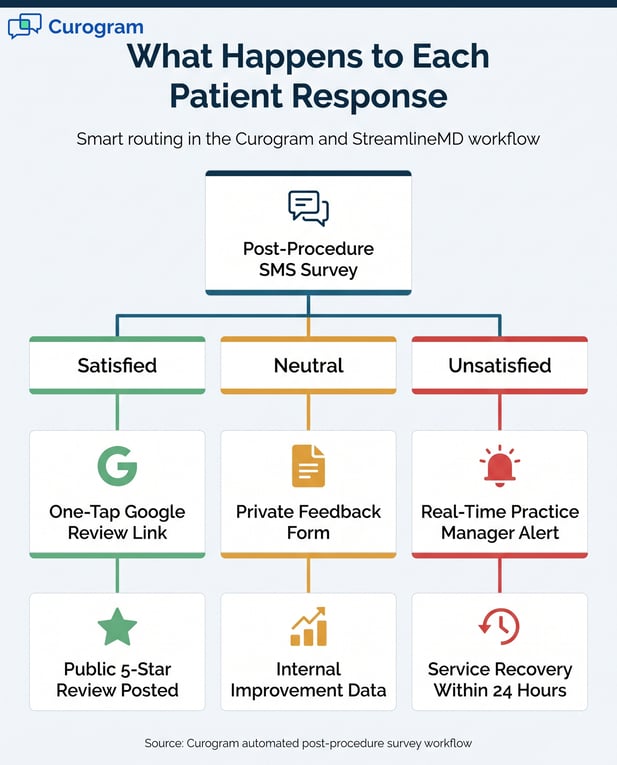
The same workflow handles unhappy patients with care. The routing rules sort feedback before any of it reaches a public profile. That is what protects your rating while you grow it.
Satisfied responses go straight to the Google review prompt. That is the public-facing path. It is the one that builds the wall of five-star reviews over time.
Neutral responses go to a private feedback form. The patient gets a chance to share what could have been better. The practice gets useful data, with no public review asked for.
Unsatisfied responses skip the public flow. They go straight to a practice manager alert in real time. Staff can call the patient that same day, hear the issue out, and start service recovery before any frustration reaches Google.
A screening mammography case is not the same as a vein ablation. The follow-up should not feel the same either. Curogram lets you set message timing, tone, and triggers by modality.
A pain procedure patient may get a softer check-in 24 hours later, asking about comfort. A routine MRI patient may get the survey right at checkout. The system fits the patient experience, instead of forcing every case into one template.
Curogram client data from clinical settings shows the impact in hard numbers. One multi-location practice grew its review base from 32 to over 1,000 in 90 days. They added 1,064 new five-star reviews in three months and ended with a 90% five-star rating.
That is not a small lift. It is enough to flip the Google profile from a weakness into a strength. Practices in this range often see 25 to 35% more direct-to-practice referrals within six months, since the wall of reviews now beats or matches the local hospital. That is the real return on closing the reputation gap.
The reputation gap is not a story about poor clinical work. It is a story about silence. Patients leave happy and never say a word online. Hospitals fill that silence with hundreds of reviews while independent centers stay quiet.
That silence has a price tag. It is paid in lost referrals, longer ramp times for new sites, and steady pressure from larger rivals. The pressure shows up on the bottom line, even when every clinical metric looks great.
A one-time review push will not move the needle for long. What works is a workflow that runs every day, on every patient, without staff lift. That is the bar Curogram was built to clear.
The setup pulls happy patients into the review funnel when their feeling is strongest. It also pulls upset patients into a private channel, where the practice can act before the issue goes public. Both halves matter. One builds your rating, the other guards it.
StreamlineMD already runs the clinical and billing side of your business. It tracks the procedure, the report, and the claim. What it does not handle is the patient-facing side after checkout. That is the gap Curogram closes.
When the two work side by side, the result is a single thread from order to review. Each happy outcome turns into public proof of your work.
Each issue turns into a chance to recover the patient before damage is done. The pair gives you the cleanest way to automate reputation management for the imaging center, end to end.
The fit is not generic. The radiology and interventional focus shows up in the timing rules, the modality tagging, and the message tone. That is why teams pick Curogram over horizontal vendors that treat imaging like any other clinic.
Imagine logging into Google Business Profile in three months. The review count has grown from a handful to several hundred. The star rating sits above 4.8. New patient calls have ticked up.
Referring physicians stop asking why their orders end up at the hospital. The case study numbers back this up.
A multi-location practice added more than 1,000 new five-star reviews in 90 days. That is what the workflow does when given room to run.
The simplest way to see this in action is a short demo. Our team can walk through the survey-to-review flow on screen, project your 90-day review forecast, and show the integration with StreamlineMD live. There is no setup work on your end to see it.
If you want to see where you stand right now, ask for a Reputation Gap Analysis.
We will pull your current Google profile against the top hospital imaging departments in your area, side by side. Schedule your demo today and start closing the gap.

1 min read
💡 Reputation management in DrChrono helps small clinics grow their practice. They can attract new patients effortlessly through the following...

1 min read
 Jo Galvez : May 11, 2026, 2:00:00 PM
💡 How do imaging center staff ask patients for reviews without sounding pushy? Stop asking by hand. Send an automated SMS survey 30 minutes after...

1 min read
Jo Galvez : May 11, 2026, 4:00:00 PM
💡 Patient reviews healthcare consumers read on Google now drive most imaging center choices. Around 90% of new patients check ratings before...