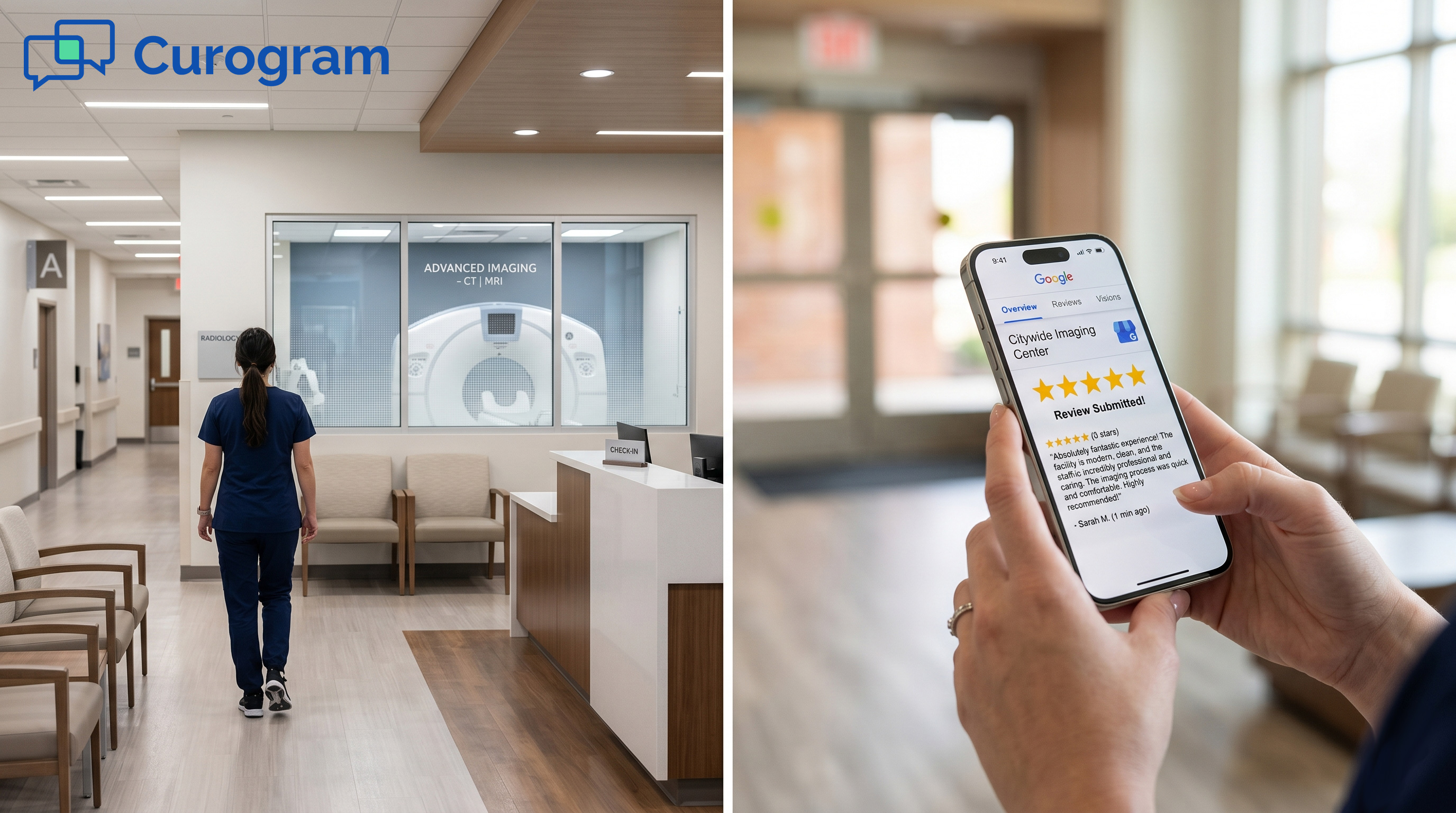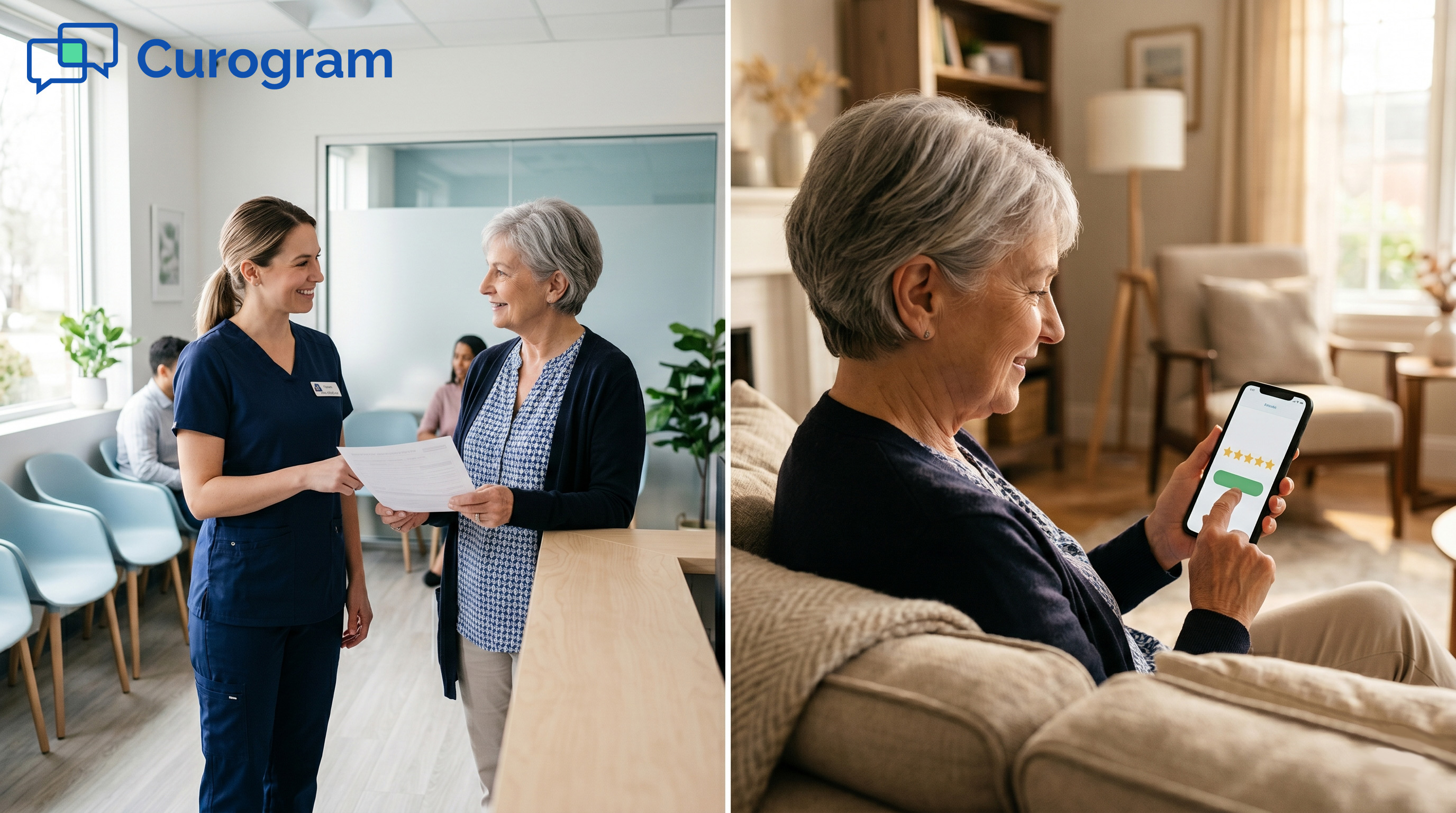

That gap is a trust gap. It costs referrals and revenue. The fix is not nagging patients. It is removing friction from the ask.
Curogram pairs with StreamlineMD to send a single SMS survey after a visit. Happy patients get a one-tap link to Google. Unhappy ones share private feedback first. The result is honest input and a stronger profile, fast.
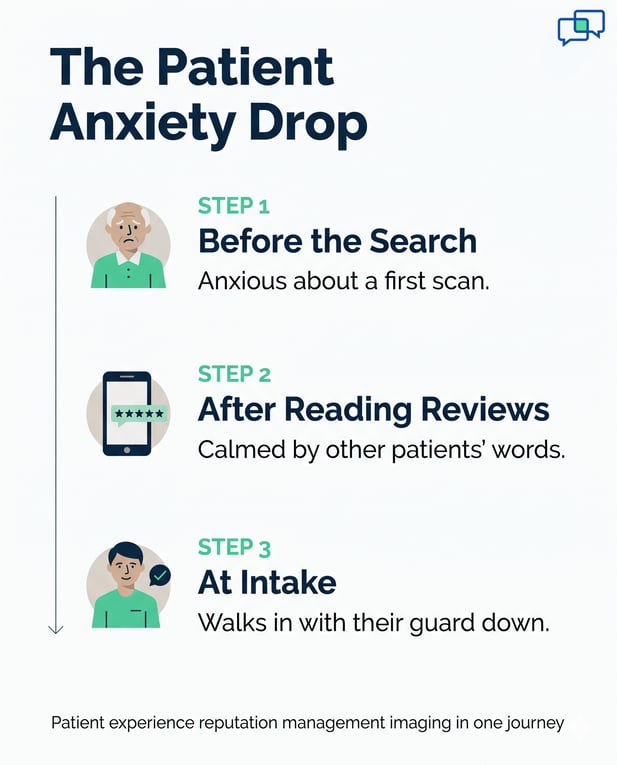
A 68-year-old woman has to get her first MRI. She is nervous. She Googles the imaging center her doctor mentioned. She skims the star rating, then reads three short reviews.
One says the staff stayed calm and kind. Another says the tech walked her through every step.
By the time she clicks the call button, her shoulders have dropped an inch. That is what patient reviews healthcare buyers really do for each other.
Behind the scenes, it is a different story. Most imaging centers do not have a system to ask for reviews. The front desk is busy. Staff feel awkward making the request. So the ask never happens.
Meanwhile, the hospital across town has a marketing team and a steady review pipeline. Their profile grows. Yours stays flat. The gap widens, even when your care is just as good or better.
This piece walks through three things. First, why the standard review request feels broken to patients. Second, how a quiet SMS workflow fixes it without an app or a hard sell. Third, what changes once those reviews start landing.
You will see why feedback is not a vanity metric. It is the bridge between a good visit and the next patient who needs you.
The Villain: Review Request Skepticism
Most patients want to help a place that treated them well. They just need a clear, easy path.
Review Request Skepticism is what happens when the path feels weird, pushy, or unsafe. Below are the three forms it usually takes.
The Awkward In-Person Ask
A staff member hands you a card at checkout. They say, “If you have a minute, please review us.” You smile, take the card, and toss it in the car.
It is not that you didn’t care. It is that the moment was wrong. You were thinking about parking, your follow-up, your next stop. The ask got buried under real life.
Why Timing Kills The Ask
Right after a scan, your mind is not on Google. You are decompressing. A request made in that window almost always loses.
A short text the next day works better. The patient is home, calm, and able to tap a link without feeling watched.
Why Staff Hesitate To Ask
Front desk teams worry about coming across as needy. They are not trained marketers. So the ask gets soft, vague, or skipped.
Automation removes that pressure. The system sends one polite message and tracks the result. No one has to perform..
The Privacy Worry
Some patients fear that leaving a review will expose their health details. They picture their diagnosis showing up on a public page. So they say nothing.
That fear is reasonable, and it is wrong. A Google review is just text and stars. Patients control every word. Nothing about their chart leaves the clinic.
What Patients Actually Share
Most reviews are about feel, not facts. “Friendly staff.” “Quick check-in.” “The tech explained the machine.”
None of that touches protected health information. Patient experience reputation management imaging programs lean into this. They show patients the kind of words other patients use.
How HIPAA Shapes The Workflow
The clinic side stays HIPAA compliant. The text only confirms a recent visit and offers a feedback link. No diagnosis, no procedure code, no chart detail.
That is the heart of SMS reputation management patient satisfaction work. Light on the patient. Safe on the clinic.
The Tech Hurdle
Older patients often skip review requests because the path feels technical. Download an app. Make an account. Remember a password. None of that is happening.
Reputation management for elderly patients only works when the steps disappear. A text. A tap. A star rating. Done.
No App, No Login, No Friction
Reputation management without app download is the standard now. Patients do not want one more icon on their phone. They want one tap that takes them straight to the review screen.
Reputation management accessibility imaging programs share this rule. If a patient cannot finish in under a minute, the system has failed.
Meeting Patients Where They Are
SMS hits 98% open rates across age groups. Email does not come close. A simple link wins because it respects the patient’s time and tools.
Once the path is that clean, the only thing left is the ask itself. That is where the next section begins.

The Guide: The Automated Reputation Builder
The fix is not louder asks. It is a quieter system that runs in the background. Curogram’s post-visit workflow handles the timing, the channel, and the routing. Staff stay focused on care. Patients get a path that respects them.
How the SMS Survey Workflow Runs
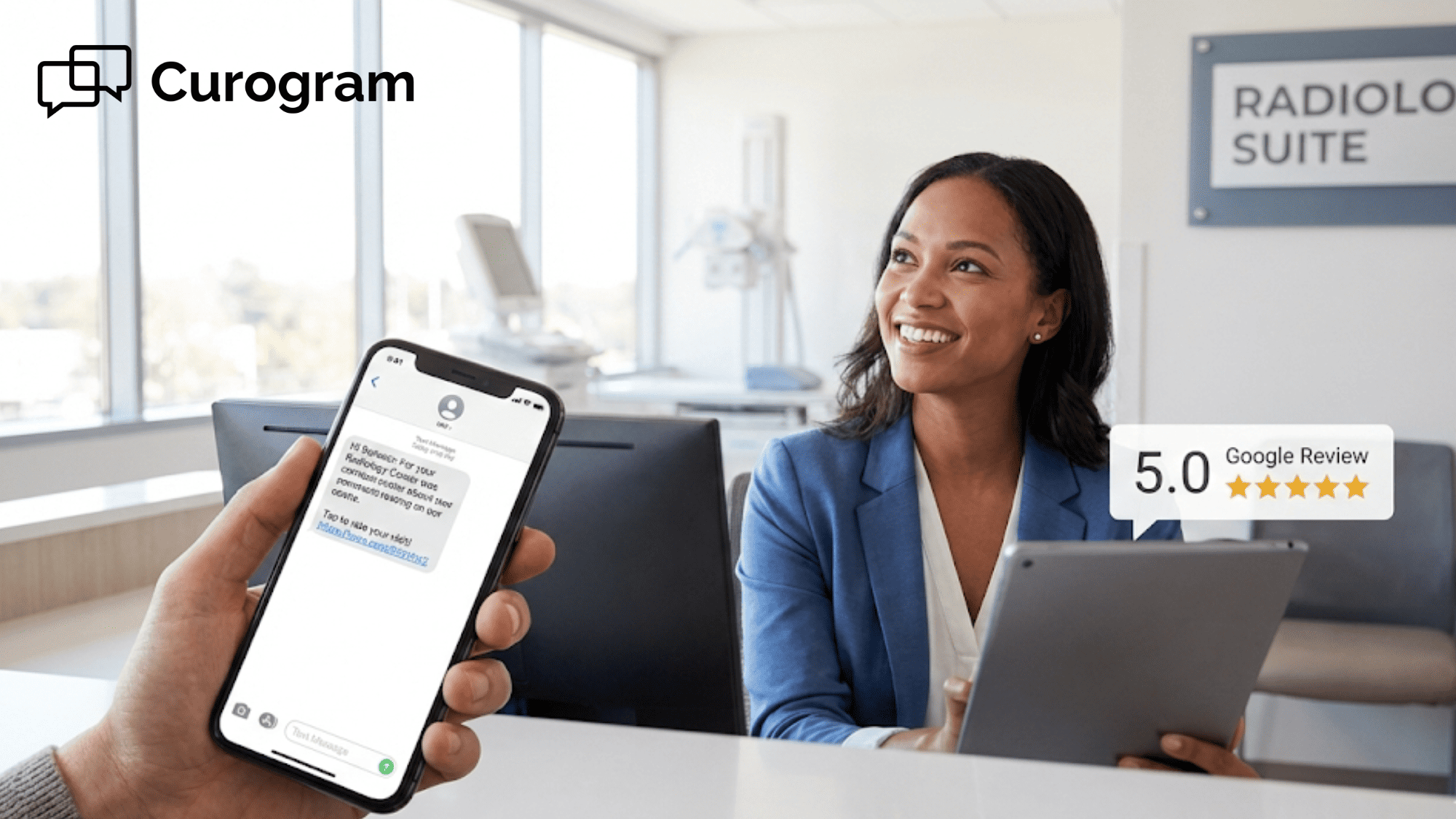
After a scan, StreamlineMD marks the visit complete. Curogram picks up that signal and sends a short text within a set window. The message is simple. One question. One tap.
If the patient rates the visit positively, the next screen offers a Google review link. If the rating is low, the patient is routed to a private feedback form. Issues stay in-house, where the team can act.
The Single-Question Start
The first text asks one thing. “How was your visit today on a scale of one to five?” That is it.
No long form. No login. The low effort is the point. Patient engagement reputation management lives or dies on that first tap.
The Smart Routing Step
Four and five star responses see a Google review prompt. One through three star responses see a quick comment box. The clinic gets a private alert.
That split is the heart of SMS reputation management patient satisfaction work. Public praise grows. Private problems get fixed before they become public.
Why It Fits Imaging and Older Patients
Radiology and interventional centers have unique flow needs. Curogram is built around them, not retrofitted. That matters when your average patient is 60-plus and your average exam runs short on chitchat.
Built For Radiology Workflow
Modality, prep, and post-scan timing all shape the right send window. A CT patient is ready for a survey at a different moment than a vein procedure patient.
The platform respects those gaps. That is what reputation management accessibility imaging means in practice.
Designed For Older Patients
Reputation management for elderly patients works best when the message looks like a normal text from a friend. Plain language. No links inside links. No app store detour.
Curogram keeps the path that simple. Older patients respond at rates that surprise most practice managers.
The Quiet Magic of Honest Reviews
This system does not buy reviews or hide bad ones. It just asks at the right moment, in the right way, and routes the answer to the right place. Patients who had a great visit say so. Patients who didn’t are heard before they post.
Public Wins, Private Fixes
A practice running this loop sees two things grow at once. Star count climbs on Google. Internal complaints surface earlier, when they are still cheap to solve.
That is patient experience reputation management imaging work that actually moves both numbers. Not just the public one.
Trust Compounds Over Time
Each new review makes the next click easier. After 90 days, the profile starts to feel busy and current. New patients notice.
Curogram client data from clinical settings shows one multi-location practice gathered 1,064 new five-star reviews in three months. That kind of volume changes the search result entirely.
The Success: Reputation Management Transformation
Once the system is running, the changes show up in places leaders did not expect. Search rank moves. Anxious patients show up calmer.
Staff feel proud instead of awkward. Below is what that looks like in numbers and in the room.
What the Results Look Like in Numbers
The case data tells a clear story. Quiet automation produces loud growth. Below is a snapshot from a multi-location practice using the same survey-to-review flow described above.
|
Metric |
Before Curogram |
After 3 Months |
|---|---|---|
|
New 5-star reviews |
Few per quarter |
1,064 added |
|
Share of 5-star ratings |
Mixed, often under 70% |
90% of patients |
|
Patient effort to leave review |
Card, app, or login |
One SMS, one tap |
|
Staff time spent asking |
Manual at checkout |
Near zero |
Source: Curogram client data from clinical settings.
How the Patient Experience Shifts
Numbers are the easy part. The bigger change is in how patients walk in. They have already read what others said. Their guard is lower from the start.
Less Anxiety At Intake
A first-time MRI patient who read calm, kind reviews arrives less tense. The tech does not have to do as much soothing. The whole visit moves smoother.
That is patient experience reputation management imaging at the human level. The reviews do warm-up work the staff used to do alone.
More Word-Of-Mouth That Travels
Reviews show up in family chats and friend group threads. A daughter searching for her father’s vein clinic sees the rating and stops worrying. She books.
Patient engagement reputation management is not just about Google rank. It is about the conversations that happen off the screen, sparked by what is on it.
How Staff and Owners Feel the Change
The internal mood shifts too. The front desk stops dreading the review ask. Owners stop staring at a flat profile. Marketing stops guessing what to do next.
Pressure Off The Front Desk
Staff no longer feel like they are begging. The system does the asking. Their job is just care, which is what they signed up for.
Morale climbs in small ways. People are kinder when they are not under quota.
Clarity For Owners And Managers
Owners get a dashboard, not a guess. They see weekly review counts, average ratings, and which sites get hit. Decisions stop being vibes-based.
Curogram client data from clinical settings shows that practices reach competitive parity with hospitals in about 90 days. That is fast enough to shift a referral pattern in a single quarter.
Conclusion: Transform Your Reputation Management Workflow
Review request skepticism is not a personality flaw in your patients. It is a system flaw in how the ask is delivered. Fix the system and the reviews come in honestly and at scale.
Every part of the flow gets lighter. Patients tap once. Staff stop asking out loud. Owners watch the profile fill in week after week.
The reviews are not a brag wall. They are a service. They help the next anxious patient pick a place to trust.
Honest negative reviews still come in, and that is fine. They surface real issues early. Reputable centers want them.
The system does not silence anyone. It just routes feedback where it can do the most good.
The best version of this loop is invisible to patients. One text. One tap. Done. That is how reputation management without app download should always feel.
Reputation management accessibility imaging principles guide every choice. If a 75-year-old cannot finish it in under a minute, it gets simpler.
Hospitals will keep their marketing teams. You probably will not match that headcount. You do not need to.
A steady review engine pulls weight that a marketing department used to. It works while staff sleep. It compounds over months.
Most independent centers are clinically equal to hospital outpatient imaging. Search results do not show that yet. Reviews are the fastest way to make the proof visible.
Patient experience reputation management imaging programs close that visibility gap month by month.
If your StreamlineMD setup is already running, the survey-to-review layer plugs in cleanly. There is no rip and replace. Just a quieter, faster way to ask.
Schedule a demo to see how reputation management automation works alongside your StreamlineMD workflows.
Frequently Asked Questions
Around 90% of patients check Google before picking an imaging center. A strong profile signals that other people felt safe and respected there. Without reviews, even a great clinic looks untested in search. Asking is how good care becomes visible.
The text confirms only that the patient had a recent visit and offers a feedback link. It never includes a diagnosis, procedure code, or chart detail. The patient writes whatever they want. That keeps SMS reputation management patient satisfaction work safe on both sides.
Reputation management for elderly patients depends on simple steps. One text. One tap. No app, no login, no password. Curogram keeps the path that short on purpose. Reputation management accessibility imaging is the design rule, not an afterthought.
Patients with a bad visit deserve to be heard quickly, not stuck on a public form. Private routing lets the team fix the issue and follow up. It does not block negative reviews. It just gives people a faster way to be heard first.
Most practices see a clear shift in 60 to 90 days. Curogram client data from clinical settings shows one multi-location practice added 1,064 five-star reviews in three months. That kind of growth is enough to change how a center ranks against hospital competitors.