9 min read

Patient Recall for Follow-Up Imaging: Automated SMS for StreamlineMD

Patient Recall for Follow-Up Imaging: Automated SMS for StreamlineMD
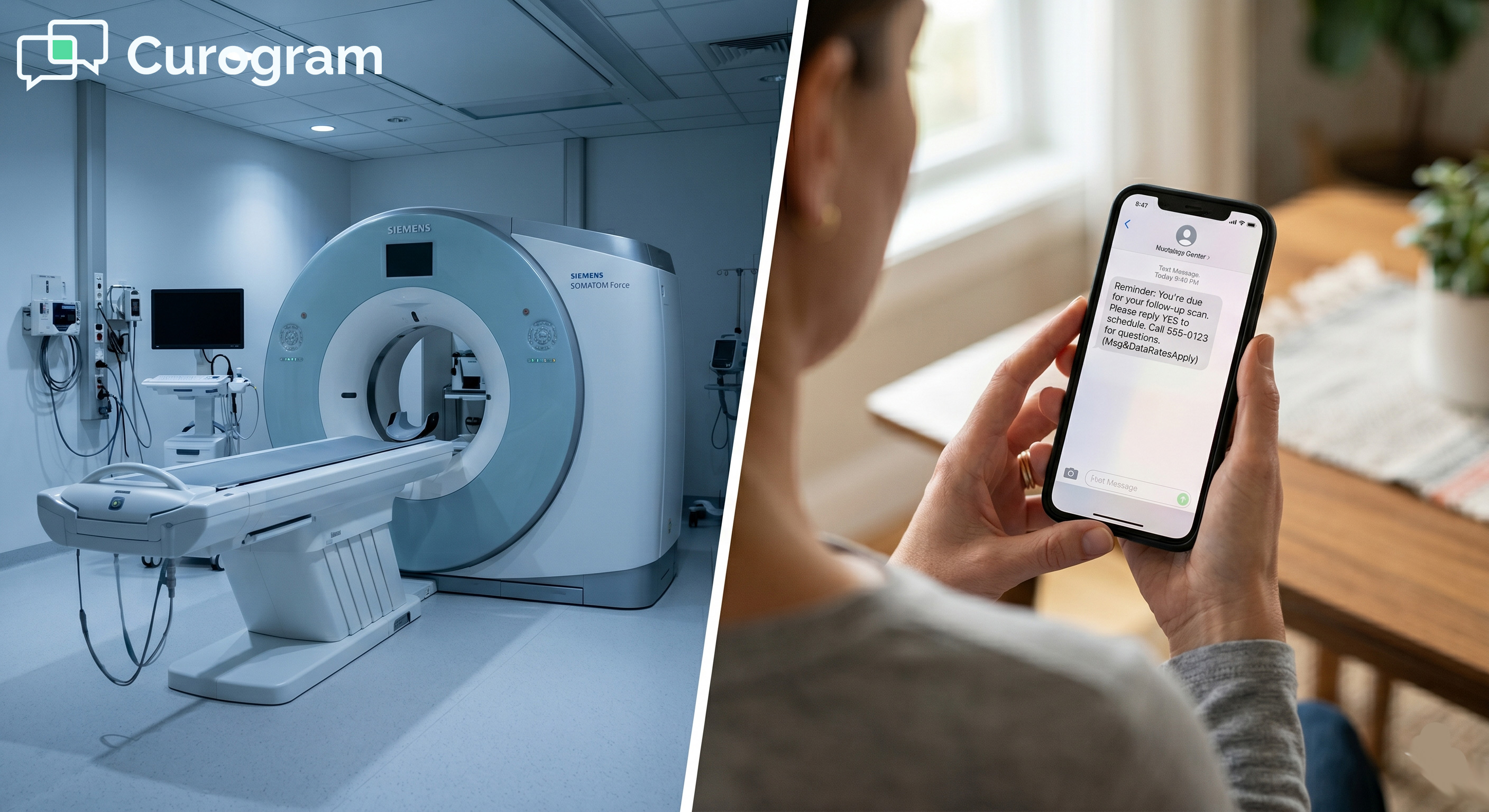
💡 Patient recall SMS for follow-up imaging radiology is the practice of sending automated text messages to patients overdue for repeat scans. This includes surveillance ultrasounds, annual screening, repeat CT monitoring, and post-procedure follow-ups.

Imaging centers often sit on databases of 5,000 to 50,000 lapsed patients. Manual recall through letters or phone calls recovers only 5 to 10%.

Based on Curogram client data from clinical settings, SMS recall achieves a 35% reconversion rate, with one multi-location practice bringing back 1,240 patients from a single campaign.

For radiology groups, this means recovered revenue, fuller imaging suites, and less manual work for staff. SMS recall pairs cleanly with StreamlineMD billing workflows and stays HIPAA-compliant from setup to send.

Your imaging center has a quiet revenue problem. Thousands of past patients are overdue for follow-up scans right now. They are not lost. They are simply waiting for a reminder.

Most radiology groups still rely on paper letters and phone tag to bring these patients back. The results are predictable. Letters yield about a 5% response rate. Phone calls eat staff hours and often end in voicemail.

Meanwhile, imaging suites run below capacity while patients drift to competitors. This is the recall black hole.

It is the gap between what StreamlineMD does well, like billing and procedural records, and the patient outreach work that no EMR was built to handle. The result is slow recovery, missed revenue, and burnt-out coordinators.

There is a better way. Patient recall SMS for follow-up imaging radiology turns that dormant database into your highest-ROI revenue stream.

One text message, sent to the right patient at the right time, asks them to reply YES and book.

Based on Curogram's internal data, this approach achieves a 35% reconversion rate. That is seven times the response rate of paper. The math is striking.

A practice with 10,000 lapsed patients can recover roughly 3,500 of them. At an average reimbursement of $1,200 per study, that is $4.2 million in recovered imaging revenue.

Curogram client data also shows one multi-location group recovered 1,240 patients from a single campaign, generating about $1.4 million.

This guide walks through how mass messaging for radiology practices works inside StreamlineMD. You will learn how to spot the hidden cost of the recall black hole.

You will see how Curogram's recall engine fits into your daily workflow. And you will see what success looks like, measured in patients, hours, and dollars. 

The Villain: The Recall Black Hole

Every imaging center has a database full of patients who should be back on the schedule. Surveillance ultrasounds. Annual screenings. Repeat CT scans. Post-procedure check-ins.

Yet most of these patients never return on time, and most practices never know why. This is the recall black hole.

It is the silent gap between StreamlineMD's clinical strength and the patient outreach it was never designed to handle. Below, we break down how this gap forms and what it costs your practice each month.

The Manual Recall Trap

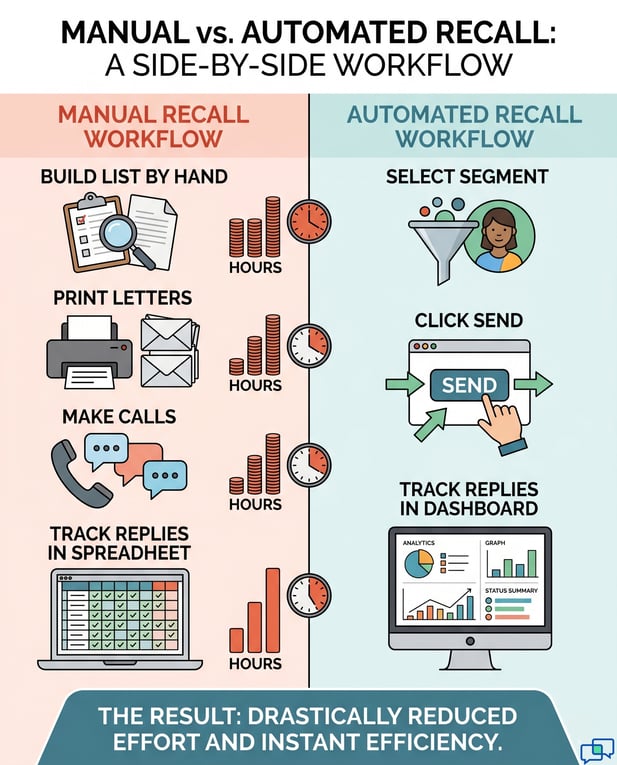
Practice managers spend hours each week building recall lists by hand. They filter by study type, pull contact info, and draft letters or call scripts. Then they wait.

Paper letters take weeks to print, mail, and deliver. They yield about a 5% response rate. Phone calls take 5 to 8 minutes each, and 40 to 60% land in voicemail. Staff cycle through callbacks, leaving little time for actual patient care.

The Hidden Cost of Phone Tag

Phone-based recall is one of the most expensive workflows in any radiology practice. Coordinators can spend 40 to 60 hours per month chasing patients who may never call back. That is time pulled away from in-clinic care and front desk support.

Why Letters Fall Flat

Paper letters cost roughly $800 per location per month in postage, printing, and labor. They arrive late, get tossed in the mail pile, and rarely prompt a reply. The 5% response rate is not a problem you can fix with better letterhead.

The Cost of Empty Imaging Slots

When recall fails, your imaging suite suffers. Utilization drops from a healthy 90% range to 70 or 80%. Each empty slot represents lost revenue from patients you already know.

The math compounds quickly. A 10,000-patient lapsed database, recovered at the manual rate of 5%, brings back 500 patients.

That same database, recovered at the SMS rate of 35%, brings back 3,500. At $1,200 average reimbursement, that gap equals $3.6 million in unrecovered revenue per location.

Recall Method

Response Rate

Patients Recovered (10K database)

Revenue Recovered

Paper letters

5%

500

$600,000

Phone calls

8%

800

$960,000

SMS recall

35%

3,500

$4.2M

Based on Curogram's internal data and average imaging reimbursement of $1,200 per study.

The Ripple Effect on Your Practice

The recall black hole does more than shrink revenue. It strains staff, drags down patient satisfaction, and weakens your position against larger hospital imaging departments.

Those competitors have bigger outreach teams and more budget to chase the same patients.

Staff Burnout Builds Slowly

Coordinators stuck on phone tag get tired. Turnover rises. New hires take months to ramp up, and the recall list keeps growing in the background.

Competitive Pressure Grows

Hospital imaging centers can absorb low recall rates because volume covers the gap. A small or mid-size radiology group cannot. Every lapsed patient who books elsewhere is one less booked with you.

The recall black hole is not a permanent feature of your practice. It is a workflow gap, and a workflow gap can be closed.

Comparison of time-consuming manual radiology recall vs efficient automated workflow

The Guide: The Patient Recall Engine

Closing the recall black hole does not require a new EMR. It requires a layer that sits next to StreamlineMD and handles what StreamlineMD was never built for: patient-facing outreach at scale. That is where Curogram fits in.

Below, we walk through how the recall engine works, how it pulls data from your existing systems, and why it lands so well with imaging patients. Each piece is built to feel routine, not technical.

How the Recall Engine Works

Curogram connects to your StreamlineMD patient database and lets you build recall segments in minutes. You pick the criteria, like procedure type, last imaging date, or referring provider. The system pulls a clean list of overdue patients, ready for outreach.

From there, deployment is one click. A typical message reads: "You are overdue for your annual vascular ultrasound. Reply YES to schedule."

The patient replies. Your front desk follows up. Bookings appear on your calendar within hours, not weeks.

Building Patient Segments

Segmentation is what makes recall work. A blanket message to 10,000 patients feels like spam. A targeted message to 500 patients due for surveillance ultrasounds feels relevant.

One-Click Deployment

Once a segment is set, sending is fast. The mass messaging imaging center integration runs in the background, with no manual exports or spreadsheet juggling. Staff can launch a campaign during a coffee break.

The StreamlineMD Mass Messaging Workflow

The StreamlineMD mass messaging workflow keeps recall close to your existing tools. Patient data stays inside StreamlineMD.

Curogram pulls only what is needed for outreach, then logs every send, response, and opt-out for compliance.

This matters for radiology groups that handle complex billing and procedural notes. Your clinical team keeps working in StreamlineMD.

Your outreach team works in Curogram. The two systems stay in sync without forcing staff to learn a new platform.

Workflow Step

StreamlineMD

Curogram

Patient records and billing

Primary system

Read-only access

Recall segment building

Source data

Active workspace

SMS send and response tracking

Not built for this

Primary system

Compliance audit trail

Clinical records

Communication logs


Specialty Fit for Imaging and Interventional Radiology

Curogram supports mass messaging for interventional radiology and general imaging alike. Each modality has its own recall rhythm, and the platform adapts to match.

Surveillance ultrasounds run annually. Post-procedure follow-ups run at 3 to 6 months. Repeat CT monitoring runs at 6 to 12 months.

Sample messages stay short and clear. "Your follow-up CT scan is due. Reply to confirm your appointment."

Or, "Time for your post-procedure imaging follow-up. Reply YES to schedule." Patients reply with one word, not a portal login.

HIPAA-Compliant Communication

The platform delivers HIPAA-compliant mass messaging imaging from day one. Curogram is SOC 2 Type II certified, with opt-in management and full audit trails built in.

Smart Frequency Controls

Curogram tracks who got what message and when. A patient contacted in one campaign gets excluded from overlapping ones, so no one feels pestered.

This is how you automate mass messaging imaging center outreach without losing the human touch.


The Success: Mass Messaging Transformation

The best way to understand the recall engine is to see what changes when a practice turns it on. Numbers tell part of the story. Workflow shifts tell the rest.

Below, we walk through a real-world example, the metrics that moved, and what staff experienced once manual recall was off their plate. The pattern repeats across radiology groups of every size.

The Starting Point

The practice in this example ran imaging across three locations. They served roughly 15,000 lapsed patients combined, spanning surveillance ultrasounds, repeat CT monitoring, and post-procedure follow-ups. Their recall workflow was entirely manual.

Coordinators logged 40 hours per month on phone calls. Paper letters cost about $800 per location per month and yielded a 5% response rate.

Imaging suite utilization had slipped from 85% to 78%, and the trend was pointing down. Empty slots were starting to feel routine.

A Database Stuck in Place

The lapsed patient list kept growing. Staff could not work fast enough to keep up. Each month, more patients aged out of their recall window with no contact.

Revenue Slipping Quietly

The drop in utilization translated to real dollars. At an average reimbursement of $1,200 per study, even small dips meant six figures per quarter walking out the door.

The Shift to SMS Recall

The team rolled out three campaigns over six months. Each targeted a different cohort: annual surveillance ultrasounds, repeat CT monitoring, and post-procedure follow-ups.

Curogram pulled the segments from StreamlineMD, and staff launched each campaign in under 10 minutes.

Response tracking ran in real time. Coordinators stopped chasing patients cold and started calling back the ones who had already replied YES. The shift turned outreach from guesswork into a list of warm leads.

From Cold Calls to Warm Replies

A patient who texts YES has already opted in. The follow-up call lasts a fraction of the time of a cold callback. Staff close more bookings per hour with less effort.

Faster Campaign Setup

Setup time dropped from days to minutes. The mass messaging for radiology practices workflow lets one staff member run what used to take a small team.

The Outcome

The results were significant and measurable. Based on Curogram's internal data, the practice recovered 1,240 patients across three locations in six months, a 35% reconversion rate.

At an average reimbursement of $1,200, that translates to roughly $1.49 million in recovered imaging revenue.

Metric

Before SMS Recall

After SMS Recall

Reconversion rate

5% (paper)

35% (SMS)

Patients recovered

~750

1,240

Staff hours per month

40

8

Imaging suite utilization

78%

91%

Recovered revenue

Baseline

~$1.49M

Based on Curogram's internal data.

Staff time dropped by 80%, freeing 32 hours per month for actual patient care. Imaging suite utilization climbed from 78% to 91%. Coordinators reported less burnout and more sense of progress.

This is what mass messaging transformation looks like in practice. Not a software install. A revenue recovery layer that turns a dormant database into a working asset.

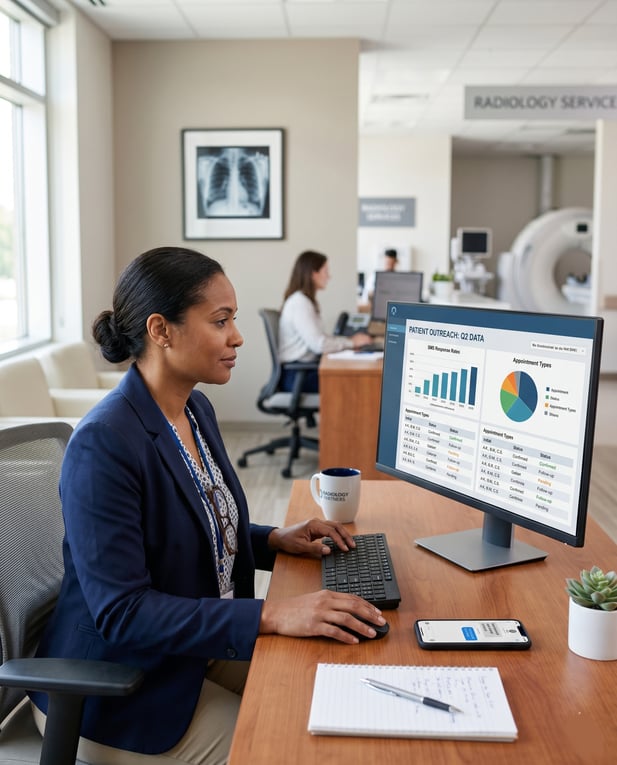
A radiology practice manager analyzing patient outreach data and SMS response rates

ConclusionTransform Your Mass Messaging Workflow

The recall black hole is not a fact of life for radiology practices. It is a workflow gap, and workflow gaps can be closed.

Every imaging center sitting on a database of overdue patients has a recovery opportunity hiding in plain sight.

Below, we pull together the key takeaways and lay out what to do next. The path forward is shorter than most practice managers expect.

Manual recall recovers 5 to 10% of lapsed patients. SMS recall, based on Curogram's internal data, recovers 35%. That gap is the single biggest revenue opportunity in most radiology practices today.

The reasons are simple. SMS lands in seconds, not weeks. It works on any phone, with no app or portal login.

Patients reply with one word, and your team books warm leads instead of chasing cold ones.

A 10,000-patient lapsed database, recovered at 35%, brings back 3,500 patients. At $1,200 per study, that is $4.2 million in recovered revenue. Even smaller practices see meaningful gains.

Curogram pulls patient data from StreamlineMD, builds segments by procedure and date, and deploys campaigns in minutes.

Staff hours drop. Bookings rise. The two systems stay in sync without forcing your team to learn new tools.

StreamlineMD handles clinical documentation and billing. Curogram handles patient outreach. Together, they create a complete imaging center workflow that neither system delivers alone.

This is how modern radiology groups stay competitive against larger hospital imaging departments. They do not outspend the competition. They out-execute on patient engagement.

Imaging margins are tighter every year. Practices that recover even a fraction of their lapsed database gain a real edge. Those that ignore the recall black hole watch revenue drift to competitors.

Coordinators are too valuable to spend on phone tag. Freeing 30 to 40 hours per month means real time back for patient care, intake, and front desk support. That is a quality-of-life win for your team and a quality-of-care win for patients.

The fastest way to see the impact is to see it on your own data. A short demo walks through how the recall engine works inside StreamlineMD and what your recovery numbers could look like.

Imaging centers using Curogram are recovering $400,000 to $800,000 annually with SMS recall campaigns.

Most build their first campaign in under 10 minutes. The setup is light. The payoff is not.

Schedule a Demo to see how the recall engine works inside your StreamlineMD environment. The recall black hole is solvable. The revenue is already yours. It just needs a way back home.


Frequently Asked Questions

How often should we run recall campaigns?

Most imaging centers run two to four recall campaigns per year, based on follow-up intervals. Surveillance ultrasounds typically run annually, post-procedure follow-ups every three to six months, and repeat CT monitoring every six to twelve months.

A quarterly cadence keeps momentum strong without causing patient fatigue. Curogram's frequency controls also block overlapping sends, so no patient gets contacted twice in the same window.

Why does SMS outperform paper letters and phone calls?

SMS lands in seconds, gets a 98% open rate, and asks for a one-word reply. Paper letters take weeks to deliver and yield about 5% response. Phone calls eat staff time and often end in voicemail. The friction is lower for the patient, which is why reconversion rates climb to 35% based on Curogram's internal data.

How does the workflow stay HIPAA-compliant?

Curogram is SOC 2 Type II certified and built for HIPAA-compliant mass messaging imaging from the ground up. Opt-in management, audit trails, and consent tracking are part of the platform. Every send, response, and opt-out is logged for compliance review. Practices keep full visibility into who consented and when.

What happens if a patient does not respond?

Curogram tracks response rates in real time, so non-responders are easy to spot. Many practices send a second SMS three days later, which lifts overall response without feeling pushy.

Patients who reply STOP are automatically excluded from future campaigns. The system handles the cleanup, so staff can focus on the patients who replied YES.

How long does it take to build the first campaign?

Most practices launch their first recall campaign in under 10 minutes. Curogram pulls patient segments directly from StreamlineMD, so there is no manual export or spreadsheet work. Staff pick the criteria, draft a short message, and click send. The hardest part is deciding which cohort to recover first.