
10 min read

Automate Imaging Follow-Up Recalls | RamSoft & Curogram

Automate Imaging Follow-Up Recalls | RamSoft & Curogram
💡 Imaging centers using RamSoft generate hundreds of radiologist-recommended follow-ups every month.                            
But without an automated system, scheduling coordinators are left manually calling patients from spreadsheets — and reaching fewer than half of them.      
Curogram solves this with HIPAA-compliant, text-based recall campaigns that contact patients automatically at the right interval.            

Staff shift from dialing every name on a list to managing exceptions from a centralized dashboard. 

The results: imaging centers report 35% recovery of lost follow-ups, compliance rates above 90%, and scheduling coordinators reclaiming 15 or more hours per week — without adding a single staff member.

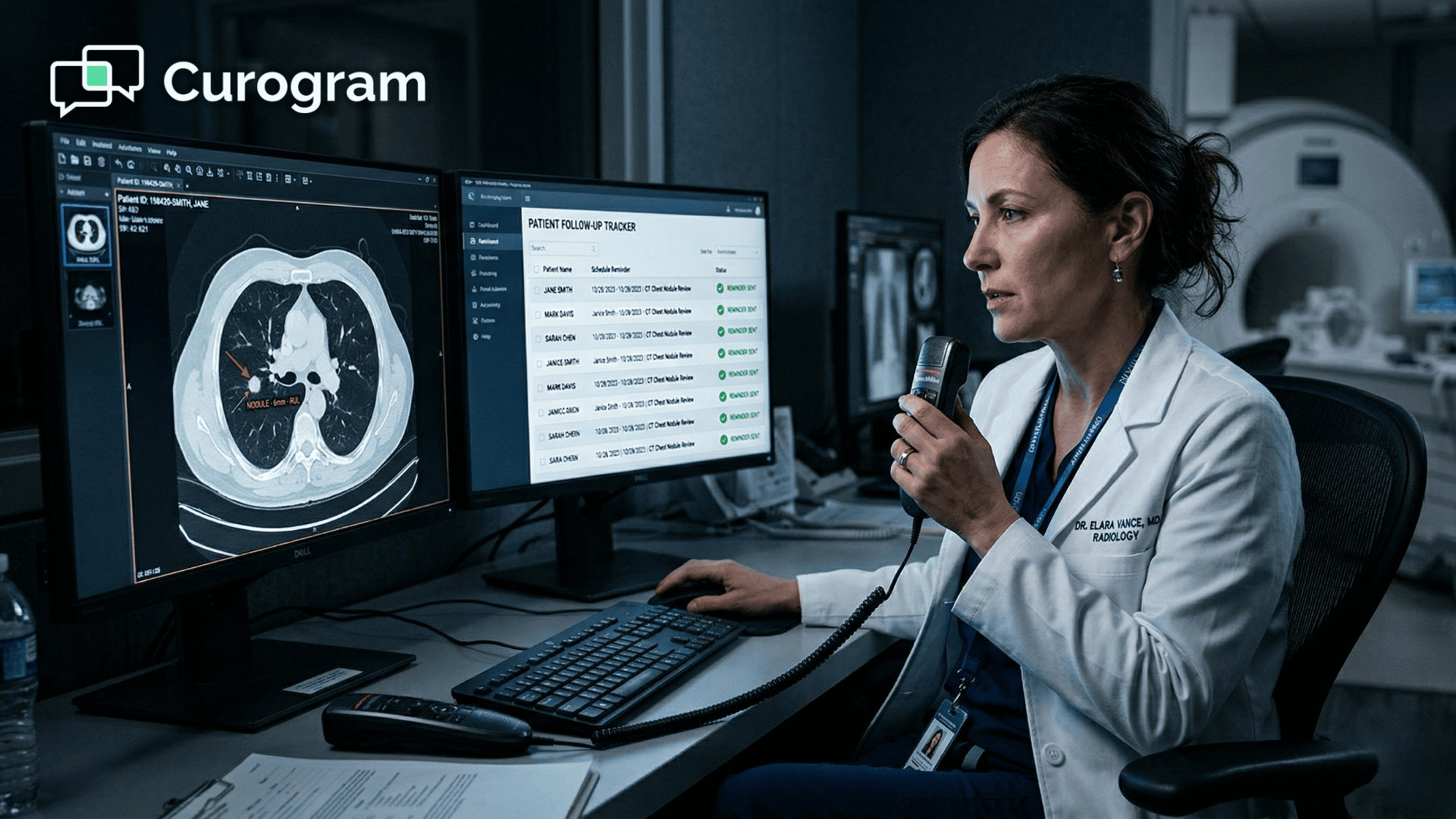
A radiologist finishes reading a chest CT and types a clear recommendation — "MRI follow-up in 6 months." The report is filed. The recommendation is documented. And then, nothing happens.

Not because anyone forgot. Not because the staff don't care.

But because the moment that report is signed, the responsibility silently shifts to a scheduling coordinator who already has 200 names on a spreadsheet, a phone that won't stop ringing, and no realistic way to reach every single person.

That is where follow-up recommendations go to die.

This isn't a small problem. A typical imaging center with 5,000 to 10,000 annual studies can have 800 to 1,500 patients needing follow-up in any given month. If your team is calling those patients manually, they're reaching maybe 40% of them — on a good day. The other 60%? They slip through.

No callback. No rescheduled appointment. No record of what happened.

For your center, that means missed revenue. For your patients, it could mean a delayed diagnosis.

And for your referring physicians, it means unanswered questions about whether their patients actually got the care that was recommended.

Here's the harder truth: the problem isn't your staff. They're working as hard as they can. The problem is the workflow itself — one that was never designed to scale.

Manual follow-up recall is a process built for a smaller, simpler time. And for most imaging centers today, it simply isn't working anymore.

There is a better way.

It starts with understanding exactly why the current approach keeps failing — and what it's actually costing you.

The Spreadsheet That's Quietly Running Your Recall Program Into the Ground

Let's walk through a real scenario.

Your scheduling coordinator arrives Monday morning. She opens the recall spreadsheet — a shared file that's been updated by three different people across two shifts. There are 200 patients listed, each with a radiologist-recommended follow-up from somewhere between 4 and 14 months ago.

Some have notes. Some don't. A few names are duplicated.

She starts calling.

Realistically, she can get through about 30 calls in a full day — between answering the front desk phone, handling new appointment requests, processing paperwork, and fielding questions from staff.

Of those 30 calls, around 15 patients pick up. Of those 15, maybe 8 actually schedule an appointment.

That's 8 patients helped. And 170 untouched.

Tomorrow, the list grows again.

Why the Numbers Keep Getting Worse

Now multiply that across a week, a month, a quarter.

A typical imaging center is running a scheduling coordinator workload that simply cannot absorb the volume of follow-up tracking required at scale.

And if you're operating across 10, 50, or 200 locations, the math becomes genuinely alarming.

~30 patients contacted per day.

That's the realistic ceiling for a scheduling coordinator making manual recall calls — factoring in front desk duties, paperwork, and appointment intake. On a list of 200, that leaves 170 people untouched before the day ends.

The voicemail callback rate from patients? Consistently low.

Many patients on the recall list have moved, changed numbers, or simply don't recognize your facility's number anymore — especially if the original study was 10 or 12 months ago.

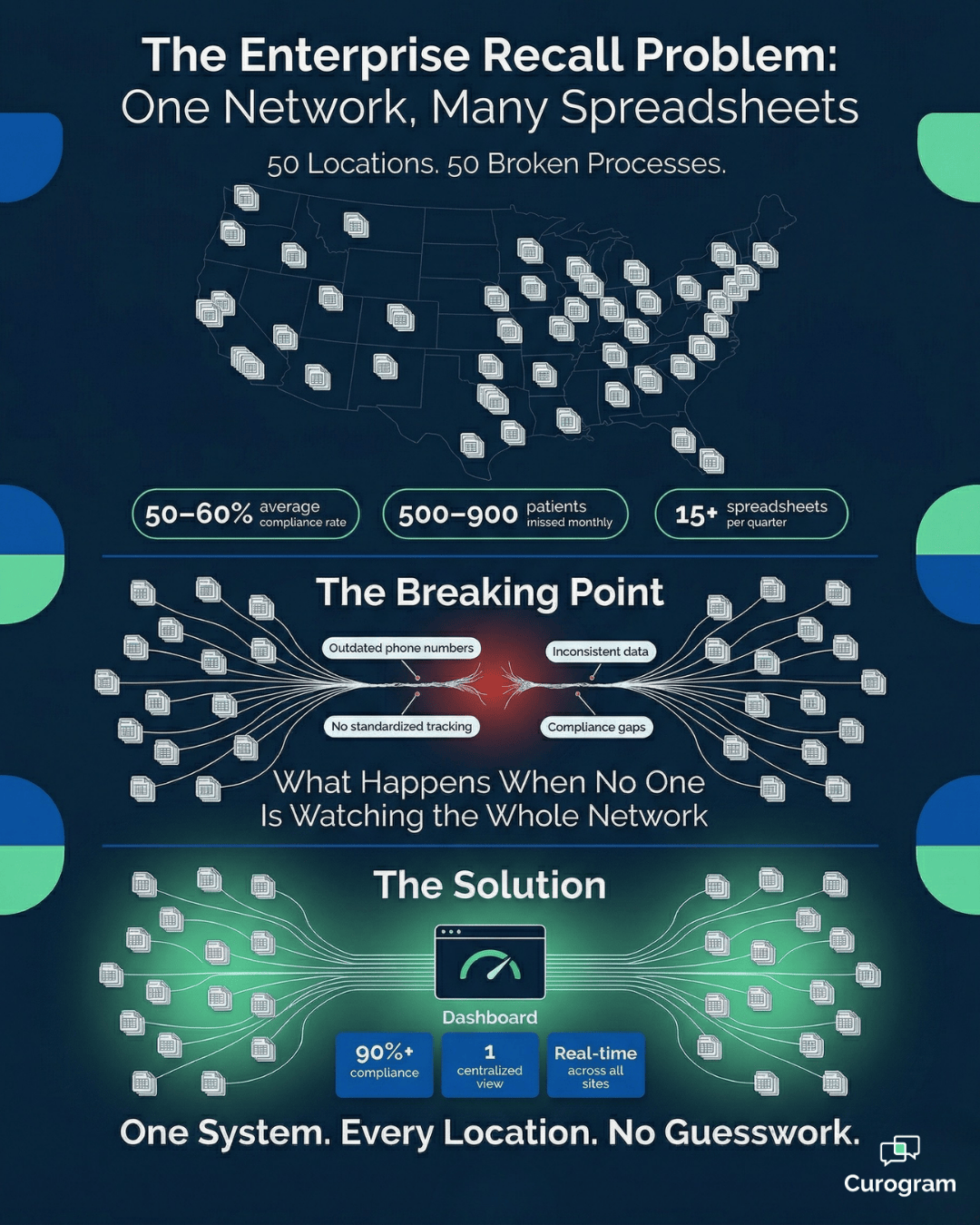
500–900 patients fall through the recall system every single month

At a typical imaging center — not because of carelessness, but because manual calling simply cannot reach them all at the right time.

And when your VP of Operations asks for Q1 recall compliance data?

You're pulling together 15 spreadsheets from 15 locations, reconciling inconsistent notes, and making educated guesses about what "completed" actually means in each one.

The problem isn't isolated to one bad day or one overwhelmed coordinator. It's structural.

The manual recall process breaks down in the same places, at the same points, every single time:

  • Patients who've changed phone numbers or moved since their last visit
  • Studies from 10 to 14 months ago where patients have long forgotten the recommendation
  • Coordinators too buried in daily intake tasks to work through the full recall list
  • Leadership with no reliable way to track compliance across multiple sites

This is the real cost of manual imaging recall management.

It's not just inefficiency. It's lost revenue, incomplete care, and a compliance record that could look very different from your actual performance on paper.

Why Cold Calls Aren't the Answer — and More Staff Won't Fix It Either

The instinct, when recall volume grows, is to add capacity. Hire another coordinator. Ask the existing team to work faster. Extend calling hours.

It sounds reasonable. It doesn't work.

The ceiling on phone-based outreach isn't willpower — it's math. A human being can only make so many calls in a day. And each call takes time regardless of whether the patient answers.

The voicemail, the wait, the redial — it adds up. Even with a larger team, you're still dependent on patients answering an unknown number from a center they visited almost a year ago.

The Channel Is the Problem

Text messages work differently. Of the calls your team does make, only about half actually reach a live person.

The rest hit voicemail — and most of those never call back. Patients read texts. They respond to texts. And unlike a phone call that requires the patient to be available at a specific moment, a well-timed text message waits for them.

The problem isn't effort. The problem is the channel — and the absence of a system that does the work automatically, without anyone having to remember to pick up the phone.

Adding staff to a broken process doesn't fix the process. It just makes the broken process more expensive.

Meet the Automated Recall Coordinator That Actually Scales

This is where Curogram changes the workflow entirely.

Instead of a spreadsheet and a phone, your team gets an automated, HIPAA-compliant text-based recall system that does the outreach for them.

Every patient who needs a follow-up — identified by study type, date range, or demographic filter — receives a personalized text message at the right interval.

Six months after their chest CT. Twelve months after their annual mammogram.

Automatically. Without anyone dialing a single number.

The message includes their name, a clear reason for the outreach, a booking link, and your facility's contact information. It reads like a message from your practice, not a generic blast from a system they've never heard of.

Staff don't manage a list of 200 patients. They manage a dashboard.

How the Campaign Builder Works

Curogram's Campaign Builder is the engine behind mass recall campaigns for imaging centers.

Here's how a typical campaign runs:

  • Your team defines the campaign — for example, "Annual Mammography 2024 Patients."
  • They set filters: study type (mammography), date range (January through December 2024), and patient demographics (women aged 40 to 75).
  • Curogram automatically identifies every matching patient in the system — whether that's 500, 1,000, or 5,000 people.
  • A coordinated, personalized text sequence goes out to all of them at once.
  • Patients who don't respond to the first message receive a follow-up reminder automatically.
  • Staff review the dashboard: who responded, who scheduled, who opted out, and who still needs attention.

No manual list-building. No spreadsheet maintenance. No guesswork.

How It Connects to RamSoft

Curogram doesn't replace RamSoft — it adds the communication layer that RamSoft doesn't have.

There are three ways to get patient data into the system:

  • Manual upload: Export your follow-up list from RamSoft as a CSV or Excel file and upload it to Curogram. The system matches patients by name, date of birth, and phone number.
  • API integration: Curogram connects directly to your RamSoft instance via API, automatically identifying patients with follow-up recommendations and triggering messages when the recommended interval arrives.
  • Campaign Builder: Your staff manually define a campaign with filters, and Curogram identifies the matching patients from within its database.

The API path is the most seamless — once it's set up, patient follow-up automation runs with almost no manual input. Your team sets the rules once, and the system handles the rest.

Infographic showing manual vs. automated imaging recall across a multi-location network

What Happens When You Replace the Spreadsheet With a System

The results aren't marginal. They're a meaningful shift in how your center operates.

In one documented case, a multi-location practice using Curogram's SMS recall approach saw 35% of patients who received a recall message schedule an appointment within a single month.

From a starting list of 3,540 patients, 1,240 previously unreached individuals completed their follow-ups within 90 days of the first automated message.

Think about what that means in real terms.

At an average imaging study revenue of $300 to $500 per appointment, recovering 1,240 patients represents between $372,000 and $620,000 in recaptured revenue — from a patient population the practice had already written off.

What the Shift Looks Like Day to Day

Beyond revenue, the operational shift is just as significant.

Scheduling coordinators move from spending 8 to 12 hours per week on manual calling to spending 1 to 2 hours managing exceptions — time that can go toward patient service, new appointment intake, or higher-value tasks that actually require a human touch.

Instead of calling every name on a list, your team monitors a dashboard and steps in only where a human is actually needed:

  • Patients requesting a different appointment date
  • Contacts flagged with outdated phone numbers
  • Individuals who explicitly opt out and need to be marked accordingly
  • The small percentage who need a direct, personal follow-up call

That's a fundamentally different job. And for most coordinators, it's a better one.

Recall compliance rates climb from the typical 50–60% range to 90% and above.

Referring physicians stop having to wonder whether their patients followed through. They get a confident, system-backed answer instead of a "we'll check and call you back."

And for enterprise imaging networks, the change at the leadership level is equally dramatic. Instead of pulling together 15 different spreadsheets from 15 different locations and hoping the data is consistent, a VP of Operations opens one dashboard and sees recall compliance rates across every site — by location, by campaign type, by time period.

That's the kind of visibility that enables real decisions about staffing, resource allocation, and performance improvement.

Patient reading automated follow-up recall text at an imaging center waiting area

Enterprise Imaging Networks: One Dashboard, Every Location

If you're managing a network of 50, 100, or more imaging centers, the recall problem isn't just a workflow issue. It's a governance issue.

Without centralized recall management, each location is essentially running its own version of the same broken process. Different spreadsheets, different tracking methods, different standards for what counts as "completed."

When compliance audits happen, you're reconciling inconsistencies across dozens of sites — a process that is slow, stressful, and unreliable.

Standardized Campaigns, Local Flexibility

Curogram's enterprise dashboard changes that. Headquarters can design standardized campaign templates — mammography recall, lung CT screening, bone density follow-up — and deploy them across every location simultaneously.

Each site receives a consistent message, sent at a consistent interval, using a consistent process.

Regional offices retain flexibility.

They can customize templates with local phone numbers, office hours, and addresses while the core message and timing remain standardized.

Headquarters maintains full visibility into how each campaign is performing at every site.

For enterprise radiology center staff productivity, this means less time spent on coordination and more time spent on actual patient care. It also means your compliance data is accurate, accessible, and auditable — not reconstructed from memory every quarter.

Reach every patient in seconds. Use mass messaging for urgent closures, health alerts, or clinic news with a 98% open rate with Curogram.

Follow-up compliance rates:

50–60% with manual tracking. 90%+ with automated recall workflows.

For a network of 50 locations, that gap represents thousands of patients per quarter either getting the follow-up care they need — or not.

From Spreadsheet to System: The Results That Matter

Let's bring all of this together.

The problem isn't a people problem. Your scheduling team isn't failing. They're operating inside a workflow that was never designed to handle today's imaging volume, today's patient expectations, or today's compliance requirements.

A Better Process Produces Better Outcomes

Imaging center follow-up recall workflow automation doesn't just make things easier. It makes things possible — things that genuinely cannot be done at scale with a phone and a spreadsheet.

When you automate the recall process, your TCPA-compliant recall messaging reaches patients through a channel they actually use.

Your scheduling coordinator workload drops dramatically. Your imaging recall management becomes a system instead of a guessing game.

And your compliance record reflects what's actually happening — not what someone was able to document before the day ran out.

The formula, for RamSoft imaging centers especially, is straightforward: Blume for records. Automated texts for everything else.

Stop Losing Patients to a Process That Was Never Built to Scale

Manual recall doesn't just cost you time. It costs you patients, revenue, and the confidence that comes from knowing your follow-up program is actually working.

Curogram was built to solve exactly this problem — not by adding complexity, but by replacing a broken process with one that runs on its own.

Automated text sequences go out to the right patients at the right time. Staff manage exceptions, not exhausting lists. Leadership sees the full picture without assembling a patchwork of spreadsheets.

If your imaging center is still running follow-up recalls the old way, the gap between where you are and where you could be is measurable in hours, patients, and dollars.

Centers using automated recall workflows report 35% appointment reconversion from previously lost patients, 90%+ recall compliance rates, and 15 or more hours reclaimed per coordinator each week.

That's not a small improvement. That's a fundamentally better way to run your recall program.

Ready to see how it works inside your own center? Schedule a demo with Curogram and see exactly how automated recall campaigns run alongside your RamSoft system — from the first automated text to the final compliance report. No spreadsheets required.


Frequently Asked Questions

Are mass text-based recall campaigns TCPA-compliant?

Yes — when the platform is configured correctly. TCPA compliance requires express written consent from patients before sending text-based outreach, a clear opt-out option in every message, prompt honoring of any opt-out requests (within 48 hours), and maintenance of a do-not-contact list. Curogram manages all of this automatically. Consent is documented in the patient record, every recall message includes "Reply STOP to unsubscribe," and opt-out requests are processed without any manual intervention. For clinical follow-up outreach — where the purpose is to continue or establish a treatment relationship — a TCPA exemption for healthcare providers may apply. Even so, documenting consent is best practice, and Curogram tracks this directly in the dashboard.

How does Curogram know which patients need follow-up? How does the data connect to RamSoft?

There are three integration paths, depending on your setup. First, your team can manually export a list of patients needing follow-up from RamSoft and upload it to Curogram as a CSV or Excel file. Curogram matches patients by name, date of birth, and phone number. Second, Curogram can connect directly to RamSoft via API, automatically identifying patients with open follow-up recommendations and triggering messages when the recommended timeframe arrives — this is the most hands-off option. Third, your team can use the Campaign Builder to manually define criteria (study type, date range, demographics) and let Curogram identify all matching patients in the database. This third option works especially well for screening campaigns like annual mammography recall.

Can we manage recall campaigns across 50 or more locations from a single dashboard?

Yes. Curogram's enterprise dashboard gives network leadership full visibility into recall compliance, response rates, and scheduling outcomes across every linked location. Headquarters can build standardized campaign templates — lung CT screening, annual mammography recall, bone density follow-up — and deploy them across the entire network at once. Regional offices can adjust local details like office phone numbers, addresses, and hours of operation while keeping the core message and timing consistent. The dashboard shows, at a glance, how many patients were contacted, what the response rate was, how many appointments were confirmed, and what the compliance rate looks like by location and by campaign. That kind of centralized data is what makes meaningful quality decisions possible.

What happens if a patient says they already completed their follow-up at a different facility?

That's one of the most common gaps in manual recall tracking — and one of the most frustrating. With Curogram, patients can reply directly to the recall text to let your team know they've already been seen elsewhere. That response is logged in the dashboard, the patient is marked accordingly, and no further outreach is sent. Your coordinators don't have to guess, follow up separately, or update a spreadsheet by hand. The system captures the response and keeps the record clean. For referring physicians asking whether a patient followed through, your team now has a documented answer — even if the imaging happened at another facility.

How long does it take to set up an automated recall campaign for the first time?

For most imaging centers, the setup process is straightforward and doesn't require a lengthy IT implementation. If you're using the manual upload path, your team can have a campaign running within a day — export your follow-up list from RamSoft, upload it to Curogram, set your filters, write or select your message template, and send. The API integration takes more initial configuration but eliminates the need for manual uploads going forward. Either way, Curogram's onboarding team walks you through the process, and the platform is designed to be learned in a single session. Most coordinators are comfortable managing campaigns independently within their first week.