10 min read

RamSoft Radiology Follow-Up Recall | Mass Text Outreach

RamSoft Radiology Follow-Up Recall | Mass Text Outreach
💡 RamSoft imaging center follow-up recall mass messaging patient outreach is the process of automatically notifying patients about recommended follow-up imaging studies using text-based campaigns.                           
When a radiologist documents a follow-up recommendation in RamSoft, tools like Curogram trigger outreach sequences at the right interval—no manual effort required.      

Imaging centers using automated recall campaigns report a 35% patient reconversion rate. For a center running 40 studies per day, that translates to thousands of recovered appointments annually—and hundreds of thousands in recaptured revenue.           

Without automation, follow-up recommendations sit in static reports that most patients never read. 

Curogram connects RamSoft's reporting workflow to direct patient communication, ensuring every radiologist recommendation leads to a scheduled study.

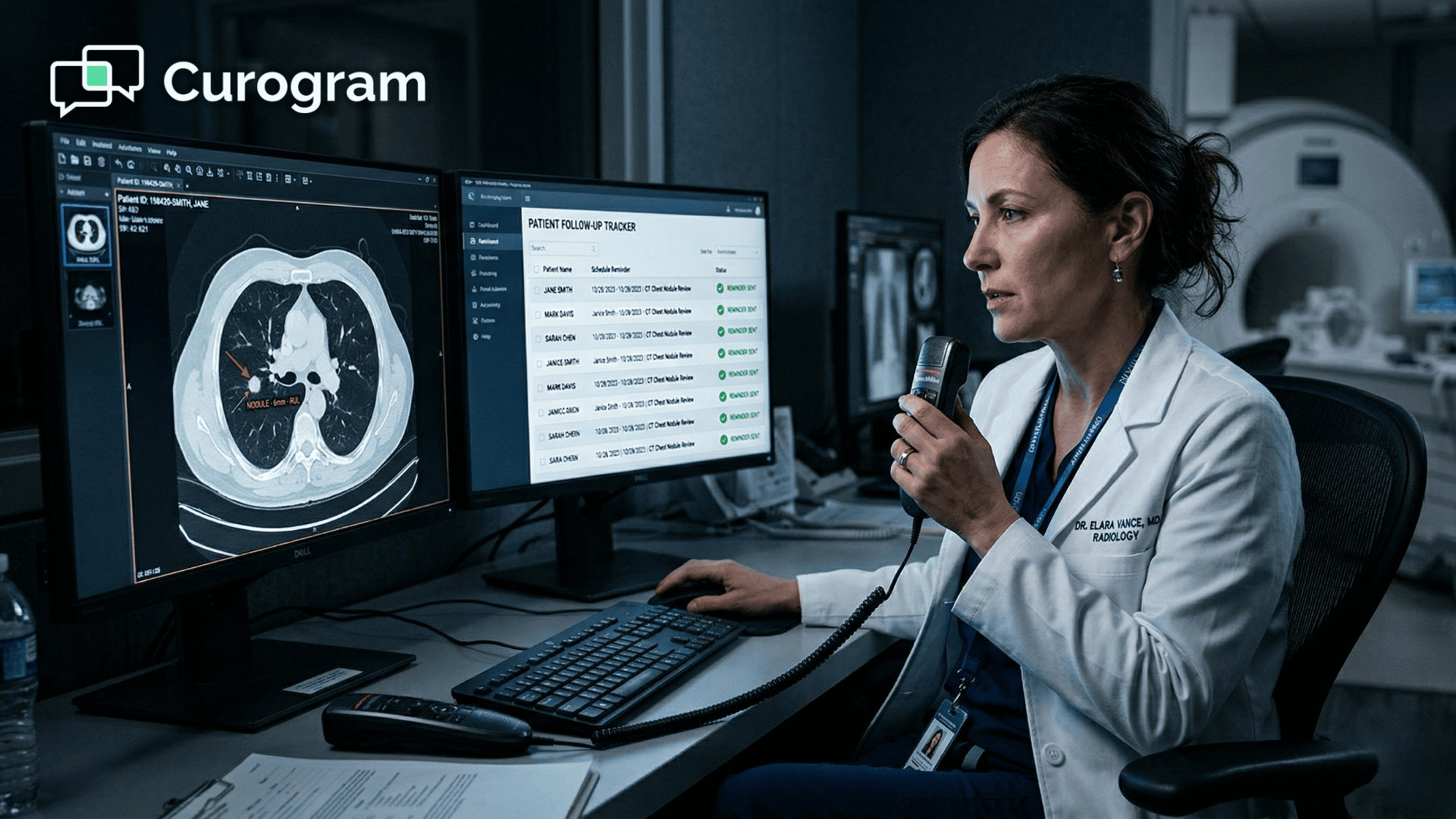
Your radiologist just finished dictating a report. It's thorough, clinically precise, and ends with a clear recommendation: "Six-month follow-up MRI advised for further characterization of indeterminate finding."

That recommendation took clinical expertise to make. It might be the most important sentence in the report.

And there's a very good chance the patient will never act on it.

Not because they don't care. Not because their physician is negligent. But because there is no system in place to make sure the follow-up actually happens.

The report goes to the referring physician. The referring physician has hundreds of reports to review that day. The patient gets the imaging done, moves on with life, and assumes someone will call if anything is urgent.

Six months pass. Nothing happens.

Think about how often this plays out in your center.

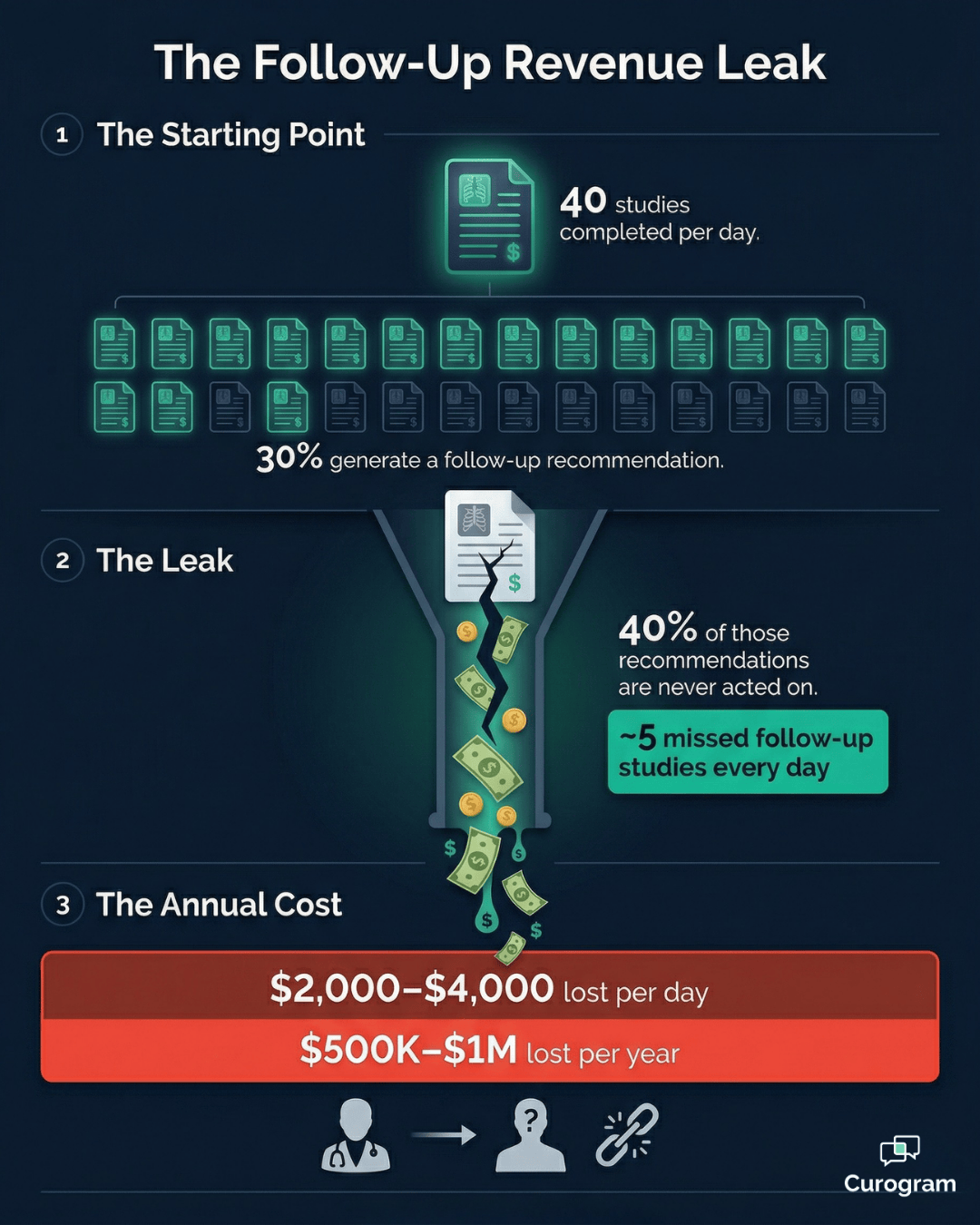
If 30% of your studies generate a follow-up recommendation—and industry patterns suggest 40% of those are never acted on—you're looking at 4 to 5 missed follow-up studies every single day. At $800 per MRI and $300 per CT scan, that's somewhere between $2,000 and $4,000 walking out the door daily.

Annualized, you're looking at $500,000 to $1 million in unrecovered revenue. Every year.

That number is uncomfortable. It should be.

The problem isn't clinical. RamSoft's AI-powered reporting engine—working alongside tools like RADPAIR, iCAD, and Therapixel—produces excellent, accurate recommendations. The gap is what happens after the report is finalized.

There's no automated bridge between the radiologist's recommendation and the patient's phone. No system that sends a text six months later saying, "Hey, your doctor recommended a follow-up scan. Here's how to schedule it."

RamSoft imaging center follow-up recall mass messaging patient outreach isn't a nice-to-have. It's a clinical and revenue imperative.

This article breaks down why the current system fails, what a purpose-built follow-up engine looks like, and what happens when imaging centers actually fix the problem.

How a Follow-Up Recommendation Gets Lost in the System

Here's the honest sequence of events at most imaging centers.

A radiologist completes a study and dictates a recommendation. RamSoft's reporting tools—RADPAIR for AI-assisted drafting, iCAD for suspicious finding detection, Therapixel for mammography-specific intelligence—help produce a clinically solid report.

The recommendation is documented. The report is finalized. From a clinical standpoint, the job is done.

Then the report lands in the referring physician's inbox.

Where the Chain Breaks Down

The referring physician reviews dozens, sometimes hundreds, of reports per day. Follow-up imaging recommendations are buried in clinical language, sandwiched between findings and impressions.

Even when a physician does notice the recommendation, there's often no streamlined way to communicate it to the patient.

Calling takes time. Email raises HIPAA concerns outside a secure portal. The assumption—stated or unstated—is that the patient will handle it.

But patients don't handle it. They got their scan. They haven't heard anything alarming. They assume no news is good news. The idea that they need to proactively schedule a follow-up imaging appointment in six months is simply not on their radar.

Meanwhile, RamSoft's patient-facing tool, Blume, gives patients access to their imaging history and reports—which is genuinely useful.

But app adoption is never universal, and passive access to a report isn't the same as an active prompt to schedule a follow-up. Most patients won't open the app looking for a recommendation they don't know exists. There's no mass messaging feature built into the platform.

No recall campaign functionality. No outreach engine.

The recommendation sits in static text, unseen by the only person who needs to act on it.

What This Costs Your Imaging Center—In Real Numbers

Let's make this concrete.

At a center running 40 studies per day, roughly 12 of those generate a follow-up recommendation. If 40% of those recommendations are never acted on, you're losing about 5 follow-up studies daily.

At an average revenue mix of $800 per MRI and $300 per CT, that's $2,000 to $4,000 walking out the door every single day—or $500,000 to $1 million a year in unrecovered revenue.

These aren't theoretical numbers. They're based on realistic study volumes and standard imaging reimbursement rates.

For your center, the exact figure depends on your mix of modalities, your daily study volume, and how thoroughly follow-up recommendations are being tracked.

The point isn't the specific dollar amount. The point is that this revenue exists—and without structured radiology quality improvement processes, it continues to slip through the cracks.

The clinical work was already done. The recommendation was already made. The only thing missing is a system to act on it.

That's where the real problem lives—and why the current approach keeps failing.

Why Waiting on Referring Physicians Doesn't Work

It sounds simple:

The referring physician receives the report, follows up with the patient, the patient schedules. It isn't.

Referring physicians operate under enormous volume pressure. Parsing a follow-up imaging recommendation out of a radiology report—and then translating it into a patient action—is a manual, time-consuming step that competes with everything else on their plate. Even well-intentioned physicians miss it.

Some assume the imaging center will track it. Others assume the patient will read their report online.

Infographic showing how missed radiology follow-ups cost imaging centers up to $1M annually

The Tools Aren't There—and Neither Is the Accountability

There's also a structural gap. Referring physicians typically don't have tools that connect directly to radiology follow-up workflows.

They can't trigger a text message to the patient. They can't schedule a recall campaign from their EHR

. The communication bridge simply doesn't exist in their system.

The result is that radiology follow-up imaging recall—whether for a mammography screening reminder text, an LDCT lung cancer screening follow-up, or a BIRADS follow-up protocol—becomes entirely dependent on informal processes:

  • Sticky notes and staff callbacks that don't scale
  • Patient self-scheduling that assumes awareness the patient doesn't have
  • Phone outreach that competes with every other task on a front desk's daily list

None of these are reliable at scale, and none create a documented, auditable trail.

Blume, RamSoft's patient engagement app, gives patients access to their imaging history and reports. That's genuinely useful. But app adoption is never universal, and passive access to a report is not the same as an active prompt to schedule a follow-up.

Most patients won't open the app looking for a recommendation they don't know exists.

The imaging center is left with a choice: accept the status quo and absorb the revenue loss, or build an automated system that does what no one else is doing—texts the patient directly, at the right time, with the right information and a direct scheduling link.

The Follow-Up Engine: Closing the Gap Between Report and Appointment

This is where Curogram changes the equation.

Curogram is a HIPAA-compliant patient communication platform that integrates directly with RamSoft.

When a radiologist documents a follow-up recommendation in the RamSoft reporting workflow, Curogram automatically triggers an outreach sequence.

No manual intervention. No data entry. No staff time.

From Report to Scheduled Appointment—Automatically

Here's what that sequence looks like in practice:

  1. Radiologist finalizes report with a follow-up recommendation (e.g., "Six-month follow-up MRI for BIRADS 3 finding")
  2. Curogram's integration routes the follow-up trigger from RamSoft into the recall engine
  3. A text message is scheduled for the appropriate interval—typically six weeks before the recommended follow-up date
  4. The patient receives a plain-English text: "Hi [Name], your radiologist recommended a follow-up [imaging type] around [date]. Here's how to schedule: [link]"
  5. The patient taps the link, schedules the appointment, and the confirmation flows back into RamSoft for documentation

No app download. No portal login. No phone tag. Just a text message that meets the patient where they already are.

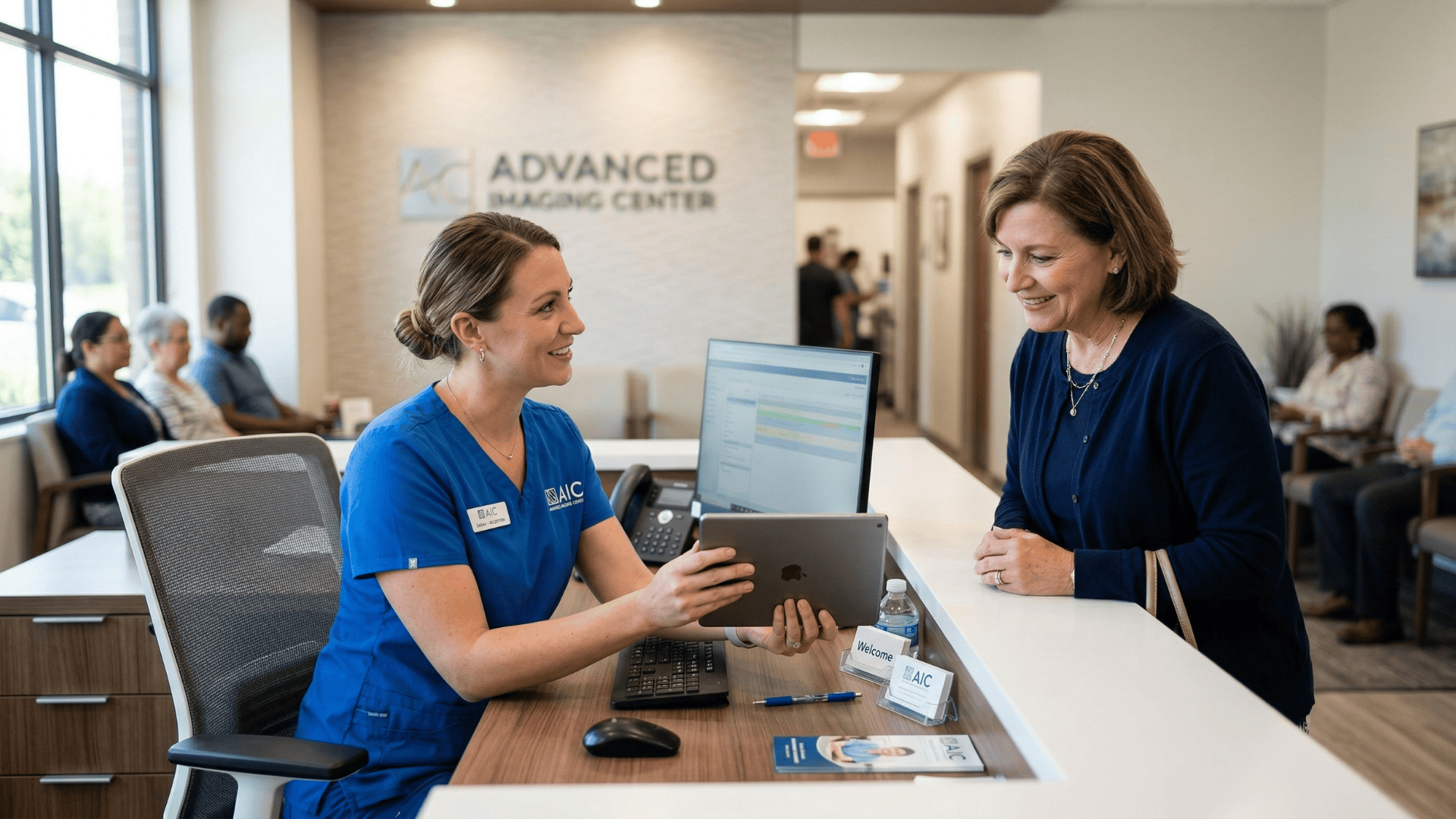
Front desk staff showing a patient a text-based imaging follow-up reminder on a tablet

The Preventive Screening Campaign Engine

Beyond individual follow-up recall, Curogram enables imaging centers to run proactive imaging center patient recall campaigns at scale.

Think about the eligible patient populations sitting in your database right now—women 40 and older due for an annual mammography screening reminder text, high-risk patients aged 40 to 74 with a 30+ pack-year smoking history who qualify for lung cancer screening LDCT recall, and postmenopausal women 65 and older who haven't had a DEXA bone density scan.

These aren't emergency follow-ups. They're standard-of-care preventive studies that keep scanner slots full and patients healthy.

Curogram lets your team create and launch these campaigns in minutes. Enterprise networks can deploy identical campaigns across all locations simultaneously, with centralized reporting on conversion rates.

The text-based architecture is what makes this work at scale.

Every patient with a phone number gets the message—regardless of whether they've downloaded an app or enrolled in a patient portal.

Reach is universal. Opt-out is automatic on every message. And all responses—scheduling confirmations, questions, opt-outs—flow back into RamSoft for documentation and compliance tracking.

How RamSoft Mass Text Outreach Works at the Campaign Level

Campaign Type Eligible Population Recommended Outreach Interval
Annual mammography reminder Women 40+ 12 months from last study
Lung cancer screening (LDCT) High-risk patients 40–74, 30+ pack-years 12 months (annual per guidelines)
Bone density screening (DEXA) Postmenopausal women 65+ 24 months
BIRADS 3 follow-up Patients with short-interval recommendation 6 months from original study
Lung nodule surveillance Fleischner Society protocol patients 3–12 months depending on nodule size

Each of these campaigns runs through a single interface. Patient lists are filtered from your existing RamSoft data. Messages go out automatically. Responses are logged.

And your team spends zero additional time on outbound communication.

What Happens When Every Recommendation Becomes a Scheduled Study

The results imaging centers see when they implement automated recall aren't marginal improvements. They're structural revenue recoveries.

Curogram's recall campaigns achieve a 35% patient reconversion rate. That means for every 100 patients who receive a recall message, 35 schedule an appointment within 30 days.

Here's what that looks like at scale.

Imagine a 10,000-patient annual mammography recall campaign. At a 35% reconversion rate, that's 3,500 scheduled mammography appointments. For a four-scanner facility running 8-hour days, that fills roughly 2 to 3 weeks of scanner capacity.

At an average reimbursement of $250 to $300 per mammography study, that's approximately $875,000 to $1.05 million in recovered revenue—from a single preventive imaging campaign.

One practice using Curogram's SMS recall approach brought back 1,240 patients through targeted follow-up outreach alone.

Those patients had either missed their follow-up window or never scheduled at all. The recall message was the only prompt they needed.

Beyond Revenue: What Consistent Follow-Up Actually Changes

The financial impact is significant. But the operational shift matters just as much.

When automated follow-up recall runs consistently, several things change across your center:

  • Scanner slots stay full with clinically important studies, not just new patient volume
  • Referring physicians receive documented confirmation that their recommended follow-ups were completed—building referral trust over time
  • BIRADS 3 findings are actually re-evaluated at six months, and lung nodule protocols are tracked per Fleischner Society guidelines
  • Clinical compliance becomes auditable, with every recall message and patient response logged in RamSoft

Enterprise networks stop relying on location-by-location follow-up processes and instead run synchronized campaigns from a single platform.

And the imaging center director who once reviewed thousands of missed follow-up recommendations in a year-end audit now has a system that prevents those gaps from forming in the first place.

The math is straightforward. The clinical case is even stronger.

The question is why imaging centers waited this long to automate what should have been automated from the start.

Turn Your Follow-Up Queue Into Scheduled Appointments

RamSoft's clinical tools are among the best in radiology. RADPAIR, iCAD, and Therapixel help your radiologists produce accurate, detailed reports with clearly documented follow-up recommendations.

That's the hard part. And you're already doing it well.

The gap is what comes next. The moment the report leaves the radiologist's workflow, the follow-up recommendation is at risk of falling through the cracks—invisible to the patient, buried for the referring physician, and invisible to your revenue cycle.

Curogram closes that gap. Not by replacing what RamSoft does, but by completing the communication loop that RamSoft doesn't cover.

Blume manages the patient's relationship with their imaging history.

Curogram manages the outreach that drives the next scheduled study. They're not competing—they're complementary.

Your radiologists have already made the recommendation. The clinical intelligence is in the report. What's missing is the message that actually reaches the patient.

One simple text. A scheduling link. A confirmed appointment.

That's the difference between a recommendation that disappears into a static report and one that becomes a filled scanner slot.

Schedule a demo to see exactly how Curogram's text-based follow-up recall integrates with RamSoft and what a 30-day pilot would look like for your center. 


Frequently Asked Questions

Is Mass Text Messaging Compliant with HIPAA and TCPA Regulations?

Yes. Curogram operates under a HIPAA Business Associate Agreement with RamSoft-connected accounts and maintains full TCPA compliance for text-based patient outreach. Patient consent is collected at enrollment through explicit opt-in, and every message includes a clear opt-out option. For follow-up recall campaigns, consent is documented during intake or initial visit registration. Enterprise imaging centers can manage consent centrally across all locations, with HIPAA audit trails available for compliance verification at any time.

How Are Follow-Up Intervals Automated, and Can We Create Custom Recall Campaigns?

Curogram supports two approaches. The first is automated triggering: when a follow-up recommendation is documented in RamSoft, Curogram extracts the recommended interval from the report and schedules the patient outreach message automatically—no staff input required. The second is manual campaign creation for preventive screening programs, where administrators define the eligible patient population (for example, women 40+ for annual mammography) and set the messaging cadence. Both approaches work at enterprise scale, with centralized management across 50 or more locations and automated reporting on recall conversion metrics.

Can Curogram Coordinate Recall Campaigns Across Multiple RamSoft Locations?

Yes, and this is one of Curogram's most significant advantages for multi-site networks. An enterprise imaging center or teleradiology network can create a single campaign—say, an annual mammography screening awareness push—and deploy it simultaneously across all locations with unified management. Each location's patient data remains segmented for privacy and compliance, but the messaging, scheduling workflows, and reporting dashboards are centralized. Networks managing 50 or more locations use Curogram to run coordinated preventive imaging campaigns that reach hundreds of thousands of eligible patients at once—a task that simply isn't feasible without text-based automation at scale.

What Happens When a Patient Responds to a Recall Text?

Curogram is a two-way texting platform, so patient responses are captured in real time and routed back to your team through the same interface your staff already uses. If a patient replies to schedule, ask a question, or request a different time, your front desk sees the message and can respond without switching systems. Opt-outs are processed automatically and logged immediately—no manual tracking required. All interactions are documented within RamSoft for compliance purposes, giving you a complete, auditable record of every recall message sent and every patient response received.

How Quickly Can an Imaging Center Launch Its First Recall Campaign?

Most imaging centers are up and running within a single pilot period. Curogram offers a 30-day free pilot that typically starts with one campaign—annual mammography reminders, lung cancer screening outreach, or bone density recall—using your existing patient data from RamSoft. There's no complicated technical setup on your end. The integration pulls eligible patient lists directly from your RamSoft workflow, and your team can review and approve the campaign before a single message goes out. By the end of the pilot, you'll have a clear reconversion rate, a measurable revenue impact, and a straightforward decision on whether to scale.