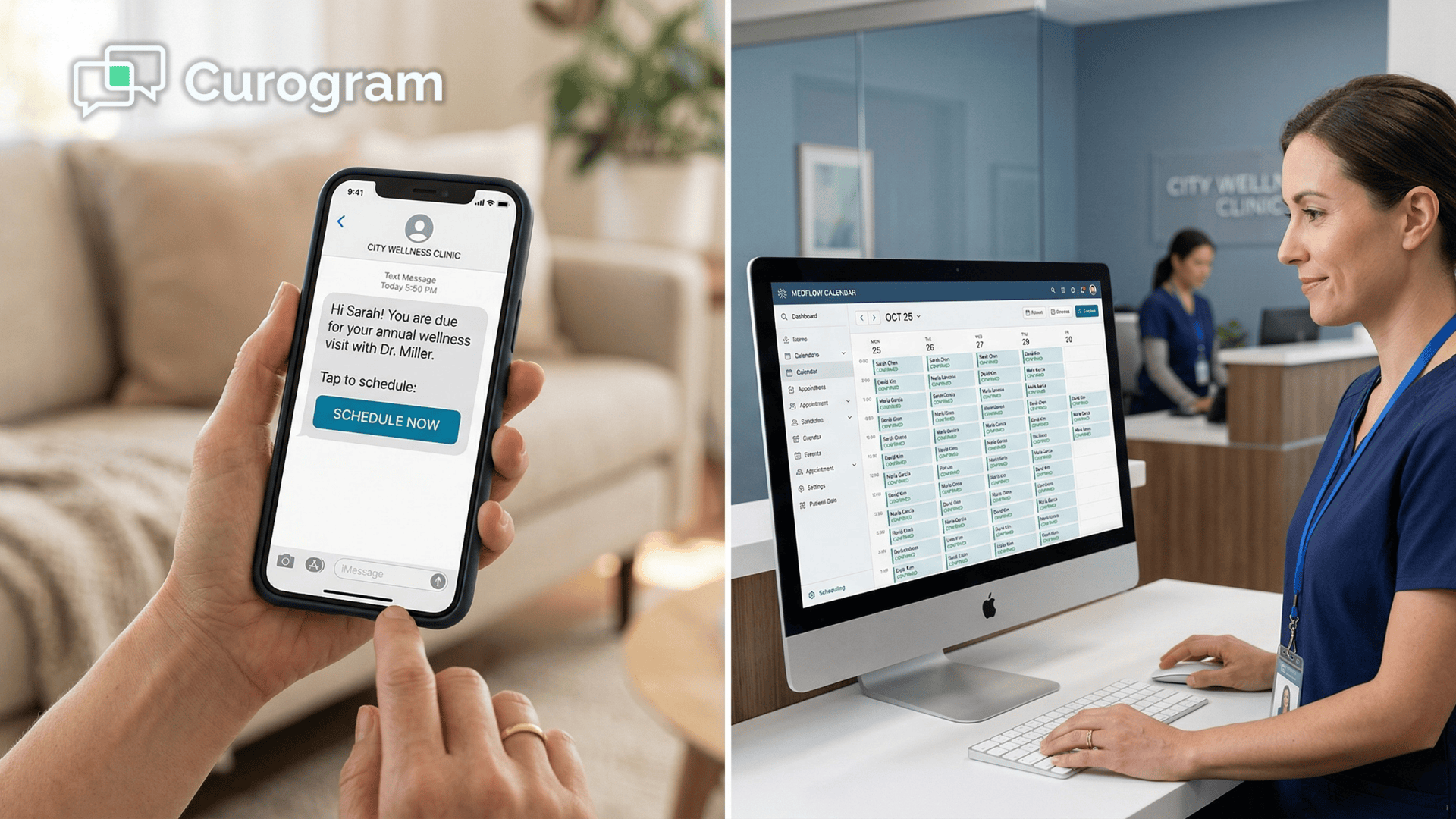
10 min read

Cloud 9 Ortho Recall via Text | Retainers, Reactivation & Revenue

Cloud 9 Ortho Recall via Text | Retainers, Reactivation & Revenue
💡 Cloud 9 orthodontic recall via text uses Curogram’s Text-First Recall Engine to target post-treatment, lapsed, and consultation patients — reaching every phone number with a 98% open rate.             

For practices managing dormant panels, Curogram's mass messaging broadcast campaign delivers personalized, one-tap scheduling links to each patient.    

A multi-location practice achieved a 35% appointment reconversion rate, recovering over 1,200 dormant patients in a single campaign cycle.  

For DSOs and OSOs, centralized campaign coordination lets you deploy retainer check recall, patient reactivation, and seasonal campaigns across every location simultaneously — with full analytics to measure results at both the practice and network level.

Imagine opening your Cloud 9 patient database on a Monday morning. You have 3,000 patients on file. Business looks good on paper.

Now look closer.

Three hundred of those patients finished braces over a year ago and haven't come back for a retainer check. Two hundred came in for a consultation, loved the practice, and never scheduled their bonding appointment.

One hundred and fifty active patients missed their last adjustment and haven't rescheduled.

Another 150 paused treatment at some point and never restarted.

That's 800+ patients who should be on your schedule this week. They aren't.

This isn't a patient loyalty problem. These families aren't unhappy with your care. They haven't switched to a competitor down the street. They drifted — slowly, quietly — because no one reached them through the channel where they actually pay attention.

Your practice sent emails. Roughly 30% of them opened one. Portal notifications went out. Most parents haven't logged into the portal since treatment ended.

Your front desk made calls. Voicemail. No callback.

The gap between the patients in your database and the patients on your schedule has a name: the dormant panel. And it is costing your practice real money every single month.

Here is what that looks like in dollars: 300 post-treatment patients missing their retainer check at $150–$300 per visit equals $45,000–$90,000 in unrealized annual revenue — from patients you already treated, already built trust with, and already have in your system.

That's before you count lapsed actives, unconverted consultations, or patients who paused mid-treatment.

The good news? They're still in your database. You can still reach them. But the channel matters — and most Cloud 9 practices are using the wrong one.

This article explains exactly how orthodontic recall text message campaigns work, why text outperforms every other recall method, and how Curogram's broadcast campaign tools help you recover revenue from your dormant panel — retainer check by retainer check, reactivation by reactivation.

The Quiet Revenue Leak Hiding in Your Patient Database

The dormant panel problem isn't one problem. It's four — and each one has its own revenue cost.

The Patient Who Finished Treatment and Disappeared

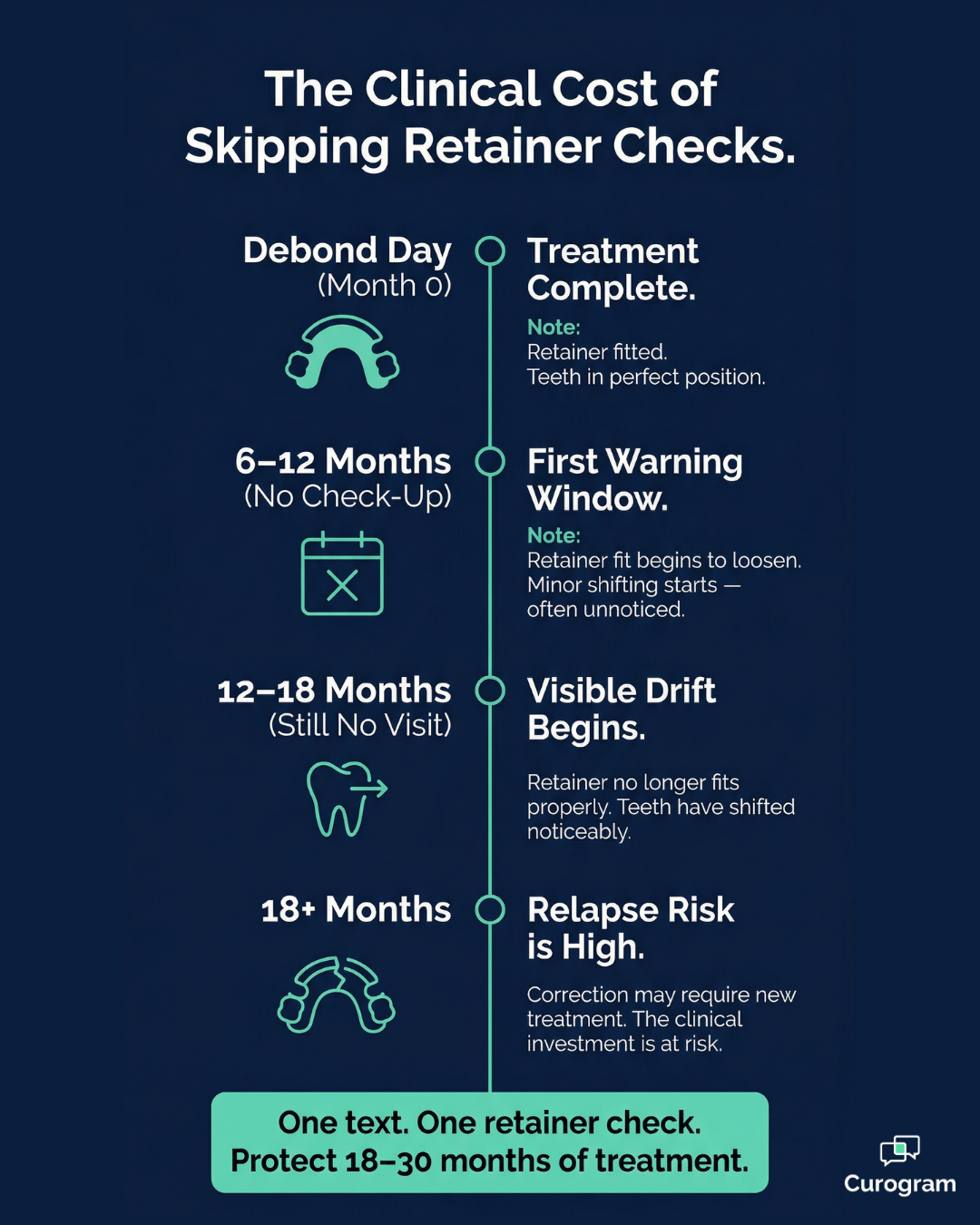
Think about a patient who just completed 24 months of braces. Beautiful result.

At debond, the orthodontist says,

"Come back in six months for a retainer check." The family fully intends to.

Then school starts. Work gets busy. Six months becomes twelve. Twelve becomes eighteen.

No one ever followed up with a text.

The child's retainer no longer fits as well as it did at debond. Teeth are slowly shifting. The family doesn't know because they haven't been in. Multiply this across 300+ post-treatment patients in your Cloud 9 panel and you have a clinical concern and a revenue gap that grows wider every month.

At $150–$300 per retainer check, 300 overdue patients represent $45,000–$90,000 in annual revenue sitting untouched in your database.

The Consultation That Almost Converted

A parent brought their child in for a new patient consultation. The treatment plan was presented. The parent was engaged, asked good questions, and left with a $5,000–$7,000 estimate in hand. They said they'd think about it.

They meant to follow up. Life got in the way.

Research on purchase behavior consistently shows that intent to buy fades fast. For a family that left your practice with a $5,000–$7,000 treatment estimate.

The drop-off looks something like this:

  • At consultation: ~80% likely to start treatment
  • At 30 days with no follow-up: ~40%
  • At 90 days with no follow-up: ~20%

For practices with a 20–30% consultation-to-start fall-through rate, that's 2–5 lost new starts per month — or $10,000–$35,000 in monthly production that walked in the door and walked back out.

A personalized follow-up text at each of those intervals changes that math entirely.

The Active Patient Who Just Stopped Showing Up

Imagine a patient mid-treatment. An adjustment was scheduled for March 15. They didn't show.

No cancellation — they just didn't come. Your front desk called. Voicemail. Sent an email. No response.

Now it has been eight weeks since their last adjustment. Treatment timelines are extending. The parent probably means to reschedule but keeps forgetting.

One text — "Hi [Parent], [Child's Name] is due for an adjustment.

Let's keep treatment on track — schedule here:

[Link]" — reaches them in the channel where they respond and gives them a one-tap path back onto the schedule.

Why Email and Phone Recall Have Stopped Working

Most Cloud 9 practices rely on email and phone calls for patient recall outreach. The results are consistent — and consistently inadequate.

Channel Open / Answer Rate Scheduling Rate Key Limitation
Email 30–50% open rate 2–5% Competes with 80–120 daily messages
Phone calls 15–20% answer rate 5–10% of answered calls Arrives during work hours when parents can't pick up
Text (SMS) 98% open rate Read within 3 minutes No structural limitation — reaches the patient

This isn't a messaging quality problem. No amount of better subject lines or more persuasive voicemail scripts fixes a structural channel mismatch. Email competes with dozens of other unread messages. Phone calls arrive when parents are in meetings.

Text reaches the phone in their pocket — the one they check within minutes.

Practices that move from email and phone recall to a text-first broadcast campaign approach see recall response rates increase 3–5x.

That's not an incremental improvement. That's a fundamentally different outcome.

How Curogram Closes the Gap Between Your Database and Your Schedule

Curogram's recall approach isn't a mass blast to your entire patient list. It is a targeted, segmented, personalized orthodontic recall text message campaign built specifically for how orthodontic patient panels actually behave.

Targeted by Segment, Personalized by Patient

The practice manager defines exactly who gets each campaign.

The Cloud 9 database is filtered by any combination of the following:

  • Treatment status (active, post-treatment, consultation, lapsed)
  • Last visit date (e.g., more than 12 months ago)
  • Appointment type (debond, adjustment, retainer check, consultation)
  • Provider or location (for multi-provider and multi-site practices)

The system pulls matching patients and creates a targeted campaign list — not a catch-all blast, but a precise segment.

Each patient receives a personalized text — their name, their child's name, and a message specific to their treatment status.

Not a generic "we miss you." A targeted message that speaks directly to where that patient is in their treatment journey.

This is what separates a mass messaging broadcast campaign from a spam blast. It's relevance at scale.

Timeline infographic showing the clinical risks of skipping orthodontic retainer checks

The Specific Segments That Drive Revenue Recovery

Curogram's recall campaigns are designed around the segments that matter most to orthodontic practices.

Here's how they work in practice:

  • Retainer Check Recall: Post-treatment patients overdue for monitoring, triggered at 6, 12, or 18 months after debond. These campaigns directly address the retainer check compliance gap.
  • Treatment Reactivation: Patients who paused treatment or missed multiple adjustments, with messaging focused on getting treatment back on track — and recovery of $5,000–$7,000 per reactivated case.
  • Consultation Follow-Up: Patients who had a consultation but never started treatment, with a graduated sequence: 30-day check-in, 60-day gentle nudge, 90-day last-chance outreach.
  • Seasonal Campaigns: Back-to-school ortho evaluations, clear aligner awareness for patients who previously declined traditional braces, and holiday promotions for new consultations.

Each segment has pre-built message templates the practice can customize and deploy — no copywriting required.

One Tap From the Text to the Appointment

Every recall text includes a direct scheduling link. The parent taps it, sees available appointment times, selects a slot, and books — all from their phone, in under a minute.

No phone call. No patient portal login. No hold music.

This matters more than it sounds.

The gap between

"I should schedule" and "I just scheduled" is where recall campaigns live or die.

Removing every possible friction point — and replacing it with a single tap — converts intention into action at the exact moment of engagement.

Multi-Location Campaign Management for DSOs and OSOs

For multi-location organizations, Curogram's mass messaging enables a level of coordination that simply isn't possible with email or phone-based recall.

At the corporate level, the VP of Operations can build a single campaign template and push it across every location simultaneously — each patient directed to their specific practice's scheduling page, not a generic link.

A retainer check recall campaign launched across 100 Cloud 9 locations reaches every post-treatment patient in the network in a single deployment.

Campaign analytics aggregate across the organization for executive reporting, while location-level data reveals which practices are outperforming and where additional outreach is needed.

This is centralized campaign management that scales without adding staff.

The Analytics That Make Every Campaign Smarter

Every campaign generates a full performance report.

At a glance, the practice manager can track:

  • Texts sent and delivered
  • Scheduling link clicks
  • Appointments booked per campaign
  • Revenue recovered by patient segment

That last metric is the one that matters most. It turns recall from a front-desk task into a measurable revenue activity.

The practice manager can see which patient segments respond at the highest rates, which message templates perform best, and which send times generate the most engagement.

Over time, this data builds a recall playbook optimized for your specific patient population. Each campaign learns from the one before it.

Parent reading an orthodontic recall text in a practice waiting area, front desk in background

What Happens When You Actually Reach Your Dormant Patients

The results of systematic text-based patient reactivation aren't theoretical.

A multi-location practice using Curogram's text-based recall campaigns achieved a 35% appointment reconversion rate, recovering 1,240 patients who had fallen off the schedule.

For orthodontic practices on Cloud 9, the revenue implications of that single number are significant.

The Revenue Recovery That Lives in Your Database Right Now

Here's what a 35% reconversion rate looks like for a typical Cloud 9 practice with 800 dormant patients:

Segment Dormant Patients 35% Recovery Revenue Per Patient Recovered Revenue
Retainer Check Overdue 300 105 $150–$300 $15,750–$31,500
Lapsed Active Treatment 150 53 $1,500–$3,000 (partial case) $79,500–$159,000
Unconverted Consultation 200 70 $5,000–$7,000 $350,000–$490,000
Paused Treatment 150 53 $5,000–$7,000 $265,000–$371,000

These are realistic, conservative estimates based on the $5,000–$7,000 full-case value typical for comprehensive orthodontic treatment.

Reach every patient in seconds. Use mass messaging for urgent closures, health alerts, or clinic news with a 98% open rate with Curogram.

Curogram clients report 10–20% revenue increases from recovered appointments — revenue that was sitting in the database, unreachable by email and phone, waiting for a text.

It's Also a Clinical Obligation

Revenue recovery is not the only reason to prioritize retainer check recall. It is also, frankly, a clinical necessity.

When post-treatment patients skip retainer monitoring, the consequences compound quietly:

  • Teeth begin shifting gradually, often without the patient noticing
  • Retainers no longer fit as they did at debond
  • By the time the patient returns, correction may require additional treatment

The 18–30 months of clinical investment in straightening a patient's teeth can unravel in months without proper follow-up. Systematic retainer check recall via text protects that investment — returning patients to the chair before small shifts become significant relapse.

It also sends a message to families: your practice cares about outcomes beyond the final appointment. That kind of ongoing care builds the loyalty and word-of-mouth referrals that fuel long-term practice growth.

The Gap Between Text-First Practices and Everyone Else

Consider the competitive math. A typical email or phone-based recall effort achieves a 5–10% reconversion rate.

Curogram's text-first approach produces a 35% rate. That's a 3–7x improvement from the same patient panel, with no additional new patient marketing required.

Over 12 months, the compounding effect of systematic text-based recall creates a measurable performance gap between practices that use it and those that don't.

The practice with active broadcast campaign recall generates more revenue from the same patient base, funds better technology and staffing, and delivers a higher standard of ongoing care. The practices still relying on email and voicemail are leaving that same revenue on the table every month.

The dormant panel recovery difference between those two practices isn't strategy. It's channel.

Your Patient Panel Is Waiting — Let's Wake It Up

Here's the honest truth: your Cloud 9 patient database is already full of revenue. It's not hidden or locked away.

It's sitting in post-treatment status, in consultation follow-up queues, in lapsed active records — patients who had a great experience with your practice and fully intended to come back.

They just need to hear from you — through the right communication channel.

Every week you rely on email and phone calls for recall, the dormant panel grows.

More retainer checks go unscheduled. More consultations cool past the point of conversion. More mid-treatment patients drift off the schedule. And none of it shows up as a loss on your revenue report — because the patients are still in the database.

The opportunity just quietly disappears.

Text-based recall changes the dynamic completely. A targeted broadcast campaign to 300 post-treatment patients takes minutes to build and deploy. Within 48 hours, retainer check appointments start filling the schedule — from patients who haven't been in for 12–18 months.

That same week, a consultation follow-up campaign reaches 200 families who toured the practice and intended to start treatment. Some of them are going to book a bonding appointment.

This is not a future upgrade. This is a revenue recovery tool your practice can use right now.

For DSOs and OSOs managing multiple Cloud 9 locations, the impact is multiplied across every practice in the network — simultaneously, with centralized oversight and location-level analytics.

Your patient database is not a static list. It is a revenue engine. But only if you can reach the patients inside it.

Stop leaving those appointments in the database. Text your dormant panel, give every patient a one-tap path back to the schedule, and watch what happens to your recall numbers over the next 90 days.

Schedule a demo today to see exactly how Curogram's text-first recall campaigns recover revenue from your Cloud 9 practice's dormant panel — retainer check by retainer check, reactivation by reactivation.


Frequently Asked Questions

Can we send recall campaigns to patients who aren't enrolled in the patient portal?

Yes — and this is one of the most important advantages Curogram offers for recall. Text-based campaigns reach patients by phone number, not portal login. Every patient with a mobile number in your Cloud 9 database can receive a recall text, regardless of whether they have ever logged into a portal, opened an email, or answered a phone call from the office. For most practices, this expands the reachable recall population by 40–60% compared to portal-dependent recall systems.

How do we make sure we aren't texting patients who are already scheduled?

Curogram's campaign builder lets you filter by scheduling status before any message goes out. You can exclude patients who already have an upcoming appointment, patients who were contacted within a set window (such as the past 30 days), and patients who have opted out of marketing messages. The system ensures your broadcast campaign reaches only the patients who are genuinely overdue — not ones who are already engaged and on the calendar.

Is there a limit to how many patients we can message in one campaign?

Curogram's mass messaging supports campaigns of any size, from a focused 50-patient retainer check recall to a 5,000-patient seasonal campaign across multiple locations. Messages are delivered in compliant, throttled batches to protect deliverability and meet carrier regulations. You can schedule campaigns for optimal send times — such as Tuesday or Wednesday mornings, which tend to produce the best engagement — and monitor delivery and response in real time through the campaign analytics dashboard.

How long does it take to build and launch a recall campaign?

Most campaigns can be built, reviewed, and deployed in under 30 minutes. Curogram provides pre-built message templates for each patient segment — retainer check recall, treatment reactivation, consultation follow-up, and seasonal campaigns — that the practice manager can customize with the practice name, provider name, and relevant details before sending. There is no technical setup required beyond selecting a segment, choosing a template, and hitting send.

Does Curogram's text recall work for DSOs managing multiple Cloud 9 locations?

Yes. Multi-location campaign coordination is one of Curogram's core capabilities for DSO and OSO networks. Corporate-level users can build campaign templates once, deploy them simultaneously across all locations, and direct each patient to their specific location's scheduling page. Campaign analytics aggregate at the network level for executive reporting, while location-level detail allows operational leaders to identify which practices are converting at the highest rates and where additional recall outreach is needed.