
10 min read

Radiology Reminders | Text-Based Prep for Exa Imaging Centers

Radiology Reminders | Text-Based Prep for Exa Imaging Centers
💡 Exa RIS manages complex imaging workflows, but it has no built-in way to contact patients. That gap leaves staff making manual calls to share prep instructions and confirm appointments. Curogram closes that gap by connecting to Exa's API and sending modality-specific prep instructions via text, matched to the exact study type.

MRI patients get safety screening questions. CT patients get fasting rules. Ultrasound patients receive clothing guidance. Each message includes a confirmation link so patients can respond before they arrive.

Based on our internal data, imaging centers that use text-based reminders and confirmation loops can cut no-show rates by up to 65%.

For a center running 80 studies per day, that improvement can recover more than $64,000 per month. Curogram delivers this at a fraction of the cost of enterprise tools like openDoctor, making it a practical option for independent imaging centers.

Think about what it costs when a patient misses an MRI slot. Not just the revenue. The equipment sat idle, the technologist waited, and the next patient could not be moved up in time. Multiply that by five or six slots a day.

Exa RIS handles scheduling, billing, image routing, and insurance checks. It keeps the complex side of imaging running smoothly. But it was never built to talk to patients. That part is left entirely to the front desk.

So staff make dozens of calls each day. They read prep instructions over the phone, leave voicemails that often go unanswered, and ask about metal implants while a line forms at the window. It is not a system. It is a workaround.

The result is predictable. Studies get cancelled or delayed. Patients arrive unprepared, and slots sit empty. All of it shows up on the revenue line at the end of the month.

Imaging center no-show reduction is not just an admin goal. In radiology, an unprepared patient is also a safety concern. A patient with an undisclosed implant entering an MRI suite creates real risk for everyone involved.

Most of this is preventable. Exa PACS patient communication does not have to rely on manual calls. With the right integration, prep instructions go out by text at the right time, patients confirm, and staff see who is ready before the appointment starts.

This article covers how that system works, what it costs when it is missing, and what imaging centers stand to gain when they put it in place.

The Villain: The $4,000-a-Day Empty Scanner

Every imaging center knows the pain of an empty scanner slot. But most do not track exactly what it costs each day. This section breaks down where the problem starts and why the financial and clinical stakes are higher than most people realize.

The Gap in Exa RIS Patient Communication

Exa RIS is a capable platform for managing radiology operations. It handles resource-based scheduling, color-coded insurance alerts, and pre-authorization tracking. For imaging teams, it is a powerful hub. For patients, it is invisible.

What Exa RIS Handles Well

Exa RIS was built to manage the clinical and operational side of imaging. It routes DICOM images, handles billing, tracks scanner availability, and connects with referring physicians.

The platform also supports intelligent scheduling that accounts for equipment type, technologist availability, and study duration. All of this is genuinely useful.

Most imaging centers using Exa schedule 80 or more studies per day. That volume depends on every slot being filled with a prepared, confirmed patient. Exa can track the slot. It was never designed to reach the person.

Where the Communication Stops

Without built-in outreach, most centers rely on front-desk staff to make the calls. On a busy day, that means 60 to 100 outbound calls.

Staff leave voicemails, read prep instructions out loud, and hope patients follow through. It is slow, hard to track, and even harder to scale.

The only alternatives used to be expensive. Enterprise tools like openDoctor start at $2,500 per month, which puts them out of reach for many independent imaging centers. So the manual process continues, and slots keep slipping.

The Real Cost of Empty Scanner Slots

An empty MRI slot does not just represent a missed study. It represents lost equipment time, wasted technologist hours, and a delay in the referring physician's diagnostic timeline. The total impact runs far deeper than a single appointment.

The Financial Toll

No-show rates in radiology range from 5% to 15%, with most centers averaging around 7%. On 80 scheduled studies per day, a 7% no-show rate means five to six empty slots daily.

At $800 per study on average, that adds up to $4,000 to $4,800 per day in lost revenue. Over a month, the loss climbs to $88,000 or more. For centers with higher no-show rates, the damage is even greater.

No-Show Rate

Empty Slots (80/day)

Est. Daily Loss ($800 avg.)

Est. Monthly Loss

5%

4

$3,200

$70,400

7%

5-6

$4,000-$4,800

$88,000-$105,600

10%

8

$6,400

$140,800

14.2% (pre-intervention)

11-12

$8,800-$9,600

$193,600-$211,200


Add the cost of wasted contrast agents, technologist overtime, and rescheduling delays, and the full annual cost of poor appointment communication can exceed $1 million for a mid-sized imaging center.

The Clinical Risk

An unprepared patient is not just a scheduling problem. In MRI, a patient with an undisclosed pacemaker or metal implant creates a real safety risk.

Studies cannot proceed until the issue is resolved, which means delays, rescheduling, and in some cases, emergency protocols.

For CT with contrast, a patient who did not follow fasting rules may need to be rescheduled entirely. The contrast agent is wasted. The technologist's time is lost. And the referring physician waits longer for results. All of this happens because the right information never reached the patient at the right time.

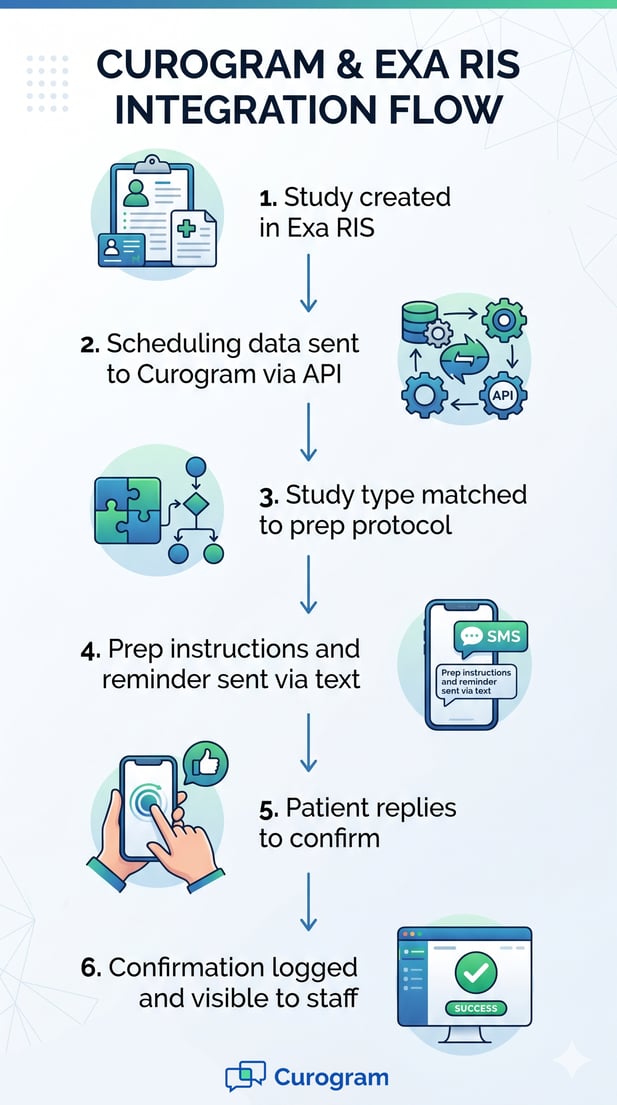
Diagram illustrating the workflow: How Curogram Connects to Exa RIS

The Guide: The Prep-and-Confirm Engine

Curogram works as a communication layer on top of Exa RIS. Once connected through Exa's API, it handles the one thing Exa was never built to manage: getting the right information to the right patient at the right time, automatically.

How the Integration Works

The connection between Curogram and Exa RIS runs through Exa's FHIR API platform, which launched in April 2025. When a study is created or updated in Exa, Curogram receives the scheduling data in real time.

It reads the study type, the patient contact details, and the appointment time, then triggers the right outreach sequence. No manual steps are needed from staff.

Study Type Detection

Curogram identifies the modality from the Exa scheduling data. MRI, CT, ultrasound, mammography, X-ray, and interventional procedures each map to a separate prep protocol. The system handles the match on its own, without any manual input from the front desk.

This matters because prep requirements vary a great deal by modality. An MRI patient needs to answer safety questions about implants and pregnancy. A CT patient needs fasting guidance and contrast allergy screening. Sending the wrong prep to the wrong patient is nearly as harmful as sending none at all.

Automated Prep Delivery

Once the study type is matched, Curogram sends prep instructions via text. Imaging centers can set their own timing: 48 hours before for medication holds, 24 hours before for clothing and jewelry reminders, and 12 hours before for fasting confirmation. Each message goes out automatically.

For MRI CT appointment text reminders, the system includes a reply option so patients can confirm they have read and understood the instructions.

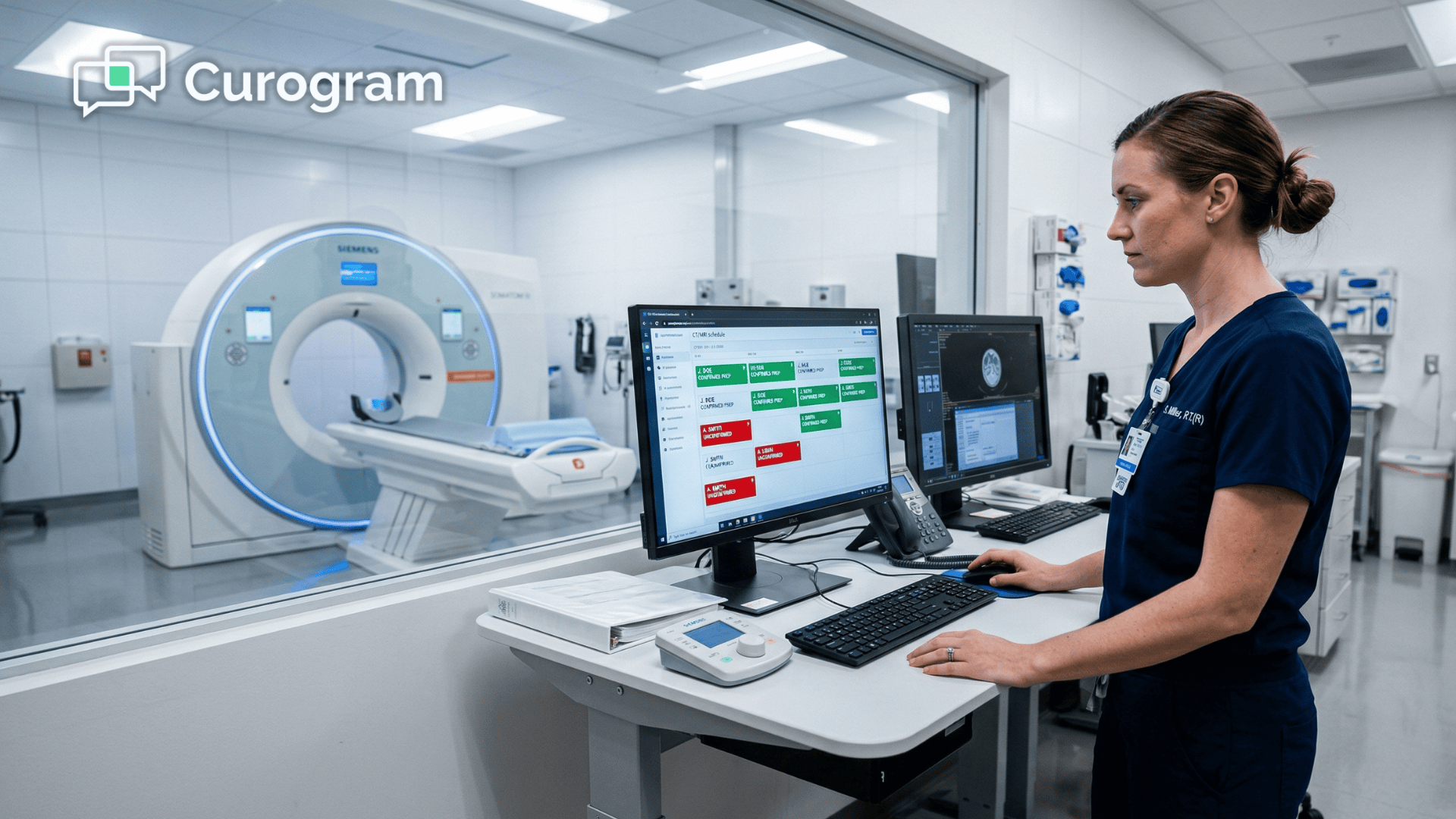
That reply is logged, creating a clear record of informed preparation. Staff can see confirmation status in real time, without making a single outbound call.

Modality-Specific Prep Protocols

Radiology prep instruction automation only works when the content matches the study. A generic reminder that says "Don't forget your appointment" does not help a CT patient who needs to fast or hold a specific medication before a contrast scan. Curogram lets each imaging center build custom protocols for every modality in its schedule.

MRI and CT Protocols

MRI prep messages include metal screening questions, such as whether the patient has had a joint replacement, carries a pacemaker, or is pregnant.

These questions are sent via a secure text link that the patient fills out before arriving. If the patient flags a concern, the center is notified before the study begins.

CT prep messages cover fasting requirements, contrast allergy screening, and medication instructions, including guidance to hold metformin 48 hours before contrast studies. All of this reaches the patient automatically, on the right schedule, without any work from the front desk.

Ultrasound and Contrast Studies

Ultrasound prep messages cover clothing instructions, hydration requirements such as a full bladder for pelvic studies, and any prep specific to the area being scanned.

Contrast studies include allergy history questions and medication hold reminders. Interventional procedures trigger pre-operative consent workflows before the day of the study.

Every message includes an imaging center patient confirmation text that the patient can reply to directly. The reply is logged, the technologist walks into the study knowing the patient is prepared, and there are no surprises at check-in.

Modality

Prep Content Sent via Text

Recommended Timing

MRI

Metal implant screening, pacemaker check, pregnancy status, clothing guidance

48 hrs + 24 hrs before

CT (Contrast)

Fasting rules, contrast allergy screening, medication holds (e.g., metformin)

48 hrs + 12 hrs before

CT (Non-Contrast)

Fasting requirements, clothing instructions

24 hrs before

Ultrasound

Hydration guidance, clothing instructions, body-area prep

24 hrs before

Mammography

Clothing instructions, deodorant avoidance

24 hrs before

Interventional

Pre-op consent, medication holds, fasting, clothing

72 hrs + 48 hrs before


The Success: Every Slot Scanned. Every Patient Prepared.

The shift from manual phone calls to automated text-based prep changes more than the front desk's daily workload. It changes the financial profile of the entire imaging center. Here is what that looks like in practice.

What the Numbers Show

Based on our internal data, imaging centers that implement text-based reminders and confirmation loops see meaningful drops in no-show rates. The results are consistent across different practice sizes and patient volumes.

No-Show Rate Improvement

Atlas Medical Center cut no-show rates from 14.20% to 4.91%. That is a 65% reduction, and a rate nearly three times better than the 7% industry average.

Applied to an imaging center running 80 studies per day at $800 per study, that level of improvement translates to recovering more than five empty slots each day.

For a center running 80 studies per day, that adds up to more than $4,000 recovered daily, or over $64,000 per month, based on our internal data.

For a smaller center running 40 studies per day, the same 65% reduction still recovers $1,600 to $2,400 per day, or up to $48,000 per month.

Confirmation Volume Growth

Covina Arthritic Clinic grew from 369 to more than 1,300 patient confirmations per month in just five months, based on our internal data. That is a 252% increase in confirmed appointments within a single practice cycle.

For a busy imaging center running 50 to 100 studies per day, that kind of volume-level automation would be almost impossible to replicate through phone calls alone. The shift also frees up front-desk staff to focus on intake, insurance questions, and tasks that require a real human conversation.

From Empty Scanner to Full Scanner

Radiology scanner utilization is one of the clearest signs of operational health in an imaging center. A scanner that sits idle loses money for every minute it is not in use.

The difference between a 7% no-show rate and a 4.9% no-show rate is not just a few empty slots. It is a different financial reality for the practice.

What Changes When Every Patient Is Prepared

When patients arrive prepared, studies start on time. Technologists do not spend the first 15 minutes of an MRI slot gathering information that should have been screened in advance.

Contrast agents are not wasted. Results reach referring physicians faster because there are no rescheduled studies pushing the queue back.

Patient safety also improves. Metal screening happens via text before the patient walks through the door. Pacemakers, implants, and pregnancy status are flagged in advance. The technologist walks into the study with documented proof that the patient was informed and ready to proceed.

The Full Scanner vs. The Empty One

The contrast between the two states is significant. Without automated prep and confirmation: 80 studies scheduled, 68 completed, 8 no-shows, 4 rescheduled due to unpreparedness.

With text-based prep and confirmation: 80 studies scheduled, 78 completed, fewer than 2 no-shows, and zero delays from unprepared patients.

Metric

Without Automated Prep

With Curogram

Scheduled Studies (daily)

80

80

Completed Studies

68

78

No-Shows

8 (~10%)

~2 (~2.5%)

Rescheduled (unprepared)

4

0

Est. Daily Revenue Loss

$9,600

~$1,600

Est. Monthly Revenue Impact

-$211,200

-$35,200


These figures apply the 65% no-show reduction seen in our internal data to a standard imaging center volume and revenue model. Individual results will vary by practice size and modality mix.

Patient in a modern medical waiting room reads an instructive message on his phone

Conclusion: Exa Is for Imaging. Curogram Is for Preparation.

Radiology imaging centers run on thin margins. Expensive equipment, high staffing costs, and declining reimbursement rates leave very little room for waste. Every empty scanner slot and every unprepared patient is a cost the center absorbs directly.

Independent imaging centers face a specific challenge. They need the clinical depth of enterprise scheduling tools like Exa RIS, but they often cannot afford the enterprise price tag that comes with full patient engagement platforms. That gap is exactly what Curogram was built to address.

The choice is often framed as a budget question: can the center afford a new tool? But the real question is different. Can the center afford to keep losing five or six scanner slots a day? At $800 per study, the cost of doing nothing is far greater than the cost of the solution.

Exa PACS patient communication has always required a third-party tool. Konica Minolta designed Exa for clinical and operational excellence, and built an open API platform for partners to fill the patient-facing gap.

Curogram fits that role: modality-specific prep instructions, confirmation loops, and automated outreach, all connected to Exa, and all priced for independent centers.

Curogram does not replace what Exa already does. It adds the one layer Exa was never designed to include. When a study is created in Exa, Curogram handles the patient side: prep delivery, confirmation, and follow-up. Staff see real-time readiness data without making a single outbound call.

The workflow is simple for patients too. They receive a text, read the prep, and reply to confirm. No app, no portal login, no friction. Most patients complete it in under two minutes.

If your imaging center is losing five or more scanner slots a day to no-shows and unprepared patients, the math is already working against you. The monthly revenue impact of that loss is tens of thousands of dollars. The fix does not have to be expensive or complex.

Based on our internal data, centers see confirmation volume increase significantly within the first 30 days. No-show rates begin to fall as patients receive timely prep instructions and have a clear, simple way to confirm. Staff workload on outbound calls drops, and the scanner fills.

The gains are not limited to revenue, either. Technologists spend less time chasing missing information. Referring physicians get results faster. And patients arrive with confidence because they knew exactly what to expect.

Exa handles the imaging. Curogram handles the patient. Together, they close the gap. 

Ready to see how it fits your center? Request a personalized demo to see Curogram and Exa in action together.


Frequently Asked Questions

How does Curogram know which prep instructions to send for each study type?

Curogram reads the scheduling data sent by Exa RIS through its FHIR API. When a study is created in Exa, the study type (MRI, CT, ultrasound, etc.) is included in the data Curogram receives. That study type is matched to a pre-built prep protocol for that modality. The right prep message then goes to the patient automatically, with no manual input from staff.

Why do imaging centers lose so much revenue to no-shows and unprepared patients?

No-shows happen most often when patients forget about the appointment or do not understand how to prepare for it. Unprepared patients arrive and cannot complete the study, which forces a reschedule and leaves the slot empty. Both problems trace back to a communication gap between the scheduling system and the patient. Without timely, modality-specific reminders, the gap stays open.

How does a confirmation loop reduce no-shows in a radiology setting?

A confirmation loop sends the patient a reminder with a reply option, usually a simple "YES" or "I'm ready" response. When the patient replies, that response is logged and visible to staff before the appointment. Patients who have confirmed are far less likely to miss the appointment because the act of confirming reinforces their commitment. Based on our internal data, centers using confirmation loops see no-show rates drop by up to 65%.

Why is patient prep especially important for MRI and contrast CT studies?

MRI safety depends on screening patients for metal implants, pacemakers, and pregnancy before they enter the scanner. If that screening does not happen in advance, it must happen at the door, which delays the study and can create a safety risk if something is missed. This is because in contrast CT, fasting and medication compliance affect whether the study can proceed at all. Proper prep is a clinical requirement, not just a convenience.

How does Curogram compare to openDoctor for independent imaging centers?

openDoctor is a full enterprise platform that includes online scheduling, digital registration, payments, and reminders. It is priced for health systems and large radiology groups, with plans starting at $2,500 per month.

Curogram focuses on text-based patient communication, including prep instructions, confirmation loops, recall messaging, and text-to-pay, at pricing built for independent centers. If your priority is modality-specific prep delivery and confirmation automation at a manageable cost, Curogram is the more direct fit.