9 min read
Radiology Patient MRI CT Prep Instructions via Text | Exa Integration
Jo Galvez
:
April 28, 2026
Curogram connects with Exa PACS/RIS to send modality-specific imaging study preparation instructions via text, 48 hours before each appointment.
Patients receive numbered steps tailored to their scan type, whether that is an MRI, CT with contrast, ultrasound, or mammography. They can reply to confirm and text back with questions.
Based on our internal data, imaging centers using automated text reminders see no-show rates that are 53% lower than the industry average. The result is higher prep compliance, fewer rescheduled studies, and fuller scanner schedules.
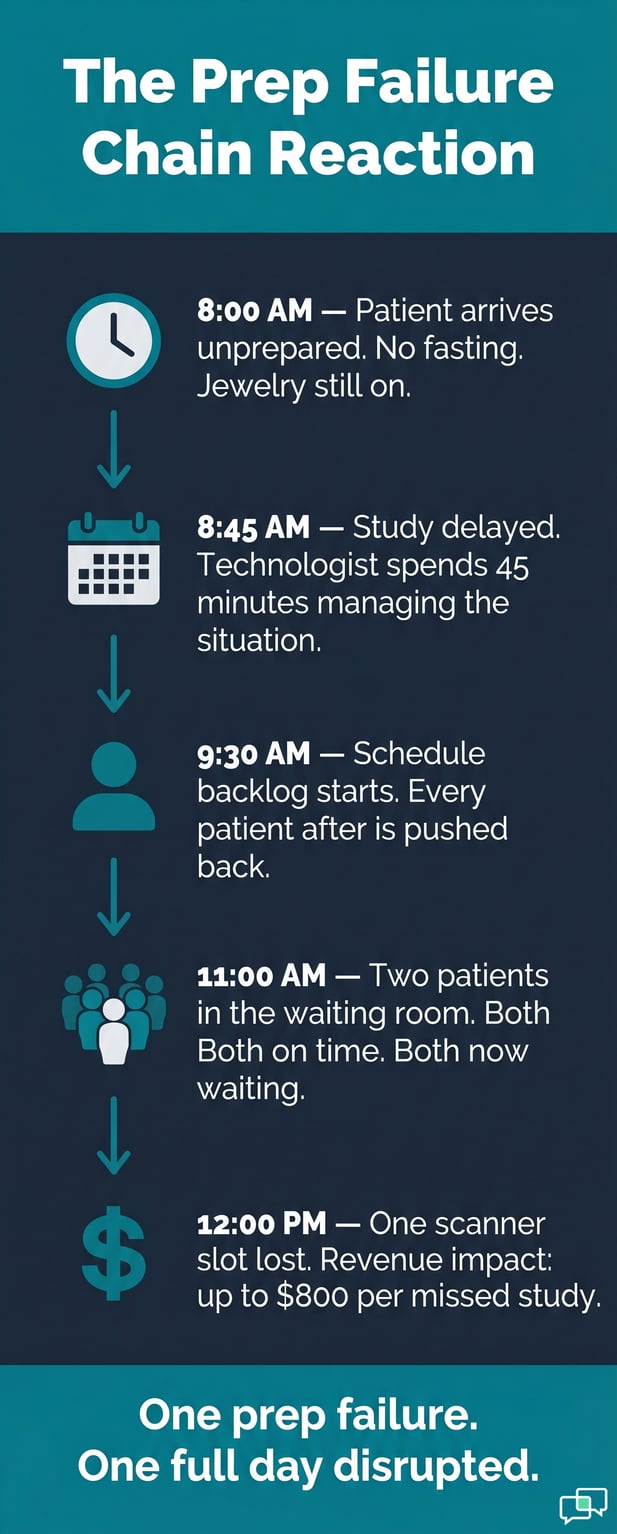
A patient books an MRI six weeks out. Life gets busy. By appointment day, they have forgotten every prep step the scheduler mentioned. No fasting. Jewelry still on. The medication they were told to hold is still in their system.
That single oversight delays the scan. Other patients wait longer. Staff scramble to adjust. The scanner sits idle for 45 minutes. All because prep instructions never reached the patient in a clear and timely way.
Most imaging centers still rely on phone calls to deliver prep instructions. But calls don't always get through. Voicemails go unchecked. When no clear guidance arrives, patients turn to the internet, where conflicting advice leaves them more confused than before.
The breakdown is common, and it is expensive. For a center running 80 scans a day, losing even four or five slots per week to prep failures can mean thousands in lost revenue each month.
Here is what works instead: sending radiology patient MRI CT prep instructions directly to a patient's phone, 48 hours before the study. Plain language. Numbered steps. A reply option so patients can confirm they read them. That is imaging study preparation handled through text, and it changes the outcome.
This article breaks down why prep instruction delivery fails, what a text-based solution looks like, and what happens to no-show rates and scanner use when the system works.
Curogram integrates with Exa PACS/RIS to automate the full prep instruction workflow. Each patient receives instructions tailored to their specific scan type. Staff can see real-time confirmation status without picking up the phone.
The Villain: The Prep Instructions You Never Got
Prep instruction failure is not a patient problem. It is a communication gap. Between the referral, the scheduling, and the actual appointment day, clear prep guidance often never reaches the patient. When it does arrive, it may be too vague, too late, or too hard to follow.
Referral-to-Imaging Handoff Failure
A patient is referred to an imaging center by their doctor. The referring office tells them, "The imaging center will contact you with prep details." The imaging center assumes the patient knows to call in. Neither side takes ownership. The patient gets nothing.
This handoff gap is common. Research across imaging practices suggests that 20 to 30% of referred patients never receive clear prep instructions before their study. Phone calls get placed. Lines are busy. Messages are left. But with no two-way channel and no tracking, there is no way to know who got the message and who did not.
Why Phone Calls Often Fall Short
Phone-based prep delivery depends on timing, reach, and follow-through from both sides. A front desk staffer calls during lunch. The patient is at work. A message is left, but the patient does not call back. Or calls after hours, when no one answers. The loop never closes.
For imaging centers handling dozens of studies per day, making individual calls to every patient is a drain on staff. It is also unreliable. A missed call is a missed prep instruction, and a missed prep instruction often means a delayed or rescheduled study.
What Patients Do Without Clear Instructions
Without guidance from their imaging center, patients search online. They find a mix of medical sites, hospital FAQs, and forum posts, each giving slightly different advice. "Fast from midnight." "Fast for four hours." "No water either." The confusion is real.
By the time the patient arrives, they may have followed the wrong steps, or none at all. They often don't mention it to the technologist until the scan is about to begin. At that point, the only options are delay or reschedule.
Unprepared Arrival = Delayed or Rescheduled Study
When a patient shows up unprepared, the delay is immediate. A CT patient who ate breakfast cannot receive contrast. An MRI patient who did not disclose a metal implant needs screening before entering the room. A mammography patient wearing metallic deodorant needs time to change. Each situation pushes the schedule back.
These delays do not stay isolated. One late start in the morning can ripple through every study that follows. Other patients wait longer. Staff lose time. And the scanner, one of the most expensive assets in the facility, sits idle while the team works around the problem.
The Ripple Effect of One Late Start
A single 30-minute delay at 8 AM can shift every study that follows. By mid-morning, the schedule may be running 90 minutes behind. Patients who arrived on time are frustrated. Staff are rushing. Radiologists waiting on images sit idle. One prep failure compounds into an operational setback that affects the entire day.
The Real Cost of a Missed Scanner Slot
An MRI scanner running at full capacity generates significant daily revenue. Based on our internal data, imaging centers that lose even five slots per month to prep-related issues could recover $4,000 or more by closing that gap. Losing scanner time is not just a scheduling inconvenience. It is a direct hit to the revenue report, month after month.

The Guide: Text-Delivered Prep Protocol
The prep instruction problem has a clear fix: send step-by-step instructions to the patient's phone before the appointment, with enough time to act on them. Automated text delivery handles this without adding work for staff. It reaches patients where they already are, and it gives both sides a record of what was sent and received.
Modality-Specific Text Instructions
Not all imaging studies need the same prep. A pelvic ultrasound requires a full bladder. An MRI requires a metal safety screening. A CT with contrast requires fasting and, in some cases, a medication hold. Sending the same generic reminder to every patient will not work.
Curogram connects to Exa RIS prep instruction workflows by reading the scheduling data for each appointment. It then pulls the matching prep template and sends it to the patient 48 hours before the study. No manual selection. No risk of sending CT prep to an MRI patient.
What Patients Receive Before Their MRI
A patient scheduled for an MRI gets a text that covers the safety screening process. The message walks them through metal implants, pacemakers, recent surgeries, and fasting requirements. It also tells them what to wear and how early to arrive.
Because MRI fasting instructions SMS delivery happens 48 hours in advance, patients have time to plan. They can pause medications, arrange support, or reply with questions before the day of the scan. Staff see those replies in real time and respond directly from the dashboard.
CT Contrast Prep Made Simple
CT contrast prep instructions text messages are designed to be direct and easy to follow. Patients get a numbered list: stop eating at midnight, hold metformin 48 hours before, skip the jewelry, and drink plenty of water after the scan. No medical jargon. No wall of text.
When the steps are simple and the channel is familiar, patients are far more likely to follow through. Compliance improves not because patients became more careful, but because the instructions finally made sense and arrived at the right time.
Clear Steps and Confirmation Reply
Busy patients do not read paragraphs. They scan for action items. Numbered steps, short sentences, and plain words are what get results. Curogram's prep texts are built this way: each instruction is a single line, and patients can confirm with one reply.
Radiology appointment reminders delivered through HIPAA texting include a simple call to action at the end: "Reply YES to confirm you are ready." That one reply tells the imaging center the patient received the message. Without it, the staff are guessing who is prepared and who is not.
The Confirmation Loop
Once a patient replies, their confirmation appears in the Curogram dashboard. Staff see at a glance which patients are confirmed and which ones have not responded. Those who have not replied can get a follow-up text or a targeted phone call, rather than calling the entire schedule.
This is the patient prep confirmation text workflow in action. It replaces the habit of calling everyone with the smarter approach of reaching only those who actually need follow-up.
Follow-Up Reminders That Close the Gap
A second reminder goes out 12 hours before the appointment. This gives patients who missed the first text a chance to catch up. It also reinforces key steps for those who read the first message but may have forgotten a detail by the morning of the scan.
Two touches. Confirmed receipt. Real-time tracking. That is the imaging center patient preparation text automation working as it should, without adding a single phone call to the staff's workload.
The Success: Every Slot Scanned. Every Patient Prepared.
When prep instructions reach patients clearly and on time, the results show up fast. Scanner slots stay full. Studies start on schedule. Patients walk in knowing what to do. Staff spend less time firefighting and more time on care.
Prep Compliance Rate
Text has a read rate that other channels cannot match. Based on our internal data, 85 to 95% of patients who receive text-delivered prep instructions read and confirm them within two hours. Patient portal uploads and in-office forms land somewhere between 40 and 50%. That gap explains a great deal.
When patients receive imaging center no-show reduction prep tools built around text, they engage. They do not have to log into a portal. They do not have to check their email. The message arrives on the device they already use, in a format they are used to reading.
Text vs. Other Delivery Methods: Completion Rate Comparison
|
Delivery Method |
Read / Completion Rate |
|
Text with confirmation reply |
85 to 95% |
|
Patient portal upload |
40 to 50% |
|
In-office paper form |
30 to 45% |
|
Voicemail |
20 to 35% |
Source: Based on our internal research.
From Anxious to Confident
Imaging studies, especially MRI and CT with contrast, carry real anxiety for first-time patients. When patients receive clear, official guidance from their imaging center, that anxiety drops. They know what to expect. They followed the steps. They arrive ready, not worried.
This shift changes the visit experience. Patients are more at ease. Technologists spend less time repeating basic instructions at the door. And patient satisfaction scores tend to rise when communication is clear and timely. Good prep is also good patient experience.
Clinical and Operational Outcome
Better prep compliance means fewer study delays. Fewer delays mean fuller schedules. And fuller schedules mean more revenue, not from seeing more patients, but from not losing the ones already booked. The clinical and operational gains happen together.
Based on our internal data, imaging centers using Curogram see no-show rates that are 53% lower than the industry average. For radiology, where the industry no-show rate averages around 18%, cutting that figure to 8% makes a real impact on daily throughput and monthly revenue.
Fewer Reschedules, Fuller Schedules
Each rescheduled study leaves a gap. That gap is scanner time that generates no revenue. If a center loses five MRI slots per month to prep-related issues, at roughly $800 per study, that is $4,000 in missed revenue. Based on our internal data, recovering those slots through better prep delivery can add $4,000 to $8,000 per month in recaptured revenue.
Radiology study preparation messaging is not just a patient experience upgrade. It is a scheduling and revenue tool with results you can measure in dollars.
Fewer Safety Issues, Faster Turnaround
Undisclosed metal in an MRI suite is a safety risk. A patient who did not stop metformin before contrast is a clinical risk. When radiology study preparation messaging is handled through a two-way text workflow, these risks come up before the patient reaches the scanner, not during the study.
Fewer last-minute safety holds mean technologists stay on schedule. Radiologists receive cleaner studies they can read quickly. And patients get their results sooner. Better prep delivery is better care, from scheduling all the way to the reading room.
Conclusion: The Prep-and-Confirm Engine
Exa PACS/RIS manages image storage and radiologist workflow with precision. But direct patient communication sits outside that system. The gap between scheduling a study and delivering clear prep instructions is exactly where delays, reschedules, and prep failures happen.
Curogram fills that gap. It connects to Exa's scheduling data, identifies the study type, and sends modality-specific prep instructions directly to the patient's phone, automatically and on time. Patients confirm. Staff track. The scanner keeps moving.
The outcome is measurable. Based on our internal research, imaging centers using Curogram see no-show rates 53% lower than the industry average, a 10 to 20% increase in recovered revenue, and a patient population that arrives prepared rather than confused.
This is not a complicated change. It is a communication workflow that already exists in most centers, made smarter and more reliable through automation. Phone calls are still there for edge cases. But for the other 90% of patients, a well-timed text is enough.
Ready to see how other imaging centers are cutting prep-related delays and recovering lost scanner revenue? Schedule a demo and see how Curogram works with Exa.
Frequently Asked Questions
Curogram reads the scheduling data from Exa PACS/RIS to identify the study type for each patient. It then matches the appointment to the correct prep template, whether for MRI, CT with contrast, ultrasound, or mammography. The text goes out automatically, 48 hours before the study. Your team configures the templates once, and the system handles the rest.
Text messages are read by 85 to 95% of recipients within two hours of delivery. Phone calls, by contrast, often go unanswered, and voicemails are checked at much lower rates. Texts do not depend on both parties being available at the same time. They also create a record the patient can refer back to, which reduces the chance of a forgotten step.
At the end of the prep instruction text, patients are prompted to reply with a simple "YES" or "OK" to confirm. That reply shows up in the Curogram dashboard in real time, marked against the patient's appointment. Staff can see at a glance who has confirmed and who has not, and they can follow up with unconfirmed patients directly.
Some prep steps require advance planning. Holding metformin before a contrast CT scan, for example, needs to start 48 hours in advance. Fasting schedules also need time to arrange around work and family. Sending instructions 48 hours out gives patients enough time to act on each step rather than scrambling the morning of the scan.
Many no-shows happen not because patients forgot the appointment, but because they forgot the prep steps, panicked, and avoided the visit altogether. When clear, timely instructions arrive by text with a chance to ask questions, patients feel ready and confident about showing up.
Based on our internal data, imaging centers using Curogram's automated reminders see no-show rates that are 53% lower than the industry average.