
10 min read

Text Your Imaging Center | Direct Patient Support Before MRI & CT

Text Your Imaging Center | Direct Patient Support Before MRI & CT
💡 When patients are referred to an imaging center for an MRI or CT scan, prep questions come up fast. Can they eat? Is their metal implant safe? Instead of waiting on hold or hoping for a callback, they can now text the imaging center directly for answers.

Curogram gives imaging centers a dedicated HIPAA-compliant SMS line. Patients use the texting app they already have. No app downloads. No patient portal login. Staff see the message and reply within minutes.

Based on our internal data, imaging centers using Curogram see appointment confirmation rates above 75%. Less anxiety. Fewer no-shows. More prepared patients. If your phone system is leaving patients without answers, direct two-way texting is the fix.

A patient gets a referral for an MRI. Their shoulder has been hurting for months. Their primary care doctor wants imaging done right away. The patient leaves the office with a piece of paper and a phone number.

They call the imaging center that afternoon. Nobody picks up.

They leave a voicemail. No one calls back that day.

The next morning, they try again. They sit on hold for eight minutes. When they finally reach someone, the staff member sounds busy and rushed.

The patient wants to ask if their titanium shoulder implant is safe for an MRI. They get a short, unclear answer. They hang up still unsure if their scan is even safe.

This happens every single day at imaging centers. Patients call, wait, and hang up without real answers.

Some cancel their study out of fear. Some arrive on the day of their scan without following prep instructions. The result is delayed care, lost revenue, and disappointed referring physicians.

There is a better way. When patients can text their imaging center with prep questions and get clear, fast replies, the whole experience changes. Anxiety goes down. Preparation improves. No-shows drop.

This article covers why phone-based patient communication fails at imaging centers. It also shows how two-way direct texting solves the problem from the first message.

Curogram integrates with Konica Minolta Exa to give imaging centers a dedicated HIPAA-secure SMS line. Patients text using the app already on their phone.

No downloads, no patient portal login. Staff reply through a shared inbox, often within two minutes.

When patients know they can get their radiology prep questions answered by text, the experience feels different from the start. That first clear, fast reply sets the tone for their entire visit. It signals that your center cares about the patient, not just the scan.

The Villain: The Voicemail Before Your MRI

Phone calls are still the main way most imaging centers handle patient questions. But phone calls fail patients more often than centers realize.

When the line is busy, and no one calls back, patients are left anxious and uninformed before one of the most stressful medical experiences they face.

When Patients Try to Reach You, They Hit a Wall

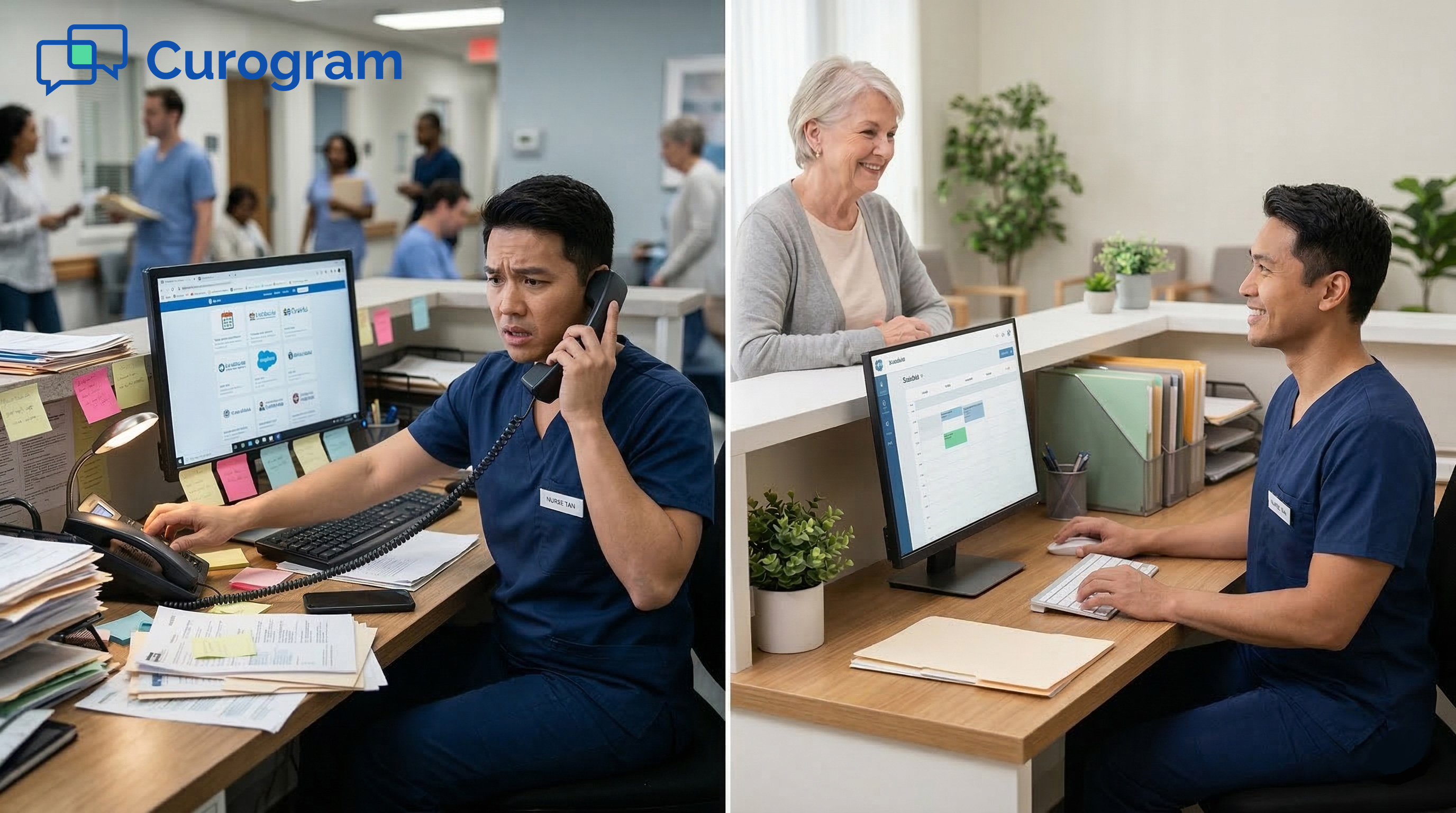
Imaging centers are busy places. Staff are scheduling, verifying insurance, and managing walk-ins all at once.

When a patient calls with prep questions, the timing is almost never right. The experience that follows often makes a bad situation worse.

The Safety Questions No One Answers

A first-time patient's imaging center communication experience often starts with fear, not confidence. The patient has been told they need an MRI.

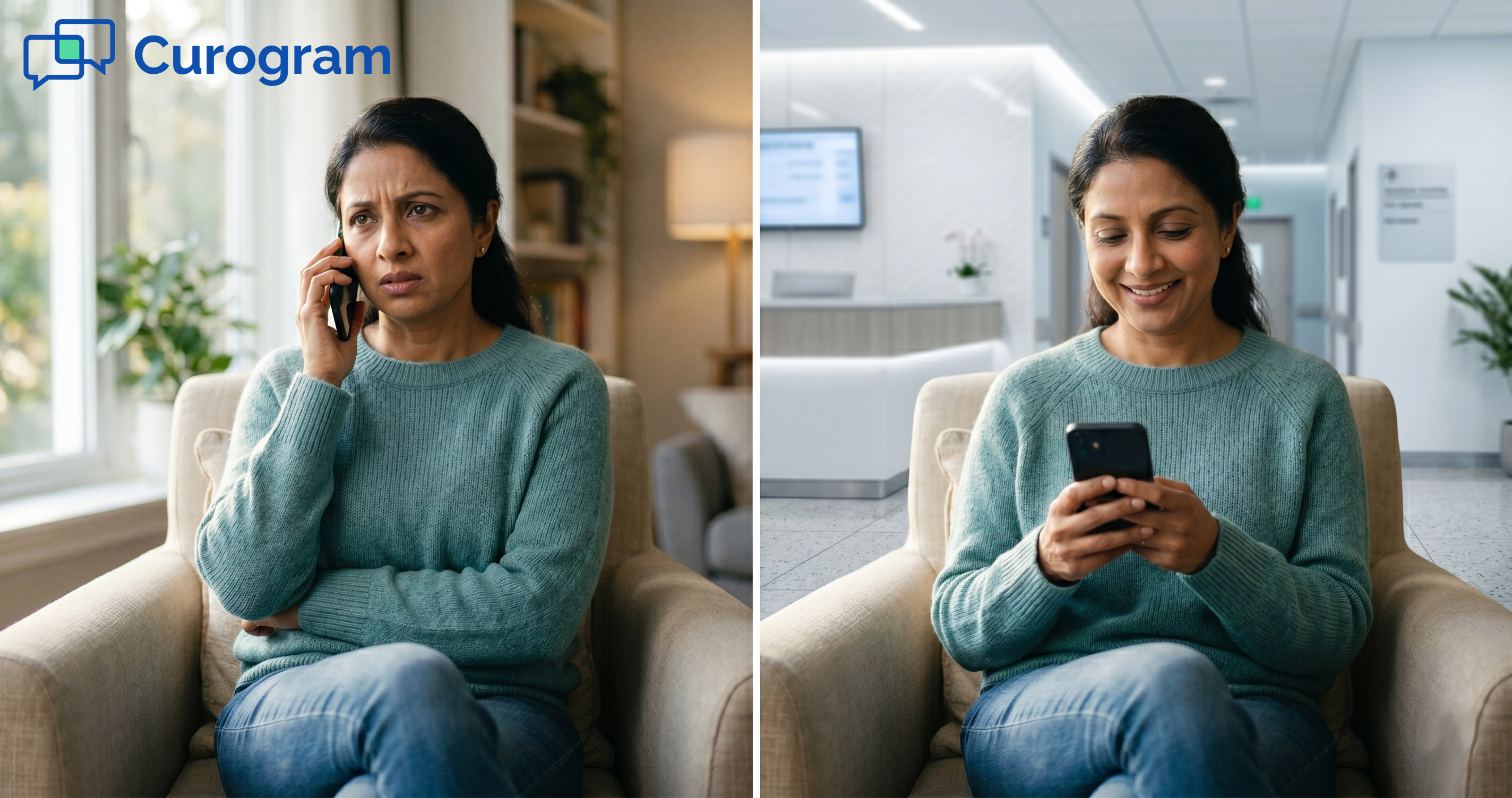
They have a metal implant. They want to know if the scan is safe. They call and get placed on hold. After five minutes, they hang up.

That night, they search online and find ten different answers that conflict with each other. Their anxiety grows. The questions patients have before a scan are real and important.

Is the implant safe? Do they need to fast before a CT? Will they feel pain during a contrast injection?

These are not small concerns. Left unanswered, they lead to cancellations and unprepared arrivals.

Three Calls. Still No Answer.

Many patients don't give up after the first call. They try again the next morning. The front desk is now handling insurance calls and other scheduling. They take a message and say someone will call back. That callback never comes.

On the third call, a staff member picks up but is between patients and gives rushed, incomplete answers. By this point, the patient has lost confidence in the center. Some decide to cancel.

Others consider switching to a different imaging center that offers online chat or email support. The imaging center loses a patient, and the referring physician loses the diagnostic result they were counting on.

What Happens When Prep Questions Go Unanswered

When patients don't get answers before their scan, the problems don't stop at anxiety. They show up in the waiting room, in the scan suite, and in the data that referring physicians depend on. Poor prep communication creates problems that ripple outward in every direction.

Patients Arrive Unprepared

A patient arrives for their MRI wearing a metal underwire bra. Another shows up for a contrast CT without knowing they have a kidney condition that affects contrast eligibility.

These are not rare events. They are the natural result of poor patient communication at the radiology imaging center level.

When patients are not prepared, scans get delayed or compromised. Technologists spend extra time screening patients who should have been cleared before arrival.

The scan suite falls behind schedule. Other patients wait longer, and study quality can suffer.

The Ripple Effect on Referring Physicians

Referring physicians expect results within 48 hours. When a study is delayed or canceled due to poor patient prep, those results don't come on time. The physician calls the imaging center. Trust erodes with every explanation.

Imaging center no-show reduction through text messaging directly affects how referring physicians view your center. When patients cancel at the last minute or fail to show up at all, the referring physician has sent a patient to your center who received no care.

Based on our internal data, each missed study can mean $800 to $1,500 in lost revenue, not counting the long-term cost of losing a referral relationship.

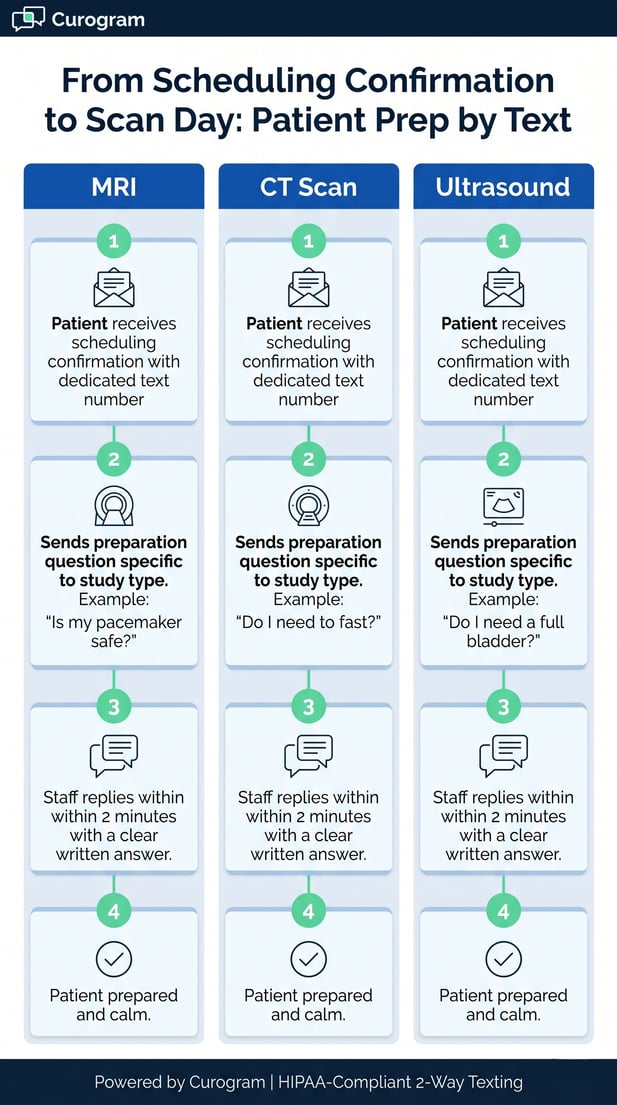
Text-based MRI patient preparation timeline with four steps

The Guide: Text Your Imaging Center

There is a simple fix to the phone tag problem, and your patients already use it every day. Two-way text messaging gives patients a direct line to your staff without a phone call, without a hold queue, and without the anxiety that comes from unanswered voicemails.

A Dedicated Line That Patients Actually Use

When imaging centers adopt direct text messaging through Curogram, the experience changes from the moment a patient books their scan. The scheduling confirmation they receive includes a dedicated SMS number.

The message is clear: "Have questions about your MRI? Text us here." Patients can reach out right away, on their own time, from any device they already own.

How the Text Line Works

The patient opens their regular SMS app and types their question. No portal login. No app to download. The message goes to a shared staff inbox in the Curogram dashboard. Staff see the message and reply within two minutes.

This is what imaging center patient support via text looks like in practice. A patient asks about fasting before their CT. Staff reply with the exact prep instructions for that study type.

A different patient texts a photo of their insurance card. Staff confirm coverage before the patient even arrives. Every exchange is logged, searchable, and HIPAA-secure.

HIPAA Texting and MRI Preparation Safety Checks

A common question from imaging centers is whether text messaging is safe for medical conversations. The answer is yes, when done through a HIPAA-compliant platform.

HIPAA texting for MRI preparation and other sensitive pre-scan questions is fully supported through Curogram.

All messages are encrypted during sending and when stored. Curogram operates under a Business Associate Agreement (BAA) with your center and is SOC 2 Type II certified.

Staff can answer questions about implant safety, contrast allergies, and medication use without any compliance risk. The text channel is as secure as your EHR.

How It Works Across Study Types

Different scan types come with different prep needs. The same text line handles all of them. Staff can answer questions specific to MRI, CT, ultrasound, or contrast studies through one shared inbox. Patients get the right answers for their specific study every time.

MRI, CT, and Ultrasound Questions via Text

For MRI studies, patients often ask about metal implants, pacemakers, pregnancy, and claustrophobia. These are safety-critical questions that affect whether a scan can happen at all. When answered before the patient arrives, the technologist can set up correctly and greet a prepared patient.

For CT studies, patients are asked about fasting. For abdominal ultrasounds, they need to know about a full bladder. For pelvic studies, the prep is different still.

Texting lets staff send the right instructions for the right study, without asking the patient to call back to confirm.

Real-Time Screening Before the Scan

For studies that involve contrast injection, real-time screening via text is a major time-saver. Patients can be asked about allergies and kidney function before they ever leave the house. If a concern comes up, staff can flag it in Curogram and have a plan ready before the patient arrives.

This is where patient anxiety reduction during radiology prep is most effective. A patient who knows their contrast question has been reviewed and cleared feels far more at ease walking into the scan suite.

Instead of waiting until arrival to find out there may be a problem, the issue is handled ahead of time, every time.


The Success: Prepared Patients, Reduced Anxiety, Zero Empty Slots

When patients get their questions answered before their scan, the benefits reach every part of your center. Staff spend less time on the phone.

Technologists work with prepared patients. Scan suites stay on schedule. And referring physicians get their results on time.

Faster Replies, Calmer Patients

Text messages get read. Open rates for SMS messages top 90% within the first two minutes. When patients receive fast, clear replies to their prep and safety questions, their anxiety drops before they ever walk through your door.

Why Speed Changes the Patient Experience

Patient anxiety reduction during radiology prep doesn't require a long counseling session. It requires accurate, timely information.

A patient who texts "Is my pacemaker safe for an MRI?" and gets a clear reply within two minutes feels supported and seen. A patient who calls and gets a voicemail feels abandoned.

Speed builds trust. When patients see that your center responds quickly, they show up on time and with confidence. They know what to expect. They have followed the prep instructions. They are ready for their scan.

The Link Between Prep and Scan Quality

Prepared patients don't just show up on time. They show up correctly. No metal jewelry. No missed fasting window. No unreported kidney condition that complicates a contrast study.

When patients receive and understand their instructions via text, the information sticks in a way that a rushed phone call never can.

Texts are written down. Patients can re-read them the morning of their scan. They can forward them to the family member who is driving them. This alone reduces setup delays in the suite and improves the quality of the diagnostic result.

What This Means for Your Center

Better patient prep has a direct effect on your center's performance. Scans happen on time. Staff are less reactive. The data backs this up in clear, measurable ways.

No-Show Reduction and Revenue Impact

Based on our internal data, imaging centers using Curogram see appointment confirmation rates above 75%, with the process fully automated.

Our internal research also shows that Curogram's no-show rates run 53% lower than the industry average. For context, one no-show can mean $800 to $1,500 in lost scan revenue.

Imaging center no-show reduction through text messaging doesn't just save one slot. It protects the relationship with the referring physician who sent that patient. When patients show up prepared and on time, the entire referral cycle works the way it should.

Impact Summary: Text Messaging vs. No Text Messaging

Metric

Without Text Messaging

With Curogram Texting

Appointment Confirmation Rate

Often below 60%

Above 75% (based on internal data)

No-Show Rate

Industry avg. ~14%

Up to 53% lower than industry avg.

Staff Time on Phones

60+ minutes per day

Significantly reduced

Patient Prep Compliance

Low without clear instructions

Higher with written text instructions

Revenue Risk

High from last-minute cancellations

Protected by confirmed, prepared slots


Referring Physician Satisfaction

Referring physicians measure your center by one thing: did their patient get imaged on time, and were the results ready when promised?

When Curogram handles first-time patient imaging center communication and prep, the answer to both questions becomes yes more often.

When physicians see that their patients are arriving prepared and on time, they notice. Repeat referrals follow. Based on our internal data, centers that improve confirmation rates see a 10 to 20% increase in revenue as recovered appointments contribute directly to the bottom line.

That kind of growth doesn't come from a new scanner. It comes from better patient communication at every step.

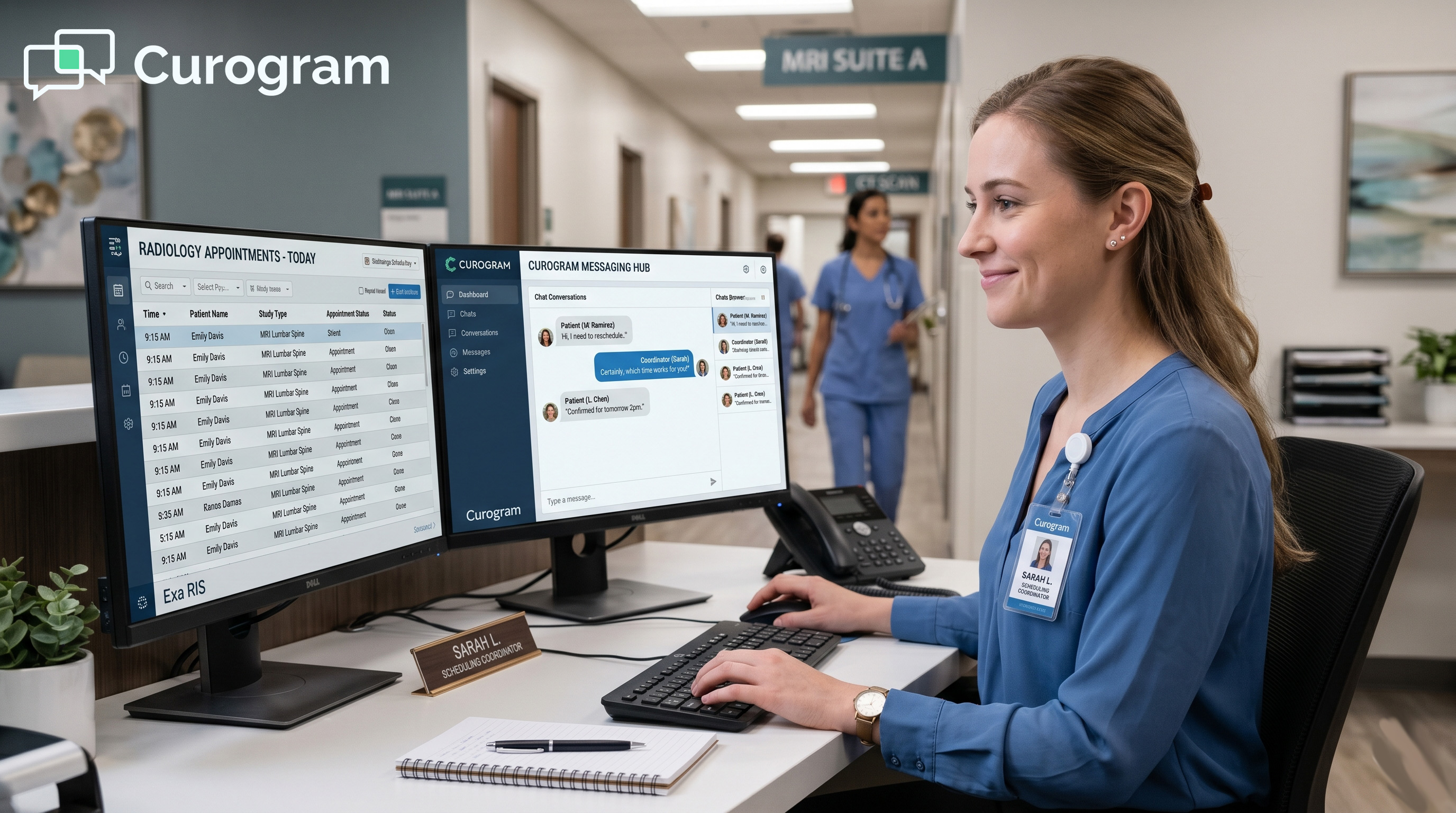
Smiling medical receptionist at a desk managing patient text communications

Conclusion: Your Images Are World-Class. Your Patient Communication Should Match.

Konica Minolta Exa is built for imaging workflow. It handles scheduling, DICOM archives, and radiology reports at scale. What it doesn't include is direct patient communication. That's where Curogram comes in.

Curogram integrates directly with Konica Minolta Exa. The two platforms work together, each doing what it does best. Exa manages the clinical workflow. Curogram manages the patient relationship before, during, and after the scan.

Exa is a world-class imaging platform. It stores and routes DICOM images, manages radiology reports and read workflows, and handles scheduling and study tracking at scale. For a high-volume imaging center or radiology group, Exa is built for the diagnostic side of the operation.

But Exa is not designed to send a text to a nervous patient asking if they can wear their hearing aids into the MRI suite. That gap in patient communication is exactly where Curogram steps in.

Curogram fills the patient communication gap that every imaging platform leaves open. When a patient is booked in Exa, their scheduling confirmation can include a Curogram text number. From that point on, all patient communication flows through Curogram's two-way HIPAA-secure SMS inbox.

Your scanner may cost a million dollars. Your patients deserve communication that matches that level of care. Curogram gives them a way to reach your team quickly, get answers before their scan, and arrive confident and prepared.

Switching to direct text messaging is not a major overhaul. It works alongside your existing Exa system. And the cost is a fraction of what enterprise patient engagement platforms charge.

Enterprise patient communication platforms can run $2,500 per month or more. Curogram delivers the same two-way HIPAA-compliant texting at a cost that fits independent imaging centers and smaller radiology groups, the same groups that Exa was built to serve.

This makes imaging center patient support via text accessible for centers that don't have large IT budgets. You get the security, the features, and the patient experience improvement at a price that makes sense for your practice size.

87% of healthcare patients prefer text messages for appointment and prep information. Your current phone-based system is working against that preference. Every unanswered call is a missed chance to reduce patient anxiety and confirm a slot.

Patient communication at radiology imaging centers is changing. Patients expect the same ease they get from retail and banking: a quick text, a fast reply, a clear answer.

Curogram aligns your center with that expectation. It's HIPAA-secure, requires no new software for patients, and based on our internal data, it works.

Ready to see how it fits your center? Request a personalized demo to see Curogram and Exa in action together.


Frequently Asked Questions

How does texting help reduce patient anxiety before a radiology scan?

When patients can text their imaging center with prep and safety questions, they get clear answers fast. Knowing their implant is compatible, or that fasting instructions are simple, removes the fear of the unknown.

Text replies can be re-read, shared with a family member, or saved for the morning of the scan. That easy access to information reduces worry in a way that a busy phone line never can.

Why is HIPAA compliance important when patients text an imaging center?

Health information shared over text must be protected under HIPAA. If a patient texts about a kidney condition, a metal implant, or a contrast allergy, that message contains protected health information.

HIPAA-compliant platforms like Curogram encrypt messages during sending and when stored, and operate under a Business Associate Agreement with your center. This means patients and staff can exchange sensitive prep information safely.

How does direct texting help imaging centers reduce no-shows?

Patients are far more likely to show up when their questions have been answered and their prep instructions are clear. Text reminders sent before a scan have an open rate above 90%, much higher than phone calls or emails.

When patients confirm their appointment by text, staff know in advance who is coming and who may need a follow-up. Based on our internal data, imaging centers using Curogram see no-show rates up to 53% lower than the industry average.

How quickly can imaging center staff respond to patient text messages?

Staff respond through a shared inbox in the Curogram dashboard, which shows all incoming patient messages in real time. Most replies go out within two minutes during regular business hours.

After hours, patients can still text, and staff reply when they open the inbox the next morning. Common questions about prep instructions or arrival directions can also be handled with saved message templates for faster turnaround.

Why do patients prefer texting over calling an imaging center with prep questions?

Patients prefer texting because it fits into their schedule. They don't have to block off time to make a call, sit on hold, or wait for a callback. They can send a message at 10 PM the night before their scan and know a reply will be waiting for them. Text is also written, which means patients can re-read their prep instructions as many times as they need.