

8 min read

Patient Review Privacy for Opus EHR Behavioral Health

Patient Review Privacy for Opus EHR Behavioral Health
💡 Patient Google review experience for Opus EHR behavioral health programs needs a privacy-first approach. Stigma, employer fears, and insurance worries keep grateful patients silent. Curogram sits next to Opus and sends a post-visit text that never names the clinic as a behavioral health provider.

This 42 CFR Part 2 compliant review solicitation gives patients a one-tap path to Google Reviews on their own terms. Patients who tap five stars are routed to Google. Patients who rate low are routed to private feedback.

Curogram client data from clinical settings shows 90% of surveyed patients leave 5-star reviews. One multi-location practice grew from 993 baseline reviews to 8,159 total reviews. The result: a safe channel for recovery stories that helps the next person find quality care.

A patient finishes their last IOP session. The counselor says, “You did the work.” The patient agrees. This place pulled them back from the edge.

Then they think of the next person. Someone at 2 AM, typing “best treatment near me” with shaking hands. They want to say, “Go here. It is real.”

But no one ever asked them to leave a review. No card. No link. No follow-up text after the visit ended.

Even if there was, would they feel safe? Will their name show on a public page? Will their boss see? Will the insurer find out?

The gratitude stays locked inside. The Google profile stays at 14 reviews. A louder rival with 400 reviews wins the next search. Not because it is better, because it asked.

That gap follows a script you can recognize. Stigma keeps SUD patients quieter than dental or eye care patients. Fear of exposure beats out gratitude every single time. Until someone removes the fear.

This is the patient Google review experience for Opus EHR behavioral health privacy gap in plain view. Opus runs your clinical side with strength. It just does not ask for reviews. The platform was not built for that.

A strong Google profile is not a luxury for treatment programs anymore. Referral sources check it before they call.

Insurance case managers click it before they list you. Scared patients at 2 AM scroll it before they dial.

A thin profile costs you admissions, even with great outcomes. Your best stories stay locked behind privacy walls. Clinical wins never reach the people who need help most.

The fix is not louder marketing. It is a private way to invite each patient to share. Let me show you how that works in real practice. 

The Villain: The Silenced Voice

Every program has voices that go unheard. In behavioral health and SUD treatment, the silence runs deeper than anywhere else in healthcare. Let us name the villain holding your Google profile down.

The Reality

Opus EHR is built for clinical care. It manages charts, schedules, notes, and billing well. It does not include a patient-facing review tool. There is no built-in survey, no SMS prompt, and no link sent after a session ends.

That gap matters more in behavioral health than in any other field. Patients leaving a dental visit will leave a 5-star review without much thought. Patients leaving an SUD program rarely do, even when grateful.

Why? Stigma. Naming a treatment program in public can feel like outing yourself. So organic reviews stay low, and Google profiles stay thin.

The Agitation

A patient just finished 12 weeks of IOP. They want to thank the program. They want to tell someone scared and searching that this place is the real thing. But there is no path.

Even when they think about leaving a review, the fear kicks in. Will my employer see this? Will my family read it? Will my insurance company flag me later?

So the post stays in their head. The facility has 14 lifetime reviews. Most are old. A negative one from 2022 sits at the top.

The Consequence

This silence is not random. It compounds month after month. Fewer reviews mean lower local search ranking. Lower ranking means fewer patient inquiries.

Fewer inquiries mean a lower census. Lower census means fewer patients to ask. The loop tightens with every quiet week.

Now compare your profile to a louder rival across town. They have 400 reviews and a 4.6-star average. Their clinical outcomes are nothing special. But they show up first when someone searches “treatment near me.”

Referral sources notice this, too. Hospital discharge planners check Google before they pick a partner. So do insurance case managers and EAP coordinators. A thin profile signals risk, fairly or not.

The Result

Inside your walls, the clinical wins keep coming. Patients hug counselors at discharge. Families call to say thank you. Alumni text to share two-year sobriety milestones.

Outside your walls, none of that shows. Your Google profile reflects 1% of the real story. The other 99% lives only in your private notes.

That gap is the silenced voice. It is the space between clinical truth and online presence. And it sits in plain sight, every day, on every search.

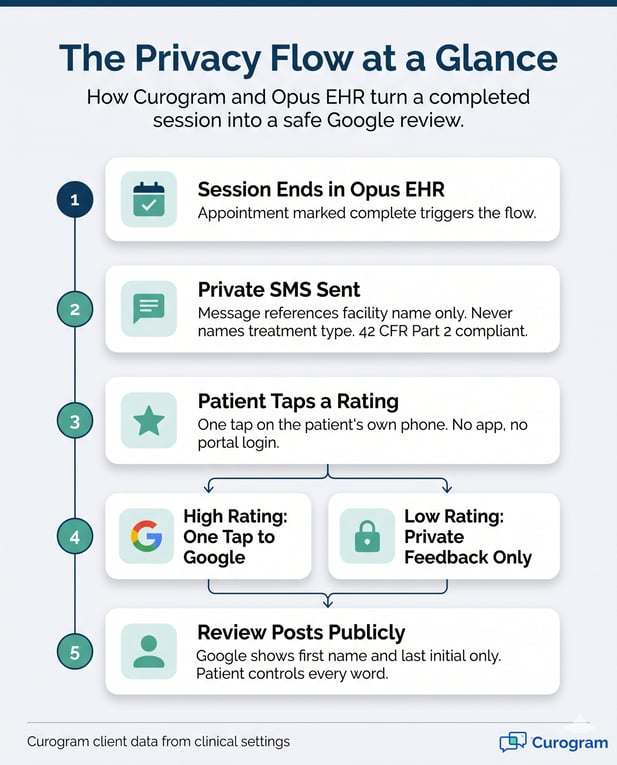
An infographic detailing the HIPAA-compliant process for securing online reviews in behavioral health

The Guide: The Safe Channel

If the silenced voice is the villain, the guide is the safe channel. Curogram sits next to Opus EHR and gives patients a private way to share. The whole flow is built around their fears, not your marketing goals.

The Solution

Curogram works alongside Opus, not inside it. When a session is marked complete in Opus, Curogram triggers a simple SMS. The text goes to the patient’s own phone. No app, no portal login, no staff member watching.

The message is short and respectful. It asks how the visit went. It links to a quick rating step. Patients who tap the high stars get a one-click path to Google.

Patients who tap low stars get routed to private feedback only. If a patient ignores the text, nothing happens. No second prompt. No staff follow-up.

The Feature

The privacy protections run through every step. Safe recovery story sharing on Google Reviews depends on this kind of layered design. Patients control what they say, where they say it, and whether they say it at all.

How the SMS Reads

The text never names the facility as a behavioral health or SUD provider. It just lists the practice name. To anyone glancing at the patient’s phone, it reads like a standard post-visit survey. This 42 CFR Part 2 compliant review solicitation keeps treatment type out of the message stream.

How the Review Itself Stays Private

Patients write their own words. There is no coaching, no suggested text, and no need to mention treatment type at all. Google shows first name and last initial only by default.

That anonymous recovery review for behavioral health Opus EHR practices is the standard flow, not a special workaround.

The Integration

Curogram does not require code changes inside Opus. There are no API fees for this feature. Setup takes a few days at most. Staff training runs under 10 minutes.

After setup, the system runs itself. Sessions in Opus trigger surveys at smart times. Two hours after a quick outpatient visit. Next day after IOP.

The clinical team treats patients. Curogram handles the rest in the background. No one has to remember to ask. No one has to track who got asked.

The Recovery Advocacy Fit

This part matters in behavioral health more than in any other field. Many recovery models stress helping others as part of staying well.

Twelve-step programs call it service work. Peer support groups call it giving back.

A Google review can be a small act of service. “I am sharing so the next person knows.” That is patient advocacy through Google reviews for SUD users when given a safe channel.

The barrier was never willingness. It was the mechanism. Curogram is the mechanism.


The Success: The Amplified Voice

What happens when patients get a safe channel? They show up. They share. They build the profile that helps the next person walk through your door.

Here is what that looks like, in numbers and in scenes.

The Metric

Curogram client data from clinical settings shows what unlocked sharing looks like. 90% of surveyed patients leave 5-star reviews when prompted through the automated text. One multi-location practice grew from a 993-review baseline to 8,159 total reviews over time.

For a treatment facility starting at 14 reviews, even the first 30 days can flip the page. A thin profile becomes credible. A credible profile becomes a referral magnet.

The growth pattern shows up clearly in real practice data:

Month

Total Reviews

August 2023

993

December 2023

2,260

June 2024

4,771

December 2024

8,159


That growth came from automated surveys alone. No staff asks. No paid services. Just a private invite at the right time.

The Shift

The change is more than a higher star rating. It is the amplified voice. Patient stories told on their own terms, in their own words.

The Google profile fills with real reviews.

“Compassionate staff.”

“Professional treatment.”

“Saved my life.”

Each one is a small piece of stigma chipped away.

This is treatment normalization at scale. One review at a time. One patient at a time. The community starts to see what your team has known all along.

The Outcome

Picture a patient who finished IOP three months ago. They are stable in recovery. They open their phone and see a simple text. “How was your experience at [Facility Name]?”

They tap 5 stars. A second message appears. “If you would like to help others find quality care, share here.” One tap opens Google.

They write: “Compassionate staff, professional treatment, changed my life.”

Two minutes total. That review joins 185 others on your profile.

The next person searching at 2 AM finds it. They read those words. They find the courage to call your admissions line. That is the amplified voice in motion.

A patient at home with coffee and smartphone, reflecting during a private review session

Conclusion: Give Your Patients a Voice That Helps Others Heal

Treatment programs spend years building clinical excellence. The team trains hard. The protocols sharpen. The outcomes improve.

But all that work stays invisible without a way for patients to share what they got. That is the gap Opus EHR alone cannot close. Opus runs the clinical side well. It just was not built to ask for reviews.

And in behavioral health, no other field needs more help in asking. The fix is not louder marketing. It is not paid review services or fake ratings.

It is a private channel that honors patient fears. And it turns gratitude into a public voice. Curogram is that channel. It sits next to Opus EHR.

It sends a post-visit text that never names the program as a behavioral health or SUD provider. It routes happy patients to Google with one tap.

It routes upset patients to private feedback only. It treats every patient as a person, not a marketing asset.

Curogram client data from clinical settings shows this approach works. 90% of surveyed patients leave 5-star reviews when given the chance. One multi-location practice grew from 993 baseline reviews to 8,159 total.

The voice was there the whole time. Patients were just waiting for a channel that respected them first. Behavioral health patient review privacy in Opus practices used to mean silence.

Now it can mean a stream of real reviews. Built one patient at a time. With every privacy guardrail in place. This is the stigma-free review process for addiction treatment that real recovery deserves.

Think back to the patient at the start of this article. The one who finished IOP and wanted to help the next person. Think about the 2 AM searcher with shaking hands.

The path between them is short. It just needs a bridge that respects both ends. That bridge is the safe channel. It is the patient who shares because someone gave them a private way to share.

Your program changed lives this month. Last month, too. The month before that. Those wins deserve to be visible to the next family making the hardest call of their life.

Every completed session is a chance for a patient to help someone else find what they found. Some will say yes. Some will say no. All will have the choice.

Many will write the review that changes someone’s search results at 2 AM. That is the work. That is the win. Your best outcomes deserve to be seen.

Schedule a demo to see how Curogram fits next to Opus EHR.  


Frequently Asked Questions

How does Curogram protect patient privacy during the review request?

The system never names your program as a behavioral health or SUD provider in the SMS. The text just references the facility name, in line with 42 CFR Part 2. To anyone glancing at the phone screen, it reads like a standard post-visit survey. Patients keep full control over what they say in any review they choose to write.

Why do behavioral health programs see fewer Google reviews than other practices?

Stigma is the main reason. Many patients fear that posting about treatment will expose them to employers, family, or insurers. Without a private, respectful invite, gratitude stays inside the visit. A safe channel removes the fear and unlocks the voice.

How long does it take to set up Curogram alongside Opus EHR?

Setup runs in days, not months. There is no code work needed in Opus and no extra API fees for this feature. Staff training takes under 10 minutes total. After that, Curogram triggers surveys based on completed sessions in your schedule.

Why does a Google profile matter so much for admissions in SUD treatment?

Most new patient leads see your Google profile before your website. So do hospital discharge planners, EAP coordinators, and insurance case managers. A thin profile signals risk to all of them, fairly or not. A strong profile signals trust and drives both direct inquiries and referral source confidence.

How does Curogram handle a patient who has a poor experience?

Patients who rate low are routed to private feedback only, never to Google. Their concerns go straight to your team in private. You get a chance to address the issue before it ever shows up in public. That protects both the patient relationship and your online reputation.


Intercept Negative Reviews | The Private Release Valve

Intercept Negative Reviews | The Private Release Valve

💡 To mitigate negative patient reviews for Prime Clinical users, the most effective approach is a smart routing survey system.This system sends a...

Read More
Practice Fusion Reputation Management | Automated Google Reviews

Practice Fusion Reputation Management | Automated Google Reviews

💡 Practice Fusion automated Google review requests, powered by Curogram's Review Engine, send a post-visit text to every patient after each...

Read More
Reputation Management for Independent StreamlineMD Centers

Reputation Management for Independent StreamlineMD Centers

💡 Patient reviews healthcare consumers read on Google now drive most imaging center choices. Around 90% of new patients check ratings before...

Read More