8 min read

Google Reviews for Opus EHR Practices: New 5-Star Reviews in 3 Months

Google Reviews for Opus EHR Practices: New 5-Star Reviews in 3 Months
💡 Automated Google reviews for addiction treatment Opus EHR practices fix a quiet gap. Opus EHR runs your clinical work well. But it has no built-in tool for review solicitation. That leaves great programs invisible online.
Curogram fills that gap.

After each visit, patients get a private text. Happy patients are sent straight to your Google profile. Unhappy patients are routed to private feedback first.

Based on our internal data, one multi-location practice earned 1,064 new 5-star reviews in just 3 months. 90% of surveyed patients left 5-star ratings. For behavioral health and SUD care, that visibility drives real admissions.

Your program saves lives. Your Google profile says otherwise. That gap is more common than most clinical directors realize. And it costs admissions every single month.

Opus EHR is built for clinical work. It handles intake, notes, and billing. But it offers no automated patient surveys Opus EHR teams can use to ask for feedback. So no one asks. The reviews never come.

Meanwhile, the new center down the road keeps growing. They have 200 reviews and a 4.7-star rating.

Your program has 18 reviews and a 3.4. A hospital discharge planner searches for help. They click the higher-rated option.

This is where automated Google reviews for addiction treatment Opus EHR practices change the math. The system runs in the background.

After each visit, a text goes out. Happy patients tap once. Their review lands on Google.

That single shift solves the Opus EHR reputation management behavioral health problem at the root. It is not about marketing tricks. It is about giving grateful patients a quiet, private way to speak up.

Stigma is real in SUD care. Many patients want to help others find good treatment. But few will post about rehab on their own. A private SMS prompt gives them the door. It does not push. It just opens.

Behavioral health Google Business Profile optimization is now a census tool. 90% of new leads check your Google profile before your site. A thin profile loses to a strong one. Every time.

In this guide, we will walk through three shifts: the villain blocking growth, the guide that fixes it, and the visible program your clinical work deserves to be. Each shift maps to a real fix you can run. 

The Villain: The Invisible Program

Most Opus EHR practices have a strange problem. The care is great. The outcomes are real. But the online story does not match.

This section unpacks why that gap exists and what it costs your program each month.

The Gap Inside Opus EHR

Opus EHR handles the core clinical workflow well. Intake, notes, MAT, billing, and e-prescribing all run inside the platform.

That is what it was built for. But the review solicitation behavioral health Opus EHR teams need is not part of the system.

There is no built-in survey trigger after a visit. No SMS prompt. No way to guide a happy patient to Google in one tap. So the work falls to the staff, and they are busy. The ask never happens. The reviews never land.

Stigma Suppresses Organic Reviews

Addiction treatment carries real social weight. A patient who loved their dentist will share it freely. A patient who finished IOP will not. They worry about employers, family, and stigma. So they stay quiet.

That silence is the heart of the Google reviews SUD treatment facility problem. Without a private nudge, even your best alumni stay invisible. The clinical wins never reach the people searching for help.

Negative Reviews Carry Outsized Weight

When you only have 18 reviews, three negative ones break the score. One angry ex-employee. One billing complaint. One family is upset about the visitation. Now your rating sits at 3.4. The math is brutal.

A larger review base absorbs the noise. 200 reviews with a 4.6 average can hold a few one-stars without much damage. But thin profiles cannot. Every bad review hits the rating like a hammer.

What This Costs Your Program Each Month

Empty beds and unfilled IOP slots are not just numbers. Each empty residential bed can cost $10,000 to $20,000 a month in lost revenue. Each unfilled IOP slot runs $250 to $400 a session. The bleed adds up fast.

Worse, you cannot see it happening. Referral sources do not call to say they picked another center. Patients who search and click your competitor never tell you. The referral drought is invisible until your census drops.

Referral Sources Check Google First

Hospital discharge planners, EAP coordinators, and case managers all check Google before they pick a center. They want quick proof of quality. A strong profile is that proof. A weak one is a red flag.

Your online reputation addiction treatment center decisions are being made by people you may never meet. Reviews are the silent vote that decides where patients go next. Strong programs need a strong online voice.

The pattern repeats every week. A planner gets a discharge to place. They open Google Maps. Two centers pop up. One has 200 reviews. One has 18. The choice is made in seconds. Your strong outcomes never enter the conversation.

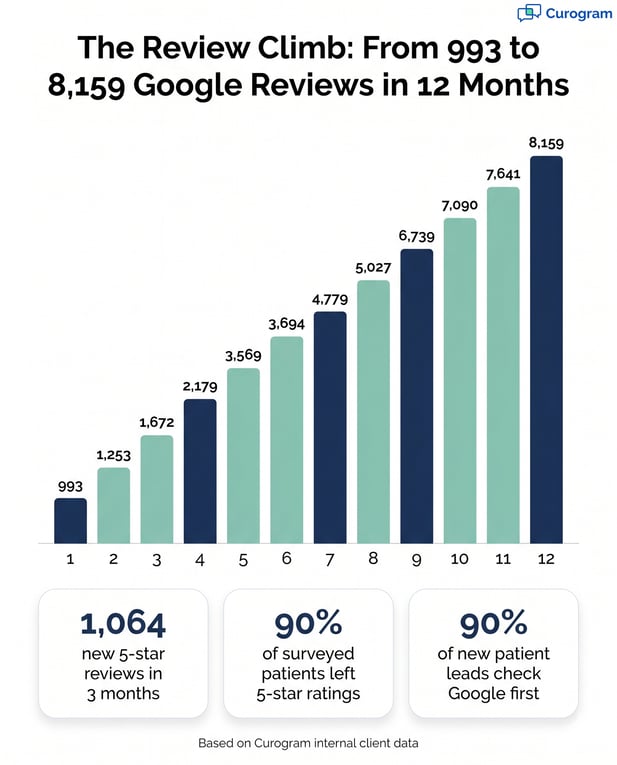
Behavioral health Google reviews growth chart from Curogram client data

The Guide: The Trust Builder

There is a simple fix for the gap Opus leaves open. It does not change your clinical workflow. It does not add work for your staff. It just turns each visit into a quiet chance to grow your online voice.

How the Automated Survey Flow Works

Curogram sits next to Opus EHR. When a visit ends, the system sends an SMS survey to the patient. The text is short. It asks how the visit went. That is the first step in the review path.

A happy patient taps a 5-star rating. They are sent straight to your Google Reviews page. One tap. Their review is live. The system does not write the review. The words are all theirs.

Negative Feedback Stays Private First

If a patient reports a poor visit, the survey routes them to private feedback. Your team gets a chance to fix the issue before it lands on Google. This is service recovery, not review filtering.

Many concerns are simple. A billing question. A wait time gripe. A scheduling mix-up.

Solve them in private, and most patients move on. Some even leave a 5-star review later, once their issue is handled.

Built for Behavioral Health Privacy

The SMS is private. No staff watching. No clipboard. No pressure. The patient answers from their own phone in their own time. That fits the trust we ask of behavioral health and SUD care.

The prompt is optional. The words are theirs. No coaching. No scripts. Just a clean path for the people who want to help others find good treatment to actually do it.

Why This Fits Opus EHR Practices

Opus EHR does not need to be replaced. Curogram works alongside it. The review trigger fires off the appointment workflow. No staff action required. The reviews grow while your team focuses on care.

Setup takes days, not months. Staff training runs under 10 minutes, based on our internal data from clinical settings. The system is built for small and mid-sized practices that cannot afford a long rollout.

Opus EHR Alone vs. Opus EHR + Curogram

Review Task

Opus EHR Alone

Opus EHR + Curogram

Post-visit survey

Manual or none

Automatic SMS

Google review prompt

Not included

One-tap link

Bad review routing

Goes public

Private first

Staff time per ask

5 to 10 minutes

Zero

Review velocity

Slow and uneven

Steady and rising


The result is a steady drip of fresh, real voices. No staff time. No clipboards. No awkward in-person asks. Just a system that runs in the background while your clinical team stays focused on care.


The Success: The Visible Program

When the review system runs in the background, the change shows up fast. Profiles that sat quiet for years start to move.

This section walks through the shift, the numbers, and what it means for your daily admissions work.

The Numbers Behind the Shift

Based on our internal research, a multi-location practice using Curogram earned 1,064 new 5-star reviews in just 3 months. 90% of surveyed patients left a 5-star review. The practice grew from about 993 baseline reviews to 8,159 over the campaign window.

That kind of volume reshapes a profile. A 3.4-star center with 18 reviews can climb past 4.5 stars within a quarter.

Google's local algorithm rewards review count, recency, and rating. Steady volume keeps you climbing.

Review Velocity Signals Trust

Google reads steady, recent reviews as a sign of a live, trusted business. A profile with 50 new reviews this quarter ranks higher than one with 50 reviews from three years ago. Velocity matters as much as volume.

This is the core of behavioral health Google Business Profile optimization. You are not chasing a one-time spike.

You are building a steady drip of fresh voices that keeps you near the top of Maps results.

Alumni Become Your Best Reviewers

Many recovery patients want to give back. The automated SMS gives them a quiet way to do it.

Alumni reviews often carry the strongest stories. Stories of hope, change, and gratitude land harder than any ad copy.

Those voices help the next person searching. A parent looking for help for a son. A spouse looking for a way out. They read those words and feel safe picking up the phone to call your center.

What the Visible Program Looks Like Day to Day

Picture a quarterly review at an Opus EHR behavioral health center using Curogram. Three months back, the profile had 22 reviews and a 3.6-star rating.

Today, it shows 186 reviews and 4.7 stars. The shift is visible on the first page of search.

The admissions director reports a 30% lift in direct patient inquiries from Google.

Two new referral relationships with hospital discharge planners have opened up. Both planners named the Google rating as a factor in their choice.

Before and After: A Sample Reputation Shift

Metric

Before Curogram

After 3 Months

Total Google reviews

22

186

Average star rating

3.6

4.7

Direct Google inquiries

Baseline

+30%

New referral partners

0

2


This is the visible program in action. The clinical work was always strong. Now the online story matches.

That match is what turns referral searches into real admissions and what keeps your census steady month after month.

The shift also feeds itself. More reviews lead to higher Maps placement. Higher placement leads to more clicks.

More clicks lead to more visits. More visits lead to more reviews. The loop keeps building once it starts.

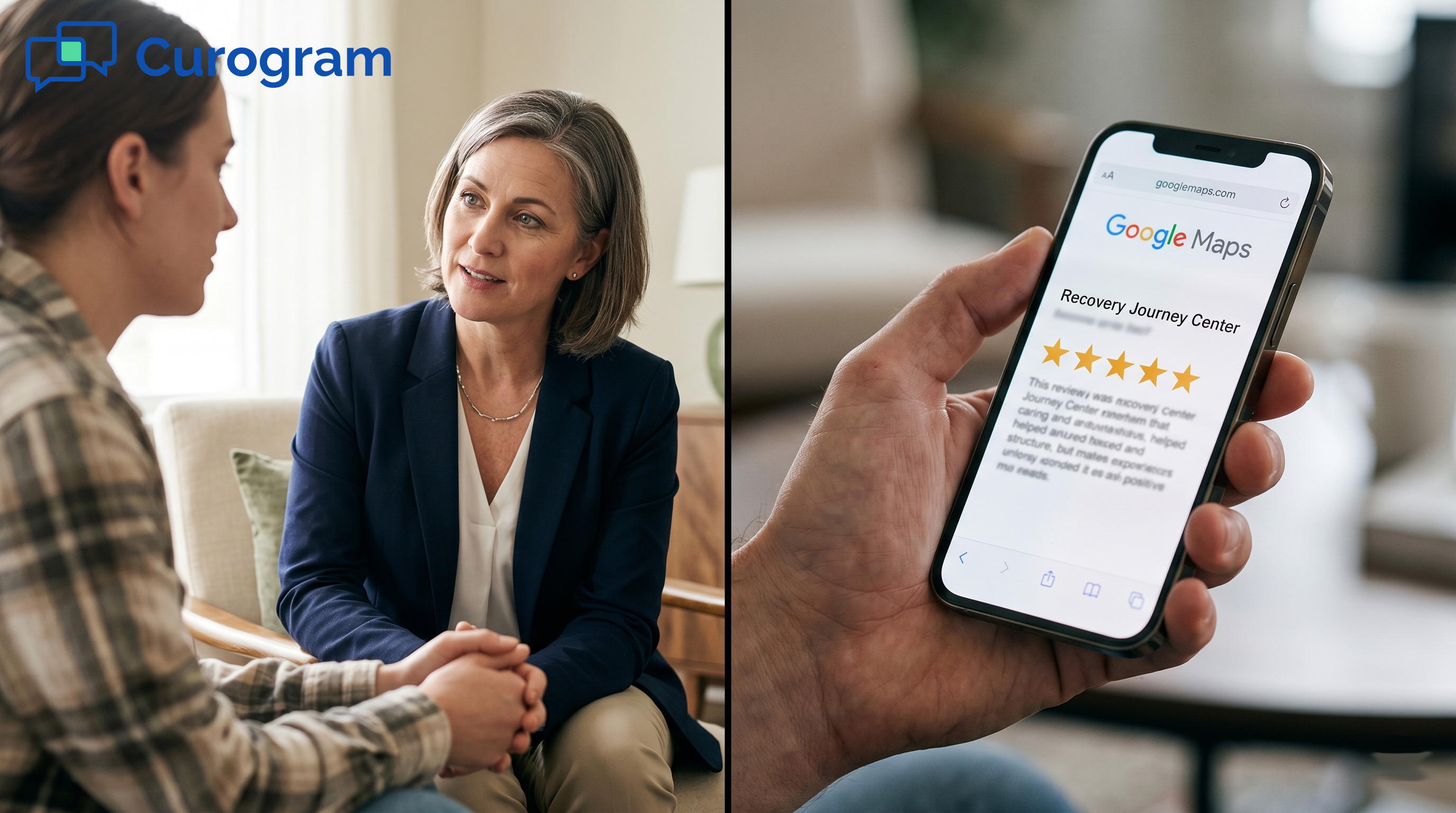
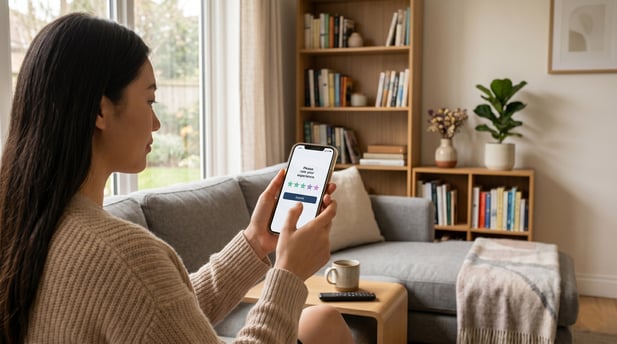
Patient using a smartphone to complete a post-visit 5-star review from home

Conclusion: Make Your Clinical Excellence Visible

Your patients' stories are the best ad your program will ever have. The only question is whether those stories ever reach Google. Without a system, most never will. With one, they flow on their own.

Opus EHR was built for clinical work. Curogram was built for the rest. Together, they cover both sides of a modern behavioral health and SUD center. Strong care inside. Strong voice outside.

Automated Google reviews for addiction treatment Opus EHR practices solve a problem that quietly drains admissions.

The gap is not a marketing issue. It is a census issue. And it can be closed in days, not months.

Think about the math again. Each empty bed costs $10,000 to $20,000 a month.

Each lost referral is a patient who needed help and got it somewhere else. The cost of doing nothing is higher than the cost of fixing it.

The fix is not loud. It is a single text after each visit. A one-tap path for the happy patients. A private route for the unhappy ones. That is it. The rest happens on its own in the background.

Based on our internal data, one practice earned 1,064 new 5-star reviews in just 3 months. 90% of surveyed patients left a 5-star rating.

Those numbers are not a fluke. They are what happens when you ask, kindly and quietly, every time.

Your alumni want to help others find what they found. Stigma keeps them quiet on their own. A private SMS prompt gives them a safe way to speak. Many will take it. Their words will reach the people searching tonight.

Strong programs deserve strong profiles. Strong profiles drive a strong census. Strong census funds the clinical work that started the whole cycle. The loop closes when reviews flow at the same rate as outcomes.

There is one more piece worth saying. This is not about gaming Google. It is about giving real patients a private way to share real wins. The reviews are theirs. The words are theirs. The story is true.

That truth is why this works for behavioral health and SUD care. Authentic voices land harder than ads.

They reach the parent searching at midnight. They reach the spouse, looking for one good option. They reach the next admission.

Ready to see your Google profile catch up to your care? Book a demo and see how Curogram works alongside Opus EHR to turn every visit into a quiet chance to grow your online reputation.  


Frequently Asked Questions

How does mobile intake protect patient privacy compared to lobby paperwork?

Mobile intake keeps the sensitive answers on the patient's own phone, in their own space. They write their substance use history on the couch, not in a shared lobby. Curogram's forms are HIPAA-compliant and SOC 2 certified, with 42 CFR Part 2-compliant data handling for SUD treatment. Privacy goes up, not down.

Why do behavioral health patients respond better to SMS forms than portal links?

SMS has a 98% open rate. Portal emails often sit unread for days. Behavioral health patients, especially in SUD care, may not check portals at all. A text shows up where they already look, and the form opens with one tap.

How long does it take a patient to finish 19 pages of intake on their phone?

Most patients finish in about 25 minutes. The forms save progress, so they can pause and pick up later. Tap-and-select inputs cut typing time. Patients can spread the work across an evening instead of a single lobby sitting.

Why does pre-arrival paperwork raise treatment commitment?

The act of filling out forms is a small step toward treatment. Behavioral health research links small early steps to bigger follow-through. A patient who spends 25 minutes the night before is already halfway in. They show up more often.


How does mobile intake change what the first session feels like?

The clinician walks into the room with the intake already read. The first words are clinical, not clerical. The patient is greeted, not handed a pen. That shift sets the tone for the whole arc of care and starts a stronger therapeutic bond.