


9 min read

Therapy Practice Google Reviews | What New Clients See

Therapy Practice Google Reviews | What New Clients See
💡 From a client's perspective, therapy practice Google Reviews shape new client discovery long before anyone opens a TherapyNotes practice's website. When people look for a therapist, your Google listing shows up first. They scan star ratings and review counts in seconds. That quick view, not your skill, often decides who gets the call.

Most behavioral health clinics on TherapyNotes have fewer than 50 reviews. Strong practices stay hidden while rivals with 200+ reviews win the booking. Curogram changes that. Its automated post-session texts invite happy clients to leave a 5-star review, with no awkward ask.

One multi-location practice earned 1,064 new 5-star reviews in just 3 months (Curogram client data from clinical settings). More reviews mean a better search rank, so the right clients find you first.

Picture a parent at midnight. The baby is finally asleep. She grabs her phone and types three words: therapist near me. What she sees next decides who she trusts with her care.

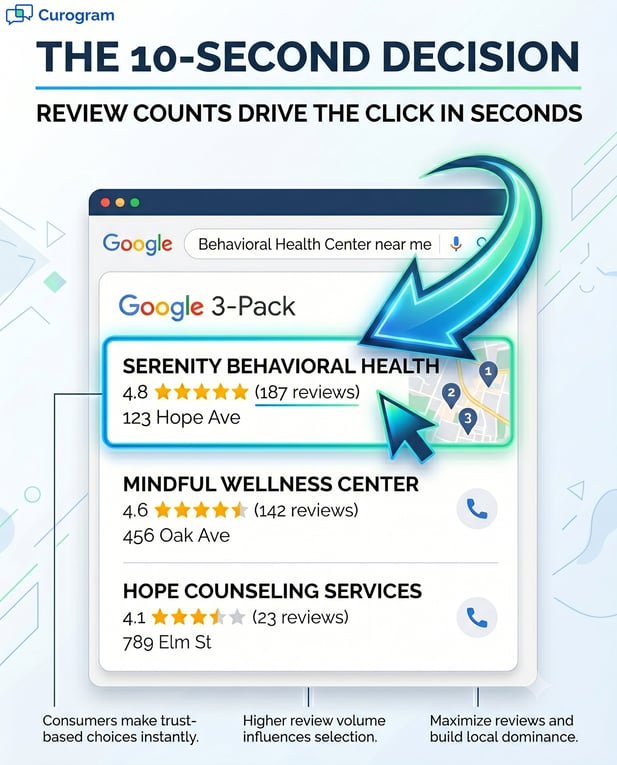
Google shows her three practices. Each one has a star rating and a number. She does not read websites yet. She reads counts.

One has 187 reviews. One has 142. One has 23. In under ten seconds, she taps the busiest one.

She is not lazy. She is tired, worried, and short on time. The fastest sign of safety wins. Tonight, that sign is a number.

That single glance is the therapy practice first impression Google hands every searcher. It lands before a credential is checked.

This is how clients choose therapists now: Google Reviews act as a shortcut for trust. When real signals are missing, people lean on the crowd.

Here is the hard part for behavioral health. The practice with 23 reviews may be the best fit on the block.

The clinician there might handle her exact need. She will never know, because she never opened the page.

Most practices running TherapyNotes sit in that quiet third spot. Their care is excellent. Their listing is thin. So new client decision making keeps tilting toward louder rivals.

The gap is not about quality. It is about being seen. A strong clinic with few reviews is, in plain terms, invisible online.

This article views that search moment through your future client's eyes. You will see why review counts drive the choice. You will also see how to close the gap, without ever asking a client face to face.

None of this is about clever marketing tricks. It is about being visible at the moment that matters most. Being found is the first kind of care a busy clinic can offer. 

The Villain: The Invisible Practice

Step into the client's shoes for a moment. Search results are not neutral. They rank trust by numbers, and thin listings quietly lose.

Around 90% of prospective clients see your Google profile before your website (Curogram client data from clinical settings).

The Search That Decides in Seconds

A client realizes they need help. They open Google and type therapist near me. Google answers with the local 3-pack. Three practices appear, each with a star rating, a review count, and a distance.

The eyes go straight to the numbers. 187 reviews at 4.9 stars. 142 reviews at 4.7 stars. 23 reviews at 4.3 stars. The choice is made in seconds.

Distance matters a little. The star count and review total matter far more. It all happens before any website opens, before a license is read, before a specialty is checked. The review count is the gate, and most people never look past it.

Think about how fast this is. No phone call. No form. Just a thumb and a screen. The busiest listing feels like the safe one, even with no proof of fit.

Why Clients Pick by the Numbers

This behavior can feel unfair, yet it is not random. People use reviews to guess at quality when they cannot judge it directly.

For counseling practices, the Google Business Profile is now the front door. New client decision making leans on therapist reviews more than on any ad.

There is a quiet bias at play too. A long review list looks like a long line outside a shop. People assume the crowd knows something they do not. So they join it.

A Rational Choice With Missing Information

The searcher is not making a bad call. They are making a smart call with thin data. Google Reviews stand in for quality when nothing else shows.

A practice that gathers no reviews sends no signal. So the results tell the client that rivals are the safer pick.

That message is false, but it still shapes the click. This is the core of weak behavioral health practice online reputation among clients.

The Revenue That Walks Away

Each skipped client is real money lost. At about $120+ per session, one client can mean steady income for months. Lose 5 to 10 clients this way each month, and the hole grows fast.

That works out to roughly $7,200 to $14,400 in monthly revenue handed to rivals. These were not clients you failed to help. They were clients who never found you, because the listing stayed silent.

None of this means a competitor is better. It means they are louder. Over a year, that loss can climb into six figures. For a small practice, that is a hire you could not make, or a room you could not open.

Flowchart showing patient journey to finding a therapist through online reviews

The Guide: The First Impression Builder

The fix is not to nag clients or hire an agency. It is to let a steady stream of real reviews appear on its own. That is where Curogram steps in.

How Automated Reviews Work Alongside TherapyNotes

TherapyNotes runs your clinical work well. It does not build your public reputation. Curogram fills that gap and sits beside TherapyNotes with no API access needed.

After each visit, Curogram sends a short, warm text. Happy clients are guided to a 5-star Google review in a tap or two. No clinician has to ask. No front-desk staffer has to chase anyone.

The client never sees Curogram at all. They just see a busy, trusted practice. That flow steadily lifts TherapyNotes practice visibility for prospective clients, week after week. These texts ride the same secure channel clients already trust for two-way scheduling messages.

Setup is light, and it does not change how you chart or schedule. Your team keeps working in TherapyNotes exactly as before. Curogram runs in the background, after the visit, on its own.

The Review Velocity Engine

Google does not only count reviews. It also checks how fresh they are. Recent reviews signal a practice that is active and well liked.

Curogram's Review Velocity Engine keeps new reviews coming on a regular beat. A clinic posting fresh reviews each week tends to outrank one with old, stale ratings.

Old reviews fade in Google's eyes. A clinic that earns a few new ones each month stays current and climbs.

Think of it like a heartbeat for your listing. A steady pulse tells Google the practice is alive. Long silence tells it the opposite. The engine keeps that pulse going for you.

Why It Fits Behavioral Health

Choosing a therapist is a tender, anxious step. Reviews lower that worry. When a client sees that 150 others felt cared for, doubt fades.

Many therapists find it odd to ask for a review after a raw session. The request can feel wrong in a healing space. Curogram removes that ask completely, so the bond stays clean.

Automation does not invent praise. It surfaces the real warmth that already lives in your work. The kind words were always there. Now prospective clients can see them before they decide.

There is a gentle filter built in too. A quick check asks how the visit went first. Happy clients are nudged toward a public review. Anyone less pleased can share private feedback, so issues get fixed quietly.

Imagine your profile growing from a dozen reviews to well over a hundred. Same great care, far louder signal.

Your team feels the relief. too. No more chasing reviews between sessions. The system does the quiet work, and the front desk wins its time back. Clients feel respected, not sold to, since a short optional text reads as thoughtful. 


The Success: Your Online Reputation Matches Your Clinical Reality

When reviews catch up to real care, the search picture changes. The numbers stop hiding your work. They start showing it off.

The Proof in the Numbers

Numbers tell a fast story to a worried searcher. A higher count and a fresher feed both say the same thing: this practice is trusted and active.

The table below contrasts a quiet listing with a thriving one (Curogram client data from clinical settings).

Trust signal

Quiet listing

Thriving listing

Review count

12 reviews

120+ reviews

Star rating

4.2 stars

4.9 stars

New 5-star reviews in 3 months

A handful

1,064

Share of texts that became 5-star reviews

Low and uneven

About 90%

New client inquiries (within 6 months)

Flat

Up 30% to 40%


One multi-location practice earned 1,064 new 5-star reviews in just 3 months. About 90% of clients who got the automated text left a 5-star review.

Within six months, practices often report new client inquiries rising 30% to 40%, driven by stronger local search visibility.

Look down the right column. Each line points the same way: more trust, more recency, more new clients. That is the picture a searcher rewards.

The jump from a dozen reviews to over a hundred is not a dream. It is a measured result, repeated across busy clinics.

The Trust Signal

Clients feel a clear shift the moment your listing looks alive. A full profile with recent, honest reviews removes hesitation.

Instead of pausing at a sparse page, they see a practice that people like them already trust.

That feeling is the trust signal at work. It is the quiet yes that happens before any call. The choice to reach out goes from maybe to yes.

Picture two open tabs. One profile is bare. One is full of recent, warm notes. The full one wins almost every time, and it wins fast.

A Client's Path to Your Door

A new mother searches ‘therapist for new moms near me’. Your practice appears with 165 reviews and a 4.9-star rating.

She reads one line: the intake was easy, the staff were warm, the scheduling felt flexible.

She taps the number and books an intake. On Thursday, she walks in. She found you because Google showed her that 165 others trust you. Every one of those reviews came from a simple text, not a single awkward request.

For a vulnerable client, that proof matters most. Seeing others helped makes the first step less scary. The right reputation does not just win a booking. It eases a real fear.

She did not study credentials for an hour. She trusted the crowd, then trusted her gut. Both pointed straight to you. That is the whole point: great care plus visible proof fills a waiting room.

A close-up of a person looking at ratings of various behavioral health centers on Google

Conclusion: Be Found by the Clients Who Need You

Your clinical skill already exists. The only question is whether your future clients can see it before they choose. Right now, many cannot.

TherapyNotes captures the quality of your care. It was not built to broadcast that quality to the wider world. Curogram handles that second job, quietly and well.

When your Google Reviews mirror your real client satisfaction, the right people find you first. They find you before the louder practice down the street. Your reputation finally tells the truth about your work.

Reviews are not vanity. For a person in pain, they are a thread of trust. They say, in plain words, that help here is real. That message can be the nudge that gets someone through your door.

Your quiet third spot is not a verdict on your skill. It is a gap in what the world can see. Gaps can be closed.

This is not about gaming a system. It is about fairness. A clinic that does great work deserves a listing that says so.

Most reviews never come because no one wants to ask. The ask feels strange in therapy, and that is understandable. So the answer is to remove the ask, not to push harder.

The work is small and steady. One text after each visit. One happy client at a time. Over months, the count climbs on its own.

Search is where the journey starts now. Not a referral, not a flyer, just a phone at midnight. Meet people there, and the rest of your care can do its job.

Trust grows in small steps. A 5-star note from a real client is one of them. Hundreds of those notes build a wall of proof that any searcher can see.

You do not need a bigger budget. You need a steady system that does the asking for you. That is the whole idea, and it asks nothing of your clinicians.

Think back to that parent at midnight. She is searching right now, in your town, for someone like you. What will she see when your listing appears? Make sure it reflects the care you truly give.

Picture the difference six months out. A profile that once held a dozen reviews now holds well over a hundred. Same care, louder voice, more clients served.

Start by seeing where you stand today. Book Your Personalized Demo with Curogram. You built a practice that helps people heal. Let more of them find their way to your door.  


Frequently Asked Questions

Why do Google Reviews matter so much for therapy practices?

They are the first thing most clients see. About 90% of prospective clients view your Google profile before your website (Curogram client data from clinical settings).

Google also ranks practices partly by review count, quality, and how recent they are. More and fresher reviews mean a higher spot and more calls, with no ad spend.

How does automated review collection protect client privacy?

The text message stays neutral and never names therapy or any condition. A simple line like "How was your visit" keeps things general. 

Clients decide what to write, and most keep it broad and kind. The design lowers the chance of any clinical detail showing up in public.

How quickly will a practice see an impact on local search rankings?

Google reacts to review velocity, meaning new reviews per week, not just the total. Most practices notice ranking gains within 6 to 8 weeks of steady review collection.

Full movement in the local 3-pack often shows up within 3 to 4 months. The key is a regular flow, not a one-time push.

Why do strong practices end up with so few reviews?

Therapists rarely feel right asking for a review after a personal session. The request can clash with a healing relationship.

So reviews trickle in at one or two a month, far too slow to compete. The care is great, but the public proof never catches up.

How does automated review collection fit a behavioral health workflow without feeling pushy?

It runs after the visit through a short, friendly text. The clinician never has to bring it up, so the session stays focused on care. Clients can ignore it or reply in seconds. The whole process feels light, optional, and respectful.