



TherapyNotes includes built-in telehealth, but its premium video features cost extra each month. Some clients also hit portal friction that delays the start of care. Curogram works next to TherapyNotes for psychiatry, counseling, and group practices.
Your staff sends a text, the client taps the link, and a HIPAA-compliant video session opens. Practices report no-show rates 53% lower than industry averages, based on Curogram client data from clinical settings. For behavioral health, fewer missed sessions means clients stay on track with care.
Somewhere, a client with anxiety is getting ready for therapy. She opens the email with her video link and taps it.
A login screen appears and asks for a password she cannot recall. Her heart starts to race before the session even begins.
She clicks forgot password and waits for a reset email. She tries again, finds the right page, and clicks join.
The browser asks for camera and microphone access. The video loads, but the sound will not work.
By now, she has texted the front desk for help. The session starts 12 minutes late. Her stress is higher than when she logged on. The tool meant to ease her care just made it harder.
This is the download wall. It blocks the very people that behavioral health practices want to serve.
Clients with anxiety, ADHD, or depression feel each extra step. One small tech snag can be the reason they cancel.
Missed sessions are not just lost income for a practice. In behavioral health, a skipped visit can break a fragile routine. It can stall progress that a client worked hard to build. The stakes here run higher than a simple no-show.
Many practices feel stuck. TherapyNotes includes telehealth, which is a real strength. Still, some clients face logins and setups that slow them down. There is a simpler path.
The TherapyNotes telehealth alternative no download behavioral health teams need is an SMS-launched video tool. Clients tap one text link and join a secure session.
Curogram offers easy telehealth for therapy clients, with no app to install. It works right next to TherapyNotes, so your records stay in place.
Your team sends a text, and the client joins in seconds. The session starts on time, and care moves forward. This guide shows how the one-tap session works and why it matters.
The Villain: The Download Wall
TherapyNotes deserves real credit for building telehealth into its platform. Many behavioral health systems still do not. But the way some clients reach a session can create friction. That friction has a name: the download wall.
What The Download Wall Really Is
The download wall is the gap between what a portal offers and what clients actually use. It looks small on paper. In practice, it stops sessions before they start.
A Barrier Hidden Inside The Portal
TherapyNotes routes some virtual visits through its client portal. Clients may need to log in or set up software first.
Premium features like group sessions and screen sharing cost $15 per clinician each month. The basic option is included, but it has limits.
Group therapy often needs the paid tier to work well. So, a TherapyNotes virtual session with no portal login is not always the default.
That gap is where many clients get stuck. A few minutes of setup can undo a week of progress.
When Tech Friction Makes Anxiety Worse
For a client with anxiety, troubleshooting triggers the stress they came to treat. For a client with ADHD, each extra step is a real mental hurdle.
For someone in a low mood, one snag can tip them toward canceling. These are not minor delays for the people you serve.
The tool meant to help becomes the reason they stay away. Access drops at the exact moment it matters most. The wall hits hardest where care is needed most. Simplicity is not a luxury here; it is part of the treatment.
Think of the client who finally booked after weeks of delay. A login error can send that courage right back down. The wall does not just cost a slot; it can cost trust.
What The Wall Costs Your Practice
The download wall does not just frustrate clients. It drains revenue and staff time, too. Both add up faster than most teams expect.
The Price Of Sessions That Never Start
Say a session brings in about $120 on average. Every client who quits because the video would not work is lost income.
For a 10-clinician group, even two or three such drops a week add up. That can mean $1,000 to $1,500 in lost revenue each month.
Add premium telehealth fees on top, and the cost grows. Frustrating sessions are expensive in more ways than one.
The math gets worse as your practice grows. None of it shows up on a single invoice, which makes it easy to miss.
The Daily Drain On Your Team
Staff can spend one to three hours a day on I cannot connect messages. Clinicians start late and lose billable minutes. Each delay ripples into the rest of the schedule. The whole day feels rushed and reactive.
It feels backward for a practice built to lower barriers to care. The telehealth tool ends up making therapy harder, not easier. That is the quiet cost of the download wall. Your team feels it every single day.
Front-desk staff did not sign up to run a help desk. Over time, the strain shows in morale and turnover. A simpler tool hands that time back to your people.

The Guide: The One-Tap Session
Curogram acts as the one-tap session for TherapyNotes practices. It removes the wall and meets clients where they already are.
The channel is simple: a text message. The result is care that starts without a fight.
How The One-Tap Session Works
The flow is built to be fast and familiar for every client. There are no new tools to learn. The steps feel like sending a text.
From Text To Face-To-Face In Seconds
A staff member starts the visit from the Curogram dashboard. The client gets a text with a secure link.
They tap it, and a video session opens in their phone browser. There is no app, no portal, and no password to reset.
The whole trip from text to therapist takes under 10 seconds. The friction is gone before it can start. The browser asks once for camera and mic access. After that, the client is face-to-face with their clinician.
One Channel Your Clients Already Use
Curogram pairs TherapyNotes telemedicine with an SMS launch that clients already know. The same texts carry reminders, intake forms, and billing. The video link arrives from a number clients recognize. This keeps the whole experience in one familiar place.
Clients do not juggle apps or logins. They just open a text, the way they do every day. That habit lowers the odds of a missed session. Familiar tools feel safe, and safe tools get used.
Older clients often fear new apps and downloads. A plain text link feels far less scary to them. That comfort can be the reason they show up at all.
Built To Work With What You Have
Curogram does not replace your clinical tools. It adds a simpler way to connect. Nothing about your core workflow has to change.
It Runs Alongside Therapynotes
Your team keeps writing notes and billing inside TherapyNotes. Curogram handles only the video and messaging layer.
It works next to TherapyNotes without needing special access. Your records and routines stay exactly where they are.
Think of it as a TherapyNotes video session alternative for clients who want the easiest path.
You add ease without losing the system you trust. Clinicians document the way they always have. Clients simply get a smoother way in.
There is nothing new for clinicians to install or learn. The Curogram layer simply sits beside your daily tools. Setup is light, and the payoff starts fast.
Made For Behavioral Health Needs
SMS video works on any smartphone, even older ones. Clients need no app storage or strong broadband to start.
This makes HIPAA-compliant video therapy alongside TherapyNotes reachable for more people. Tech limits stop being a reason to skip care.
It offers telehealth for behavioral health practices, with no download required. That matters for clients who face real tech barriers.
Simple access is a clinical value, not just a perk. The easier the join, the more likely the session is to happen.
This also helps reach clients in rural or low-signal areas. A short text link loads where heavy apps would stall. Care can travel as far as a single message.
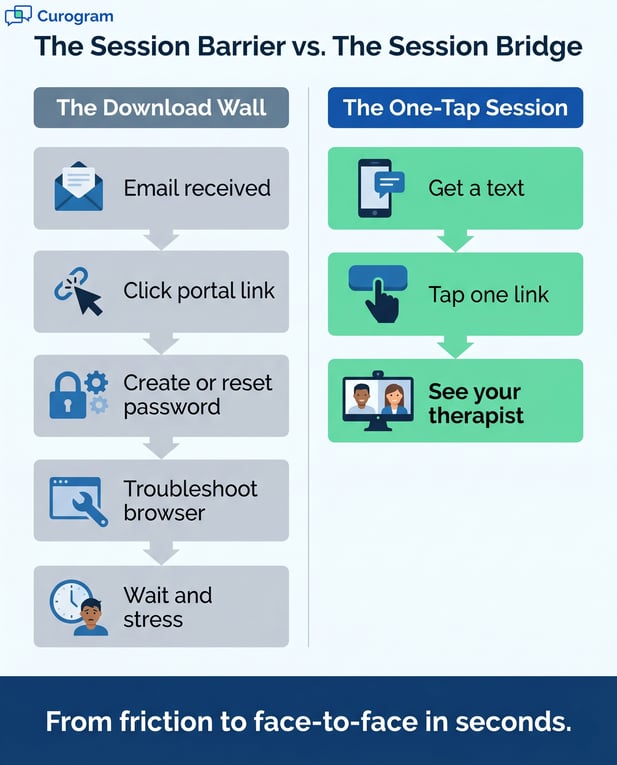
The Download Wall vs. The One-Tap Session
|
The Download Wall (Portal) |
The One-Tap Session (Curogram) |
|
Open the email and find the link |
Get a text from a known number |
|
Log in or reset your password |
Tap the secure link |
|
Allow camera and mic access |
Allow camera and mic once |
|
Wait for the page to connect |
Join the session |
|
Often start the visit late |
Start the visit on time |
The Success: Sessions Start on Time. Clients Stay in Care.
When the wall comes down, the whole day changes. Sessions begin on time. Staff stops playing tech support. Most of all, clients stay connected to their care.
The Proof In The Numbers
The shift shows up in hard data and in daily routines. The gains are easy to feel and easy to measure.
Fewer No-Shows, More Kept Sessions
Curogram practices see no-show rates 53% lower than industry averages. One client cut no-shows from 14.2% to 4.91% in three months.
That is about 3X better than the typical rate. This reflects Curogram client data from clinical settings.
In behavioral health, missed visits often run higher than in other fields. Each saved session means recaptured revenue.
More importantly, clients stay on track with treatment. Fewer gaps in care lead to better outcomes over time.
Saved sessions protect both the client and the practice. Each kept visit keeps a treatment plan moving. The numbers reflect real people, not just a chart.
A Friction-Free Schedule
Clinicians win back the 5 to 10 minutes once lost to setup. Staff stops fielding I cannot log in texts. Hybrid care gets easier, too. The team can focus on people instead of tech.
The only difference is whether you prep a room or send a link. Virtual and in-person visits run on the same simple flow. The schedule finally holds together. A calmer schedule means a calmer practice.
Reminders and links can ride on the same text thread. Clients see their confirmation and their join button together. One message does the work of several.
A Calmer Day For Your Whole Team
Picture how this plays out on a normal afternoon. The change is small in each moment but large by week's end. It adds up quietly.
One Afternoon, Four Sessions, Zero Calls
It is Wednesday at a 10-clinician counseling practice. Curogram texts each client a video link before the start time. All four clients tap and join from their phones. Sessions begin on time, with zero calls to the front desk.
No password resets. No browser puzzles. No rescheduling chain reactions. The hour runs the way it was meant to.
By the end of the day, the difference is plain. Less scrambling, fewer interruptions, more real care. The team even leaves closer to on time.
Higher Completion, Better Care
The manager reviews her afternoon and finds no tech interruptions. The clinical director checks the week and sees attendance climb. When joining is easy, more clients show up and stay. The trend builds week after week.
That is the real goal behind every feature. Not just smoother software, but care that actually happens.
Each kept session is a person who got the help they needed. That is what success looks like in behavioral health.
Small wins like this stack up over a month. A few saved sessions a week become dozens by quarter's end. That is real revenue and real continuity of care.
Conclusion: Keep TherapyNotes. Simplify Your Sessions.
TherapyNotes is built to handle your clinical records and billing. It does that job well.
Curogram handles a different job: getting clients from their phone to their therapist. One documents the session, and the other makes sure the session happens.
Think of it this way. TherapyNotes is for your records. Curogram is for your clients' access to care. The two work side by side, each doing what it does best.
You keep the system your team already trusts. You simply add a smoother way for clients to connect. Nothing has to be ripped out or rebuilt. The change is small for staff and large for clients.
The download wall is a quiet drain on any practice. Every client who cancels because the video would not work is a session you earned but could not deliver. Those lost visits add up in revenue and in care. They also wear down a team that wants to help.
Removing that wall is simple. Give clients a one-tap path to their therapist. A single text link can replace logins, apps, and reset emails.
For people managing anxiety, ADHD, or depression, that ease can decide if they show up at all.
This is what easy telehealth should feel like. There is no app, no portal, and no extra stress. Just a tap, and care begins.
The goal is not flashy tech. The goal is a session that actually happens. That is what your clients need most.
For many behavioral health teams, access is the whole battle. You cannot treat a client who never makes it onto the call. Lowering that first barrier changes everything downstream.
None of this asks you to leave TherapyNotes behind. It asks you to remove one stubborn point of friction. That single change can lift attendance across your whole schedule.
And it is not only video. The same platform also handles reminders, intake forms, reviews, and text-to-pay. So you simplify far more than one virtual visit.
Behavioral health care only works when clients keep coming back. Every smooth session builds a little more trust. Over time, that trust is what holds treatment together.
Your front desk feels the change first. Fewer panicked texts mean calmer mornings and steadier days. That calm spreads to clinicians and clients alike.
The best way to see this is to watch it work with your own setup. Schedule a demo to see how SMS-launched video runs alongside TherapyNotes.
Frequently Asked Questions
Curogram sends the client a text with a secure link. The client taps it, and the session opens right in their phone's browser. There is no app to install and no account to create. The browser asks once for camera and mic access, and then they are face-to-face with their clinician.
Many clients seek care for anxiety, ADHD, or low mood. Each extra login step can feel like a real barrier for them. Tech troubleshooting can trigger the very stress they came to treat. A TherapyNotes virtual session with no portal login removes that hurdle.
Curogram runs as a separate messaging and video layer. Your team still writes notes and bills inside TherapyNotes. It does not need special access to your records. That makes it an easy TherapyNotes video session alternative for clients who want a simpler join.
Therapy involves sensitive details that need strong protection. HIPAA-compliant video therapy alongside TherapyNotes keeps those sessions private and secure. Curogram's video is encrypted from end to end and backed by a signed agreement. This lets clients open up without worrying about their data.
Most no-shows happen when joining feels hard or confusing. A one-tap text link removes that friction. Clients who once gave up on a slow portal now join with ease. Curogram practices see no-show rates 53% lower than industry averages, based on Curogram client data from clinical settings.