11 min read

Digital Intake Forms for Elation Health Practices: Go Paperless

Digital Intake Forms for Elation Health Practices: Go Paperless
💡 Digital intake forms for Elation Health practices replace paper clipboards with mobile forms sent by text. Curogram delivers each link before the visit, so patients arrive ready instead of writing.
  • Patients fill out forms on their phones, with no app or portal login needed
  • Staff save 10–15 minutes per new patient at check-in
  • Form data is reviewed in Curogram before the patient walks in
  • HIPAA-compliant delivery is backed by a signed BAA from Curogram
  • Atlas Medical Center hit completion rates 3X better than the industry average
The fix is not a faster pen. It is meeting patients where they already are — on their phones.

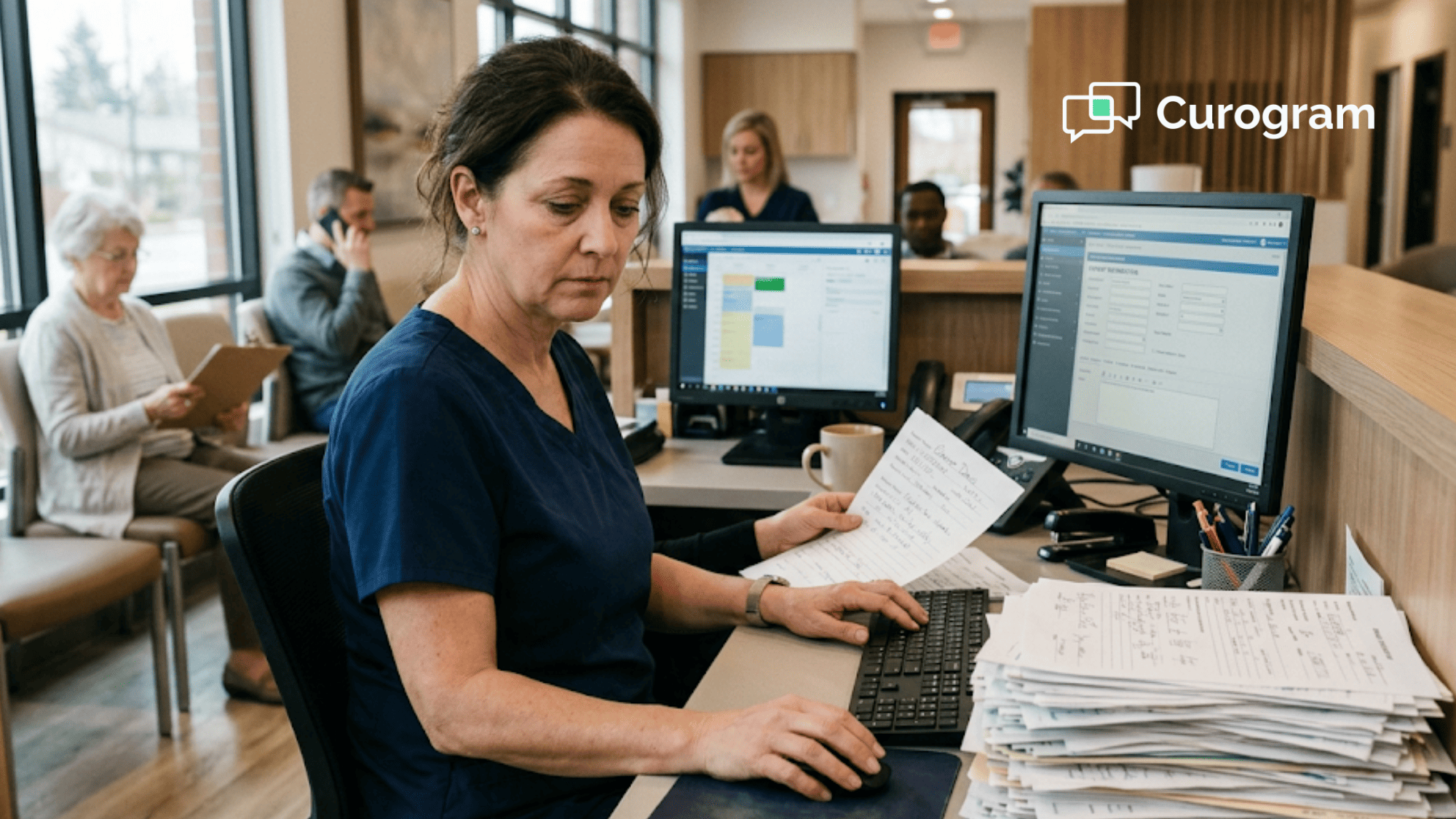
Most patients judge a medical practice in the very first 10 minutes of their visit. At many Elation Health offices, those minutes are spent writing on a stiff paper clipboard.

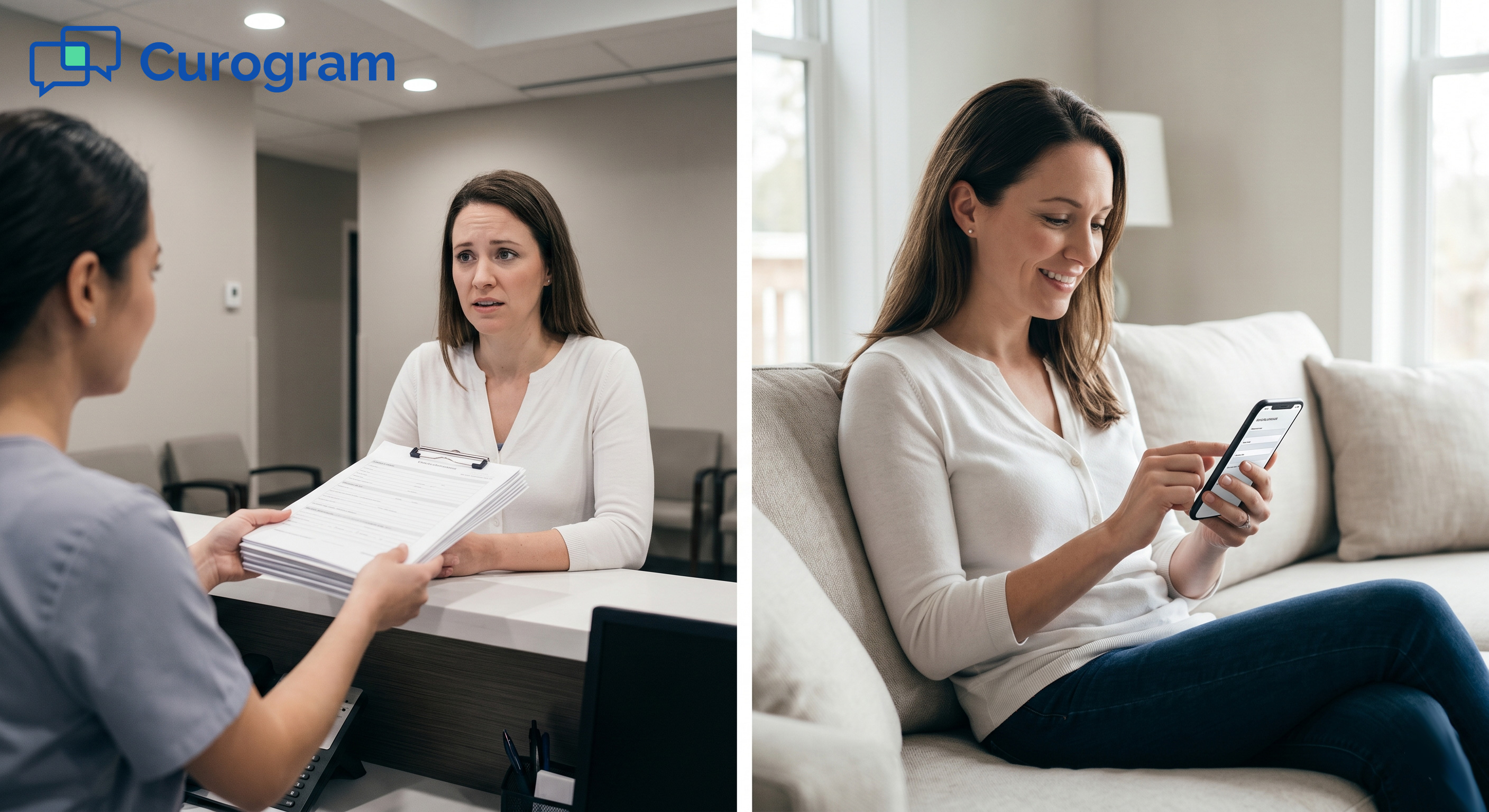
The new patient signed in five minutes ago. She holds 19 pages of forms and a pen that keeps skipping. Her medication list sits on her phone, but the clipboard wants it on paper. She is trying to recall the year she had her gallbladder out — from memory.

This is the clipboard bottleneck. It costs your front desk 15 to 25 minutes of data entry per patient. It causes claim denials from misread handwriting. And it tells new patients your practice has not caught up to 2026.

The fix is not a thicker pen or a smaller font size. It is digital intake forms for Elation Health practices. Patients fill out secure online forms on their phones, before they ever set foot in your office.

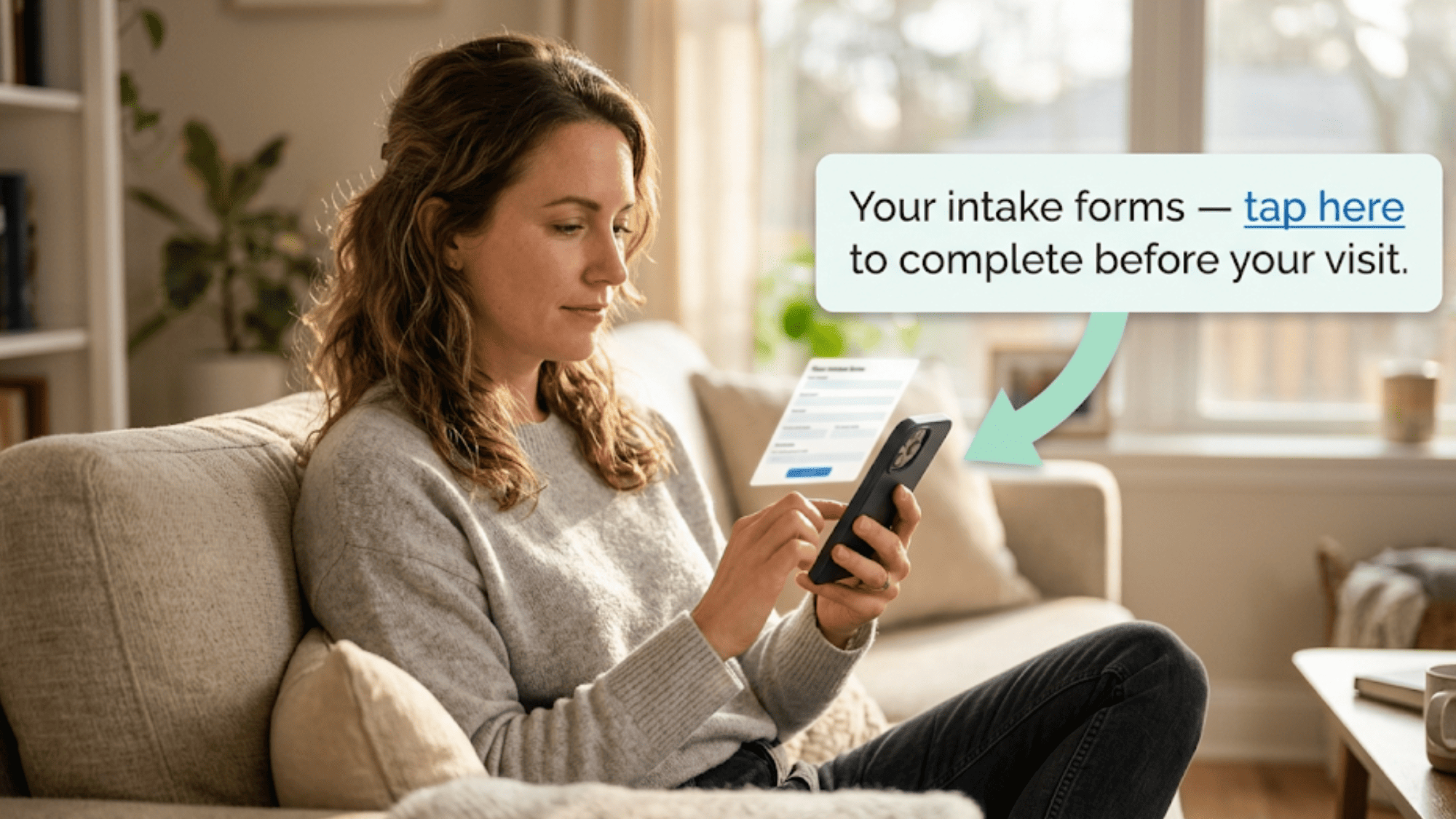
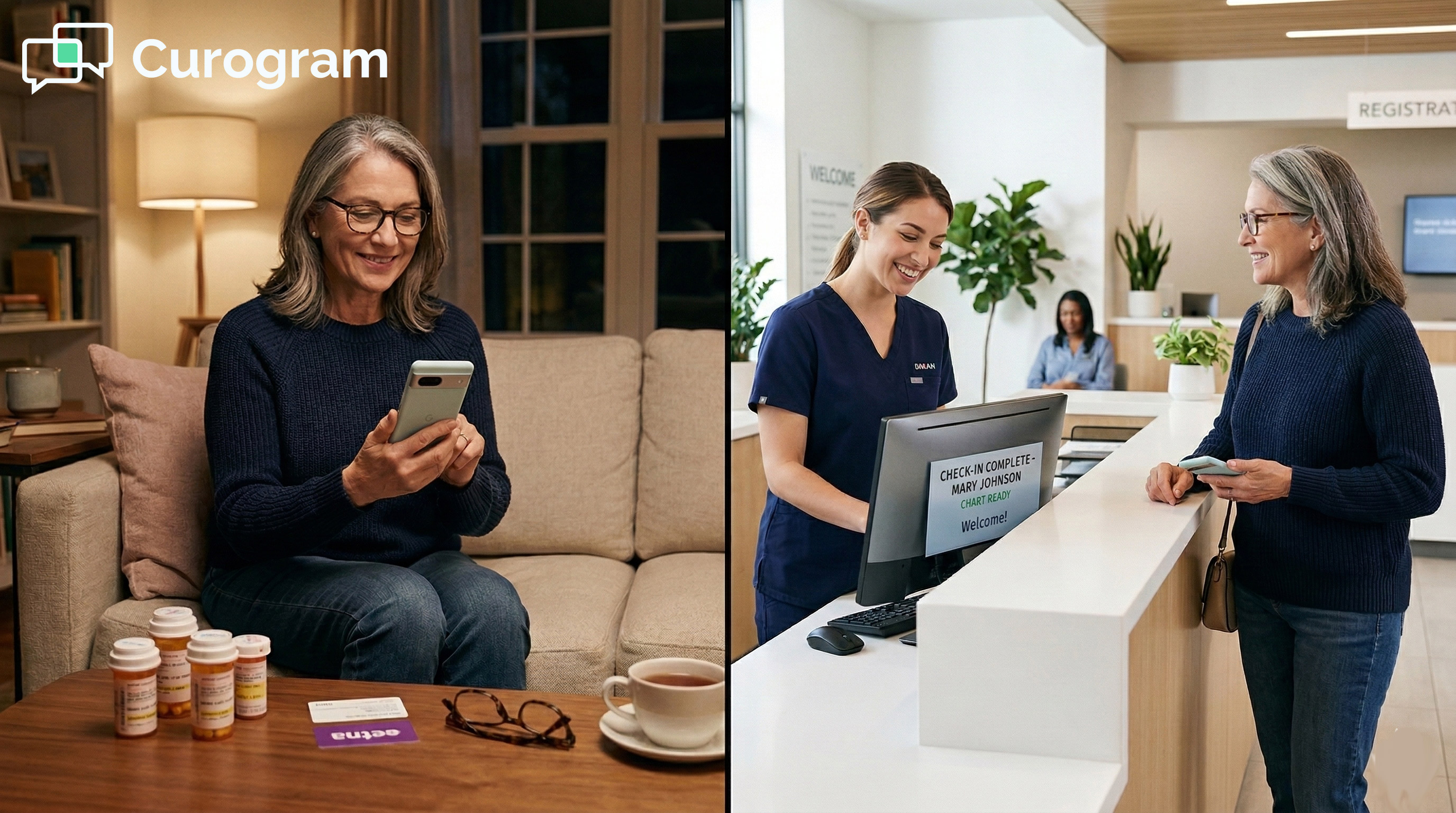
Curogram calls this the Zero-Clipboard Check-In. Forms reach patients by text — the same channel as their appointment reminders. They tap a link, finish the form on the couch, and submit. No portal login, no app to download, no clipboard to balance on a knee.

The results speak loudly. Based on our internal data, Atlas Medical Center hit digital intake completion rates 3X better than the industry average. The switch was to text-delivered forms. That is the gap between forms patients ignore and forms patients actually finish.

In this guide, we break down the true cost of paper intake at Elation Health practices. We show how Curogram fits into your digital intake workflow.

And we explain why text beats portal every time, especially for mid-market primary care and DPC clinics. Read on if your front desk is still buried in paperwork.

The Villain: The Clipboard Bottleneck

A new patient at a mid-market Elation Health practice arrives 15 to 20 minutes early. The front desk hands her a clipboard with 10 to 19 pages of paper forms.

There is the demographics page, the insurance section, and the medical history form. There is the medication list, the HIPAA acknowledgment, the consent forms, and a specialty-specific questionnaire.

The waiting room becomes a writing room. A senior patient squints at small print. A parent juggles forms while watching a toddler. A diabetic patient strains to recall every dose she takes at home.

What was meant as a five-minute check-in turns into a 20-minute paperwork session. The patient's first impression is not your warm front desk staff. It is not your clean exam rooms or your friendly medical assistants. It is a clicking pen and a stack of pages that feels older than the clinic itself.

The Data Re-Entry Marathon

After the visit, a staff member collects the clipboard and walks it back to the front desk. Then the typing starts. Each form is entered into Elation Health by hand, field by field, page by page.

Illegible handwriting forces guesses. A "7" could be a "1." A medication name with poor penmanship sends staff hunting for a clarification call. Missing fields trigger follow-up phone outreach to the patient at home.

Insurance details typed wrong can cause claim denials weeks down the line. One practice we reviewed processes 19 pages of paper forms per patient. That volume eats 15 to 25 minutes of staff time per patient — just on data entry alone.

For a 15-provider Elation Health practice seeing 30 new patients a week, that is 7 to 12 hours of paperwork transcription every week. Hours your front desk does not have to spare.

The Third-Party Trap

Some practices try to escape paper with tools like Jotform, DocuSign, or Google Forms. The pitch sounds clean: digital forms instead of paper. But there is a catch.

The forms live in a separate system. Data is collected digitally but still has to land inside Elation Health. So staff export the PDF, open it next to the Elation chart, and re-type the data across two screens.

The paper is gone. The double-touch remains. You have swapped a clipboard for a PDF download — but the workflow penalty is nearly the same.

Some platforms, like Spruce Health, offer no form capability at all. So practices end up patching together a portal here, a form builder there, and a fax line for the holdouts. That is not a digital intake workflow. That is duct tape.

The Patient Impact

Patients notice. They arrive ready to be seen, and instead they are asked to write. They expect modern healthcare, and instead they get a process that feels stuck in the 1990s.

For Direct Primary Care members who pay a premium for concierge-level care, this stings the most. They signed up because the practice promised something different. Then they walk in and get the same clipboard as every other clinic in town.

The intake experience is a signal. It tells patients whether your tech has kept up with your clinical quality. A clipboard says no.

This is the true cost of the bottleneck — not just in staff hours or claim denials, but in trust. The form your patient fills out first is the form that shapes everything that follows. And right now, for most Elation Health practices, that form is still paper.

The Guide: The Zero-Clipboard Check-In

Curogram replaces the clipboard with mobile-friendly forms sent over HIPAA-compliant text message. Patients get a link. They tap it. They finish the form. No login, no app, no paper.

This is what the team calls the Zero-Clipboard Check-In. It is built specifically for Elation Health practices that need digital intake without the headache of a third-party patchwork.

The platform does three jobs at once. It delivers the form. It collects the data securely. And it surfaces the responses for staff to review before the patient ever walks in.

For mid-market primary care groups running 5 to 20 providers, this fixes the biggest pain point at the front desk. Elation Health paperless intake is no longer a luxury feature. With Curogram, it is the default workflow. Practices keep their Elation Health setup. They just lose the clipboard.

The Feature: Text-to-Form Delivery

Curogram's secure online forms arrive in a text message. That is the same channel patients already use for appointment reminders and two-way replies. They open the message, tap the link, and the form loads in their phone's browser.

No app download is required. No portal username to recover. No password reset email at 9 PM the night before a visit.

The form is built mobile-first. Large tap targets. Big fonts. Smart fields that adjust to phone screens. Patients can finish the whole form in five to 10 minutes from their couch.

Why does this matter? Because completion rates collapse the moment you ask a patient to log in. Text-delivered forms remove that friction. The form meets the patient on the device they check 80 to 100 times a day. Once a patient finishes one form by text, they expect every form to work that way.

The Integration

Completed form data flows into the Curogram dashboard alongside the patient's Elation Health record context. Staff see what the patient submitted before the appointment starts. They can verify the data, flag missing info, or send a quick reminder text if a field needs an update.

This turns check-in into a two-minute confirmation step. The patient walks in, the staff member confirms the pre-submitted details, and the visit begins. No clipboard transfer. No re-typing. No data hostage situation between two systems.

For online patient forms, Elation EHR is the destination. Curogram is the on-ramp. The two systems are designed to work together, so the data does not get stuck in transit.

Practices that have wrestled with Jotform-to-Elation transfers in the past will spot the difference right away. It is the gap between a glued-on form tool and a real digital intake workflow.

The DPC Fit

Direct Primary Care practices live or die on patient experience. The whole model is built around feeling different from the typical insurance-based clinic. A paper clipboard at check-in undermines that promise on day one.

Curogram lets DPC practices show their tech sophistication right at the first touchpoint. A new member receives a clean, mobile-friendly intake form by text two days before her first visit. She fills it out on her couch. She arrives ready, with no paperwork in her hands.

That first impression sticks. It tells the patient: this practice is not the same as the one she just left. The HIPAA-compliant forms Elation Health practices need are not just a back-office tool — they are part of the brand. For DPC clinics charging $80 to $200 a month, this is the kind of detail that keeps members renewing.

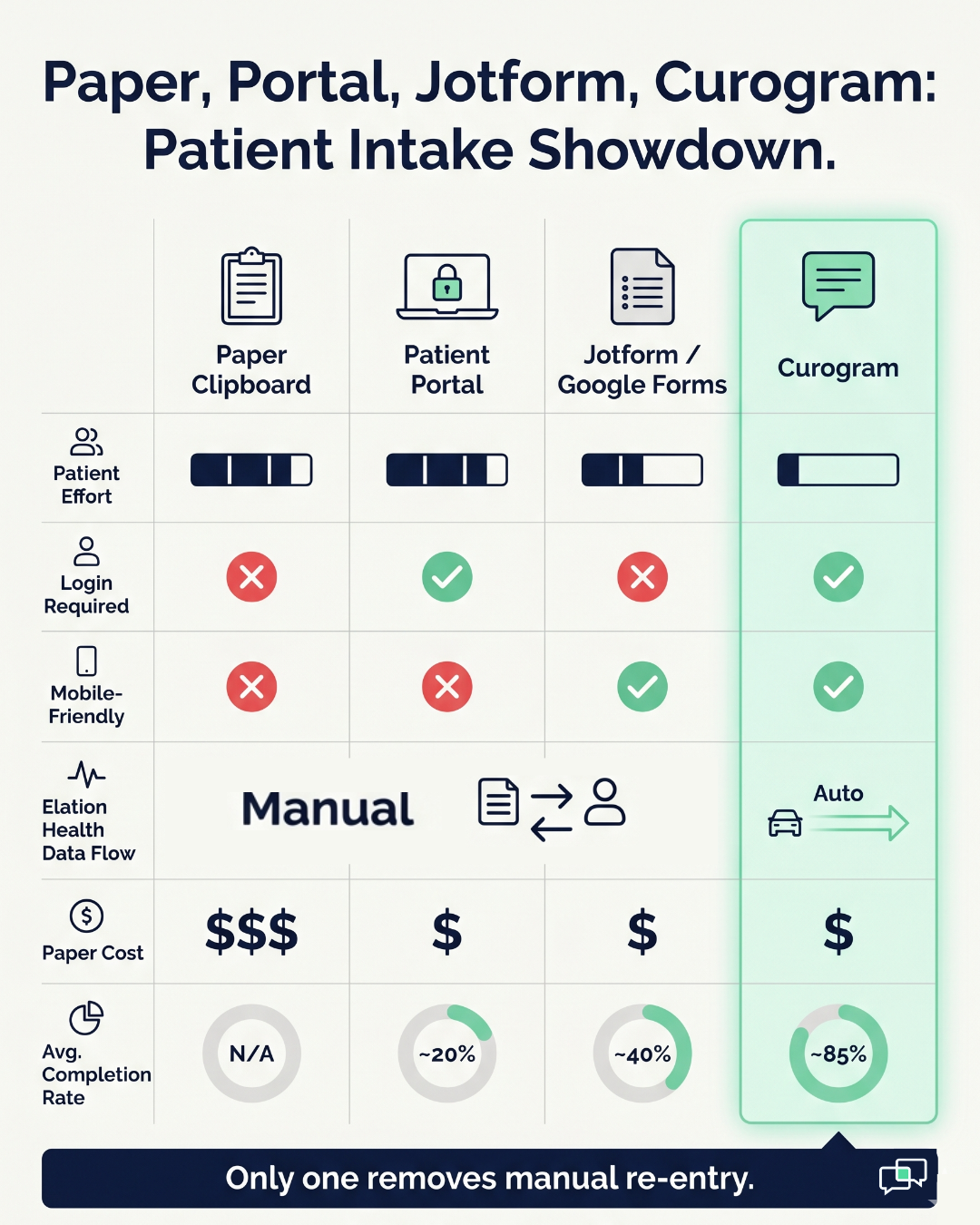
Comparison infographic of paper, patient portal, Jotform, and Curogram for digital intake at Elation Health practices

The Success: The Ready Patient

The single biggest reason digital intake fails is not the form. It is the delivery channel. Most practices push patients to a portal, and the portal eats the form before it ever gets filled out.

Based on our internal data, Atlas Medical Center solved this by switching to text-delivered intake through Curogram. The result? Digital intake completion rates 3X better than the industry average. That is not a small lift. That is a different game.

The reason is simple. Patients open texts. They do not open portals.

A 2025 industry benchmark puts portal-based form completion in the 15% to 30% range for new patient intake. That means 7 out of 10 patients show up empty-handed, ready to write on a clipboard anyway.

When forms move to SMS, completion climbs into the 70% to 90% range. The form is on the device patients already use. The friction disappears.

From Check-In Chaos to Arrival Verification

The shift goes deeper than a single metric. It changes the entire shape of check-in.

Today, in most Elation Health practices, the check-in process looks like this:

  1. Patient arrives 15 to 20 minutes early
  2. Staff hands the patient a clipboard
  3. Patient writes for 15 to 20 minutes
  4. Patient hands clipboard back
  5. Staff types form contents into Elation Health
  6. Patient is called back to the exam room

Six steps. Two waiting periods. One pile of paper.

With Curogram, the new check-in flow looks like this:

  1. Form arrives by text two days before the visit
  2. Patient finishes form from the couch
  3. Staff reviews data in Curogram, syncs to Elation Health
  4. Patient arrives, staff confirms key fields in 2 minutes
  5. Patient is called back

Five steps. One short verification. No clipboard.

That is the shift: from check-in chaos to arrival verification. The waiting room moves at the pace of the schedule, not the pace of handwriting. Patients arrive ready, not writing.

A Side-by-Side Look at the Options

Practice managers often ask how Curogram compares to other paths to paperless intake. Here is a quick view:

Method

Patient effort

Staff data entry

Data accuracy

Elation Health fit

Paper clipboard

High

15–25 min/patient

Low (handwriting)

Manual re-entry

Patient portal forms

High (login wall)

Some

Medium

Limited

Jotform / Google Forms

Medium

High (PDF transfer)

Medium

None native

Curogram (text-delivered)

Low (just tap)

2 min verification

High

Designed to fit


The pattern is clear. Every option except Curogram still drags work back to the front desk. Text-delivered forms break that pattern.

The Outcome: What a 15-Provider Practice Reclaims

Let's run the numbers on a typical mid-market Elation Health practice with 15 providers.

That practice sees roughly 30 new patients a week. Each new patient produces 15 to 25 minutes of staff data entry from paper forms. That is 7.5 to 12.5 hours of staff time per week — just on transcribing forms.

Over a year, that adds up to 390 to 650 staff hours. At an average front desk wage of $22 per hour, that is $8,580 to $14,300 a year in labor, just to type what patients already wrote.

Paper and printing add another $500 to $1,000 a month in supplies for a practice that size. Forms, printer ink, paper, clipboards, replacement pens, file folders, and the storage to hold it all.

With Curogram's digital intake workflow, most of that cost shifts or disappears:

  • Staff time drops to about 1 to 2 hours a day of light verification work, not full transcription
  • Paper costs fall by 80% to 90%, since most intake is digital
  • Claim denials caused by intake errors drop, because typed data does not get misread
  • New patients arrive with complete, legible, verified information

That is hours back, dollars back, and clean clinical data on day one. The provider opens the chart and sees a full picture, not a half-finished intake.

The Patient Side of the Win

The patient side of the story matters just as much. A new patient who fills out forms at home, on her phone, feels respected. She did not have to drive across town early just to write. She did not have to flip through pages while her toddler pulled at her sleeve.

When she walks in, the staff member greets her by name and confirms two or three quick fields. That is it. The visit starts on time, the provider has her full medication list, and her insurance is pre-verified.

This is the experience patients tell their friends about. Not the wallpaper. Not the magazines. The fact that the practice respected their time before the visit even started.


Patient completing digital intake forms on her smartphone at home before her Elation Health appointment
Why Curogram Beats Patient Portals for Digital Intake at Elation Health Practices


Portals were sold as the future of patient engagement. A decade later, most are graveyards. Patients register once, forget the password, and never log back in.

Curogram skips the portal entirely. Forms reach patients by HIPAA-compliant text. There is no login screen, no two-factor code, no app to install. The patient taps the link in the same thread that holds her appointment reminder, and she is in.

That single design choice is what drives the 3X completion lift our team has measured in client practices. The form does not change. The data fields do not change. The only thing that changes is the delivery channel — and that is what makes or breaks the entire intake process.

Here is what sets the Curogram platform apart for Elation Health practices specifically:

  • Built for SMS first. Most form tools were built for desktop and shoved onto a phone. Curogram's forms were built for the thumb from day one.
  • Designed to fit Elation Health. The data flow is not a workaround. Staff can review responses and align them to Elation Health records without a manual export step.
  • HIPAA-compliant with a signed BAA. PHI collected through Curogram is protected to the same standard as data inside your EHR — not a generic form tool gamble.
  • Custom forms with conditional logic. Build new patient intake, annual wellness, consent forms, and specialty questionnaires in one place.

The result is a digital intake workflow that finally matches how patients actually behave. They text. They tap. They finish.

Curogram is not just a form tool bolted onto a practice. It is the front door to a paperless intake process, sized exactly for mid-market primary care and DPC practices on Elation Health.

Conclusion: Intake Should Happen Before the Visit, Not During It

The clipboard is not just inefficient. It is a daily tax on your front desk and a quiet drag on your patient experience.

Digital intake forms delivered by text are the fastest way to fix it. They cut check-in times, lower data entry hours, and bring cleaner data into Elation Health. And they do all of this through the same SMS channel patients already use for reminders.

Elation Health manages your patient's clinical record. Curogram makes sure the data gets there accurately, quickly, and without manual re-entry. The EHR is the destination. The engagement platform is the on-ramp.

Most practices spend years tolerating the clipboard because the alternatives looked worse. A portal nobody opens. A third-party form tool that creates a new data silo. A fax line still humming in the corner. None of those felt like a step forward.

The Zero-Clipboard Check-In is different. It does not ask patients to change their behavior. It meets them where they already are — in a text thread on their phone. And it sends clean intake data straight into the Curogram dashboard for staff to verify before the patient ever arrives.

For mid-market primary care practices and DPC clinics on Elation Health, this is the upgrade that pays for itself in staff hours, paper costs, and patient trust.

Bring your longest, most complex intake form to the demo. We will show you how it looks as a mobile-friendly text link your patients actually finish before they arrive.


Frequently Asked Questions

Are Curogram’s online forms HIPAA-compliant for collecting patient health information?

Yes. All forms are transmitted and stored with HIPAA-compliant encryption, and Curogram provides a signed BAA. Patient health information collected through Curogram’s forms is protected under the same regulatory standards as data within your Elation Health EHR. This is a critical difference from generic form tools like Jotform or Google Forms, which may not meet HIPAA requirements without additional configuration.

Can we customize forms for different visit types and specialties?

Yes. Curogram’s form builder allows you to create custom forms for new patient intake, annual wellness visits, specialist referrals, consent documents, and any other forms your practice uses. Forms can include conditional logic, required fields, e-signatures, and specialty-specific questionnaires — all optimized for mobile completion.

What if a patient does not complete the form before their appointment?

Staff can see form completion status in the Curogram dashboard before the patient arrives. If a form is incomplete, staff can send a quick reminder text or have the patient complete it on a tablet at check-in. The form is still digital, still mobile-friendly, and still eliminates paper — even when completed day-of rather than pre-visit.

How long does it take to roll out Curogram intake at an Elation Health practice?

Most mid-market practices launch in two to four weeks. The setup includes building your form templates, mapping them to your Elation Health intake fields, training the front desk, and sending the first batch of forms by text. No hardware swap is required.

How can a practice handle patients who do not finish the form before the visit?

Staff can spot incomplete forms in Curogram before the patient arrives and trigger a one-tap reminder text. If the patient still arrives unfinished, the same form loads on a front desk tablet. No paper backup is needed at any point.