8 min read
Eliminate Paper Forms for Modmed Staff | Digital Intake Solution
Aubreigh Lee Daculug
:
May 22, 2026
Instead of transcribing handwritten clipboards into Modmed PM and EMA, staff receive structured, validated data ready for review.
Curogram delivers forms by text link, captures clean digital fields, and removes the paper-to-digital conversion that drains 6–8 hours of staff time daily. Specialty practices cut transcription errors, recover staff hours, and reduce check-in delays.
The result: front desk teams stop typing and start serving patients.
Your front desk staff didn't sign up to be data entry clerks. Yet that's exactly what most of them do for half the workday.
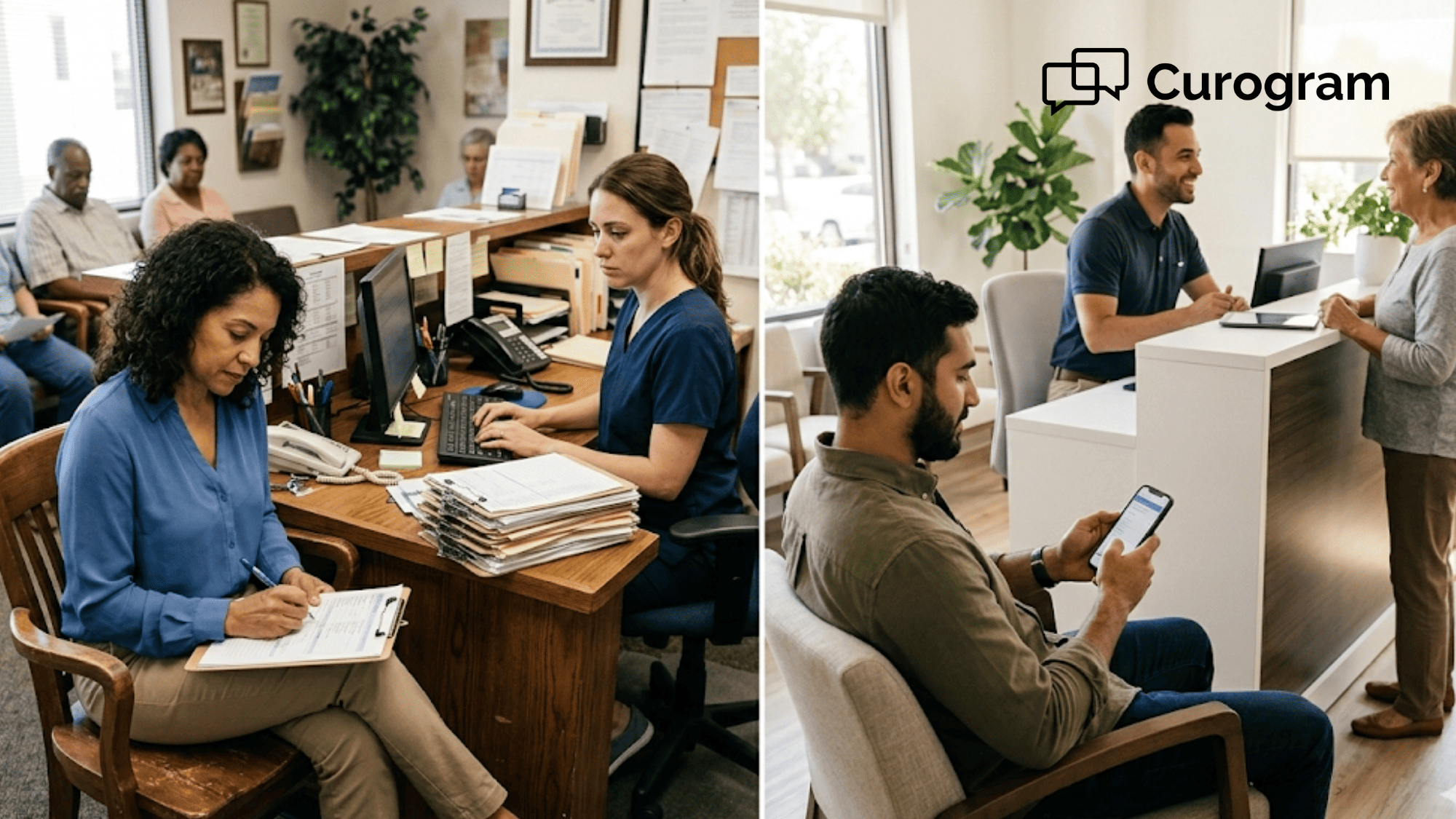
A patient walks in. They get a clipboard with 14 pages of forms. Twenty minutes later, those pages land on your coordinator's desk.
Now the real work begins.
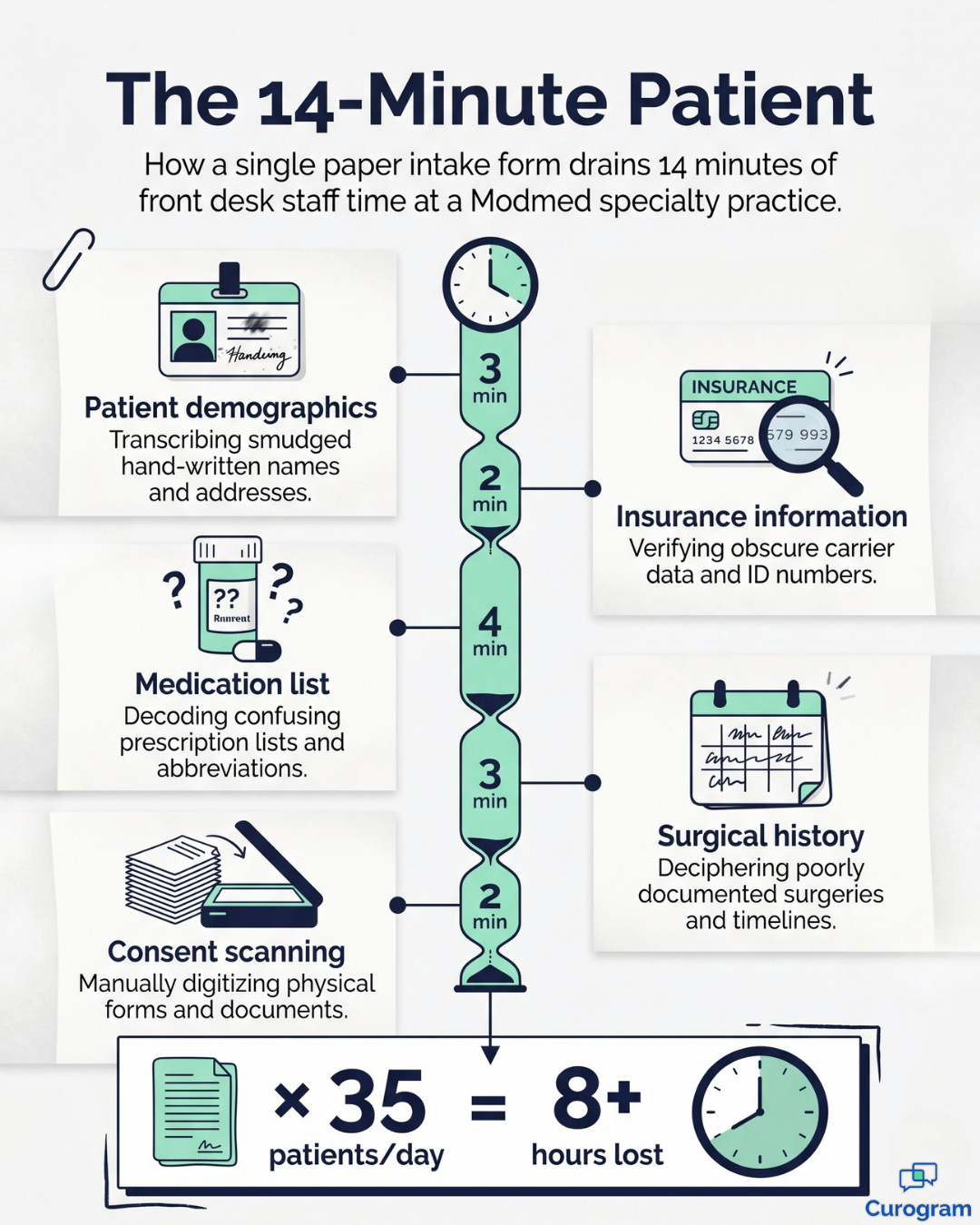
She types every line of handwriting into Modmed's PM system, squints at a smudged insurance ID, looks up a medication name the patient abbreviated, and scans the originals into the chart. Fourteen minutes per patient. Thirty-five patients a day. You do the math.
This is the Modmed front desk paper form data entry burden in its purest form. Your practice invested in a modern specialty EHR to digitize clinical workflows. But the very first step of every patient encounter, the intake itself, is still stuck in the 1990s.
The cost adds up faster than most administrators realize. Staff hours lost. Insurance denials from one bad digit. Burnout from work that feels nothing like patient care.
And worst of all?
Your most patient-facing team is buried behind a stack of paper instead of greeting the people who walked through the door.
Here's the truth about specialty practices running Modmed today: clinical documentation is digital, but the data feeding it still arrives analog. That gap is where productivity dies. It's where claims get denied. It's where your best coordinators quietly start updating their resumes.
This article walks through what that gap actually costs, why the fix isn't another scanner or a faster typist, and how digital intake closes the loop between the patient's phone and your Modmed system. Let's get into it.
How the Paper-to-Digital Bottleneck Quietly Drains Your Practice
The Paper Pipeline No One Talks About
Modmed PM and EMA are digital systems. Your practice didn't pick them by accident. You chose them because modern specialty care needs modern documentation.
So here's the strange part. The data that fills those digital fields still arrives on paper.
A patient writes. A coordinator reads. A coordinator types. That's two touches for every single field on every single form.
We call this the Double Touch, and it's the silent productivity killer hiding inside specialty practices nationwide. The information exists first on paper. Then it must be touched again to enter the digital chart.
Every additional touch invites delay, error, and wasted skilled labor.
What the Workflow Actually Looks Like
Let's walk through a real Monday morning at an orthopedic practice running Modmed.
A new surgical consult arrives at 8:45 AM. She gets a clipboard with 14 pages of paperwork. She finishes by 9:05 AM and hands it back. Now your front desk coordinator begins entering data into Modmed's PM and EMA fields.
Here's how the 14 minutes break down per patient:
| Task | Time Spent | Why It Takes So Long |
|---|---|---|
| Patient demographics | 3 minutes | Re-typing name, address, phone |
| Insurance information | 2 minutes | Pausing to decode "BKG" or "BK6" |
| Medication list | 4 minutes | Looking up abbreviated drug names |
| Surgical history | 3 minutes | Interpreting handwritten dates |
| Consent scanning | 2 minutes | Scan, save, attach as PDF |
| Total per patient | 14 minutes | Phones go unanswered the whole time |
Multiply 14 minutes by 35 patients a day.
That's more than 8 hours of skilled staff time gone, every single day, before a single phone call is returned or a single eligibility check is run.
The Hidden Cost of Transcription Errors
Handwriting introduces mistakes. A 5% error rate may sound small, but at 35 patients a day, that's 1 to 2 records daily with bad data slipping into Modmed.
Each one carries a different downstream cost:
- Transposed insurance ID digit — claim denial, $25 to $50 rework cost per claim.
- Misspelled patient name — eligibility check failure at the carrier.
- Abbreviated medication name — clinical safety flag a provider has to stop and resolve.
Across a month, that's 40 records with issues. Across a year, more than 500. The cumulative cost in denials, rework, and clinical risk lands somewhere between $15,000 and $30,000 annually for a mid-sized specialty practice.
For your team, that means real revenue is leaking out of the front desk every week, and almost none of it is being tracked.
The Staff Frustration No One Measures
Your front desk coordinators are trained professionals. They manage complex scheduling, work insurance phone trees, calm anxious patients, and keep the schedule running. They were not hired to retype handwriting for 8 hours a day.
When skilled staff function as data entry clerks, morale slips. Burnout speeds up. Turnover climbs, and you find yourself recruiting again every 9 to 12 months.
The irony stings most administrators awake at 2 AM:
The practice paid for Modmed to digitize clinical care, but intake is still stubbornly analog.
The investment never quite delivered what it promised because the front door of the workflow stayed paper.
Why Faster Typing Isn't the Answer
The Common Workarounds That Don't Work
Most practices try to solve the Double Touch by working harder. Train staff to type faster. Add a second coordinator. Buy a better scanner. Move the clipboard to a tablet that still produces a PDF for someone to interpret.
None of these fix the problem. They just spread it around.
The Real Bottleneck Is Handwriting Itself
The real issue is that handwriting itself is the bottleneck. As long as patients write and staff transcribe, you'll keep paying the transcription tax. Digital intake doesn't speed up paper. It eliminates paper.
This is where digital intake reduce transcription errors Modmed EMA workflows start to matter. The goal isn't faster transcription. The goal is no transcription.

The Digital Intake Fix Built for Modmed Specialty Workflows
Forms That Arrive Before the Patient Does
Curogram's digital intake platform sends patients a text link 24 to 48 hours before their appointment. They tap the link, complete the forms on their phone, and submit structured digital data straight into your dashboard. No paper. No scanning. No handwriting to decode.
Staff log in and see clean fields. Insurance IDs are validated. Medication names come from dropdowns, not guesses. Signatures are timestamped and stored. The work that used to take 14 minutes per patient drops to a quick review.
18 minutes → 4 minutes |
| New patient check-in time before vs. after digital intake. That's more than a 75% reduction at the front desk, with no extra staff required. |
For Curogram digital intake staff productivity Modmed, this is the structural change that finally moves the needle. Your team stops interpreting and starts verifying.
Structured Data Capture That Paper Cannot Match
Paper forms let patients skip fields, scribble illegibly, or abbreviate medications in ways no one can safely decode. Digital forms don't.
Curogram uses structured fields throughout. Dropdown menus for common medications. Standardized formats for insurance IDs. Required-field validation that won't let a patient submit until critical data is complete. Digital signatures with timestamps for consent.
The patient experience stays simple. The data quality jumps dramatically. Staff receive submissions that are already legible, already complete, and already validated against the rules you set.
Built for Your EHR Reality
Here's the honest answer about integration:
Curogram's forms deliver structured digital data your staff can confirm and enter into Modmed in a fraction of the time paper transcription requires.
Direct API write-back into specific EMA fields may depend on marketplace approval and the depth of integration available.
The immediate win doesn't require deep write-back. Structured digital data beats handwritten paper every time.
Whether you're working to replace paper forms scanning Modmed clinic workflows or aiming to automate patient intake data entry Modmed PM processes, the time recovered is real on day one.

Specialty-Specific Use Cases
Different specialties run different intake packets.
Curogram's form builder handles them all.
- Dermatology: Structured skin condition history with checkboxes and patient photo uploads replaces handwritten descriptions providers struggle to read.
- Orthopedics: Standardized surgical history and validated medication fields remove the clinical safety risk of illegible drug names.
- Ophthalmology: Pre-op checklists with required fields make sure nothing is missed before cataract or LASIK procedures.
- Pain management: Controlled substance agreements with timestamped digital signatures create compliance documentation paper simply cannot produce.
For staff time savings online forms Modmed specialty practice teams need, the right forms matter as much as the right platform.
Curogram lets you replicate your most complex intake packet, then improves on it with logic and validation paper can never offer.
What Practices Actually See After the Switch
Hours Recovered Daily
Staff data entry time drops by 50% to 75% per patient when working from structured digital forms instead of handwritten paper. For a practice seeing 35 patients a day, that's 4 to 6 hours of staff time recovered. Every single day.
8 hours — 2 hours Daily staff time spent on data entry before vs. after digital intake. Six hours come back to your team every single day.
Paper supply and scanning costs of $800 to $1,000 a month disappear. Transcription error rates drop close to zero because validated fields catch problems before submission.
The Role Shift: From Transcriptionist to Verifier
Your front desk coordinator's day transforms. Instead of 14 minutes typing handwriting per patient, she spends 3 to 4 minutes reviewing pre-filled digital data and confirming accuracy.
The work changes from interpretation to verification. From "what does this say?" to "is this correct?" Staff feel like professionals managing a workflow again, not clerks copying data they can barely read.
A Real Outcome at Scale
Here's what a 35-patient-per-day orthopedic practice looks like after eliminating paper intake. The 6 hours recovered every day get redirected to insurance pre-authorization follow-up. Because eligibility now gets verified before the appointment instead of after, claim denials drop sharply.
The waiting room thins out. Providers start on time. And the conversation about hiring another front desk person quietly goes away because the existing team can handle the volume.
This means real, recurring dollars flow back into the practice from work that was already being done badly. For most specialty practices, the savings cover the platform many times over within the first quarter.
Your Next Step Toward a Paperless Front Desk
Your front desk team is one of the most expensive parts of your operating budget. They are also one of the most patient-facing. Spending half their day decoding handwriting is bad for them, bad for your patients, and bad for your margins.
The Modmed front desk paper form data entry burden does not have to be a permanent feature of running a specialty practice. Digital intake is no longer experimental. It's the operating standard for practices that want clean clinical data, faster check-ins, lower denial rates, and a team that doesn't burn out by Thursday.
Curogram exists to take that paper-to-digital conversion off your team entirely. Patients get a text link. They complete forms on their phone. Your staff get structured, validated data ready to review. That's it.
No clipboards. No scanning. No interpreting smudged insurance IDs at 9 AM on a Monday.
Practices that make the switch typically recover 4 to 6 hours of staff time per day, eliminate $900 a month in paper costs, and cut new patient check-in times by more than 75%. The savings show up in the first month. The morale boost shows up almost immediately.
Here is the simplest way to see if it fits your practice. Bring your most complex paper intake packet. The one you wince at when you hand it to a new patient.
We'll show you the digital version, walk through how it would flow into your Modmed workflow, and answer questions specific to your specialty.
Schedule a Demo today. Fifteen minutes is all it takes to see what your front desk could look like without paper. Your team has been waiting for this conversation longer than you might realize.
Frequently Asked Questions
Yes. Curogram's form builder supports unlimited customization, including conditional logic, multi-page sequences, photo uploads, document attachments, and digital signatures. You can replicate your most complex paper intake packet in digital form, with the added benefit of required-field validation and structured data capture that paper simply cannot provide.
Patients receive a text message with a link. They tap the link, and the form opens in their phone's web browser. There's no app to download, no portal login to remember. The forms are built for mobile use with large buttons, clear labels, and simple navigation. Any patient who can read a text message can complete a Curogram form. For the rare patient who truly cannot complete forms digitally, staff can hand them a tablet at check-in pre-loaded with the same digital form.
Curogram sends automated reminders to patients who haven't yet finished their forms. If a patient still arrives without completing intake, staff can hand them a tablet at check-in with the same digital form loaded up. Even in that scenario, it's still faster and more accurate than paper. The goal is to maximize pre-visit completion, but the system handles incomplete submissions gracefully.
No. Digital intake sits in front of Modmed, not on top of it. Patients submit forms through Curogram. Staff review structured data in the dashboard and confirm it into Modmed as they normally would. The change feels less like a system overhaul and more like the paper stack quietly disappearing from the front desk.
Most practices see meaningful time recovery within the first week of go-live, simply because the volume of handwriting being interpreted drops sharply. Full impact, including check-in time reductions and lower denial rates, typically lands within 30 to 60 days as more patients adopt pre-visit form completion.