9 min read
Digital Intake Forms for Modmed Practices | Replace Paper Intake
Aubreigh Lee Daculug
:
May 26, 2026
Curogram delivers these forms through a text link — no app, no portal login — so medical history, insurance details, and consent signatures arrive digitally and legibly.
For Modmed EMA dermatology, orthopedic, and ophthalmology practices, this fix protects workflow downstream: check-in drops below 3 minutes, paper costs disappear, and handwriting-related denials nearly vanish.
A Modmed digital patient intake alternative to paper forms is no longer optional. It's overdue.
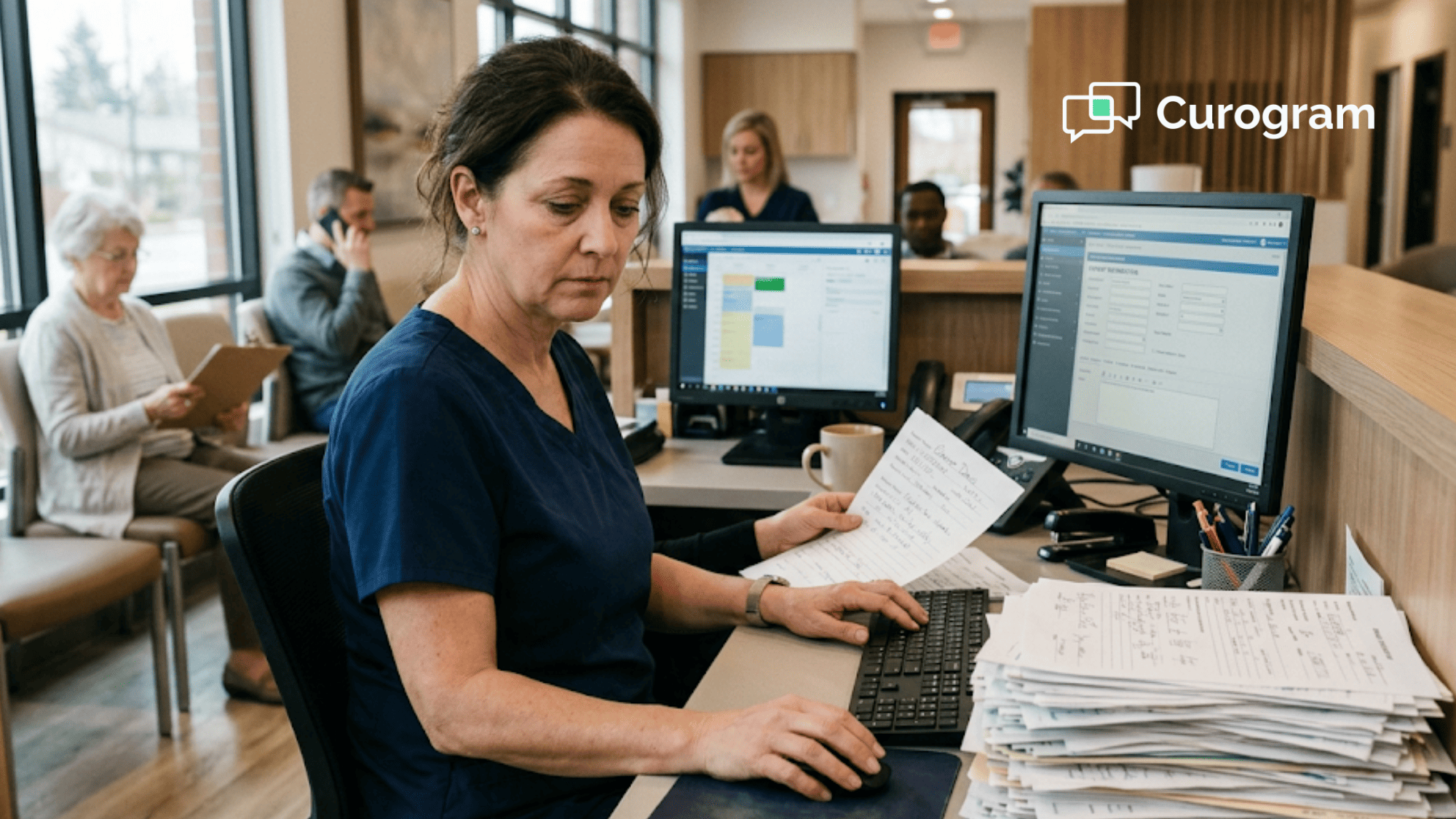
A new patient walks into your dermatology practice at 10 AM for a cosmetic consultation. They're handed a clipboard with 12 pages. They sit. They write. Fifteen minutes later, a coordinator squints at the handwriting and starts typing it into Modmed.
That coordinator can't tell if the insurance ID ends in a 5 or an 8. The medication list has three abbreviations nobody recognizes.
By the time everything is keyed in, the patient has been in your office for 23 minutes without seeing a provider.
Multiply that by 40 patients a day. Then multiply by every business day this year.
This is the quiet bottleneck inside Modmed specialty practices. Your EMA is excellent. Your clinical documentation is structured, fast, and built for specialty workflows. But none of that matters at 10:23 AM when the schedule is sliding and the front desk is buried in paper.
The problem is not your EHR. The problem is what happens before the EHR ever opens. Intake — the upstream step — still runs on a clipboard. And paper intake quietly drags down everything Modmed was designed to speed up.
This guide is for practice managers, front desk leads, and operations directors at dermatology, orthopedic, ophthalmology, and other specialty clinics running on Modmed.
You'll see why paper intake is more expensive than it looks, why traditional portal solutions fail in specialty environments, and how secure online forms digital intake Modmed specialty practices can deploy quickly — without an app download — change the math.
By the end, you'll have a clear picture of what a paperless front desk looks like, what it saves, and how Curogram fits into the Modmed workflow you already use.
Let's start with the real cost of the clipboard.
The Clipboard Problem Modmed Practices Don't Talk About
Modmed's EMA gets a lot right. Once your provider is in the exam room, clinical documentation is fast, structured, and tailored to specialty work. That part isn't broken.
What's broken is what happens before the exam room.
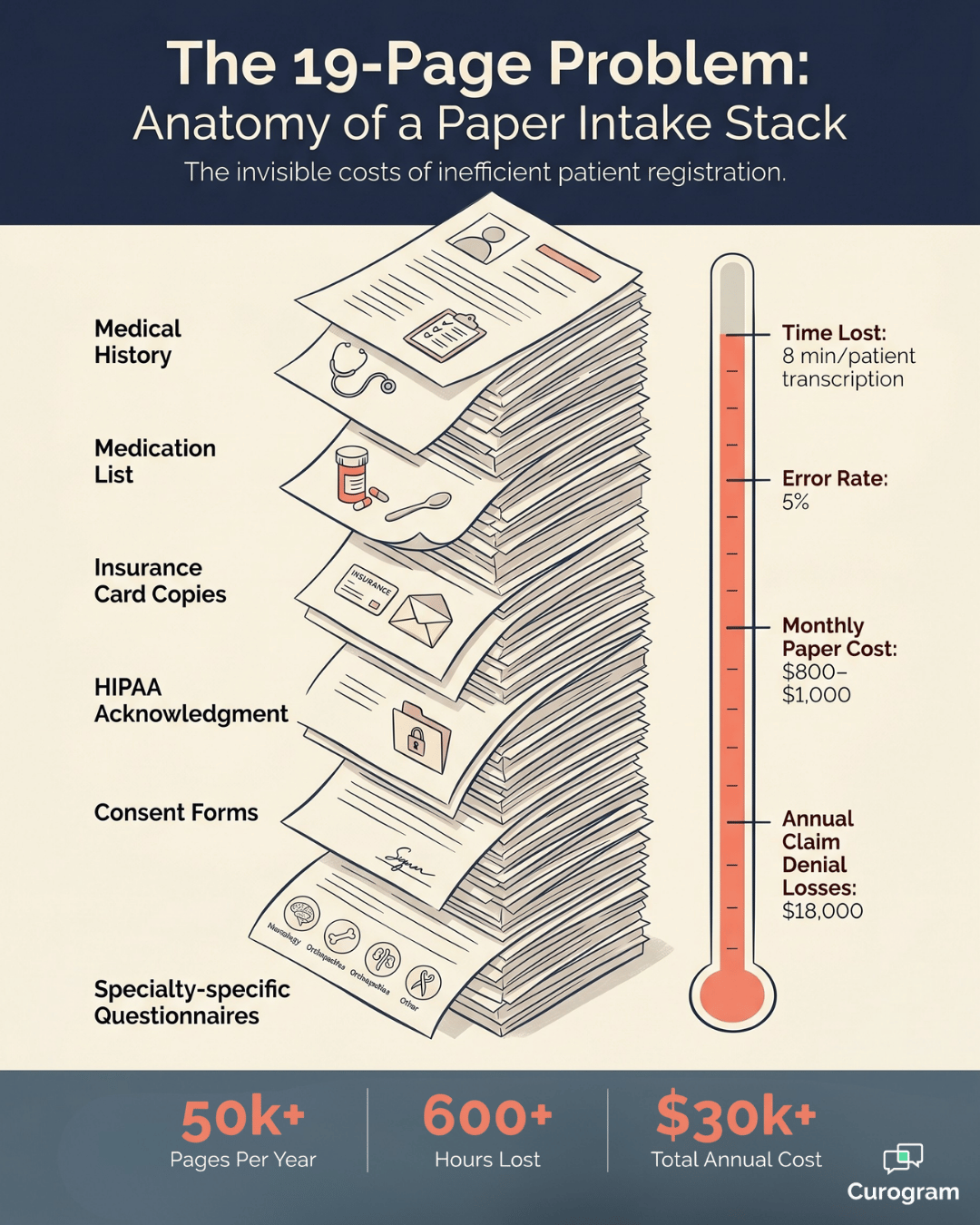
Most specialty practices on Modmed still process up to 19 pages of paper per new patient — medical history, medication lists, insurance cards, HIPAA acknowledgments, consent forms, and specialty-specific questionnaires. Patients fill these out by hand, in the waiting room, with a pen that's been chewed on twice.
Then that data gets manually retyped into your PM system. It's slow. It's error-prone. And it has barely changed in 25 years.
What 19 Pages of Paper Actually Costs Your Practice
Here's what the paper workflow looks like in real numbers for a practice seeing 40 patients per day.
| Cost Category | Per Day | Per Month | Per Year |
|---|---|---|---|
| Front desk transcription time (8 min × 40 patients) | 5.3 hours | ~115 hours | ~1,380 hours |
| Paper, printing, scanning, storage | ~$35 | $800–$1,000 | ~$10,000+ |
| Claim denials from data errors ($25–$50 each, 2 errors/day avg) | $50–$100 | ~$1,500 | ~$18,000 |
| Patient wait time absorbed by your schedule | 10 hours | 200+ hours | 2,400+ hours |
That last row is the one that hurts. You're not just paying for paper. You're paying for a slower schedule, more no-shows from waiting room frustration, and providers who start every appointment behind.
The numbers above are illustrative for a 40-patient-per-day specialty clinic. Your mileage will vary, but the pattern won't.
The Error Cascade Nobody Tracks
Paper intake creates a quiet chain of small mistakes that turn into big problems. A misspelled name on a claim form. A transposed digit in an insurance ID. A medication abbreviation the coordinator guesses at.
Each of these costs $25–$50 in administrative rework and delays payment by 30–60 days. At a 5% error rate on 40 patients per day, that's 2 problematic records daily, 40 per month, almost 500 a year.
Some of those errors never hit billing. They hit the chart.
An illegible medication list reaching a provider's screen is more than annoying — it's a clinical safety risk.
An incomplete Mohs consent that gets caught at the surgical suite delays the procedure for the patient and everyone scheduled after them.
This is the cost paper hides — and it's the foundation of why portal-only solutions, which we'll get into next, haven't fixed it.
Why Modmed's Native Tools Aren't Enough on Their Own
Modmed's patient portal exists. So why is paper still everywhere?
Because portals were built for desktops, not phones. They ask patients to log in, remember passwords, and authenticate before they can complete a single form.
For a 67-year-old cataract patient or a 40-year-old skin cancer follow-up, that friction is enough to push them back to the clipboard in the waiting room.
The result:
Portal adoption hovers, paper persists, and the front desk keeps transcribing.
Where Portals Lose Patients
Most portal abandonment happens at predictable friction points:
- Account creation and password reset loops
- Desktop-shaped forms that don't fit a phone screen
- Multi-step logins for what should be a single tap
- No clear connection between the appointment reminder and the form
Patients who hit any one of these often give up and assume they'll "just do it at the office." That assumption is what keeps the clipboard in business.
The Specialty Form Gap
Specialty intake is not generic intake.
A dermatology cosmetic consult needs photo consent and skin condition history.
An orthopedic surgical workup needs surgical history, current medications, and imaging authorization.
An ophthalmology pre-op needs medication timing, transportation arrangements, and procedure-specific consent.
Generic portal forms flatten this into one-size-fits-all templates. So practices print specialty addendums on paper, hand them to patients, and start the transcription cycle all over again.
That's why online forms for dermatology orthopedics ophthalmology Modmed workflows have to be specialty-shaped from the start — not retrofitted from a general portal.
Which raises the obvious question:
What does a system designed for this from the ground up actually look like?
Mobile-First Forms That Work With Modmed
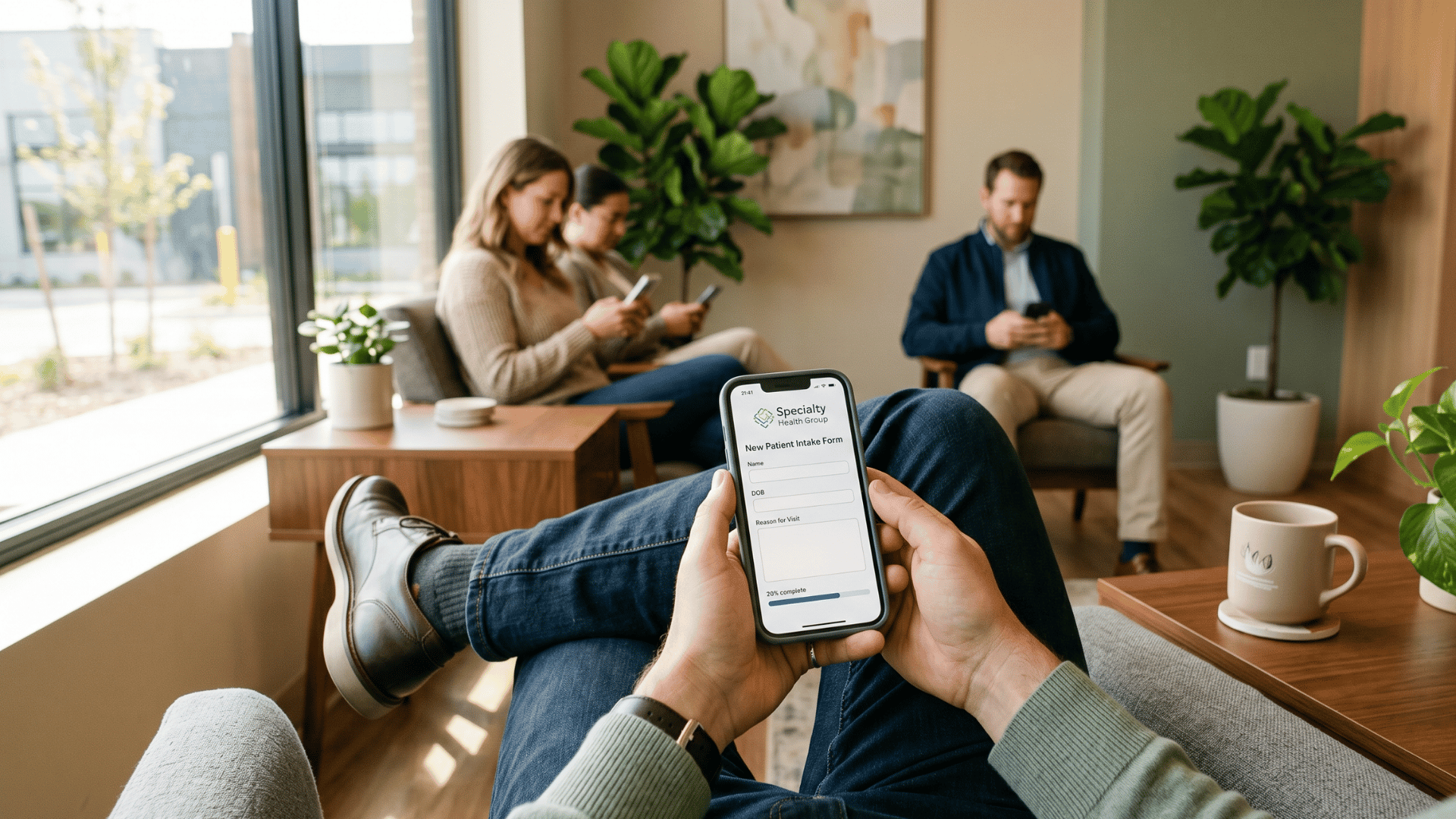
Here's the simple version of the fix. Send your forms to the patient's phone 24–48 hours before the appointment. Let them complete intake from their couch, the parking lot, or a coffee break. Have the data waiting in your system before they walk in.
That's what Curogram does. It's a Modmed digital patient intake alternative to paper forms — and it doesn't ask your patients to install anything or remember a password.

How a Text-Link Form Actually Works
The workflow is almost embarrassingly straightforward. A text message goes out before the appointment with a secure link. The patient taps it. The form opens in their phone's browser.
They fill it out with their thumb — name, address, medical history, medications, allergies, insurance card photo, e-signed consents. They submit. Done.
No app store. No portal account. No "please reset your password" dead ends.
Average completion time:
5 to 10 minutes. By the time the patient parks in your lot, their record is ready for staff review.
Built for Specialty Workflows, Not Generic Intake
Forms are fully customizable per appointment type, because a Mohs consultation doesn't need the same fields as a routine skin check.
Here's how that plays out across common Modmed specialties:
- Dermatology — cosmetic consults, Mohs pre-ops, follow-ups, photo consent
- Ophthalmology — cataract pre-ops with medication timing, transportation verification, post-op care acknowledgment
- Orthopedics — surgical history, current medications, physical therapy referral consent
- Pain management — controlled substance agreements with timestamped digital signatures
Each form is mobile-optimized — designed for a phone screen, not crammed into a desktop layout. That sounds small. It isn't. It's the difference between a 78% completion rate and a 25% one.
Where Curogram Fits Inside Your Modmed Stack
Curogram is not trying to replace Modmed. It sits in front of it.
Forms are sent through the same text channel patients already use for reminders, creating one touchpoint to confirm visits and complete intake. Completed forms arrive in Curogram's dashboard before the visit for easy digital review.
Direct write-back to specific EMA fields depends on Modmed's API marketplace approval, and Curogram's team will be straight with you about where that integration sits today. But even without direct write-back, your staff is entering data from a legible, structured digital form — not from paper.
That alone cuts transcription time by 50–75% and removes the handwriting interpretation problem entirely.
For practices that want mobile intake forms Modmed EMA integration to power, this is the practical path that works today while deeper integration is being expanded.

Security and Compliance, Built In
Forms are fully HIPAA-compliant with encrypted transmission and secure storage. Every Curogram practice gets a BAA. No patient data sits on the patient's phone after submission.
The same security standard Curogram applies across its platform applies to every form field, signature, and uploaded ID card.
This is Curogram online forms Modmed patient engagement built for healthcare, not retrofitted from a generic form builder.
Once the system is in place, the operational difference is hard to miss — and that's where we go next.
What Changes When You Replace Paper Intake at a Modmed Specialty Clinic
The clearest way to see the difference is to walk through one practice day.
Take that 40-patient-per-day dermatology clinic from earlier and compare the two workflows side by side.
| Workflow Step | Paper Intake | Pre-Visit Digital Intake |
|---|---|---|
| Patient form completion location | Waiting room | Home, parking lot, anywhere |
| Average check-in time | 15–20 min/patient | 2–3 min/patient |
| Daily front desk transcription time | ~10 hours | ~2 hours |
| Monthly paper & scanning cost | $800–$1,000 | Near zero |
| Data error rate from handwriting | ~5% | Near zero |
| Patient time in lobby before provider | 20+ min | 5 min |
That's 8 hours of front desk time recovered every day. Forty hours a week. Time that can move to insurance verification, prior authorization follow-up, and the patient experience work that actually grows the practice.
One Curogram client, Atlas Medical Center, achieved intake efficiency 3X better than industry average using this exact workflow.
The Front Desk Role Quietly Upgrades
The job changes character. Your coordinator stops being a transcriptionist and starts being a verifier. Instead of typing for 8 minutes per patient, they're spending 60 seconds confirming what's already in the system and flagging anything that needs follow-up.
That shift matters for retention. Front desk burnout is real, and a big chunk of it comes from repetitive data entry work.
Remove it, and your team gets to do the parts of the job they actually wanted — helping patients, solving problems, supporting the clinical team.
The Downstream Impact Modmed Practices Notice First
Three things change quickly when you replace paper intake Modmed specialty clinic workflows depend on:
- Claim denials drop — structured digital fields catch insurance IDs correctly the first time
- The schedule holds — providers start on time because patients are intake-ready when they arrive
- Patient satisfaction climbs — the visit begins with care, not with a clipboard
The financial piece is worth pausing on. For a practice running $1.2M in annual claims, even a 2% reduction in denials is roughly $24,000 in recovered revenue. Pair that with the reclaimed staff hours and the saved paper costs, and the ROI math becomes hard to argue with.
This is what pre-visit digital intake Modmed EHR users see in the first 60–90 days.
Retire the Clipboard: Start With a 15-Minute Look
Modmed gave your providers a clinical documentation system built for specialty work. Your patients deserve an intake experience that matches it.
Right now, somewhere in your practice, a coordinator is squinting at handwriting.
A patient is filling out their medical history for the third time this year. A claim is about to be denied because someone wrote a 5 that looks like an 8. None of that is necessary anymore.
Curogram replaces the clipboard with mobile-friendly digital forms that arrive on the patient's phone before the visit.
No app. No portal login. No paper at the front desk. Forms are HIPAA-compliant, fully customizable per appointment type, and delivered through the same text channel your patients already trust for appointment reminders.
For specialty practices running on Modmed, this is the upstream fix. It protects the clinical workflow downstream and gives you back staff hours that paper has been quietly stealing.
The numbers are concrete: check-in time drops by roughly 80%, paper costs of $800–$1,000 per month disappear, and front desk teams reclaim 8 hours a day that can be redirected to revenue-generating work like insurance verification and prior authorization.
You don't need a six-month implementation to find out if this works for your practice. You need 15 minutes.
Schedule a Demo and bring your most complex intake form. We'll show you the digital version, walk you through how it fits with your Modmed workflow, and give you a clear picture of what a paperless check-in would look like for your specialty practice.
Frequently Asked Questions
Yes. Curogram's forms are fully HIPAA-compliant with encrypted data transmission, secure storage, and a Business Associate Agreement (BAA) for every practice. Patients submit medical history, insurance details, and consent signatures through a secure web form — the same standard of data protection applied to every Curogram feature. No patient data is stored on the patient's phone after submission, and your practice retains full control over data access permissions.
Yes. Curogram's form builder allows unlimited customization. A dermatology practice can have separate forms for cosmetic consultations, Mohs surgery pre-ops, and routine follow-ups. An ophthalmology practice can create cataract-specific pre-op forms alongside general exam intake. An orthopedic group can build different forms for surgical consults versus physical therapy intake. Each form is tied to the appointment type, so patients receive only the forms relevant to their specific visit — no generic templates padded with irrelevant questions.
Completed form data is available in Curogram's dashboard for immediate staff review the moment the patient submits. Direct write-back to specific EMA fields may require API marketplace approval from Modmed, and Curogram's team will be transparent with you about where that integration stands. In the meantime, your staff is entering data from a legible, structured digital form — not handwritten paper — which reduces data entry time by 50–75% and virtually eliminates transcription errors. Most practices see the operational benefit immediately, regardless of write-back depth.
Most patients complete the full intake in 5 to 10 minutes on their phone, often spread across multiple short sittings before the appointment. Paper intake in the waiting room typically takes 15 to 20 minutes of focused time — under pressure, on a clipboard balanced on a knee. Patients overwhelmingly prefer the mobile version, which shows up in completion rates well above traditional portal averages.
The same forms remain available on a tablet at check-in, so your front desk has a fallback. But because reminders are tied to the appointment confirmation text — and the form takes minutes, not hours — most patients complete intake before they arrive. Practices typically see completion rates climb week over week as patients learn the workflow.