9 min read
Digital Intake for RamSoft Imaging | Pre-Visit Screening via Text
Aubreigh Lee Daculug
:
April 15, 2026
Table of Contents
Secure online forms delivered via text let patients complete modality-specific screening, consent, and medical history from their phones before they ever walk through the door.
No app download. No registration. Just a link sent 24–48 hours before the appointment that 80%+ of patients complete on their own.
For centers running 40–80 studies per day, eliminating pre-visit paperwork delays recovers thousands in daily scanner utilization and frees technologists to start studies on time — every time.
A patient walks into your imaging center 10 minutes early.
She's scheduled for an MRI. She's nervous, she's never been here before, and she has no idea what's about to happen.
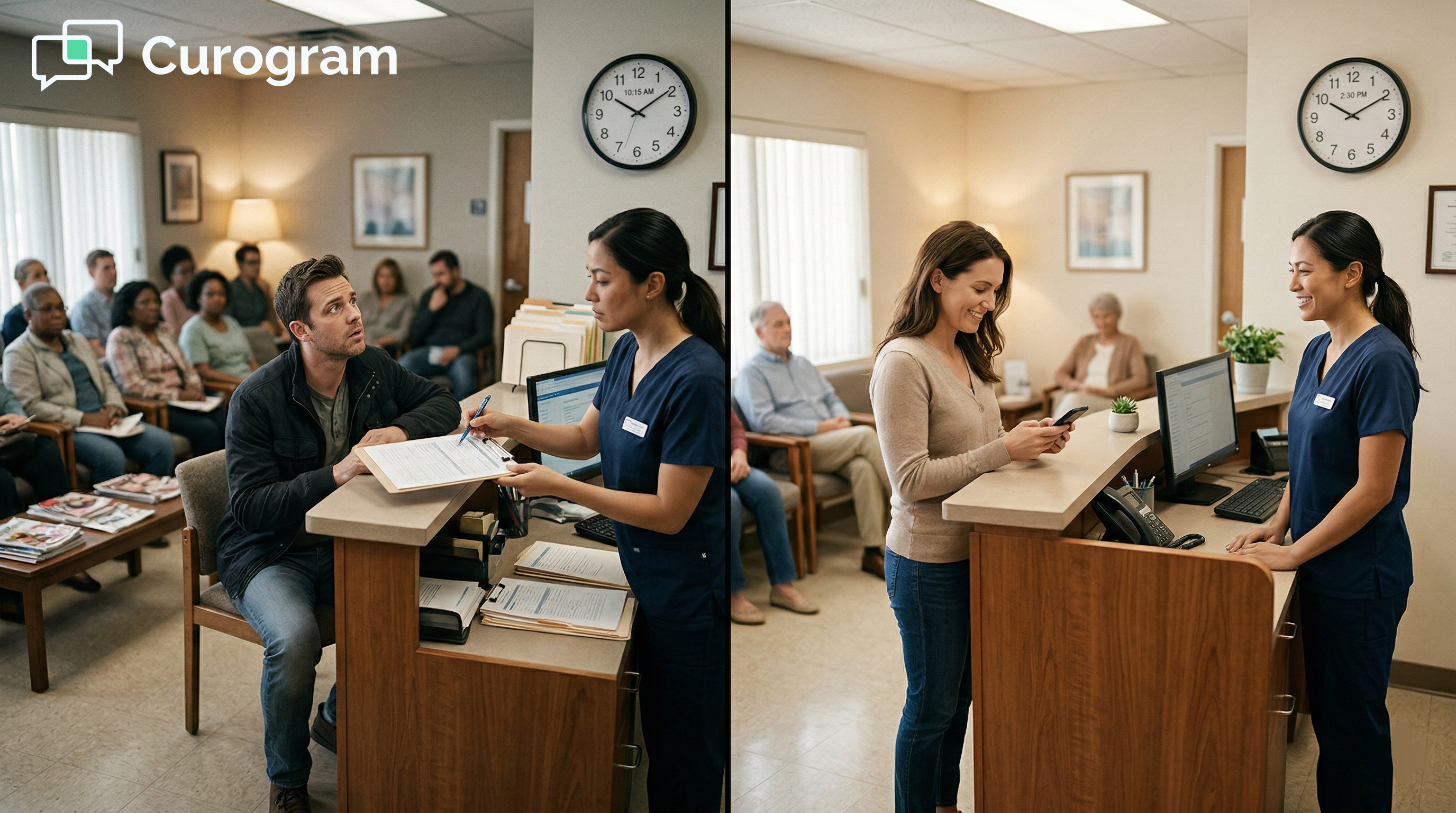
Your front desk hands her a clipboard.
Now she's sitting in the waiting room, squinting at a dense medical history form she doesn't fully understand, trying to figure out if her knee replacement counts as a "ferromagnetic implant." Your technologist is already prepped and ready — waiting.
The scanner is open. The slot is ticking.
This happens dozens of times every day in imaging centers across the country. And most of them don't realize how much it's costing them.
Twenty minutes of intake delay per patient doesn't sound dramatic. But run the numbers across 40 studies a day at a busy center, and you're looking at hundreds of thousands of dollars in lost annual revenue.
That's before you count the staff time spent re-keying illegible handwriting into the RIS, the authorizations not verified until the patient is already seated, or the contrast screening questions that don't get flagged until a technologist is mid-protocol.
The clipboard is not just a nuisance. It's a clinical bottleneck with a real dollar amount attached to it.
RamSoft-powered imaging centers have some of the most advanced infrastructure in radiology — AI-assisted diagnostics, zero-footprint PACS viewers, enterprise-grade imaging systems.
But intake, the one workflow that happens before every single study, still starts with paper.
It doesn't have to.
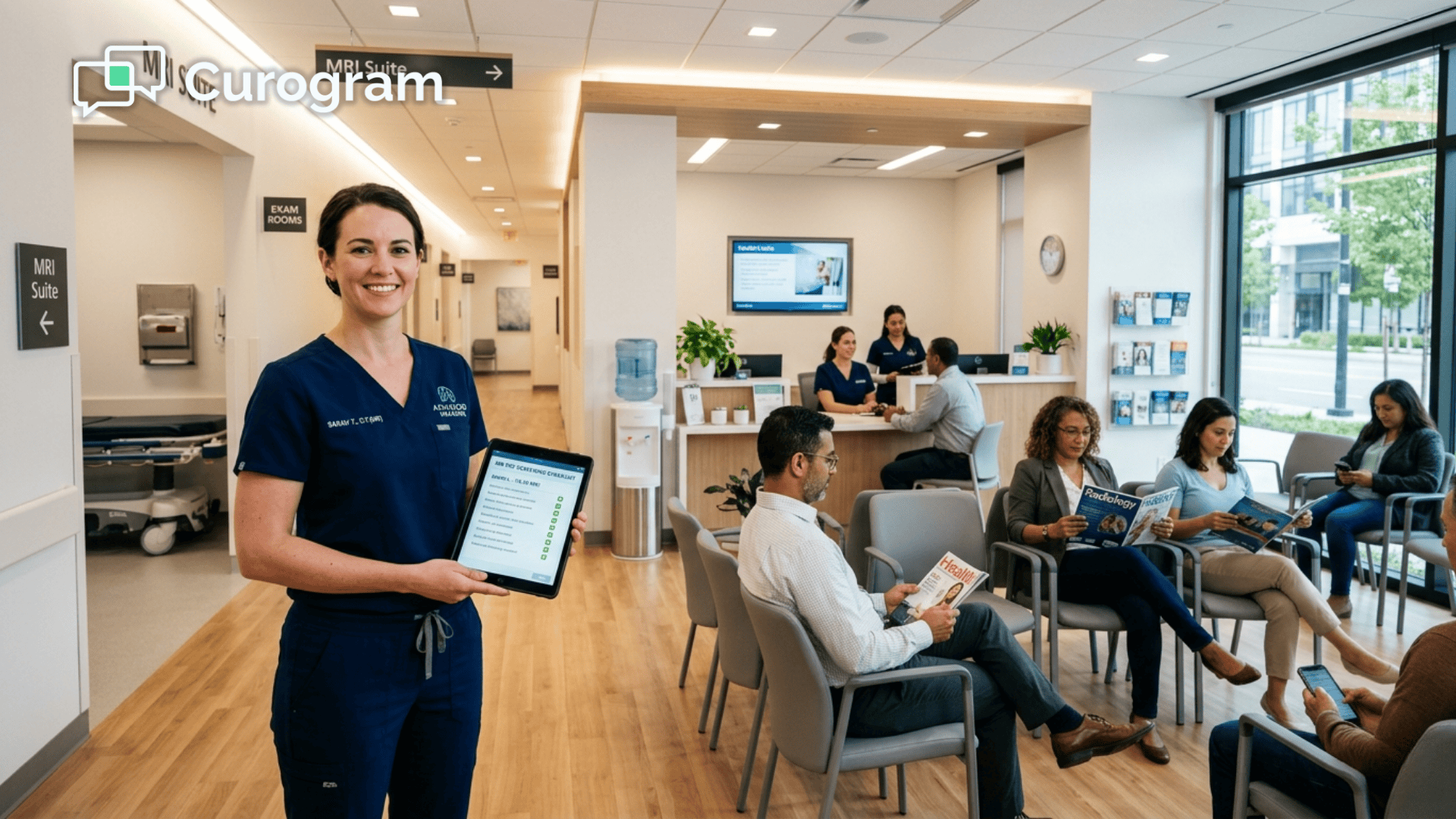
Secure online forms delivered via text change the entire pre-visit experience. Patients get a link before their appointment. They complete everything on their phone in under five minutes — no app, no login, no friction. By the time they arrive, your technologist already has the screening data they need.
Studies start on time. Scanners stay full. And your team stops managing paperwork and starts focusing on patient care.
This guide breaks down exactly how that works, what it costs, and what you stand to gain.
When Paper Intake Becomes Your Biggest Operational Liability
Think about what actually has to happen before a technologist can begin a CT or MRI study.
What Technologists Need Before a Single Scan Can Start
Pre-visit intake isn't administrative busywork. Every form captures clinically critical data that directly determines whether a study can safely proceed:
- Contrast screening: Kidney function (eGFR), prior allergic reactions, and active medications — metformin, ACE inhibitors, diuretics, blood thinners — all interact with contrast agents in ways that can seriously harm a patient.
- MRI safety screening: Metal implants, pacemakers, cochlear implants, aneurysm clips, and ferromagnetic surgical hardware must be identified before the patient enters the suite. This is not optional.
- General medical history: Prior malignancies, radiation exposure, and pregnancy status affect both imaging interpretation and protocol safety.
- Consent documentation: Procedure consent, contrast consent, and sedation consent for pediatric or claustrophobic patients.
When all of that happens in the waiting room, you're creating a bottleneck at the worst possible moment — when the scanner is ready and the patient is already there.
Here's what the cascade looks like in practice.
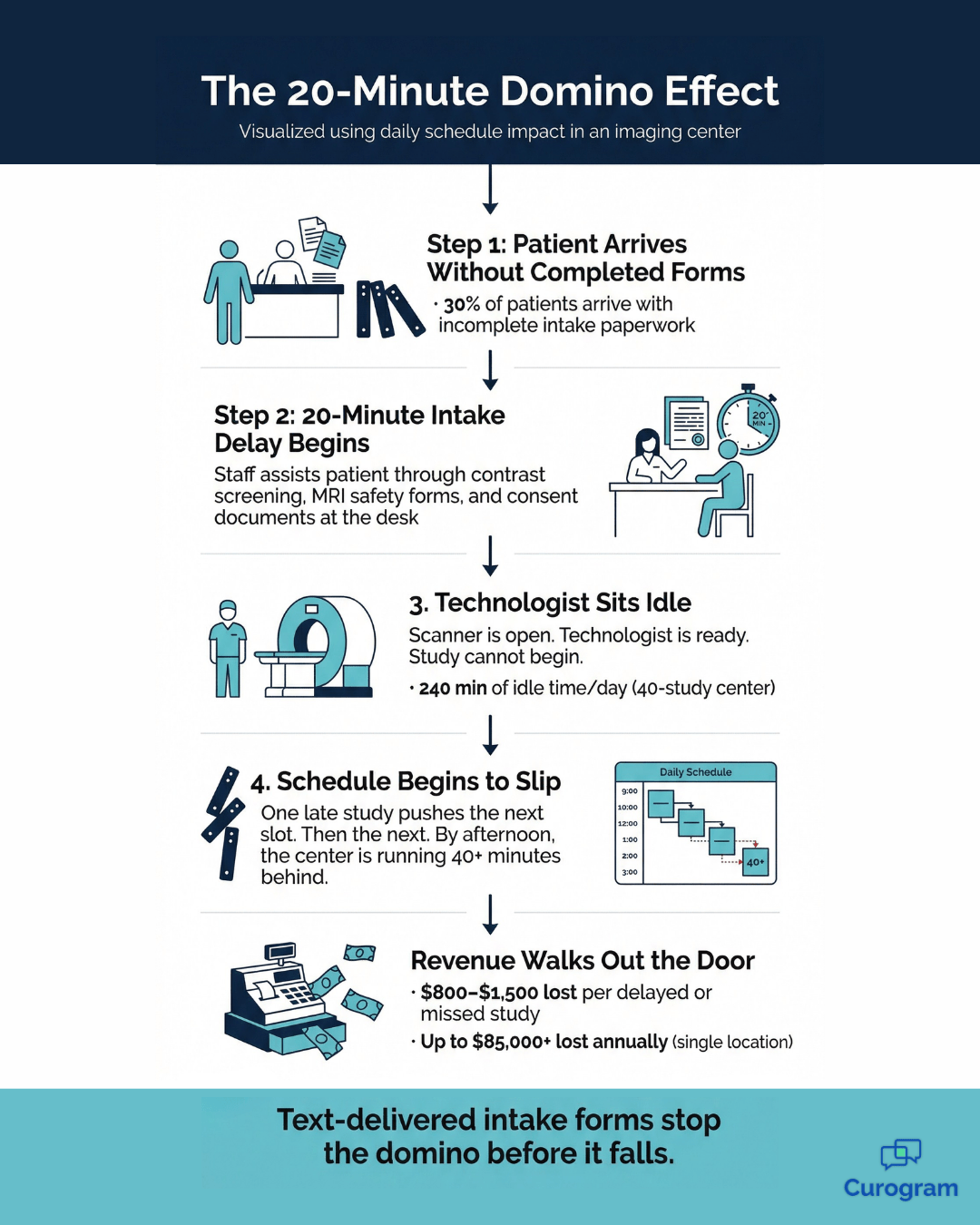
A center running 40 studies per day, where just 30% of patients arrive without completed intake, is dealing with 12 patients per day who each require 20 minutes of staff-assisted intake.
That's 240 minutes of technologist idle time. Every single day.
At $35 per hour in technologist labor costs, that wasted time adds up to roughly $140 in unrecoverable productivity. Daily.
And that figure doesn't account for delayed studies, insurance authorizations flagged too late, or staff manually re-entering illegible handwriting into the RIS.
And that figure doesn't account for the human cost: overwhelmed patients, exhausted front desk staff manually entering data, and insurance authorizations that don't get flagged until the patient is already checked in.
Why App-Based Intake Doesn't Solve the Problem
RamSoft's Blume patient app offers genuinely impressive features. Report explanations powered by ChatGPT. Image viewing and sharing. Appointment requests. Digital forms accessible inside the app.
But here's the limitation that matters: Blume requires patients to download it, install it, and register.
The Patient Who Won't Download Anything
For follow-up imaging patients — people returning for a six-month scan or annual screening — that investment in app adoption makes sense. But the majority of MRI, CT, and ultrasound patients are first-time visitors.
They were referred for a single diagnostic study. They have no prior relationship with your facility. They are not going to download and register in a patient portal for one appointment.
That's not a criticism of Blume. It's just the reality of imaging center patient demographics.
App-based tools are built for engaged, returning patients. Pre-visit intake needs to reach every patient — including the ones who have never heard of your facility before today.
Text reaches all of them.
A Smarter Intake Engine: How Text-Delivered Digital Forms Work
Curogram's approach to pre-visit preparation is built on one simple insight:
99% of people have a phone that receives text messages. Every one of them can tap a link.
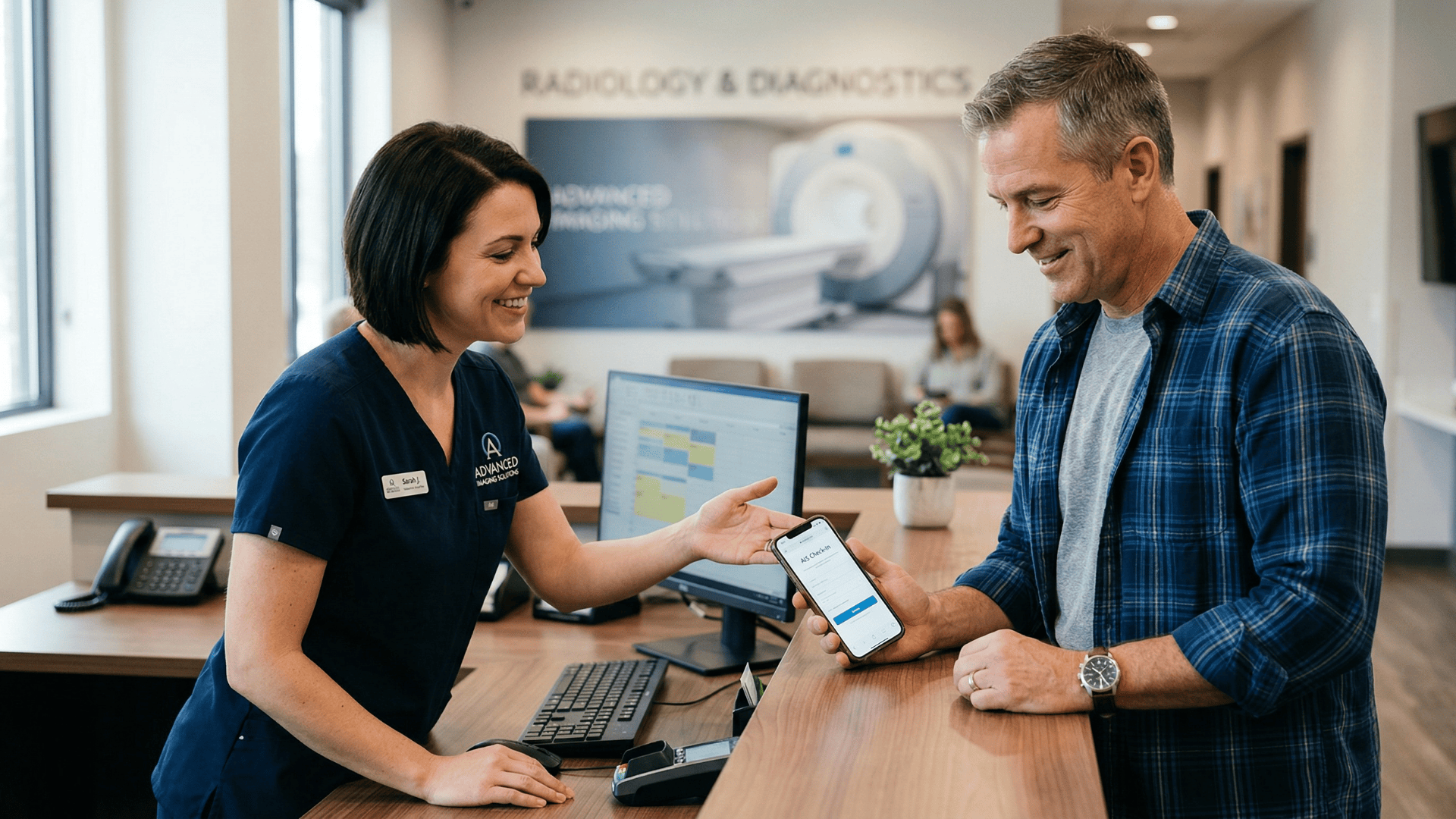
When a patient is scheduled for an imaging study, the imaging center sends a text containing a secure link.
The patient taps it from whatever phone they have — no app download, no username, no password. The form opens in their browser and adapts to the specific study they're booked for.
The Right Form for the Right Study
This is what modality-specific intake actually looks like in practice:
- A patient scheduled for contrast-enhanced CT receives a contrast screening questionnaire covering eGFR, medication interactions, and prior reactions.
- A patient booked for an MRI receives a metal implant screening form designed specifically to catch ferromagnetic hardware before they get anywhere near the suite.
- A patient undergoing a radiation-sensitive study is prompted with pregnancy screening questions appropriate to their age and demographics.
Most patients complete their form in 3–5 minutes. The questions are mobile-optimized, progress-tracked, and filtered by skip-logic — so patients only see what's relevant to their specific study.
From Phone to PowerServer — Automatically
Forms are sent 24–48 hours before the appointment. Responses are stored in HIPAA-compliant encrypted cloud storage and synced directly back to RamSoft PowerServer or OmegaAI via HL7/FHIR integration.
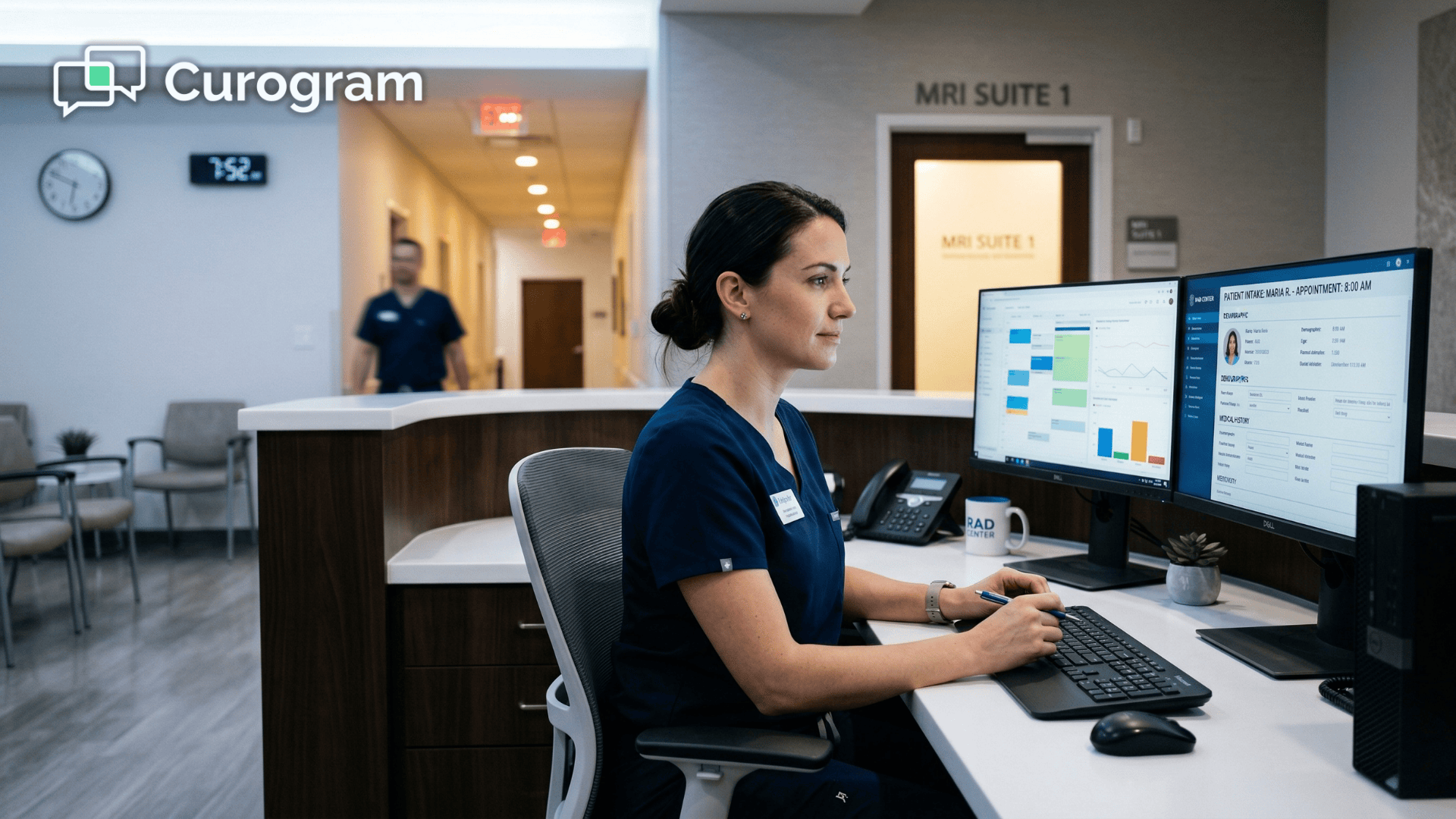
By the time the patient walks in, the technologist has already received a notification:
Patient pre-screened, contrast screening clear, MRI-safe, ready for study.
No data entry. No re-keying. No waiting.
That's what pre-visit preparation looks like when it actually works.

What Changes When Every Patient Arrives Pre-Screened
The operational shift is immediate and measurable.
When secure online forms are completed before arrival, the waiting room intake bottleneck simply disappears.
Patients walk in, verify identity, and go directly to the scanner. Technologists start studies on schedule.
The domino effect of late-running slots — delayed studies pushing into lunch, afternoon slots running over, staff staying late — stops before it starts.
The Revenue Impact
For a center running 80 studies per day, that shift is significant. With paper intake, 30% of patients generate roughly 480 minutes of technologist idle time daily. With text-delivered intake, that figure drops to around 100 minutes — accounting only for the small share of patients who miss the text entirely.
Daily labor waste falls from $280 to under $60. Daily revenue at risk shrinks from $1,600–$3,200 to $400–$800.
| $300K–$600K in annual revenue recovered — estimated for an 80-study center. |
| That's the difference between paper intake running on 30% of patients and text-delivered pre-screening reaching 80%+ of your scheduled volume before they arrive |
Example calculations based on typical center volumes and industry-standard study rates. Actual results vary by modality mix, patient volume, and staff structure.
The Clinical Safety Dimension
Beyond revenue, there's the clinical safety dimension. Contrast screening verified before arrival means adverse reactions are flagged before protocol begins.
Metal implant screening completed before the patient enters the MRI suite means no last-minute surprises at the magnet door. Pregnancy screening documented before gadolinium or radiation exposure means clinically appropriate modifications are made in advance, not reactively.
The result isn't just a faster center. It's a safer one.

Why Text-Based Intake Is Built for the Imaging Patient Population
Primary care and specialty practices serve panels of returning patients who have established relationships with the clinic. Those patients are more likely to download an app, create a portal login, and engage with ongoing digital communication.
Imaging centers serve a fundamentally different patient population.
A preventive lung cancer screening patient may return once a year. A mammography patient follows a similar schedule. But the vast majority of MRI, CT, and ultrasound patients are referral-based, one-time visitors.
They were sent by a referring physician for a single diagnostic study. Their relationship with your facility begins the day they schedule and ends — from their perspective — when they get their results.
That patient will not download an app for a single visit.
| 80%+ of imaging patients are first-time, referral-based visitors. |
| They have no prior relationship with your facility and no reason to create a patient portal account. Text meets them exactly where they are — no setup, no barrier, no friction. |
Text messaging meets them where they already are.
It doesn't require a prior relationship with the facility, a smartphone with available storage, or any account setup. It works for first-time patients, walk-in patients, elderly patients on older devices, and patients referred from out of the area.
Blume and Curogram: Better Together
This is why Curogram and Blume serve complementary roles in a RamSoft-powered imaging center.
Blume handles the post-study patient relationship — viewing images, understanding reports, requesting follow-up appointments.
Curogram handles everything that needs to happen before the study begins — form completion, appointment confirmation, prep instructions, and payment collection.
Blume builds long-term patient engagement. Curogram ensures that every single scheduled patient walks in ready.
Together, they create a complete patient communication ecosystem — one optimized for retention, the other for operational readiness.
The Real Cost of Doing Nothing: A Financial Breakdown
RamSoft imaging centers understand infrastructure investment. The financial case for text-delivered intake forms is straightforward.
The Hidden Cost of Staying With Paper
| Factor | Daily | Annual (250 days) |
|---|---|---|
| Intake delays (40-study center, 30% of patients) | 12 patients × 20 min = 240 min | — |
| Technologist idle time cost (at $35/hr) | $140 | $35,000 |
| Revenue risk per delayed/missed slot (at $800/study) | $800–$1,200 | $200,000–$300,000 |
| Manual data re-entry (est. 5 min × 12 patients) | 60 min | 250 hours |
| Combined estimated annual loss | — | $70,000–$85,000+ |
These figures represent a conservative estimate for a single mid-size center. Multi-location groups multiply the impact accordingly.
What Curogram Text-Delivered Intake Actually Costs
For a center processing 8,000–10,000 studies annually.
Curogram's pricing runs approximately $200–$400 per month — or $2,400–$4,800 per year. What that covers:
- HIPAA-compliant text delivery to every scheduled patient
- Modality-specific intake form logic and customization
- HL7/FHIR integration with RamSoft PowerServer or OmegaAI
- One-time IT setup of approximately 2–3 hours
That means the payback period is roughly 1–2 months. By eliminating intake delays for even 30% of daily studies, most imaging centers recover Curogram's full annual cost in the first four to six weeks of use.
This isn't a speculative return on investment. It's a direct, traceable reduction in a known, quantifiable operational loss. The clipboard is already costing you money.
The question is how long you want to keep paying for it.
Stop Losing Revenue to a Clipboard: See Curogram in Action
Your scanner is one of the most expensive and productive assets in your facility.
Every minute it sits idle because a patient is still filling out a paper form in the waiting room is a minute you've already paid for and can't recover.
The good news is that this is a solvable problem. And the solution doesn't require new infrastructure, a lengthy implementation timeline, or a change in how your clinical team operates.
It requires a text message sent 24–48 hours before every appointment.
Secure online forms delivered via text put pre-visit preparation where it belongs: at home, on the patient's phone, the day before they arrive.
By the time they walk through your door, your technologist already has everything they need. The study starts on time. The scanner stays full. Your team spends the day doing clinical work instead of intake management.
For imaging centers on RamSoft PowerServer or OmegaAI, Curogram fits directly into your existing workflow.
No new systems. No parallel platforms. Just clean, structured intake data arriving in PowerServer or OmegaAI before every study — exactly where your technologists already look.
The financial case is clear. A mid-size center processing 40 studies per day and losing 20 minutes of intake time on 30% of its patients is leaving $70,000 to $85,000 on the table every year.
Curogram's integration costs a fraction of that — and most centers recover it in the first month or two.
Your clinical imaging technology is already best-in-class. Your pre-visit preparation process should be, too.
Schedule a Demo to see how Curogram integrates with your RamSoft PowerServer or OmegaAI system — and how text-delivered intake forms can eliminate your clipboard bottleneck in 15 minutes or less.
Frequently Asked Questions
Yes. Curogram's entire text delivery and form collection system operates under a Business Associate Agreement with RamSoft-powered imaging centers. The secure link sent to patients leads to forms hosted on Curogram's SOC 2 Type II-certified platform with end-to-end encryption. All responses are stored in encrypted cloud storage and synced to RamSoft via HL7/FHIR secured APIs. No patient data is retained outside the imaging center's RamSoft system once form completion is confirmed.
Completion rates depend on form design and timing. Curogram templates have achieved 80%+ completion rates when forms are sent 24–48 hours before the appointment — not the same day. The key factors are clear, mobile-optimized form design, progress indicators showing patients how far along they are, and skip-logic that hides questions that don't apply to the individual patient. For patients who don't complete the form via text, your staff still has time to call and complete it over the phone. The goal is to pre-screen 80%+ of patients automatically — not 100% — because the time saved on the majority far outweighs the follow-up calls needed for the remainder.
Curogram syncs intake data directly to RamSoft via standard HL7/FHIR APIs. When a patient completes a form via text, Curogram securely transmits the responses — contrast screening results, metal implant questionnaire answers, consent acknowledgments — into the patient's pre-procedure record in PowerServer or OmegaAI. Technologists open the patient record and see all pre-screened data waiting for them. No manual re-entry, no separate login, no parallel system to manage. Curogram integrates into your existing RamSoft workflow without changing how your team works.
For patients who miss the text or don't complete the form in advance, your staff follows the same intake process as before — but now it's the exception rather than the rule. When 80% of your patients arrive pre-screened, your team has the capacity to handle the remaining 20% individually without creating waiting room delays for everyone else. You're not replacing your intake process. You're automating the majority of it so your staff can focus on the exceptions.
Yes. Curogram supports modality-specific intake form logic. Contrast screening questionnaires deploy for CT and contrast-enhanced MRI studies. Metal implant safety screening triggers for MRI only. Pregnancy screening appears for radiation-sensitive modalities and is scoped appropriately by patient demographics. Your imaging center controls the form logic and content. Curogram delivers it to the right patient, for the right study, at the right time.