10 min read

Two-Way HIPAA-Compliant Texting: A Guide for Elation Health Practices

Two-Way HIPAA-Compliant Texting: A Guide for Elation Health Practices
💡 Two-way HIPAA-compliant texting for Elation Health practices replaces portal-only messaging with secure SMS that reaches 98% of patients - based on our internal data. Curogram delivers this alongside six other communication tools, all from one dashboard. Key benefits for Elation Health practices:
  • Secure 2-way SMS that reaches patients on their native phone inbox
  • No-show rates cut by up to 65%, based on our internal data
  • Front desk phone volume reduced by up to 50%
  • Replaces 3-5 single-purpose tools like Spruce Health, Klara, or Updox
  • Works alongside Elation's RESTful API and FHIR-first developer platform
For mid-market primary care and DPC practices, Curogram breaks through the Spruce Ceiling. It turns scattered communication into one clean workflow.

Patient portals were the promise. Texting is the reality.

Walk into any Elation Health office today, and you'll see the gap. Portals sit half-empty while patients ignore secure messages they never knew arrived. Meanwhile, those same patients answer text messages in under three minutes.

This mismatch costs your practice real money every week. Your front desk fields 80+ calls each day for routine tasks. No-shows climb. Staff burn out from constant phone tag. So you add Spruce Health for texting, then more tools for reminders, reviews, and forms.

Soon you're juggling five platforms to do one job - talk to patients. We call this the Spruce Ceiling. It's the point where your communication stack breaks down faster than it scales.

Two-way HIPAA-compliant texting for Elation Health practices solves the problem from the ground up. Curogram pairs secure SMS with reminders, forms, reviews, payments, and telemedicine. Messages reach patients directly on their phones - no portal login required. Based on our internal data, this drives a 98% open rate.

The impact compounds quickly. Atlas Medical Center cut no-show rates from 14.20% to 4.91% in three months, based on our internal research. That's a 65% drop in one quarter. The shift came from one simple change - giving patients a way to text back.

This article walks through how the Spruce Ceiling forms, why texting alone isn't enough, and what changes when one platform replaces five.

By the end, you'll see why so many mid-market Elation Health practices have moved away from the patchwork. And you'll know what that move could mean for your bottom line.

The Villain: The Spruce Ceiling

Every Elation Health practice eventually hits a wall with patient communication. We call it the Spruce Ceiling. It's the point where your single-purpose tools stop helping and start slowing you down. Hitting it feels like running fast through wet sand.

The Portal Paradox

Elation Health offers a strong patient portal. It supports secure messaging, online scheduling, and test results viewing. Capterra users rate Elation 4.0 out of 5 stars. But here's the catch - most patients rarely log in.

A portal requires a browser, an app, or a password. Most patients forget that password within a week of their visit. Some never bother to download the app at all. So your secure messages reach maybe 5%-15% of your patient base on any given day.

This is the paradox. The portal is well-built, but adoption stays low. Your team spends hours typing messages that nobody reads. Meanwhile, those same patients respond to texts from friends within minutes.

The Patchwork Spiral

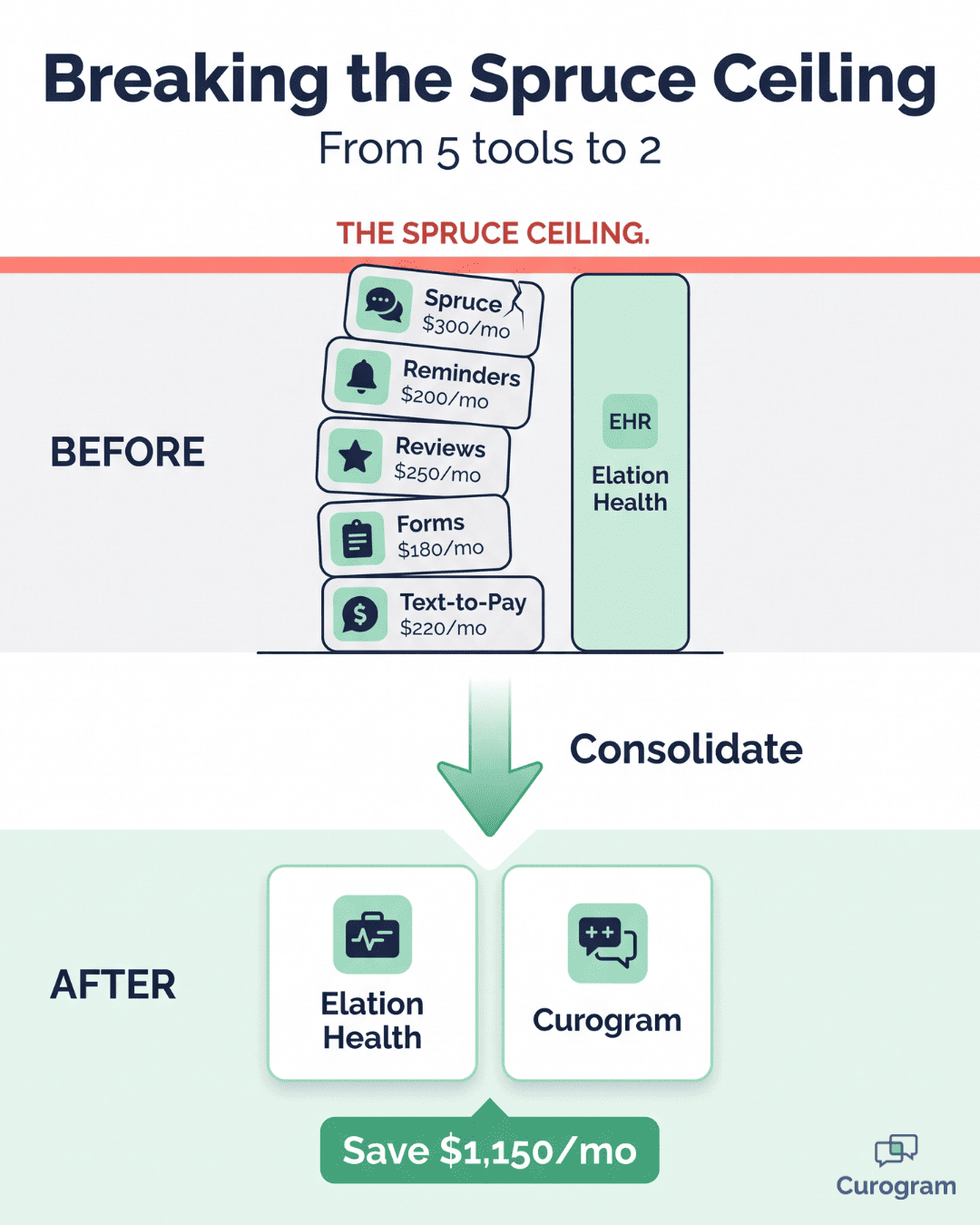
To plug the portal gap, you add Spruce Health for texting. Now staff have two tabs open all day. Then patients ask for stronger reminders, so you buy a reminder tool. That's three tabs.

Reviews drive new patient growth, so you add a reputation tool. Forms keep wait times down, so you add a forms platform. Maybe you add a separate text-to-pay system too. Now your team manages five logins, five invoices, and five vendors.

Each tool stores data in its own silo. Your staff "double-touch" everything by copying from one system to another. Nothing talks to Elation Health directly. Nothing talks to each other.

The cost isn't just dollars. It's hours of staff time spent fighting tools instead of helping patients.

The Revenue Drain

This patchwork bleeds money two ways:

  • No-show rates climb to 10%-25% when patients can't easily confirm or reschedule. For a 15-provider practice, that means $20,000 to $30,000 in lost revenue each month. At $150-$250 per visit, every missed slot stings.

  • Your front desk drowns in inbound calls. Staff field 80+ calls daily for routine tasks. These include confirmations, directions, refill status, and billing questions. Each call eats 5-10 minutes of staff time, sometimes more.

Add it up, and you've spent two full-time roles on phone tag. Worse, those calls happen during the hours patients want to reach you. Lines stay busy. Voicemails pile up. Some patients give up and book with a competitor who answers faster.

The Human Cost

Beyond the dollars, this hurts your people. Your Practice Manager spends Tuesday afternoons evaluating new vendors. Each pitch promises to solve one problem. None promise to solve all of them in one place.

Training never ends. New hires must learn five platforms before they can do basic work. Front desk staff burn out, and turnover climbs higher each year. You hired your team to care for patients, not to manage logins.

You chose Elation Health for its clean, simple clinical design. But your communication stack has become anything but simple. The Spruce Ceiling is real, and most mid-market Elation Health practices feel it every single day. The good news? Breaking through it is easier than you think.

The Guide: The Complete Communication Layer

Curogram fills the role your single-purpose tools never could. Think of it as the complete communication layer for Elation Health practices. One platform handles every message between your office and your patients - in any direction, on any device.

One Platform, Seven Tools in One

Curogram replaces the patchwork instead of adding to it. The platform handles two-way texting, automated reminders, online forms, reputation management, mass messaging, text-to-pay, and telemedicine. All seven live under one HIPAA-compliant dashboard.

This matters because most practices use 3-5 separate tools to handle these tasks. Curogram folds them into one system your staff can learn in under 10 minutes. Each feature shares data with the others, so you only enter information once.

The result is fewer logins, fewer invoices, and fewer training sessions. Your team stops switching tabs and starts solving patient problems. That shift alone can free up hours each week.

True Two-Way SMS, Not Portal Echo

Most "patient messaging" tools route messages through a portal. Patients still need a login, an app, or a password to read them. Curogram works differently. Messages go straight to the patient's native text inbox - the same place they text their kids and coworkers.

When a patient replies, your staff sees the full conversation in one threaded view. No checking three systems. No "Did they get the message?" guessing. Just real-time chat with the people who pay for your service.

Based on our internal research, this approach drives a 98% open rate. Compare that to portal messages, which often see single-digit engagement. The difference is friction - and Curogram removes it.

Built to Work With Elation Health

Curogram works alongside Elation Health's clinical workflow. The platform connects through Elation's RESTful API and FHIR-first developer setup. Patient data flows between systems, so your staff doesn't enter the same name twice.

Conversation history stays accessible right next to the clinical chart. Your front desk can see what a patient asked yesterday before they walk through the door today. This kind of context turns generic interactions into personal ones.

For HIPAA texting Elation EHR users need, the bar is high. Curogram meets it with full encryption, a signed Business Associate Agreement, and SOC 2 certification. Compliance never slows you down. It just runs in the background, the way it should.

Visual comparison of a 5-tool patchwork stack versus a streamlined 2-tool setup with Elation Health and Curogram for HIPAA-compliant texting

Why It Fits Direct Primary Care Practices

Direct Primary Care practices on Elation Health face a unique challenge. Their entire model depends on personal relationships with members. Patients pay a monthly fee and expect concierge-level access. That promise breaks fast if every question requires a phone call.

Two-way HIPAA-compliant texting for Elation Health practices makes that promise real. A patient texts a question about a prescription. A nurse replies in minutes. The member feels cared for, and your staff handles it in seconds - not an entire phone call.

This is what we mean by Spruce Health alternative texting that actually scales. Spruce can handle the chat. But it can't pair that chat with automated reminders, post-visit surveys, or text-to-pay - all from the same screen. Curogram can.

For DPC practices managing growing panel sizes, that consolidation is the difference between burnout and balance. The SMS patient communication Elation Health users get with Curogram supports both ends. Patients get a personal feel. Your back office gets quiet efficiency.

The Success: The One-Dashboard Practice

When you replace five tools with one, the change shows up fast. Phone volume drops. No-shows fall. Staff stop running on fumes. Here's what mid-market Elation Health practices actually see after they switch.

The Metric That Tells the Story

Numbers speak louder than promises. Atlas Medical Center cut no-show rates from 14.20% to 4.91% in three months, based on our internal data. That's a 65% drop in patients failing to show up.

For context, the industry average for no-shows sits around 18%-23%. Curogram users average about half that, based on our internal research across primary care, pediatrics, psychiatry, and other specialties. The pattern holds across practice sizes and patient types.

Specialty

Industry Average No-Show Rate

Curogram Average No-Show Rate

Primary Care

19.00%

14.11%

Pediatrics

30.00%

14.00%

Psychiatry

23.00%

11.03%

Radiology

18.00%

8.00%

Dermatology

25.00%

9.00%

Pain Medicine

14.00%

10.00%

Specialty Clinics

23.00%

10.00%

(Based on our internal data.)

Curogram practices see no-show rates roughly 53% lower than industry averages. That kind of improvement translates directly into recovered revenue. For a 15-provider practice, recovering even half of missed visits at $200 each adds up to thousands in new monthly income.

From Phone Tag to Text Thread

The biggest workflow shift is how staff handle daily communication. Phone calls are linear - you take one at a time, and the rest queue up. Text threads are different. A front desk staffer can manage four or five conversations at once.

Think about the same patient need in two worlds.

  • World A: A patient calls to confirm an appointment. Your staff member spends five minutes on the call. The next caller waits in queue. The patient after that gives up and books elsewhere.

  • World B: The patient texts "yes" to a reminder. Your system logs the confirmation. A staff member answers a follow-up question in 20 seconds. Three other patients get help in the same window.

This isn't theoretical. Curogram users report phone call volume dropping by up to 50%, based on our internal data. That's hours of reclaimed staff time each day. For a busy front desk team, the change feels less like a software upgrade and more like getting two extra teammates.

What "One Dashboard" Really Means

For a Practice Manager, the daily login routine sets the tone for the whole day. Five separate logins means five passwords, five report screens, and five vendor support lines when something breaks. One login changes everything.

In a Curogram-powered Elation Health practice, your morning looks simple. You open Elation for clinical work. You open Curogram for everything else - texting, reminders, forms, reviews, payments, and virtual visits. That's two tabs, not seven.

A single dashboard means a single source of truth. Did the patient confirm their appointment? Check Curogram. Did they fill out their forms? Check Curogram. Did they pay their balance? Check Curogram. The Practice Manager gets the full picture in seconds, not 20 minutes of cross-checking.


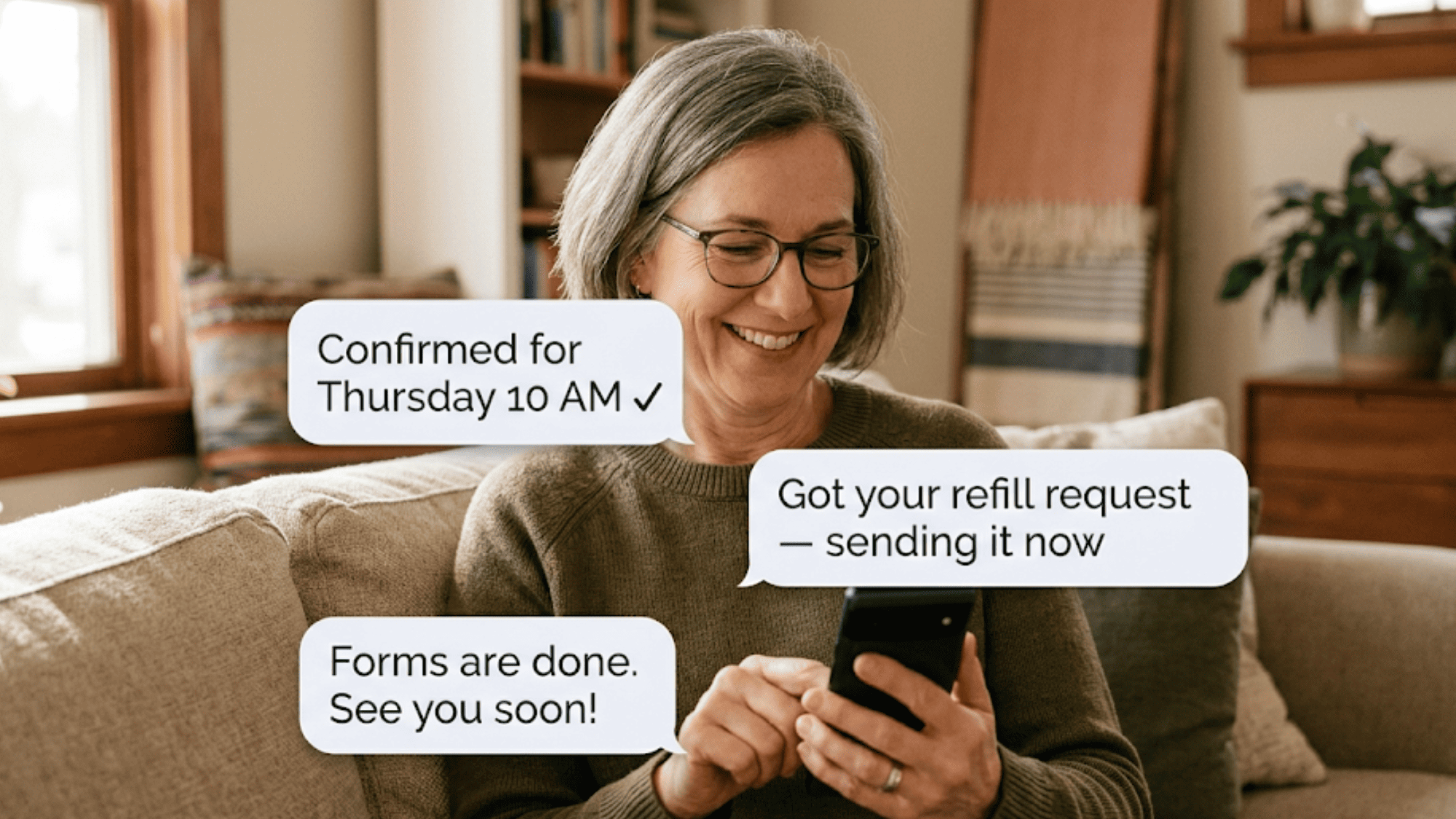
Woman smiling at her phone while receiving SMS confirmations from her medical practice using Curogram two-way texting for Elation Health

How Curogram Replaces Five Communication Tools With One

Most Elation Health practices stack up vendors like Lego blocks. Spruce Health for texting. Klara or Updox for messaging. A separate reminder tool. A separate review tool. Maybe a forms platform too. Curogram makes that stack unnecessary.

Here's what one Curogram login gives you:

  • Two-way texting with patients in real time
  • Automated appointment reminders with smart confirmations
  • Online intake forms patients fill out from their phones
  • Reputation management with automated review requests
  • Mass messaging for closures, policy updates, or recalls
  • Text-to-pay for outstanding patient balances
  • HIPAA-compliant telemedicine for virtual visits

Each feature uses the same patient database. So when a patient confirms an appointment by text, the system also pulls their forms, queues a post-visit review request, and sends a payment link if needed. No staff member touches any of it manually.

Compared to a Spruce Health alternative texting setup, the difference is scope. Spruce handles chat well.

But it cannot send branded mass messages to your full patient list. It cannot collect text-to-pay balances. It cannot run a Google review campaign on autopilot. Curogram does all of this from the same screen your staff already uses for texting.

For Elation Health practices, this matters in two ways. First, your tech stack shrinks from five tools to two - Elation for clinical, Curogram for everything else. Second, the savings stack up fast. Based on our internal data, practices that consolidate save thousands per month in vendor fees alone.

The result is more than just software. It's a simpler way to run your practice. Less juggling. More patient connection. The kind of operational calm most Elation Health practices have been chasing for years.

Conclusion: One Platform, One Dashboard, One Integration

Patient communication should not feel like a logistics puzzle. For too many Elation Health practices, it does. Five tools, five logins, and a front desk team that can't catch its breath. There is a simpler way.

Two-way HIPAA-compliant texting for Elation Health practices is the starting point. It's the channel your patients already use every day. When you meet them where they are, engagement stops being a struggle. Open rates jump from single digits to 98%, based on our internal data.

But texting alone isn't the full win. The win is what texting unlocks when paired with reminders, forms, reviews, payments, and telemedicine. That's where Curogram makes the difference. One platform replaces the patchwork. One dashboard gives your team back hours each day.

The numbers tell the story clearly. Atlas Medical Center cut no-shows by 65% in three months. Curogram practices average no-show rates 53% below industry norms. Phone volume drops by up to 50%. Each metric points to the same truth - simpler systems produce better results.

Your Elation Health EHR was built for clinical care. Curogram was built for patient communication. Together, they create the full practice experience neither platform delivers alone. You get clinical depth on one side and operational efficiency on the other.

Trade five logins for one — starting today. Request a demo and see how 80+ daily calls turn into manageable text threads.


Frequently Asked Questions

How does Curogram's two-way texting work alongside Elation Health's existing patient portal?

Curogram runs as a parallel communication channel, not a replacement for Elation's clinical features. The portal stays available for patients who prefer it, while SMS becomes the default for routine messages. Patient data flows between systems through Elation's API, so your team avoids double entry.

Why do Elation Health patients respond more to SMS than to portal messages?

SMS arrives in the same inbox as messages from family and friends. There's no password, no app to download, and no extra step. Based on our internal research, this drives a 98% open rate compared to single-digit portal engagement. Convenience wins every time.

How can a Direct Primary Care practice on Elation Health use two-way texting to grow membership?

Two-way texting creates the concierge feel DPC members pay for. Patients text questions, and your team replies in minutes. New members hear about that experience and refer friends. Curogram also automates Google review requests, which lifts your visibility for prospects.

Why should we replace Spruce Health if it already handles our texting?

Spruce handles messaging, but it can't run mass campaigns, collect text-to-pay balances, automate reviews, or send forms in one workflow. As your practice grows, that gap forces you to buy more tools. Curogram delivers all of these from a single platform built to scale.

How does Curogram protect patient data when sending SMS messages?

Curogram is fully HIPAA-compliant. Every message is encrypted in transit and at rest. The platform holds SOC 2 certification and signs a Business Associate Agreement with every practice. Your patient data stays as secure as the standards Elation Health already meets.