12 min read

HIPAA-Compliant Telemedicine for Elation Health: No-App Visits

HIPAA-Compliant Telemedicine for Elation Health: No-App Visits
💡 Elation Health does not include built-in video visits. Curogram solves this with HIPAA-compliant telemedicine for Elation Health practices and no-app virtual visits.
  • Patients tap an SMS link to join — no downloads, no logins, no portals
  • Video runs inside the same platform as texting, reminders, forms, and payments
  • One vendor replaces 3–5 separate tools
  • Spruce Health covers video but lacks reminders, forms, and reviews
  • Browser-based video uses encrypted WebRTC for full HIPAA compliance
Mid-market clinics gain a single dashboard for the full patient journey. Staff training drops to minutes, and patient drop-off shrinks at every step.

Most Elation Health practices already juggle too many tools. There is one tab open for Doxy.me, another for Spruce, a third for reminders, and a fourth for billing. Each tool sends a different link from a different number. Patients get lost in the shuffle.

The Elation EHR is strong on the clinical side. But it does not ship with a built-in video visit feature. Practices that want to offer telehealth must bolt on a separate tool, then a separate texting service, then a separate forms tool. The bills add up. So do the logins.

This guide is for clinics that want to stop the bolt-on cycle. Curogram offers HIPAA-compliant telemedicine for Elation Health practices with no-app virtual visits as part of one platform. Reminders, two-way texts, intake forms, video visits, text-to-pay, and review requests all live in the same dashboard.

The shift from many tools to one platform matters for three reasons. First, every handoff between vendors is a chance for the patient to drop off. Second, training staff on five tools costs more than training on one. Third, the budget bleeds across small monthly fees that quietly grow each year.

Based on our internal data, practices that consolidate tools and use Curogram’s automated reminders see no-show rates drop 53% below the industry average. That number does not come from video alone.

It comes from the full chain — reminder, form, visit, payment, review — moving through one system. We will walk through how that chain works, how the video piece stays HIPAA-compliant, and what the math looks like for a mid-market Elation practice.

The Case for Single-Platform Virtual Care

Adding video visits to an Elation practice sounds simple. Pick a vendor. Sign a contract. Start booking. But that single choice often locks the practice into a messy stack that grows every quarter.

The Vendor Fragmentation Problem

Most mid-market Elation clinics run 3 to 5 separate tools for patient engagement. A typical stack looks like this:

Function

Common Vendor

Avg. Monthly Cost

Video visits

Doxy.me or Zoom for Healthcare

$200–$500

Two-way texting

Spruce or Klara

$150–$300

Reminders

Solutionreach or Weave

$200–$400

Online forms

JotForm or PhreesiaLite

$100–$250

Text-to-pay

Square or PatientPay

$100–$200


That is 3–5 logins. 3–5 invoices. 3–5 training tracks for every new front desk hire. Every handoff between these tools is a spot where the patient can drop off — a wrong link, a missed text, a form they never saw.

The fix is not to add a sixth vendor. The fix is single-platform telemedicine integration that folds video into the wider engagement workflow.

Why Telehealth-Only Vendors Fall Short

Pure telehealth tools like Doxy.me handle the video call well. But they stop at the visit itself. They do not text the patient before. They do not send the intake form. They do not collect the copay after. They do not ask for a Google review.

So the patient gets four messages from four sources:

  • A reminder from Tool A
  • A form link from Tool B
  • A video link from Tool C
  • A payment link from Tool D

Each message arrives from a different number. Patients ignore unknown numbers. Staff field calls from confused patients asking, "Which link do I tap?" The drop-off rate climbs.

Per-visit fees add to the pain. A clinic running 100 virtual visits a month at $2 per visit pays $200 just for video, on top of base fees. Scale that to 200 visits and the math gets ugly fast.

The Spruce Health Telehealth Comparison

Spruce Health is the closest competitor in this space. It offers messaging, phone, fax, and video in one tool. For a small DPC clinic that only needs to text and do video, Spruce is a fair pick.

But Spruce is built as a communication platform. It does not include:

  • Automated appointment reminders tied to the EHR schedule
  • Digital intake forms delivered by SMS
  • Text-to-pay billing
  • Google review generation
  • Mass messaging for closures, flu shot drives, or recalls

A practice that picks Spruce for video still needs 3–4 more tools to cover the full patient journey. The math ends up close to the old fragmented stack.

Curogram takes a different stance. Elation Health telemedicine works as one feature within a complete engagement suite.

The same SMS thread that confirms the appointment delivers the video link. The same dashboard that shows the chat history launches the video call. The same automation that sends the reminder also sends the payment request and review ask.

Based on our internal research, this consolidation drives real outcomes. Practices using Curogram cut phone call volume by 50%, lift staff productivity by 30%+, and pull in 10–20% more revenue from recovered appointment slots. None of those gains come from video in isolation. They come from one platform handling the full chain.

The lesson: the goal is not just to add video. The goal is to fix the patient experience end to end with one tool.

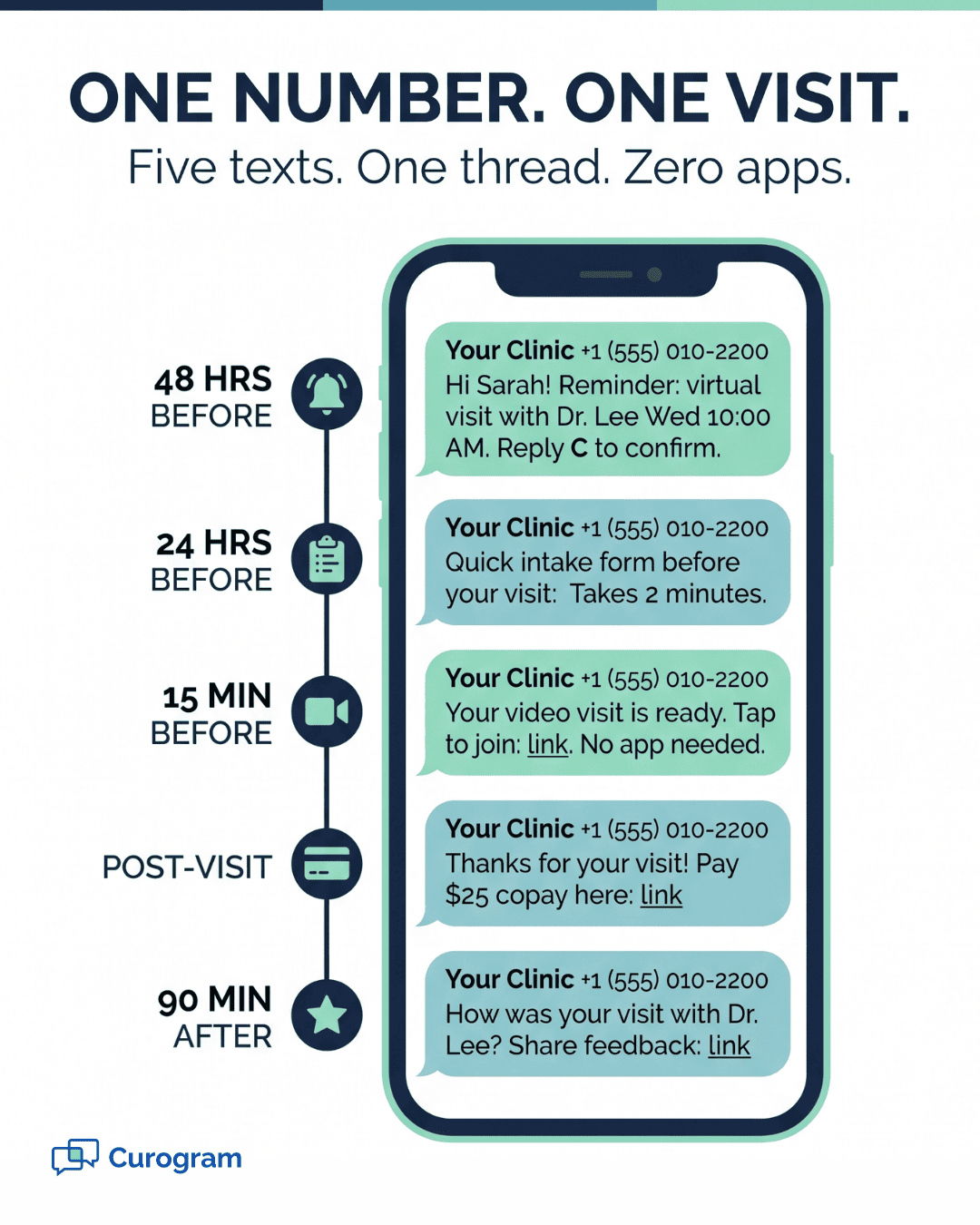
Infographic showing 5 SMS messages a patient receives during one Curogram virtual visit

The Curogram Virtual Visit Workflow

A virtual visit is more than the 15 minutes on camera. It starts when the patient books and ends when they pay and leave a review. Here is how that full chain runs through Curogram for an Elation practice.

Pre-Visit Workflow

The work begins 24 to 48 hours before the visit. An automated SMS goes out with the date, time, and a note that the visit is virtual. The text comes from the same number the patient has used for past appointments. No new sender to ignore.

A second message follows with the intake form link. The patient taps, fills it out on their phone, and submits. No portal login. No paper.

The final pre-visit text lands 15 minutes before the call. It contains the secure video link. One tap opens the browser and starts the camera check. This is the no-app telehealth Elation practices have been asking for — no download, no install, no account setup.

During-Visit Experience

The provider joins from the Curogram dashboard. On the same screen, they see:

  • The patient's full text message history
  • Completed intake forms
  • Past appointment notes from Elation
  • Payment status from prior visits

No tab switching. No alt-tabbing to pull up context. The video runs in a HIPAA-compliant browser session using encrypted WebRTC.

Practices that need clinical tools during the call can use:

  • Screen share for lab results or images
  • Document sharing for after-visit summaries
  • Secure chat for follow-up questions during the call

The provider documents in Elation, the same way they would for an in-person visit.

Post-Visit Workflow

The chain does not stop when the camera shuts off. Within minutes of the visit ending, Curogram fires three automations:

  1. Text-to-pay link for the copay or balance. The patient taps, enters a card, done. No paper invoice.
  2. Google review request about 1 to 2 hours after the visit. The timing matters — the experience is still fresh, and review yield is highest in that window.
  3. Follow-up reminder for the next appointment, refill, or care task. This runs through the same two-way texting thread, so the patient can reply with questions.

One Patient, One Thread, Five Touchpoints

The patient's full virtual visit experience runs through a single SMS thread:

Step

Time

Message Type

1. Reminder

24–48 hrs before

Confirmation text

2. Form

12–24 hrs before

Intake form link

3. Video link

15 min before

Secure visit link

4. Payment

Post-visit

Text-to-pay link

5. Review

1–2 hrs after visit

Google review request


All five messages come from the same number. All five are tied to the same patient record. All five sync with the Elation schedule.

For comparison, the multi-vendor stack would send these from five different numbers — a recipe for confusion. Based on our internal data, Curogram clients see appointment confirmation rates above 75% across these workflows, well above industry norms.

This is the model for virtual visits Elation EHR users want. One platform. One thread. One bill. The patient does not have to learn anything new — they already know how to text. The staff does not have to learn five dashboards — they already know one.

The workflow also scales without extra cost. A clinic going from 50 to 200 visits a month does not pay per-call fees. The same flat-rate platform handles the volume.

HIPAA Compliance and Technical Architecture

Video visits are a regulated workflow. A clinic that gets HIPAA wrong faces fines, breach notices, and patient trust damage.

The good news: HIPAA-compliant telemedicine for Elation Health practices with no-app virtual visits is fully achievable through browser-based tools, when the platform is built right.

Video Visit Security

Curogram's video sessions run on encrypted WebRTC. WebRTC is the same protocol that powers browser-based video on most modern smartphones, tablets, and laptops. It uses end-to-end encryption by default. Every byte of video and audio is encrypted in transit.

The security stack covers four layers:

Layer

Protection

Transport

TLS 1.2+ for all data in transit

Media

SRTP encryption for video and audio

Storage

AES-256 for any data stored at rest

Access

Role-based permissions and audit logs


Curogram also signs a Business Associate Agreement (BAA) with every client. The BAA is the legal contract that puts the vendor on the hook for HIPAA breaches alongside the practice. Without a BAA, no telehealth tool can legally handle PHI. Curogram holds SOC 2 certification, which signals a third-party audit of security controls.

Video sessions are not recorded or stored by default. If a practice wants to record for clinical or training reasons, that needs written patient consent and an opt-in setting. The metadata of every session — who joined, when, from where — is logged for compliance audits, but no clinical content is captured in those logs.

The "No App Download" Security Question

A common worry: if patients do not install an app, how is the connection secure?

The answer is that WebRTC inside a modern browser uses the same cryptographic libraries as native mobile apps. Browsers like Chrome, Safari, Edge, and Firefox all support hardware-accelerated encryption. The patient's phone treats the secure link the same way it treats online banking — using the device's built-in security chip to manage keys.

In fact, the no-app approach is often safer than a native app. Reasons:

  • No old app version sitting on the patient's phone with known vulnerabilities
  • No data left behind on the device after the visit
  • No risk of the patient sharing login credentials with family members

For HIPAA purposes, the standard is "reasonable safeguards" — and browser-based WebRTC easily meets that bar.

Integration with Elation Health

Curogram connects to Elation through the EHR's standard integration channels. The data flow runs in three directions:

From Elation to Curogram:

  • Patient demographics (name, phone, DOB)
  • Appointment schedule (in-person and virtual)
  • Provider assignments

From Curogram to Elation:

  • Visit completion status
  • Form responses (as PDF or structured data, depending on configuration)
  • Payment status

Within Curogram:

  • All SMS history
  • Video session metadata
  • Review and survey responses

Virtual visits appear on the same Elation calendar as in-person appointments. The provider does not need a separate schedule. When a virtual visit is marked complete in Curogram, the downstream automations fire — payment request, review request, follow-up — without any staff click.

Be aware: clinical documentation still happens in Elation. The SOAP note, the diagnosis codes, the orders — those live in the chart. Curogram handles the engagement layer around the visit, not the clinical record itself.

Some data write-back (like intake form responses) can flow into Elation as a file or note, but the chart remains the source of truth. Practices should ask about the latest integration depth during a demo, since the roadmap is active.

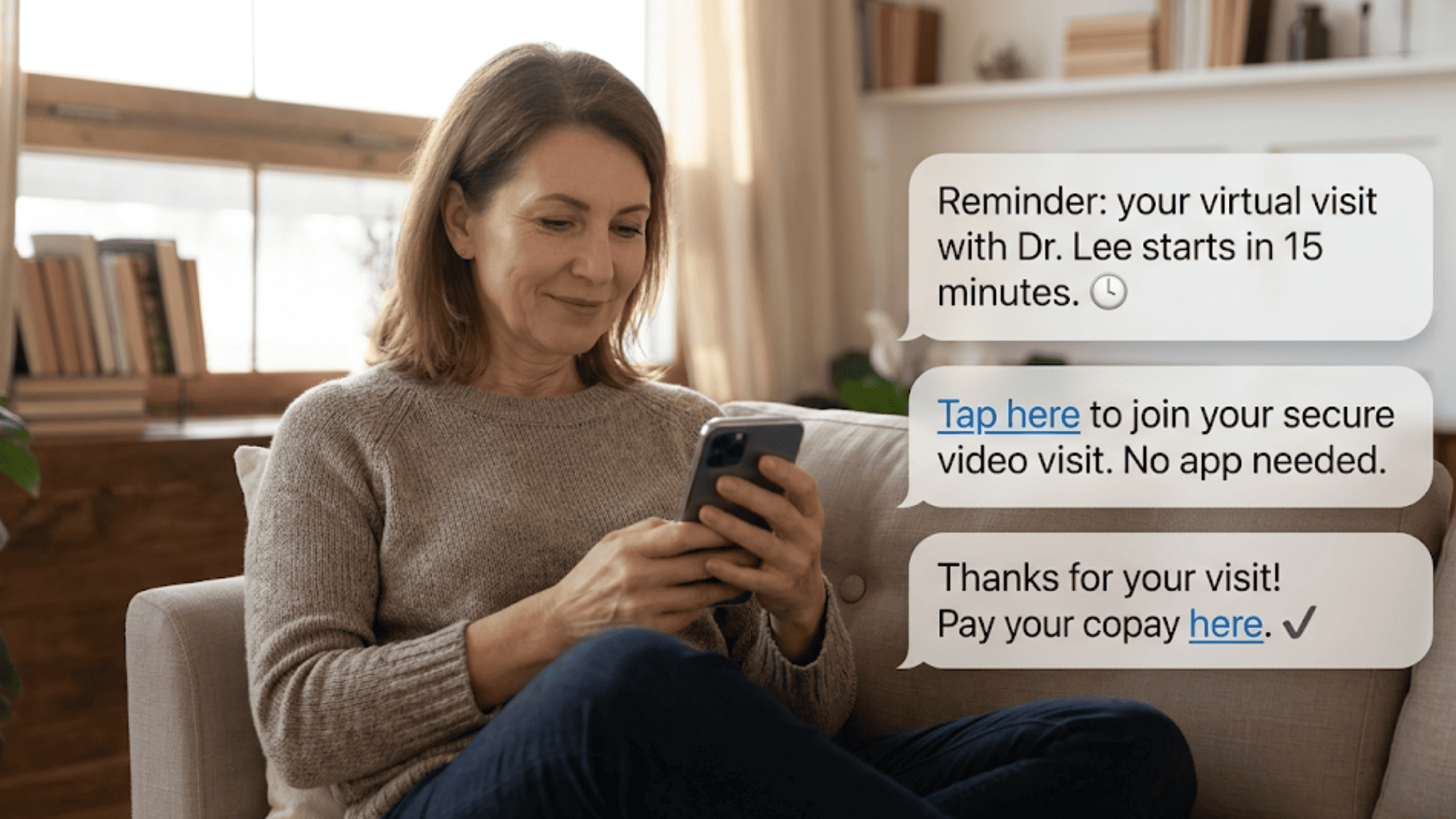
Patient receiving SMS reminders and video visit link for no-app telemedicine appointment

The DPC Virtual Care Model

Direct Primary Care (DPC) practices have a special relationship with virtual visits. For DPC, video is not an add-on — it is core to the value proposition. Members pay a monthly fee and expect easy, on-demand access to their doctor. That includes texting, calls, and video visits with no per-visit charge.

Curogram fits the DPC model in three ways:

  1. Unlimited visits at a flat rate. No per-call fees that erode DPC margins.
  2. SMS as the front door. DPC patients already text their doctor. The video visit launches from that same thread.
  3. No portal, no app. DPC is built on a personal, friction-free patient experience. Portals and app downloads break that promise. Curogram keeps it intact.

A DPC practice on Elation + Curogram can run the entire patient journey through SMS:

  • Text to schedule
  • Text to fill out intake
  • Text to join the video visit
  • Text to pay (for non-membership charges like supplements or labs)
  • Text to leave a review

The patient never opens an app. They never visit a portal. They never see a username field. For a 65-year-old patient who finds technology frustrating, that simplicity matters. For a 35-year-old patient who hates installing apps, it matters too.

Audit Trail and Compliance Reporting

When the auditor shows up, the practice needs proof. Curogram's audit log captures:

  • Session start and stop times
  • Participants (provider and patient identifiers)
  • IP addresses and device types
  • Any failed access attempts
  • Consent timestamps for any optional recording

Reports can be pulled in CSV format for the compliance officer's annual review. The HIPAA Security Rule requires audit controls, and these logs satisfy that requirement out of the box.

The Practical Test

A practice can stress-test any telehealth vendor with five questions:

  1. Will you sign a BAA?
  2. Is the video encrypted end-to-end?
  3. Do you hold SOC 2 certification?
  4. Are sessions stored without consent?
  5. Can I get an audit log on demand?

Curogram answers yes, yes, yes, no, yes. That is the floor for HIPAA-compliant telehealth — and the ceiling that many small video vendors fail to hit.

Compliance is not glamorous. But it is the foundation that lets the rest of the workflow work. Without it, the speed and convenience of single-platform virtual care turn into a liability instead of an asset.

ROI of Platform Consolidation

The case for consolidation lives or dies on the spreadsheet. Below is the math for a typical mid-market Elation practice running 150 virtual visits per month, with stats drawn from our internal data.

Vendor Cost Reduction

The old stack and the consolidated stack look like this side by side:

Function

Old Stack (Monthly)

Curogram (Bundled)

Video visits

$350

Included

Two-way texting

$250

Included

Automated reminders

$300

Included

Online intake forms

$175

Included

Text-to-pay

$150

Included

Review automation

$200

Included

Total

$1,425

One platform fee


A clinic that pays $1,425 across six vendors can often drop spend by 40–60% by moving to a single bundled platform. That is $570 to $855 saved per month, or $6,840 to $10,260 saved per year. Multi-location groups scale these savings linearly.

Staff Efficiency Gains

Training staff on one tool instead of five is the hidden win. A new front desk hire used to need:

  • 2 hours on the video tool
  • 1 hour on the texting tool
  • 1 hour on the reminder system
  • 1 hour on the forms tool
  • 1 hour on the payment tool

That is 6 hours of training before the new hire can run a virtual visit workflow. Curogram clients often complete platform training in 10 minutes — based on our internal data, this is one of the most commented-on benefits during onboarding.

Other efficiency gains:

  • Phone call volume drops by up to 50%
  • Staff productivity rises 30%+
  • Fewer mistakes — one dashboard means one place to check status
  • Fewer support tickets — one vendor handles all questions

Patient Retention and Revenue Protection

Virtual visit drop-off is a silent revenue leak. A patient who cannot find the video link, or who gets frustrated by an app install, often gives up and goes to a retail clinic or telehealth-first provider. That patient may never come back.

Curogram's no-app, text-link model cuts that drop-off sharply. Based on our internal data, practices see:

  • 75%+ appointment confirmation rates
  • No-show rates 53% lower than the industry average (down to ~5% from a ~14% baseline)
  • 10–20% revenue increase from recovered appointment slots

Apply that to a clinic running 150 virtual visits a month at $125 average revenue per visit:

  • Reclaiming 20 visits per month = $2,500 in protected revenue monthly
  • Reclaiming 30 visits per month = $3,750 in protected revenue monthly
  • Annualized: $30,000 to $45,000 in revenue saved from no-shows alone


How Curogram Turns Five Vendor Tabs Into One Patient Thread

Most platforms call themselves "all-in-one." Few actually mean it. Curogram is built around a single idea: the patient experience is one thread, not five.

That idea shapes every feature. The same SMS thread that confirms a visit also delivers the intake form, sends the video link, collects the copay, and asks for the review. The patient sees one number. The staff sees one dashboard. The clinic gets one bill.

For Elation Health practices, that means the engagement layer around the EHR finally matches the simplicity of the EHR itself. Elation is loved for being clean and fast on the clinical side. Curogram brings that same feel to the front desk and patient communication side.

Here is what that looks like in practice:

  • A patient books an appointment in Elation
  • Curogram fires a reminder text 48 hours out
  • A form goes out 24 hours before
  • The video link drops 15 minutes before the visit
  • The provider joins from the Curogram dashboard
  • A text-to-pay link follows the visit
  • A Google review request lands 90 minutes later

All from one platform. All tied to the same patient record. All with HIPAA-compliant encryption and a signed BAA.

The result is a practice that runs leaner. Based on our internal data, clients cut phone calls by 50%, lift productivity by 30%+, and grow revenue 10–20% from reclaimed appointments. New staff get up to speed in 10 minutes. New patients sign up faster because the texting experience makes the clinic feel modern.

Conclusion

Elation Health gives clinics a strong clinical foundation. But the EHR alone does not close the loop on the patient experience. Without a built-in video tool, practices have to bolt on a telehealth vendor — and the bolt-on cycle rarely stops there.

The single-platform approach changes the math. One tool replaces five. One dashboard replaces five logins. One bill replaces five invoices. The patient sees one number, taps one link, and joins one visit.

Curogram delivers HIPAA-compliant telemedicine for Elation Health practices with no-app virtual visits as one feature inside a complete engagement suite. The same texting platform that sends the reminder also sends the form, the visit link, the payment request, and the review ask. Nothing is bolted on.

The numbers back it up. Based on our internal data, clients cut no-shows by 53% below industry average. They lift revenue 10–20% from recovered appointments. They train staff in 10 minutes. They save thousands per year by ending vendor sprawl.

For DPC clinics, the fit is even tighter. The text-first, app-free model matches what DPC patients already expect. For traditional Elation practices, the fit is just as strong — the EHR stays the clinical brain, Curogram becomes the engagement layer.

The question is not whether to add telehealth. The question is whether to add it as one more vendor or as one more feature in a platform you already use for texting, reminders, forms, and payments.

Stop paying five vendors for what one platform can do. Book a Curogram demo and we will map your current stack side-by-side with our platform.


Frequently Asked Questions

Does Elation Health include built-in telemedicine?

State clearly that Elation Health does not include a native telemedicine or video visit module as of the current platform version. Practices using Elation that want to offer virtual visits must use a third-party telemedicine solution. Curogram provides HIPAA-compliant video visits as part of its integrated patient engagement platform, eliminating the need for a separate telehealth vendor.

Do patients need to download an app for Curogram telemedicine?

Confirm that no app download is required. Patients receive an SMS text message with a secure video visit link. They tap the link and join the video visit through their phone’s web browser. The technology uses WebRTC, which is supported by all modern smartphones, tablets, and computers. No software installation, no account creation, no login credentials needed.

How does Curogram telemedicine compare to Spruce Health video visits?

Acknowledge that both Curogram and Spruce Health offer HIPAA-compliant video visits. The key difference is platform scope: Spruce is a communication platform (messaging, phone, video, fax) that does not include automated reminders, digital forms, text-to-pay, Google review generation, or mass messaging.

Is Curogram telemedicine HIPAA compliant

Confirm full HIPAA compliance: end-to-end encryption on all video sessions, BAA coverage, SOC 2 certification, and no recording or storage of video content without explicit consent. Curogram’s telemedicine meets the same security and compliance standards as dedicated telehealth vendors while being embedded in a broader patient engagement platform.

Why does the no-app model improve patient retention?

App downloads and portal logins cause drop-off. Patients give up and go to retail clinics for easier access. The text-link model removes that friction, so patients show up to virtual visits and stay loyal. Confirmation rates often top 75% under this model.