Secure Patient Intake for CollaborateMD: Stop Denials at the Door
💡 Secure patient intake for CollaborateMD helps billing teams cut claim denials by removing manual data entry errors at the front door. Patients...
11 min read
Mira Gwehn Revilla
:
March 11, 2026
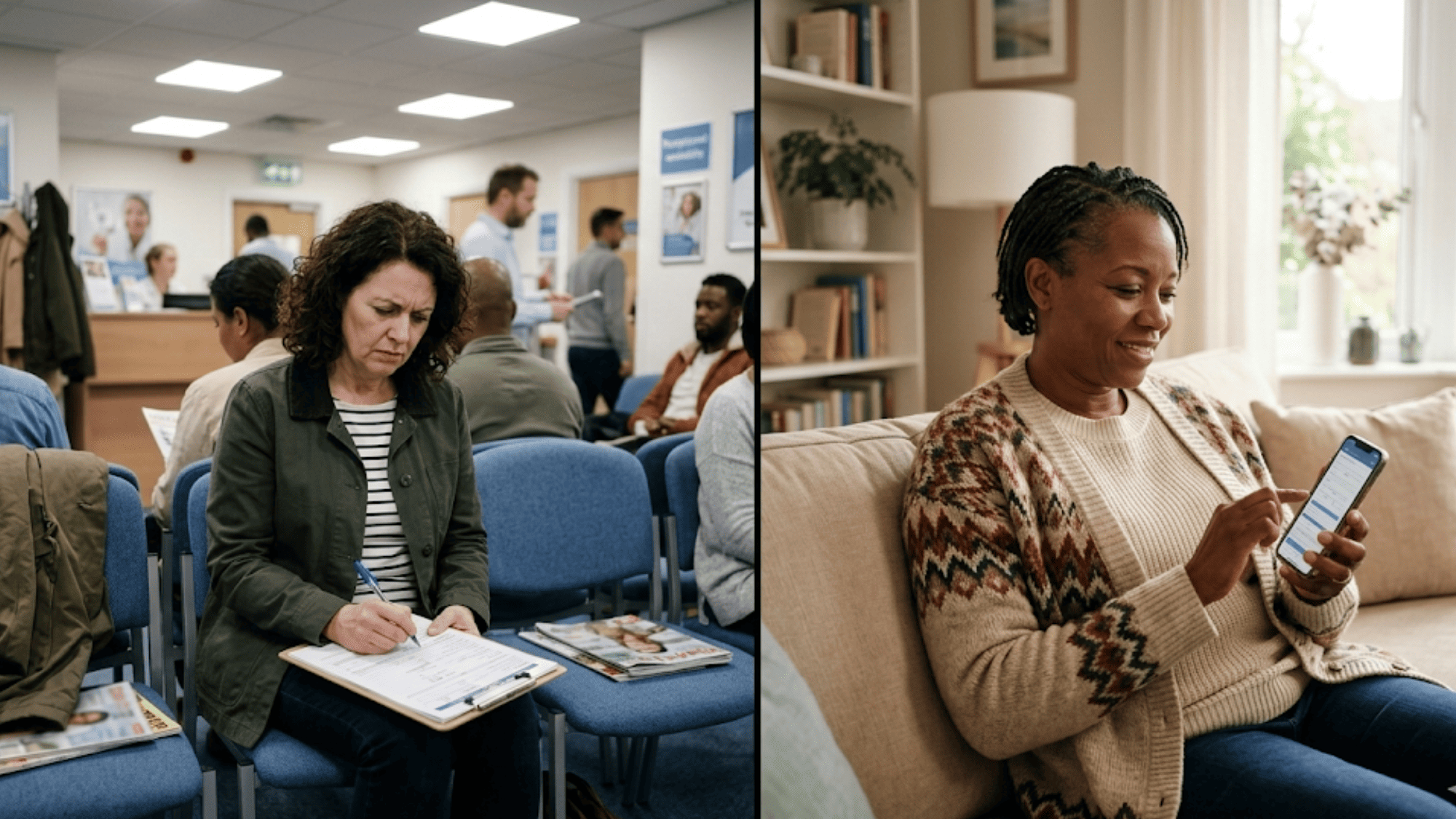
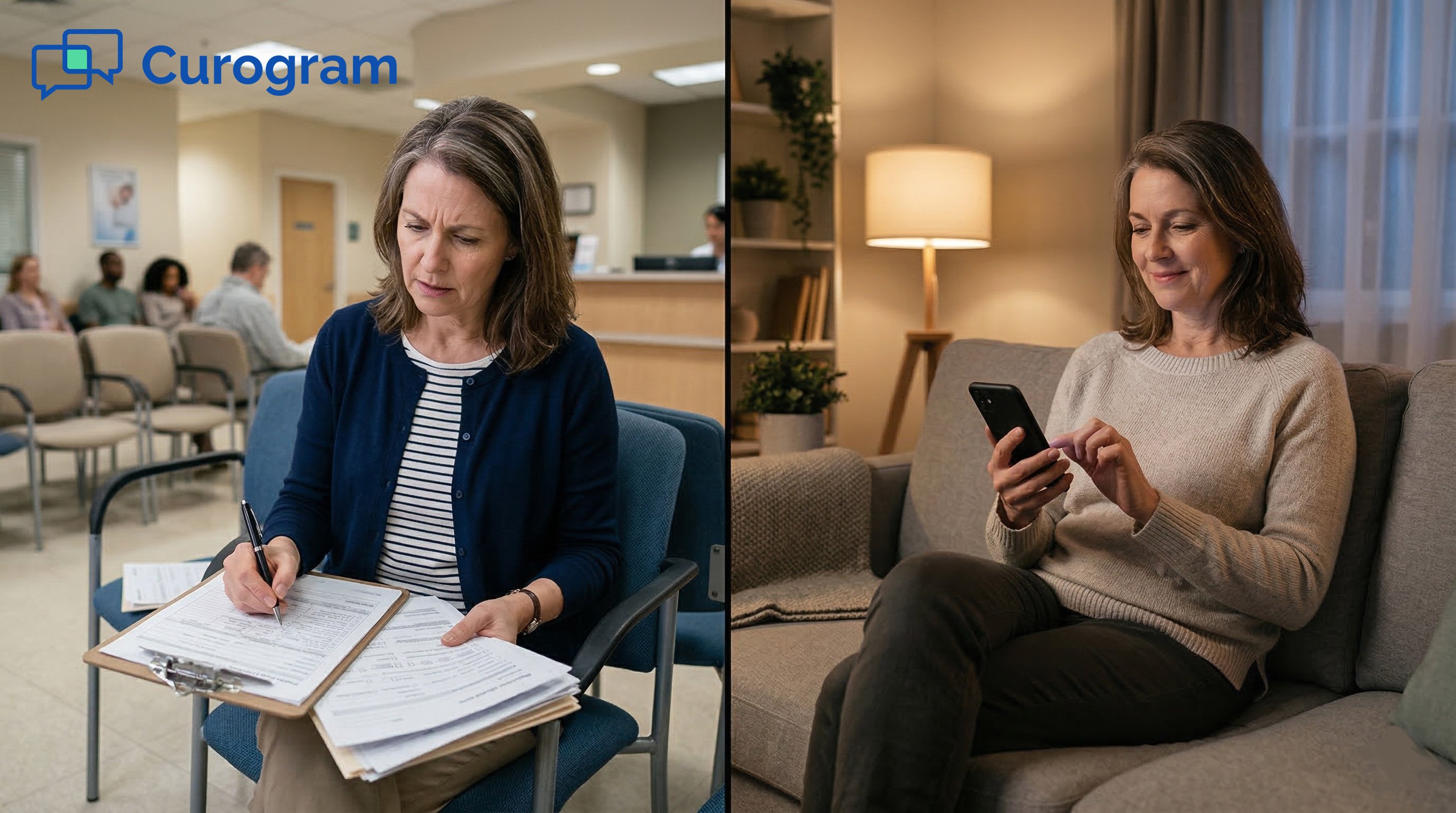
Picture this: A new patient walks into your clinic. She has a phone in her hand. She checks texts, scrolls social media, and shops online every day. But she has never once logged into a patient portal.
She's not alone. At most Athena practices, only about 30% of patients use the portal. That means 70% of your patients still show up with no data on file. They get a clipboard. They sit. They wait. And your staff types it all in later by hand.
This is the gap that holds back most practices running on Athenahealth. The portal works fine for the small group who use it.
But the rest of your patients — new visits, walk-ins, older adults, and anyone who finds portals too complex — get left behind with paper forms and slow check-ins.
There is a better way. An athenahealth patient digital intake form delivered by text gives patients a link they can tap on their phone.
No portal login. No app download. No account to set up. Just a simple form that opens in their browser and takes a few minutes to fill out.
This is what a pre-visit form on a mobile phone should look like. It meets patients where they are — on their phones, ready to engage, as long as you don't ask them to jump through hoops first.
In this article, we'll break down why portals miss most of your patients and how a patient phone form that's text delivered changes the game. You'll see real numbers, a real patient story, and the exact metrics to track once you make the switch to a portal-free intake experience.
The patient portal is not a bad tool. For the patients who use it, it works well. They can view results, send messages, and fill out forms before their visit.
But here's the catch: most patients never get that far.
Think about what the portal asks a patient to do. First, they need to create an account. Then they verify their email.
They set a password. They log in, find the forms section, fill out the fields, and hit submit. That's six or seven steps before a single piece of health data reaches your system.
For a patient who visits your clinic twice a year, that's a lot of effort for very little payoff. For a brand-new patient, it's even worse. They have no history with your practice, no reason to set up an account, and no time to figure out a new system.
This is what we call "The Portal Barrier." It's the gap between what the portal offers and what most patients are willing to do.
Portal adoption at most Athena practices sits near 30%. That leaves 70% of your patient base stuck on paper — or worse, not filling out forms at all.
Urgent care clinics feel this pain the most. A large share of patients are first-time visitors. They don't have a portal account.
They have no interest in making one for a single visit. They walked in because they need care right now, not because they want to sign up for a new system.
So what happens? The front desk hands them a clipboard. The patient sits in the lobby and fills out pages of forms by hand. Then a staff member takes the paper and types it all into Athena — field by field.
Based on our internal data, this kind of manual entry can take 5–7 minutes per patient. Multiply that across a full day, and your team loses hours to data entry that could be handled by the patient before they even arrive.
But it's not just urgent care. Primary care, orthopedics, and multi-site groups all face the same issue. Older patients often struggle with portal setup.
Patients who speak a language other than English may find the portal hard to use. And busy working adults simply skip it because they don't want to deal with yet another login.
Let's put some numbers to it. Say your practice sees 80 patients a day. If 70% arrive without pre-visit data, that's 56 patients on clipboards. At 5 minutes of staff entry per patient, that's nearly 5 hours of data entry every single day.
|
Metric |
Portal Only |
With Text-Based Intake |
|
Pre-visit data on file |
~30% of patients |
80–90%+ of patients |
|
Clipboard patients per day (80 visits |
~56 |
~8–16 |
|
Staff data entry time per day |
~4.5 hours |
~40–80 minutes |
|
Avg. patient check-in time |
8–12 minutes |
Under 2 minutes |
The portal isn't the villain here. The barrier to using it is. And for the 70% of patients who won't create a portal account, the answer isn't to push harder on portal sign-ups. The answer is to give them a path that requires no portal at all — an Athena patient mobile intake form sent by text that opens in seconds.
What if you could text your patients a link and have them fill out their intake forms on their phone — before they even leave the house? That's exactly what Curogram's Phone Form does.
It strips away every piece of friction that stops patients from completing their intake ahead of time. No portal. No app. No login. Just a text link digital registration path that works on any phone with a browser.
Here's what the patient sees:
That's it. The whole thing takes about 5–8 minutes. There's nothing to download, nothing to sign up for, and nothing to remember for next time.
This matters more than you'd think. A lot of "mobile-friendly" forms are really just desktop forms made smaller. They have tiny text, hard-to-tap buttons, and endless free-text fields that are painful to type on a phone screen.
Curogram's Phone Form is built from the ground up for mobile. The buttons are large. Fields use dropdowns instead of free text where it makes sense.
Auto-advance moves the patient through each section with no extra taps. And for insurance data, patients can snap a photo of their card instead of typing out the group number and ID by hand.
For practices in diverse communities, language is often a hidden barrier to intake. A patient who reads Spanish may struggle with English-only clipboard forms. They might need a staff member to translate, which slows down the whole check-in line.
With the Phone Form, practices can offer forms in more than one language. The patient sees the form in the language they prefer.
They fill it out on their own, with no help needed. This means no portal intake through athenahealth is even required — the text-based form covers it all.
This kind of access isn't just about speed. It's about treating every patient with the same level of care, no matter what language they speak.
Scheduled patients get the form link 24–48 hours before their visit. They fill it out from home, from work, or from the parking lot. Walk-in patients get the link at check-in and fill it out on their phone in the lobby.
Either way, the data lands in Athena before the provider walks into the room. That pre-visit form on a mobile phone path means the doctor has what they need from the start — not after five minutes of chart review.
Numbers are great. But stories show you what the numbers look like in real life. Let's walk through a real-world scenario that plays out every day at Athena practices using Curogram.
Mrs. Dominguez is 58 years old. She's a new patient at a busy orthopedic and urgent care group in San Antonio. The practice runs on Athenahealth. She was referred for a knee exam after a fall.
She has a smartphone. She texts her family every day. But she has never created an account on any medical portal — and she has no plans to start.
She's bilingual, speaking both Spanish and English. But she's more at ease reading forms in Spanish.
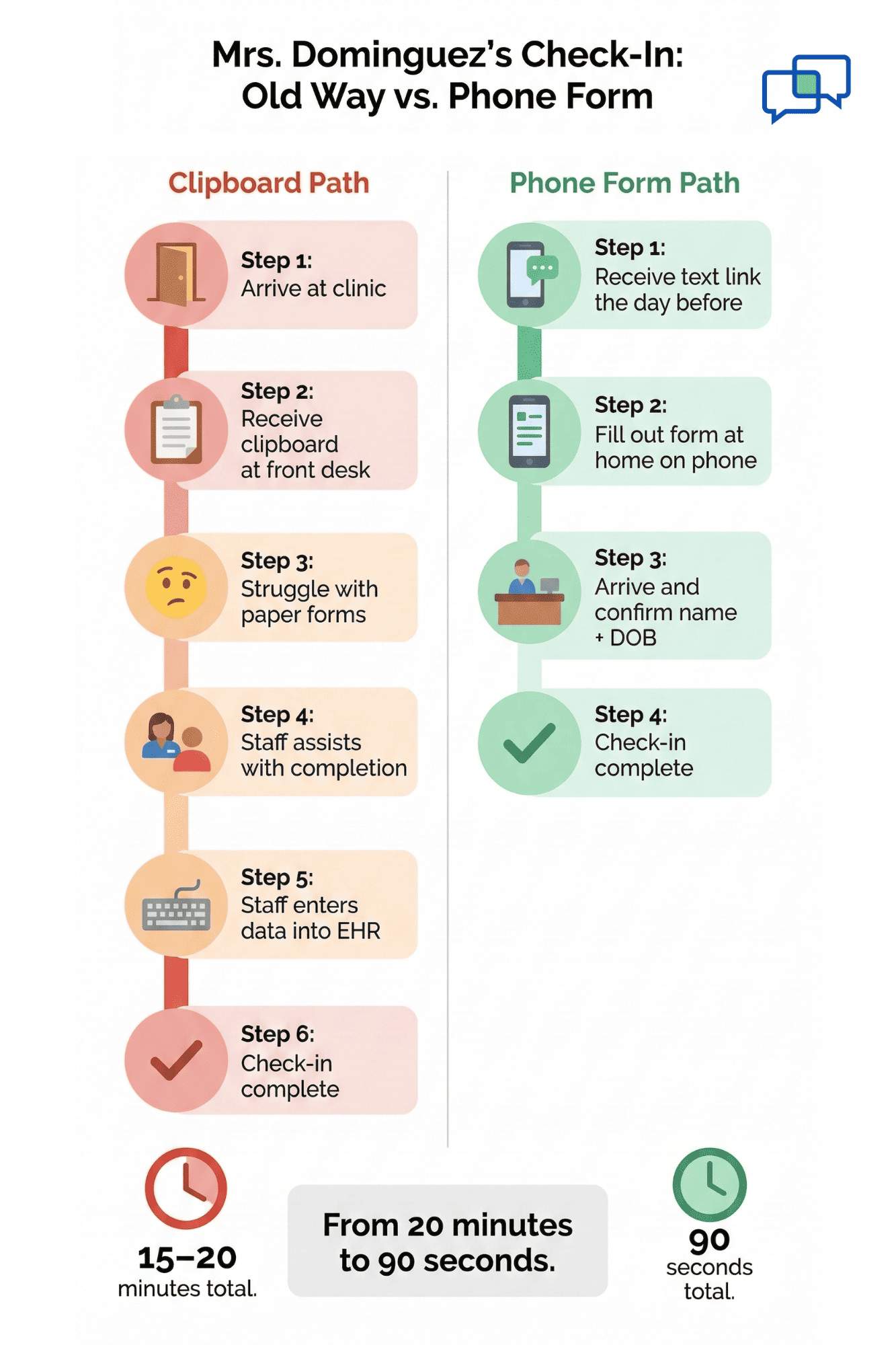
Without a text-based intake option, here's what her visit would look like:
She arrives at the front desk. The staff hands her a clipboard with several pages of forms — all in English. She sits down and tries to work through them. Some fields confuse her. She asks the front desk for help.
A bilingual staff member walks over and sits with her for about 10 minutes, helping her fill in each page. Then the staff member goes back to the desk and spends another 5–7 minutes entering the data into Athena by hand.
Total intake time: 15–20 minutes. Mrs. Dominguez feels frustrated. The staff member is pulled away from other patients. And the lobby backs up.
Now here's what happens with Curogram's Phone Form.
The day before her visit, Mrs. Dominguez gets a text in Spanish. It says her appointment is at 2:00 PM with Dr. Martinez and includes a link to her intake form.
She taps the link. The form opens on her phone — in Spanish. She fills in her name, date of birth, and address. She takes a photo of her insurance card. She lists her current meds and allergies. She checks boxes for her surgical history and signs the consent form with her finger.
The whole thing takes 7 minutes. She does it from her living room couch.
The next day, Mrs. Dominguez walks into the clinic. The front desk confirms her name and date of birth. They glance at the insurance card photo — it matches what's already in the system. She signs one consent pad. Total check-in time: 90 seconds.
She's in a room before the patient behind her finishes their clipboard. She later tells her daughter: "They texted me the forms in Spanish and I did it all on my phone. It was so easy."

Mrs. Dominguez is one patient. But think about what happens when every patient at that practice gets the same option.
New patients, return patients, Spanish speakers, English speakers, young adults, seniors — they all get a text link. They all fill out forms on their phone. And the front desk team goes from spending hours on data entry to spending minutes on quick verifications.
This is what a patient phone form text delivered approach looks like in real practice. It's not just faster. It's more fair, more inclusive, and more human.
Based on our internal research, practices that adopt text-based intake see staff time on manual entry drop by more than half. That time goes back to patient care, phone calls, and the work that actually needs a human touch.
Let's be clear: Curogram's Phone Form doesn't replace the patient portal. It covers the patients the portal can't reach.
Think of your patient base in three groups:
These patients already have accounts. They log in, fill out forms, check results, and send messages. The Phone Form doesn't change their workflow at all. They keep using the portal as they always have.
This is the biggest group — and the one most practices miss. These are patients who will never set up a portal account. But they respond to texts every day.
They include working adults who don't want another login, older adults who find portals confusing, new patients with no reason to make an account, and walk-ins who need care now. When these patients get a text with a form link, they tap it, fill it out, and move on. The form meets them right where they are.
Some patients won't fill out the form ahead of time. Maybe they missed the text. Maybe they're walk-ins. These patients get the link at check-in and fill it out on their phone in the waiting room.
Even in this case, it's still faster than a clipboard. The data goes straight into Athena. No staff typing needed.

When you add all three groups together, pre-visit data coverage jumps from about 30% to 80–90%+. Clipboard patients go from being the norm to being the rare exception. Staff data entry becomes something that happens a few times a day, not dozens of times.
|
Patient Group |
Share of Patients |
How They Complete Intake |
|
Portal users |
~30% |
Log in and fill out forms online |
|
Phone Form users (pre-visit) |
~50–60% |
Tap a text link, complete on phone |
|
In-office completers |
~10–15% |
Get text link at check-in, fill out in lobby |
|
Clipboard only |
~5–10% |
Paper forms (now the exception) |
This is how you move past low portal adoption without fighting it. You don't push patients toward the portal harder. You offer a simpler path and let the results speak for themselves.
If you're a practice admin or medical director, you want proof before you change your workflow. Fair enough. Here are the metrics to watch once you roll out text-based intake.
Compare how many patients complete intake through the portal versus the Phone Form. Text delivery removes the login barrier, so completion rates tend to be much higher. Track this weekly for the first 90 days to spot trends.
This is the number that your front desk will feel right away. Measure the average time from when a patient arrives to when they're ready to be roomed.
For patients who filled out a pre-visit form on a mobile phone, the goal is under two minutes. Compare that to clipboard patients, who often take 8–12 minutes.
Ask patients about their check-in experience through post-visit surveys. Patients who complete intake on their phone before arrival rate the check-in process higher than those who deal with paper forms in the waiting room.
Based on our internal data, practices using Curogram see a clear lift in patient feedback tied to the intake process.
If your practice serves a diverse community, track form completion among patients who use a non-English form option.
Before text-based intake, many of these patients needed staff help to fill out paper forms. After, they can complete intake on their own — in their own language. This metric shows both access gains and equity impact.
How Curogram's Phone Form Creates a Better First Impression for New Patients
First visits set the tone for the whole patient relationship. When a new patient has to sit in a lobby filling out clipboard forms, the message is clear: this practice hasn't caught up with modern care.
Curogram's Phone Form flips that script. The patient gets a text before their visit. They fill out intake on their phone in a few minutes. When they walk in, the front desk already has their info. Check-in takes less than two minutes.
That kind of smooth, fast experience tells the patient something important — this practice values their time. Based on our internal research, practices using Curogram see higher rates of patient returns and stronger online reviews tied to the intake process.
For Athena practices where portal adoption is low, the Phone Form is the fastest way to give every patient — portal user or not — a modern, easy intake path. No portal intake through athenahealth is needed for the patient to have a great first experience. The text link does the work.
And the impact goes beyond first visits. When return patients get the same easy text link for each appointment, they build a habit. Intake becomes something they do on their phone in a few minutes, not something they dread in the lobby.
The portal-free intake experience becomes the new normal — for patients and for staff.
Your patients are on their phones right now. They're reading texts, tapping links, and filling out forms for everything from food orders to bank apps. The only thing they won't do? Log into a portal to fill out your intake forms.
That's not a patient problem. It's a workflow problem. And it has a simple fix.
With Curogram's Phone Form, you text a link. The patient taps it. They fill out their info on their phone — demographics, insurance, meds, allergies, history, and consent. The data writes to Athena. Done.
No portal. No app. No clipboard. No staff data entry.
The result? Pre-visit data goes from 30% coverage to 80–90%+. Check-in drops from 10 minutes to under 2. Staff get hours back every day. And patients walk in feeling like your practice is built for the way they already live.
Start a demo and text intake forms to your patients before their next visit. Activate through the Athena Marketplace and see your pre-visit completion rate climb.
Your patients complete intake every day — on their phone, on their terms, in their language.
What if check-in took 90 seconds instead of 15 minutes? Schedule a demo to see how text-based intake makes it happen at your Athena practice.
Patients take a photo of their insurance card right inside the form. The image attaches to their record in Athena, and front desk staff verify it at check-in instead of typing out every field.
Most practices go live within days. Curogram connects through the Athena Marketplace, and staff training takes about 10 minutes since the system is built to be simple from the start.
Text messages have open rates near 98%, and the form needs no login, no app, and no account. Patients tap one link and start filling out their info right away — there's nothing standing in the way.
💡 Secure patient intake for CollaborateMD helps billing teams cut claim denials by removing manual data entry errors at the front door. Patients...
💡 Athenahealth secure online forms powered by Curogram replace paper intake with a text-based digital form that writes data straight into Athena's...
💡 Mobile patient registration for MD Systems practices lets patients fill out intake forms on their phones before they arrive at the office. ...