



Skip to the main content.

15 min read

Telemedicine vs In-Person Care: When to Use Which Option

Telemedicine vs In-Person Care: When to Use Which Option
💡 Telemedicine vs in-person care is not a one-or-the-other choice. Virtual visits work well for follow-ups, mental health, chronic disease check-ins, and minor illnesses. In-person visits are needed for complex exams, procedures, and urgent conditions.

The right care setting depends on the patient's condition, the need for a physical exam, and access to technology. A hybrid care model, one that blends both virtual and in-office visits, helps practices serve more patients while keeping care safe and effective. Clear guidelines help providers and staff make these decisions quickly and consistently.


Not every visit needs a waiting room.

Some patients drive 45 minutes for a 10-minute follow-up that could have been a video call.

Others try to manage serious symptoms at home when they really need to be seen in person. Both situations lead to the same problem: the wrong care, in the wrong place.

Knowing when to use telemedicine and when to require an office visit is one of the most useful skills a practice can build. It affects patient safety, staff workload, and overall care quality.

This guide breaks down telemedicine vs in-person care in a way that is practical for your team.

You will find a clinical decision framework, condition-specific guidance, specialty considerations, and steps you can take to build your own protocols.


The Hybrid Care Model: Best of Both Worlds

Not long ago, the question was simple: Does this patient come in or not? Now there is a third option.

The hybrid care model combines virtual and in-person visits within the same practice workflow, and it is changing how care is delivered across every specialty.

From Either/Or to Integrated Care

The old model forced a binary choice. You either scheduled an in-office appointment or told the patient to wait. Hybrid care removes that limit.

Providers can now offer a virtual check-in, follow up in person when needed, or hand off between visit types with no loss of continuity.

This shift did not happen overnight. It grew out of necessity during the COVID-19 pandemic, when practices had to serve patients remotely or not at all. What began as a short-term fix quickly proved its value.

Based on our internal data, practices that adopted telemedicine saw significant gains in patient access without a drop in care quality.

What Patients Want

Patients value convenience, but they also want to feel heard and safe. Hybrid care delivers on both. A patient with a chronic condition, for example, may prefer a quick virtual visit for routine check-ins but still wants to come in once a year for labs and a full exam. Giving them that choice increases satisfaction and keeps them engaged with their care.

What Practices Gain

For your practice, the hybrid model means better use of your space, your staff, and your schedule. Virtual visits are typically shorter and require fewer support resources.

That frees up exam rooms and clinical time for the patients who truly need to be seen. The result is a more efficient practice that can serve more people without burning out the team.

Cost is another factor. Reducing unnecessary in-person visits lowers overhead. Patients spend less on travel and time off work. When care is easier to access, patients are more likely to stay on top of their health, which leads to better outcomes over time.


Clinical Decision Framework: Virtual vs In-Person

Every scheduling decision is really a clinical decision. The best way to make those decisions consistently is to use a clear framework.

This section outlines the key factors that should guide whether a visit happens virtually or in person.

Key Factors to Evaluate

Not all virtual visit decisions are obvious. Some cases fall into a grey zone where the right setting depends on several overlapping factors. The table below gives your team a structured way to think through each one.

Factor

Favor Virtual

Favor In-Person

Condition complexity

Stable, well-managed

New, complex, or uncertain

Physical exam needed

No or minimal

Yes, hands-on required

Diagnostic testing

Not required

Labs, imaging, or procedures needed

Patient tech access

Reliable device and internet

No device, poor connection, or low comfort

Provider comfort

Condition is familiar virtually

Requires direct observation or palpation

Risk level

Low to moderate

High risk or potentially unstable


Risk Stratification

Risk stratification means sorting patients by how urgent and complex their needs are. Low-risk patients, those with stable conditions and no new symptoms, are usually safe for virtual visits.

Moderate-risk patients may need a hybrid approach: start virtual, then escalate if the visit reveals new concerns. High-risk patients should always be seen in person first.

Technology Access and Patient Readiness

A visit cannot go virtual if the patient does not have a working device, a stable internet connection, or the ability to use the platform. Before defaulting to telemedicine, your team should confirm that the patient is set up to participate.

This is especially important for older adults and patients in rural areas. If technology is a barrier, in-person remains the right choice.

Provider Competence and Comfort

Virtual visits require a different kind of clinical skill. Providers need to be comfortable reading visual cues, asking the right questions, and guiding patients through self-exams.

If a provider is not yet confident in evaluating a certain condition through a screen, that is a valid reason to default to an in-person visit. Training and experience build that confidence over time.

The goal of this framework is not to reduce in-person visits at all costs. It is to match each patient with the right setting, every time. When your team uses a consistent set of criteria, scheduling decisions become faster, safer, and easier to justify.


Excellent Fit for Telemedicine (High Appropriateness)

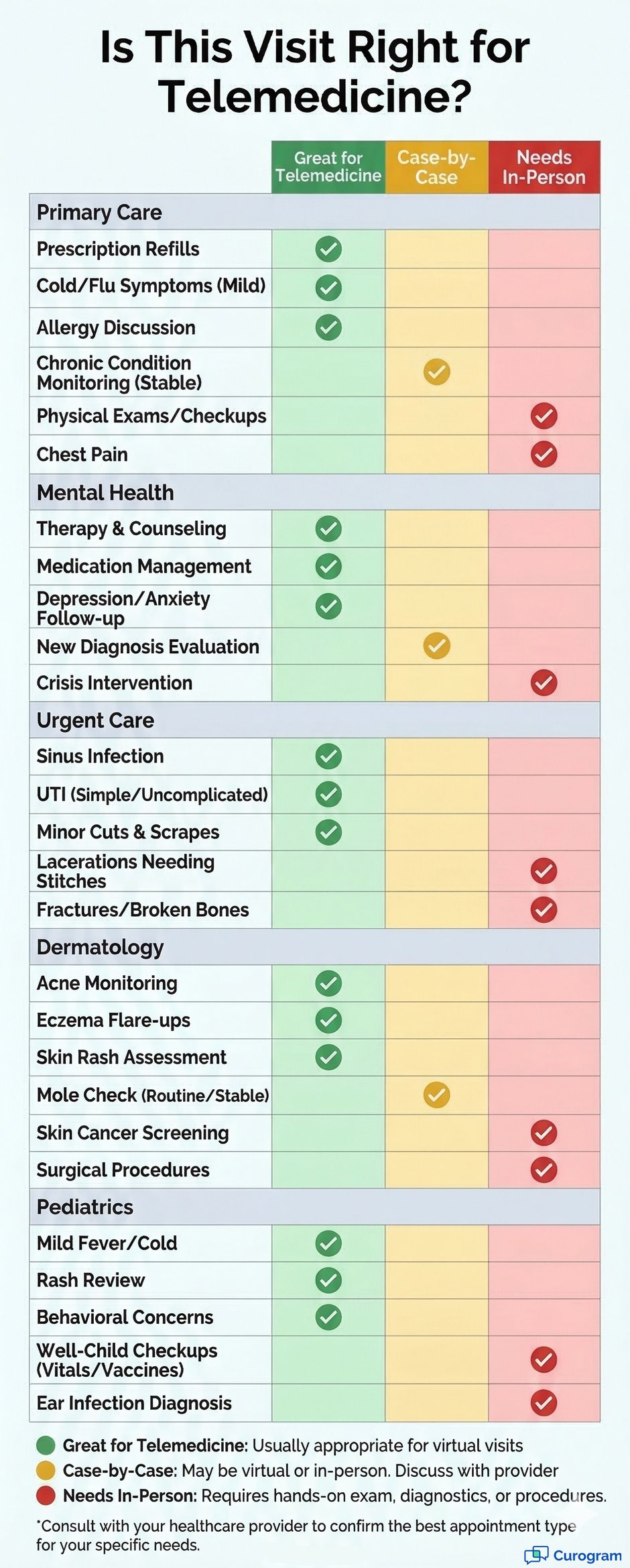
Some visits are almost always better suited for virtual care. These are cases where the provider does not need to touch the patient, test results are not required on the spot, and the condition is well understood. Knowing which visits fall into this category helps your team schedule smarter from the start.

Follow-Up and Chronic Condition Management

Follow-up visits for stable conditions are among the best uses of telemedicine. If a patient is managing diabetes, hypertension, or thyroid disease and their numbers are steady, there is little clinical reason to bring them in just to talk. A virtual visit covers the same ground in less time and with far less effort for the patient.

Mental Health and Behavioral Care

Mental health therapy and counseling translate well to video. The therapeutic relationship is built on conversation, not physical contact. Many patients actually prefer the privacy of joining a session from home.

Research and practice experience both support telehealth as an effective format for ongoing mental health care, including talk therapy, medication check-ins, and behavioral coaching.

Medication Management

Reviewing medications, adjusting doses, and checking in on side effects are all tasks that work well on a screen. As long as no new labs are needed and the patient is stable, a virtual visit is appropriate. This is especially valuable for patients on multiple medications who need frequent check-ins but are doing well overall.

Other strong virtual visit candidates include post-operative wound checks where visual inspection is sufficient, pre-operative consultations that are informational in nature, second opinions on diagnoses or treatment plans, and health coaching sessions.

Minor illness evaluations, such as a suspected upper respiratory infection, a urinary tract infection, or a straightforward rash, also fit well when the patient can describe symptoms clearly and the provider has enough information to make a clinical decision.


Infographic grid with checkmarks for telemedicine-suitable conditions


Sometimes Appropriate for Telemedicine (Case-by-Case)

Not every visit falls neatly into the virtual or in-person column. There is a middle category where telemedicine may work, but the right decision depends on the specific patient, the provider's judgment, and how the visit unfolds.

These are case-by-case situations that call for thoughtful triage rather than a blanket rule.

New Patient Visits and Annual Wellness Exams

A new patient visit that is non-urgent can sometimes start virtually. It gives the provider a chance to review history, build rapport, and decide whether an in-person exam is needed. Annual wellness exams present a similar situation.

Some components, like reviewing labs or discussing lifestyle changes, work fine on video. Others, like a physical exam, must happen in person. A modified virtual wellness visit may cover the conversational elements, with a separate in-person appointment for the hands-on parts.

Musculoskeletal and Dermatology Cases

Musculoskeletal complaints, such as mild joint pain, muscle soreness, or post-rehab check-ins, can often be assessed through guided movement and patient-reported symptoms. The key question is whether the provider can gather enough information without touching the patient.

Dermatology is similar. Many skin conditions can be evaluated visually if the image quality is good and the patient can show the affected area clearly. This is sometimes called teledermatology, and it has grown significantly as camera technology has improved.

Pediatric Sick Visits and Urgent Triage

Pediatric sick visits require extra care when it comes to virtual visit appropriateness. A parent may be able to describe symptoms in detail, but a child cannot always cooperate with a guided self-exam.

For mild symptoms where the clinical picture is clear, virtual care may be fine. For anything ambiguous or potentially serious, in-person is the safer call. Similarly, some urgent care conditions can be triaged virtually to determine whether the patient needs to come in right away or can be managed at home.

Conditions that require guided self-exam fall into this middle ground as well. If the patient can reliably perform specific steps, like checking lymph nodes or measuring a wound, and the provider can observe the process clearly, a virtual visit may yield enough clinical information. If not, in-person is the right choice.


Generally Requires In-Person Care (Low Appropriateness)

Some clinical situations are not appropriate for virtual care, regardless of how good the technology is. Trying to manage these cases remotely puts patient safety at risk.

Your team needs to recognize these situations quickly and get the patient to the right level of care without delay.

Urgent and High-Risk Conditions

Chest pain and cardiac symptoms should never be evaluated by video alone. The same applies to acute abdominal pain, which can signal appendicitis, a bowel obstruction, or other serious conditions that require imaging and a hands-on exam to assess properly. Severe injuries, trauma, or any situation where the patient's condition may be deteriorating are also clear cases for in-person or emergency care.

Conditions Requiring Procedures

Any visit that involves a procedure must happen in person. That includes wound care beyond simple visual inspection, joint injections, biopsies, catheter placements, and a wide range of other interventions. No amount of good video quality changes the fact that the provider's hands need to be involved.

Prenatal, Pediatric, and Complex Cases

The first prenatal visit should always be in person. It involves a physical exam, confirmation of pregnancy, and a full review of risk factors that are hard to assess by video. Altered mental status, regardless of cause, requires direct observation.

High-risk or unstable patients should be seen in person, not managed through a screen. Complex cases that require a thorough physical exam, such as new neurological symptoms or unexplained weight loss, also belong in the office.

The guiding principle here is simple: if the clinical picture is unclear or potentially serious, in-person care is the right default.

Telemedicine is a powerful tool, but it works best when the stakes are manageable and the situation is well understood. Knowing its limits is just as important as knowing its strengths.


Specialty-Specific Appropriateness Guidelines

Different specialties have developed their own norms around virtual care. What works well in primary care may not translate directly to pediatrics or dermatology.

This section covers the key considerations for the most common specialties using telemedicine today.

Primary Care

Primary care is where telemedicine has the broadest application. Chronic disease management, medication reviews, and follow-up visits are all strong candidates for virtual primary care visits.

The main exception is when a physical exam is clinically necessary. Good primary care telehealth protocols include clear criteria for when a virtual visit is sufficient and when the patient needs to come in.

Mental Health and Behavioral Health

Teletherapy and virtual psychiatric care have become a standard part of mental health telehealth standards. Video visits work well for individual therapy, medication management, and group sessions.

The challenge comes with patients who are in acute crisis, who may need in-person evaluation for safety reasons. Practices offering mental health telehealth should have a clear escalation plan for those situations.

Urgent Care and Pediatrics

Urgent care telemedicine triage is a growing area. Virtual urgent care works best when the provider can quickly assess whether the patient needs to be seen in person or can be managed at home. Common conditions like colds, minor skin irritations, and urinary symptoms are well-suited for this format.

Pediatric telemedicine considerations center on the child's age, symptom severity, and the parent's ability to assist with the visit. Younger children and more complex presentations typically require in-person evaluation.

In dermatology, teledermatology criteria generally include conditions that are clearly visible, not infected or actively changing, and for which the patient can provide a high-quality image. For chronic skin conditions like eczema or psoriasis, virtual follow-up is often ideal.

Chronic disease management protocols across specialties, including cardiology and endocrinology, tend to support virtual visits for stable patients and require in-person visits when new symptoms arise or when labs need to be drawn on-site.


When to Transition from Virtual to In-Person

Even a well-planned virtual visit can reveal that the patient needs to be seen in person. Knowing how to recognize that moment and how to act on it smoothly is an essential part of running a safe telemedicine program.

Clinical Red Flags During a Virtual Visit

Some warning signs should prompt an immediate transition. If a patient reports chest pain, sudden shortness of breath, confusion, or describes symptoms that suggest a serious or rapidly changing condition, the virtual visit needs to stop, and the patient needs to be directed to emergency care or an urgent in-person appointment.

These are not judgment calls. They are clinical red flags that override any scheduling convenience.

Inadequate Visualization or Communication

Sometimes the issue is not clinical urgency but a practical limitation. The patient's camera may not capture what the provider needs to see. The connection may be too poor to assess respiratory rate or facial expressions.

The patient may have difficulty describing their symptoms or following guided self-exam instructions. Any of these situations is a valid reason to switch to an in-person visit. Trying to push through with inadequate information creates clinical risk.

Patient or Provider Discomfort

If either the patient or the provider feels uncertain about continuing virtually, that discomfort should be respected. A patient who is anxious about not being physically examined may not engage as openly in the visit.

A provider who cannot form a clear clinical picture from a video session owes it to the patient to escalate. Trust and transparency in these moments build stronger relationships over time.

Making the transition smooth matters. When a provider decides mid-visit that in-person care is needed, the next steps should be clear. Your team should be able to schedule an in-person follow-up quickly, ideally the same day or the next day for urgent situations. A brief note in the chart about the reason for escalation also helps document the clinical decision and supports continuity of care for the next provider who sees the patient.


Patient Education: Setting Appropriate Expectations

Patients often do not know which type of visit to schedule. They may assume telemedicine is always faster, or that in-person is always better. Helping them understand the difference saves time for everyone and makes both types of visits more effective.

When to Schedule a Virtual Visit

Start by giving patients a clear, simple message: virtual visits work best for follow-ups, stable chronic conditions, mental health check-ins, minor illnesses, and questions about medications.

They are a good fit when no physical exam is needed, and the patient can communicate their symptoms clearly. When those conditions are not met, an in-person visit is the right call.

Preparing for a Virtual Visit

Patients should know what to expect before joining a virtual visit. They need a quiet space, a working device with a camera, and a reliable internet connection.

They should have their current medication list ready. If the visit involves reviewing a wound, rash, or skin change, they should know how to position their camera to give the provider a clear view. A short pre-visit checklist sent via text or patient portal can set them up for a much more productive visit.

When to Go to the ER Instead

Patients need clear guidance on when to skip the telehealth option entirely and go straight to the emergency room. Chest pain, difficulty breathing, sudden severe headache, confusion, uncontrolled bleeding, and signs of stroke or heart attack are all reasons to call 911 or go to the ER. This guidance should be part of any patient-facing telehealth materials and reinforced at intake.

Managing patient expectations also means being honest about what cannot be done in a virtual visit. A provider cannot listen to a heart or lung through a screen. They cannot feel a lump or assess swelling by looking at a camera.

Patients who understand these limits are more likely to accept a recommendation to come in person when it is needed. Clear communication reduces frustration and builds confidence in the care they receive, whether it happens on screen or in the office.


Quality and Safety Considerations

Telemedicine is not a lower standard of care. It is a different delivery method, and the same commitment to quality and patient safety applies.

Practices that treat virtual visits as second-tier risk both patient harm and legal exposure. Building quality into your telemedicine program from the start is far easier than fixing problems after they occur.

Maintaining Quality Across Both Settings

Quality care starts with good documentation. Every virtual visit should include a clear clinical note that captures the patient's reported symptoms, the provider's assessment, the decision-making process, and the plan of care.

If the provider chose a virtual setting because the condition was appropriate for it, that reasoning should be documented. If the provider decided the patient did not need to come in, that clinical judgment should be on record.

Risk Management and Malpractice

From a risk management standpoint, the biggest concern with telemedicine is missing something that would have been caught in person. Thorough documentation of clinical decision-making is your first line of defense.

If you followed a clear protocol, asked the right questions, and documented your reasoning, you are in a much stronger position if a visit outcome is ever questioned. Consulting your malpractice carrier about telemedicine coverage is also a smart step for any practice expanding into virtual care.

Quality Metrics for Telemedicine

Your practice should track quality metrics for virtual visits just as it does for in-person care. Relevant indicators include the rate at which virtual visits result in a same-day or next-day in-person escalation, patient-reported satisfaction scores, follow-up adherence, and clinical outcome data for conditions managed virtually. These numbers tell you whether your telemedicine program is working and where it needs adjustment.

Safety protocols for virtual care also include confirming the patient's location at the start of every visit, so that emergency services can be dispatched if needed.

Practices should also have a clear process for situations where the patient becomes unresponsive or unable to communicate during a virtual visit. These steps may feel like edge cases, but they are part of running a safe and responsible telemedicine program.


Middle-aged patient participating in a virtual doctor call via tablet


Building Your Practice's Virtual Care Guidelines

Having a telemedicine option is one thing. Using it well is another. Practices that see the most benefit from virtual care are the ones that have clear, written guidelines that every team member understands and follows. Building those guidelines does not have to be complicated.

Developing Internal Protocols

Start with the conditions your practice sees most often. For each one, decide whether it is generally appropriate for virtual care, requires in-person evaluation, or falls into the case-by-case category.

Document those decisions in a simple protocol that your scheduling staff and clinical team can reference. Revisit the protocol regularly, especially when new evidence or patient feedback suggests a change is needed.

Triage Algorithms for Scheduling Staff

Your front desk team should have a triage algorithm that helps them route patients to the right visit type at the time of scheduling. This does not mean turning schedulers into clinicians.

It means giving them a set of guided questions to ask, so they can flag cases that need clinical review before a virtual visit is confirmed. A simple decision tree, built around the most common appointment types at your practice, goes a long way.

Provider Training and Continuous Review

Providers need training specific to virtual care. This includes how to conduct a thorough patient interview by video, how to guide a patient through a self-exam, how to assess visual cues on a screen, and how to decide when to escalate.

Training should not be a one-time event. Build in regular case reviews where providers discuss virtual visits that went well, visits that revealed the need for in-person follow-up, and any near misses.

Continuous quality review closes the feedback loop. When your practice tracks outcomes and compares notes across your team, your guidelines get sharper over time. Adapting based on real experience, not just initial assumptions, is what separates a telemedicine program that works from one that stalls.

Tools like Curogram can support this process by helping your team manage scheduling, patient communication, and follow-up coordination across both virtual and in-person visit types.


Conclusion 

Telemedicine vs in-person care is not really a debate. It is a decision. One that your practice makes dozens of times each day, and one that directly affects patient safety, access, and satisfaction.

The most effective practices are not the ones that use the most telemedicine. They are the ones who use it well. That means having a clear framework, training your team to apply it, and staying honest about when virtual care works and when it falls short.

For patients, the right setting means faster access to care, less time lost to unnecessary travel, and the confidence that comes from knowing their provider is making a thoughtful decision. For your practice, it means better use of time and resources, reduced no-shows, and a stronger relationship with the people you serve.

Virtual care works best when it is purposeful. Not every patient needs to come in. Not every condition can be managed on a screen.

The moment your team develops the habit of asking that question and answering it with a clear process, telemedicine stops being a convenience feature and starts being a core part of how you deliver care.

Start with one piece. Choose the visit type your practice handles most often and write a simple protocol for it. Test it. Review it. Adjust it. Then do the same for the next one.

Over time, those small decisions become a comprehensive, practice-wide standard that makes every visit, virtual or in-person, safer and more effective.

The goal has always been the same: the right care, for the right patient, in the right place. Telemedicine just gives you more ways to deliver it. 

Request a free demo to explore how Curogram can support your virtual care operations.


Frequently Asked Questions

How do providers decide when to use telemedicine vs in-person care?

Providers typically look at a few key factors: whether a physical exam is needed, how complex or urgent the condition is, the patient's access to technology, and their own comfort with evaluating the condition virtually. Most practices use a clinical decision framework that guides these choices so that scheduling is consistent and patient safety stays at the center.

How does a practice build effective virtual care guidelines?

The process starts by reviewing the most common visit types and deciding, for each one, whether virtual care is appropriate, requires in-person evaluation, or is case-by-case. Those decisions get documented in a simple protocol that staff can reference when scheduling.

From there, providers are trained on how to conduct thorough virtual visits, and the guidelines are reviewed regularly based on outcomes and team feedback.

Why do some conditions require in-person care even when telemedicine is available?

Certain conditions simply cannot be assessed or treated without physical contact. Chest pain, acute abdominal pain, and suspected fractures all need hands-on evaluation and often require imaging or procedures that cannot happen over video. Trying to manage these cases virtually creates real clinical risk, which is why clear appropriateness guidelines are so important.

How can patient education improve the use of telemedicine?

When patients understand what telemedicine can and cannot do, they are better equipped to choose the right visit type and to prepare for it effectively. Simple guidance, like a pre-visit checklist or a one-page overview of what virtual visits cover, reduces scheduling confusion and leads to more productive appointments. It also helps patients know when to go straight to the ER instead of scheduling a virtual visit.

How do quality metrics help a practice improve its telemedicine program?

Tracking data like escalation rates from virtual to in-person, patient satisfaction scores, and clinical outcomes for virtually managed conditions gives your practice a real picture of where the program is working and where it needs adjustment. These metrics create a feedback loop that sharpens your protocols over time and helps you justify the program to payers, staff, and patients.


Telemedicine Best Practices: Complete Guide for Practices (2026)

Telemedicine Best Practices: Complete Guide for Practices (2026)

💡 Telemedicine best practices cover every part of running a safe, effective virtual care program. From clinical exams and tech setup to legal...

Read More
Telemedicine Technology Stack: What You Need for Virtual Care

Telemedicine Technology Stack: What You Need for Virtual Care

💡 Setting up a telemedicine program means putting the right tools in place before you see your first virtual patient. Your telemedicine technology...

Read More
Patient Communication for Telemedicine: Building Trust Virtually

Patient Communication for Telemedicine: Building Trust Virtually

💡 Telemedicine patient communication requires a unique set of skills that go beyond standard bedside manner. Without a shared physical space,...

Read More